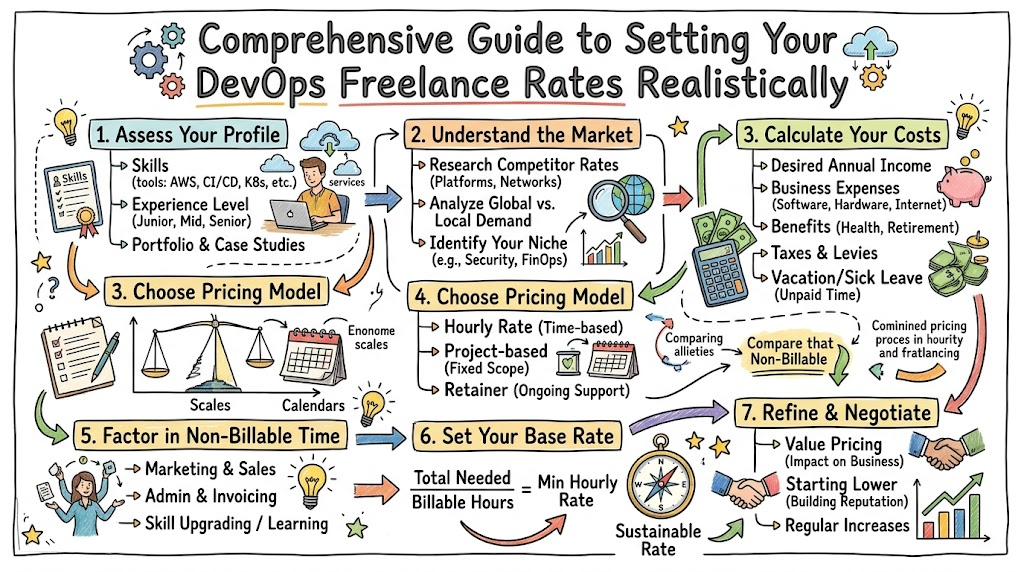
Introduction
The global shift toward cloud native architectures, rapid deployment cycles, and automated infrastructure has triggered an unprecedented demand for specialized engineering talent. Organizations of all sizes—from early-stage startups to massive multinational corporations—are looking for agility, security, and scalability. To achieve this, many companies choose to bypass traditional, slow-moving hiring processes. Instead, they actively seek independent professionals who can instantly step in, analyze their infrastructure, and optimize their delivery pipelines. This shift has turned freelancing into an exceptionally lucrative and viable long-term career path for automated systems experts.
However, moving from a stable corporate environment into the independent market introduces a completely new set of professional responsibilities. The most common and immediate obstacle that engineers face when transitioning is determining how to price their services. In a traditional corporate role, compensation is negotiated as a fixed monthly or annual package, accompanied by clear internal rubrics. In the open market, you operate as a business. This means you must define, justify, and defend the financial value of your technical skills entirely on your own.
For many beginners, setting DevOps Freelance Rates feels like complete guesswork. The lack of transparent, centralized pricing sheets across the industry often leads to immense confusion. This confusion frequently results in two highly destructive outcomes: severe underpricing or unrealistic overpricing.
When you set your prices too low, you inadvertently signal to high-quality clients that your work might be substandard. This traps you in a exhausting cycle of low-margin projects with demanding, high-friction clients. Conversely, if you set your prices unrealistically high without the proper portfolio, technical depth, or communication skills to back it up, you will alienate potential partners and struggle to secure any work at all.
Establishing a professional, structured approach to pricing is not just about making sure your monthly expenses are covered. It is about positioning your expertise as a high-value asset that directly drives business growth. When done correctly, your pricing reflects a precise balance of your technical capabilities, the complexity of the project, and the operational risks you are mitigating for your client.
To build the advanced technical confidence required to command premium rates in this competitive landscape, engineers frequently turn to structured, hands-on educational ecosystems. Platforms like DevOpsSchool provide the deep architectural knowledge, continuous integration expertise, and practical multi-cloud experience necessary to transition smoothly from a standard operations role into a highly paid independent consultant. Understanding the fundamental mechanics of market pricing allows you to turn that technical knowledge into a thriving, highly profitable freelance business.
Why Setting DevOps Freelance Rates Feels Difficult
Determining exactly what to charge for your engineering services is a complex challenge because DevOps is not a single, isolated product. It is a broad, highly integrated combination of culture, automation tools, software development patterns, and cloud infrastructure management. Unlike a front-end developer who can point to a completed, visible web page and charge a standardized fee per screen, your work as an automation engineer occurs largely beneath the surface of an organization’s technology stack.
+--------------------------------------------------------+
|          The DevOps Pricing Complexity Loop             |
+--------------------------------------------------------+
|  1. Imposter Syndrome (Fearing rejection from clients) |
|  2. Abstract Value (Automation is harder to see)       |
|  3. Variable Scopes (Tools & architectures fluctuate)  |
+--------------------------------------------------------+
The difficulty of setting accurate rates stems from three distinct challenges that affect almost every independent engineer:
The Psychological Hurdle of Imposter Syndrome
Many engineers moving into freelancing struggle with a profound lack of business confidence. When you are used to a corporate environment where software licenses, cloud budgets, and system architectures are managed across large teams, stepping out as an individual can feel exposed. Beginners often ask themselves if they are truly qualified to manage a client’s production environment independently. This self-doubt frequently leads to a defensive pricing strategy, where the engineer lowers their rates simply to avoid potential rejection during discovery calls.
The Absence of a Universal Pricing Standard
Unlike traditional IT fields or basic web development, there is no single, universally accepted directory for freelance DevOps engineer rates. One client might expect you to write a basic shell script to automate a local backup, while another might require you to orchestrate a highly available, multi-region Kubernetes cluster handling millions of live requests. Because the scope, tools, and technical stacks vary wildly from one company to the next, trying to find a one-size-fits-all pricing model is practically impossible.
The Abstract Nature of Infrastructure Value
It can be difficult to explain the concrete financial return on investment of a highly optimized CI/CD pipeline or an automated infrastructure-as-code repository to a non-technical client. Clients easily understand the value of features that users interact with directly, but they often struggle to see why they should pay a premium for system reliability, automated testing, or secret management. Translating these highly technical back-end improvements into clear, measurable business advantages is a skill that takes time to master. Without it, engineers often default to low pricing just to make their proposals look appealing.
Consider a junior freelancer who is asked by a local e-commerce startup to build an automated deployment pipeline. Because the freelancer lacks a structured pricing framework and fears losing the contract, they might offer to complete the entire setup for a tiny flat fee of $300. They quickly discover that the startup’s existing codebase is completely unorganized, the legacy hosting environment requires hours of manual troubleshooting, and the client expects constant, round-the-clock support for issues unrelated to the pipeline.
The freelancer ends up spending over sixty hours resolving deep architectural issues, resulting in an effective earning rate of less than $5 per hour. This completely unsustainable situation could have been avoided entirely by understanding the key market factors that influence professional pricing models.
Key Factors That Affect DevOps Freelance Rates
To move away from arbitrary guesswork and build a sustainable business, you must analyze your services through the lens of specific market variables. Professional freelance pricing is determined by a combination of seven core factors that directly influence your value in the eyes of a prospective client.
| Factor | Why It Matters |
| Skill Level | Determines the overall speed, accuracy, and architectural soundness of your automation solutions. |
| Experience | Reflects your proven track record in handling critical production incidents and managing real-world system failures. |
| Project Complexity | Accounts for the technical scale, integration challenges, and overall operational risk of the assignment. |
| Cloud Expertise | Focuses on your deep specialization in dominant cloud ecosystems like AWS, Microsoft Azure, or Google Cloud Platform. |
| Client Industry | Directly influences budget capacity, compliance mandates, and the financial impact of your technical work. |
| Communication Ability | Enables you to translate technical complexity into business value, manage expectations, and build client trust. |
| Portfolio Quality | Provides concrete, verifiable evidence of your past successes and your ability to deliver measurable results. |
Factor #1: Skill Level
Your skill level is defined by the technical depth of the solutions you can reliably design and deploy. It is the core foundation of your freelance pricing structure. The market evaluates your skills based on whether you are executing basic, highly documented tasks or architecting custom, enterprise-grade systems from scratch.
- Foundational Skills: This level involves basic scripting, setting up standard continuous integration workflows using basic templates, or managing fundamental system configurations. Engineers at this stage rely heavily on existing documentation and require clear, step-by-step instructions from the client.
- Advanced Skills: This level involves designing self-healing environments, orchestrating distributed containerized systems, creating immutable infrastructure-as-code modules, and implementing zero-downtime deployment strategies.
[Basic Scripting & Local CI] ---> [Multi-Region IaC & Microservices Orchestration]
  (Foundational: Lower Rates)             (Advanced: Premium Consulting Pricing)
A beginner DevOps freelancer might feel comfortable setting up a basic GitHub Actions workflow to lint code and push a Docker image to a public repository. This is a highly valuable service, but because the technical barrier to entry is relatively low, the market rate for this specific task remains modest.
An advanced consultant, however, can walk into an organization and design a multi-tenant, secure enterprise platform utilizing GitOps workflows, dynamic secrets rotation, and automated rollback strategies. The advanced engineer commands a significant premium because they possess the deep architectural insight required to design systems that prevent major operational failures.
Factor #2: Experience
While skill level focuses on your technical knowledge, experience represents your proven ability to apply that knowledge under intense, unpredictable real-world conditions. Clients are not just paying for the hours you spend writing code; they are paying for the years of trial, error, and system failures you have successfully navigated throughout your career.
In the freelance marketplace, a proven track record translates directly into an accelerated timeline for the client. An engineer with multiple years of production experience has likely encountered a wide variety of database connection bottlenecks, broken container networks, and corrupted state files. They can often diagnose and resolve a critical infrastructure outage in fifteen minutes—an issue that might take an inexperienced engineer three days of frustrating research to solve.
Clients are highly aware of this dynamic. They are more than willing to pay a much higher baseline rate to an experienced professional because it minimizes the risk of extended downtime, data loss, or blown project deadlines.
Factor #3: Project Complexity
Every project comes with its own unique set of technical hurdles and operational risks. The overall complexity of the environment you are stepping into must be carefully factored into your DevOps consulting pricing.
+-----------------------------------+-----------------------------------+
|      Low-Complexity Project       |      High-Complexity Project      |
+-----------------------------------+-----------------------------------+
| Monolithic application structure  | Distributed microservices grid    |
| Single cloud provider sandbox     | Hybrid, multi-cloud environment   |
| No strict compliance requirements  | Strict PCI-DSS / HIPAA compliance |
| Low transactional velocity        | Massive, real-time data ingestion |
+-----------------------------------+-----------------------------------+
Consider a freelance assignment where you are tasked with migrating a legacy, monolithic application from a single, on-premises virtual machine to a modern cloud provider. If the application has minimal external dependencies, no strict uptime requirements, and zero complex data replication needs, the complexity is relatively low.
Now, contrast that with an assignment requiring you to migrate a live, highly transactional financial platform distributed across multiple geographic regions with strict data residency laws, zero allowable maintenance windows, and complex legacy database schemas. The second project introduces immense operational risk. If a configuration error occurs, the client could face significant financial penalties and severe reputational damage. The pricing for the second project must reflect this high level of responsibility and risk.
Factor #4: Cloud Expertise
The specific cloud platforms and infrastructure technologies you specialize in play a major role in shaping your market value. While general systems administration knowledge is highly valuable, deep expertise in major public cloud ecosystems commands a distinct premium.
The dominant players—Amazon Web Services (AWS), Microsoft Azure, and Google Cloud Platform (GCP)—each feature highly specialized service catalogs, unique network architectures, and complex identity management systems.
AWS (IAM, EKS, RDS)       \
Azure (Entra ID, AKS)      -----> High Market Demand -----> Premium Baseline Rates
GCP (IAM, GKE, BigQuery)  /
An engineer who can effortlessly navigate the specific intricacies of AWS IAM policies, optimize multi-region VPC peering arrangements, or design cost-efficient Azure Kubernetes Service environments will always command higher rates than a generalist.
Furthermore, if you possess specialized knowledge in highly demanding ecosystem tools—such as advanced Terraform state management, custom Helm chart development, or enterprise service meshes like Istio—your market leverage increases substantially. Clients actively seek out specialists who can build robust cloud environments that align perfectly with vendor best practices.
Factor #5: Client Industry
The financial realities, regulatory constraints, and scale of your client’s industry will heavily dictate their overall budget flexibility and their willingness to pay premium DevOps contractor rates.
- Early Stage Startups: These companies generally prioritize speed of delivery and immediate cost reduction over perfect architectural elegance. Their budgets are often tight, and they are typically looking for affordable, functional automation to help them launch their initial product versions quickly.
- Highly Regulated Industries (FinTech, Healthcare, Telecom): These sectors operate under strict compliance mandates, such as PCI-DSS, HIPAA, or GDPR. A single security breach or extended system outage can cost millions of dollars in regulatory fines and legal liabilities.
These high-stakes clients view proper automation, comprehensive infrastructure monitoring, and rigorous security guardrails as essential business necessities rather than optional line items. They have the capital to invest in top-tier talent and are highly motivated to pay premium rates to ensure their platforms are resilient, compliant, and fully secure.
Factor #6: Communication Ability
Your technical acumen determines the quality of the systems you build, but your communication skills determine your ability to successfully sell, manage, and deliver those solutions to clients. In the world of independent contracting, clear communication is an absolute requirement for charging high rates.
[Complex Technical Reality] ---> (Strong Communication) ---> [Clear Business Value]
When you speak with a client, you must be able to confidently translate abstract technical concepts into clear, actionable business outcomes. A non-technical founder or an executive stakeholder rarely cares about the specific syntax of your Ansible playbooks or the exact configuration parameters of your ingress controllers. What they care about is how those tools will improve their bottom line.
If you can clearly explain that your automated testing and deployment framework will reduce their deployment failure rate by 60%, cut developer onboarding time in half, and significantly reduce monthly cloud spend, you are no longer viewed as a simple utility worker. You are recognized as a strategic business partner, allowing you to successfully command premium advisory fees.
Factor #7: Portfolio Quality
A well-crafted, metrics-driven portfolio serves as undeniable, objective proof of your engineering capabilities. It bridges the trust gap between you and a prospective client who has never seen you work before.
A high-converting portfolio does not simply list the tools you know or feature generic copies of public repositories. Instead, it presents comprehensive, real-world case studies that detail the exact problems your past clients faced, the strategic solutions you engineered, and the concrete business metrics resulting from your intervention.
Showing a case study that states: “Redesigned a legacy infrastructure stack using Terraform, reducing manual provisioning times from 4 days to 12 minutes while cutting monthly infrastructure waste by 35%” provides powerful justification for your pricing. It demonstrates that your rates are rooted in your proven ability to deliver highly profitable business results.
Common DevOps Freelance Pricing Models
Choosing the right pricing structure is just as important as setting the actual numbers. The model you select determines how your time is valued, how project scope changes are managed, and how your day-to-day client relationships function. Independent engineers typically rely on three primary models.
| Pricing Model | Best For |
| Hourly Pricing | Short-term troubleshooting, highly unpredictable project scopes, initial discovery phases, and ongoing ad-hoc infrastructure support. |
| Fixed Project Pricing | Well-defined deliverables with clear boundaries, repeatable automation setups, and highly standardized migration projects. |
| Monthly Retainers | Long-term operational support, continuous infrastructure optimization, ongoing security monitoring, and regular architectural advisory services. |
Model #1: Hourly Pricing
The hourly model is the most straightforward framework for engineers stepping into the freelance market. You establish a set rate for every single hour spent working on the client’s infrastructure, track your time meticulously using software utilities, and invoice the client at regular, agreed-upon intervals.
- Advantages: This model offers excellent protection against the common challenge of scope creep. If a client suddenly asks you to configure five additional microservices or migrate an entirely separate database that was completely left out of the initial discussion, you are fully compensated for every extra minute spent handling that additional workload. It is an ideal model for initial troubleshooting engagements where the root cause of a system issue is entirely unknown.
- Limitations: The fundamental flaw of the hourly model is that it creates a direct conflict of interest between you and your client. It actively penalizes you for becoming faster, more efficient, and highly skilled. If an experienced engineer can write an advanced automation script in two hours due to years of practice, they earn far less than an inefficient engineer who takes twenty hours to write the exact same script. Over time, this creates an artificial ceiling on your overall earning potential.
To calculate a viable baseline hourly rate, you must look beyond your desired take-home income and account for all business overhead costs. Use this clear operational formula to establish your target rate:
$$\text{Hourly Rate} = \frac{\text{Target Annual Savings} + \text{Taxes} + \text{Health Insurance} + \text{Software Licenses}}{\text{Total Expected Billable Hours Per Year}}$$
For example, if a professional aims for a net business income of $80,000 per year, and estimates $20,000 for self-employment taxes, $8,000 for healthcare, and $4,000 for specialized software tools and hardware upkeep, their total gross revenue target is $112,000.
Assuming they dedicate 30 hours per week to actual billable client work over 46 weeks of the year (allowing 6 weeks for holidays, administrative tasks, and business development), they have 1,380 billable hours available. Dividing $112,000 by 1,380 hours results in a baseline rate of approximately $81 per hour.
Model #2: Fixed Project Pricing
Fixed project pricing shifts the focus entirely away from hours spent and places it squarely on the value of the final deliverables. You work closely with the client to outline a highly specific, concrete project scope. You then quote a single, flat fee for the successful delivery of that completed system.
[Highly Detailed Scope Definition] ---> [Flat Fee Agreement] ---> [Milestone Deliveries]
- Advantages: This model completely removes the artificial earning ceiling of hourly billing. If you have built highly optimized, modular infrastructure templates over the course of your career, you can often deploy a robust, secure, multi-environment cloud infrastructure stack in a fraction of the time it would take to build from scratch. If the value of that complete deployment to the client is worth $5,000, and you can execute it flawlessly in ten hours using your pre-built modules, your effective earning rate scales beautifully to $500 per hour. Clients love this model because it gives them total budgetary predictability.
- Limitations: Fixed pricing carries a high degree of risk for the freelancer if the initial project boundaries are not defined with absolute precision. If you accept a flat fee to “migrate an application to the cloud” without explicitly specifying the exact number of services, database sizes, environment counts, and testing criteria, you can quickly find yourself trapped. You may end up trapped in months of unpaid revisions and endless scope expansions, severely damaging your project profitability.
Model #3: Monthly Retainers
The monthly retainer model represents the gold standard for independent engineers looking to build long-term stability and highly predictable recurring revenue. Under this framework, a client pays a set fee at the beginning of every month to secure a dedicated portion of your availability or to cover a clearly defined set of ongoing operational responsibilities.
- Advantages: Retainers provide excellent, dependable cash flow that allows you to run your freelance business smoothly without the constant stress of chasing new projects every few weeks. It aligns your incentives perfectly with the client’s goals. Your primary objective is to build systems that are exceptionally stable, secure, and fully automated. The more reliable and self-healing you make their infrastructure, the fewer emergency alerts you have to deal with, allowing you to maintain the contract with minimal friction.
- Limitations: This model requires exceptionally strict boundaries to protect your personal time. If the agreement is not managed carefully, clients may treat a retainer as an invitation to call you at midnight for basic IT help desks or unrelated application debugging. The contract must explicitly outline what is included—such as cloud cost reviews, patch management, or architecture advisory hours—and state that any emergency support outside of normal business hours will incur separate, clearly defined fees.
Beginner-Friendly Pricing Strategy
When you are starting your freelance journey, your immediate goal is to break through the initial trust barrier, secure your first few corporate testimonials, and build momentum. You need a structured, step-by-step roadmap that helps you price your services competitively without undervaluing your talent or pricing yourself out of the market.
+------------------------------------------------------------------------+
|                   The Beginner Pricing Escalation Path                 |
+------------------------------------------------------------------------+
| Step 1: Establish Your Cost-of-Living Baseline Rate                    |
| Step 2: Target Mid-Market Rates on Specialized Platforms               |
| Step 3: Shift to Fixed Project Bundles for Common Workflows           |
| Step 4: Graduate to Premium Value-Based Consulting Rates               |
+------------------------------------------------------------------------+
Step 1: Determine Your Absolute Baseline Floor
Calculate the minimum hourly rate required to cover your actual cost of living, self-employment taxes, insurance, and equipment costs. This number represents your absolute pricing floor. Never accept any project below this rate, as doing so will actively harm your business and lead to immediate financial strain.
Step 2: Research Local and Global Competitor Pricing
Analyze specialized freelancing platforms, industry surveys, and remote job portals to understand what junior and mid-level independent engineers are actively charging. For a beginner with solid foundational skills, targeting a modest but professional mid-market rate—typically between $35 and $55 per hour depending on geographic location—allows you to remain highly attractive to clients while maintaining your professional self-respect.
Step 3: Productize Common DevOps Workflows
Instead of selling vague, open-ended engineering hours, package your services into highly defined, easily understood fixed price offerings. For example, you can offer a “Standardized CI/CD Pipeline Setup for Node.js Applications” for a flat fee of $1,200. This makes it incredibly easy for a small business to say yes, because they know exactly what they are paying and exactly what they will receive in return.
Step 4: Leverage Early Success to Adjust Your Rates
Treat your first three clients as a valuable investment in your business reputation. Deliver exceptional value, document every optimization metric you achieve, and secure a detailed, written testimonial from each client. The moment you have three glowing recommendations and a small portfolio of real case studies, immediately raise your base rates by 20% to 30% for all future prospects. Repeat this escalation process regularly as your client queue grows.
Real-World Example: Freelancer Charging Too Little
To truly understand how damaging underpricing can be to your career, let’s examine a common real-world freelance scenario. Rahul is a skilled cloud engineer who decides to start freelancing on the side. Eager to land his very first contract, he bids on a project to optimize an automated infrastructure environment for a fast-growing startup. Fearing that a professional price quote will scare the client away, he offers a low rate of $20 per hour.
[Low Rate: $20/hr] ---> [Scope Creep & Constant Pings] ---> [Burnout / Broken Systems]
The client accepts his low offer immediately. However, because the rate is so low, the client naturally views Rahul as a cheap utility worker rather than a specialized consultant. The workflow quickly breaks down into an administrative nightmare:
- Uncontrolled Scope Creep: The client assumes that because they are paying very little, they can continuously add random tasks to Rahul’s plate. They demand he fix local developer laptop configurations, debug broken application source code, and manage user accounts.
- Constant Operational Friction: Rahul finds himself constantly interrupted by urgent messages on Slack at all hours of the day and night. The client demands immediate status updates for minor tasks, leaving him with zero focused time to write clean automation code.
- Severe Professional Burnout: Because he has to work long, exhausting hours just to generate a modest income, Rahul becomes completely drained. He doesn’t have the time or energy to research modern architectural design patterns, update his documentation, or look for higher-paying clients.
The ultimate lesson here is clear: underpricing does not protect you from difficult clients. It actively attracts them, while draining the mental energy you need to scale your business.
Real-World Example: Freelancer Pricing Strategically
Now, let’s look at a contrasting scenario featuring an engineer named Sarah. She has the exact same technical background as Rahul, but she chooses to approach the market with a structured, professional business strategy. When a medium-sized e-commerce company asks her to migrate their monolithic application to an automated container framework, she declines to quote a cheap hourly rate.
Instead, she schedules a comprehensive discovery call to uncover the client’s underlying business pain points. She discovers that manual deployments are taking their engineering team five hours every single week, and frequent configuration errors are causing costly site outages during peak shopping hours.
[Identify Pain Points] ---> [Quote Value Fixed Fee] ---> [Deliver ROI & Build Trust]
Sarah presents a clear, comprehensive project proposal based on these findings:
- A Value-Driven Flat Fee: She quotes a flat project fee of $4,500, broken down into clear, milestone-based phases. She demonstrates to the client that by eliminating manual deployment errors, her solution will pay for itself entirely within the first three months of operation.
- Strictly Defined Project Boundaries: Her contract explicitly states that the project covers exactly three deployment environments (Development, Staging, and Production), a standardized GitHub Actions pipeline, and up to four hours of post-migration training for their internal team. Any work outside of this specific scope will be billed at an additional consulting rate of $90 per hour.
- Mutual Professional Respect: Because her proposal focuses heavily on business value, the client treats Sarah as a trusted expert advisor. They respect her boundaries, avoid micromanagement, and give her the focus she needs to deliver a clean system.
Sarah completes the entire migration flawlessly in 45 hours of focused work over a few weeks. This earns her an exceptional effective rate of $100 per hour, while leaving her with plenty of energy to scale her business and learn new technologies.
Common Pricing Mistakes DevOps Freelancers Make
Avoiding major pricing pitfalls is just as important as setting your baseline rates. Many talented engineers struggle to grow their freelance businesses simply because they fall into the same common traps. Review this comprehensive checklist to ensure your business remains fully protected:
- Copying Direct Competitors BlindlyNever set your rates based solely on what other freelancers are posting on public marketplaces. Every engineer has a completely different cost of living, tax situation, technical speed, and unique specialized skill set. Your pricing must be custom-built around your own specific business realities and financial requirements.
- Failing to Define a Strict Project ScopeNever begin any freelance assignment based on a vague verbal agreement or a casual chat. If you do not explicitly put down in writing what is included—and, just as importantly, what is completely excluded—from the project, you are leaving yourself completely exposed to unpaid scope creep.
- Completely Ignoring Hidden Business OverheadsRemember that an independent freelancer does not get paid for vacation days, sick leave, or time spent pitching clients. If you only price your services to cover your immediate daily living expenses, you will quickly find yourself falling behind financially when you account for software subscriptions, hardware upgrades, taxes, and accounting fees.
- Underestimating Communication and Meeting TimelinesA major portion of any freelance project is spent inside sync meetings, writing progress reports, answering client emails, and explaining system architecture decisions to stakeholders. If you only bill for the exact minutes you spend writing infrastructure code, you are giving away hours of highly valuable consulting time completely for free. Always build a realistic communication buffer into every single proposal you send out.
Best Practices for Increasing Your Rates Over Time
As your experience deepens and your freelance business matures, your pricing should systematically evolve to reflect your increased market value. Transitioning from basic mid-market rates to premium, high-tier consulting fees requires a deliberate, focused approach.
+-----------------------------------------------------------------------+
|                    Rate Escalation Best Practices                     |
+-----------------------------------------------------------------------+
| 1. Narrow Your Technical Focus (Specialization)                       |
| 2. Transform Portfolios Into Detailed Case Studies (ROI Tracking)     |
| 3. Collect Hard, Metrics-Driven Client Testimonials (Social Proof)    |
| 4. Perfect Your Operational Infrastructure & Templates (Efficiency)   |
+-----------------------------------------------------------------------+
Narrow Your Technical Focus to a Specific Niche
Move away from pitching yourself as a generalist who handles any basic cloud task. Instead, specialize in a highly demanding sub-field, such as high-security cloud compliance for healthcare applications, or multi-cluster Kubernetes cost optimization for enterprise companies. Specialists face significantly less competition and can easily command rates that are two to three times higher than generalists.
Transform Your Portfolio Into Detailed Case Studies
Stop simply listing the tools and technologies you know. Rewrite your professional portfolio to highlight the concrete business impact of your work. Always emphasize the measurable financial returns, time savings, and risk reductions your clients achieved because of your technical interventions.
Collect Hard, Metrics-Driven Testimonials
When a project wraps up successfully, don’t just ask the client for a generic recommendation. Ask them for specific performance improvements. A written quote from a company founder stating: “Sarah’s automated migration completely eliminated our deployment errors and cut our monthly AWS spend by 40%” serves as powerful social proof that effortlessly justifies premium rates to your future prospects.
Perfect Your Own Operational Infrastructure
Invest time in optimizing your internal workflows. Build a library of highly reusable, modular infrastructure-as-code templates, shell scripts, and deployment configurations. The more efficient and repeatable you make your delivery processes, the faster you can execute high-value projects. This allows you to rapidly increase your actual earnings per hour under a fixed-price model.
Role of DevOpsSchool in Building Freelance Skills
Building the confidence to charge premium freelance rates requires a rock-solid foundation of hands-on technical skills. You cannot successfully command top-tier rates if you are unsure of how your automated architectures will perform under heavy production workloads. This is where structured, industry-aligned training programs become an invaluable asset for independent professionals.
The comprehensive training tracks provided by DevOpsSchool are designed specifically to bridge the gap between abstract academic theory and the rigorous demands of real-world client systems. Their curriculum completely bypasses generic, superficial tutorials. Instead, it focuses heavily on the actual tools, frameworks, and deployment strategies that modern companies actively look for when hiring freelance talent.
+----------------------------------------------------------------------+
|                     DevOpsSchool Skill Ecosystem                     |
+----------------------------------------------------------------------+
|  * Advanced CI/CD Engineering (Complex automated delivery pipelines) |
|  * Production Containerization (Kubernetes multi-cluster management) |
|  * Infrastructure as Code (Robust, modular Terraform blueprints)     |
|  * Production Monitoring Systems (Prometheus & Grafana telemetry)     |
+----------------------------------------------------------------------+
Through hands-on, project-driven learning sandboxes, engineers gain deep exposure to orchestrating multi-stage continuous integration and continuous delivery (CI/CD) pipelines, managing container networks at scale using Kubernetes, and provisioning multi-cloud environments via advanced infrastructure-as-code patterns.
This rigorous, real-world case study approach directly builds the deep technical competence and strategic problem-solving abilities required to walk into discovery calls, confidently diagnose a client’s complex system issues, and articulate your pricing proposals with complete authority.
Career Opportunities for DevOps Freelancers
The contemporary freelance marketplace offers a wide array of highly specialized service opportunities for independent engineers. Instead of trying to offer every service imaginable, successful freelancers maximize their revenue by packaging their skills into clearly defined, sought-after service offerings:
                  ┌──► CI/CD Pipeline Engineering
                  ├──► Enterprise Kubernetes Support
DevOps Freelancer ├──► Infrastructure as Code (IaC)
                  ├──► Advanced Cloud Automation
                  └──► Observability & Monitoring Systems
CI/CD Pipeline Engineering
Designing, building, and optimizing automated software delivery pipelines. Clients look for freelancers who can integrate automated code quality checks, security vulnerability scanning, and reliable deployment strategies into frameworks like GitHub Actions, GitLab CI, or Jenkins.
Enterprise Kubernetes Support
Helping organizations migrate their containerized workloads into managed orchestrators like AWS EKS, Azure AKS, or Google GKE. This high-paying service includes designing robust ingress strategies, configuring network security policies, and setting up autoscaling profiles to handle fluctuating traffic demands.
Infrastructure as Code (IaC) Architecture
Transforming fragile, manually configured cloud environments into clean, fully automated, version-controlled code repositories. Independent engineers utilize tools like Terraform, OpenTofu, or Pulumi to construct modular, repeatable blueprints that allow clients to spin up complete, identical environments in minutes.
Advanced Cloud Automation and Optimization
Analyzing existing cloud environments to uncover and eliminate massive resource waste, optimize resource utilization, and implement automated scaling configurations. Freelancers in this niche often build custom automation scripts to shut down idle resources, clean up abandoned storage volumes, and streamline overall cloud budgets.
Observability and Comprehensive Monitoring Systems
Configuring end-to-end telemetry systems using industry-standard tools like Prometheus, Grafana, Datadog, or the ELK stack. This service involves creating centralized, real-world dashboard layouts and proactive alerting systems that give clients total visibility into their platform health, helping them prevent major outages before they hit production users.
Industries Hiring DevOps Freelancers
Because automated software delivery has become an essential requirement across every modern business sector, independent engineers enjoy a massive, highly diversified target market. Several key industries actively look for freelance talent to help them modernize their operations:
+-----------------------------------------------------------------------+
|                    High-Yield Freelance Market Sectors                |
+-----------------------------------------------------------------------+
| * Software as a Service (SaaS): Rapid feature delivery & autoscaling  |
| * Financial Technology (FinTech): High security & PCI compliance      |
| * Modern Healthcare Systems: Rigid HIPAA guardrails & data isolation  |
| * E-Commerce Platforms: High traffic surges & 100% uptime stability   |
| * Telecom & Enterprise IT: Legacy migration & hybrid cloud patterns  |
+-----------------------------------------------------------------------+
Software as a Service (SaaS) Platforms
SaaS providers live and die by their ability to deliver new software features rapidly, securely, and seamlessly ahead of their competitors. They hire freelance professionals to help them optimize their delivery speeds, manage multi-tenant environments efficiently, and build resilient architectures that scale up automatically alongside their expanding user bases.
Financial Technology (FinTech)
FinTech applications deal with highly sensitive financial transactions and operate under rigid international compliance frameworks. They have substantial engineering budgets and are highly motivated to bring in expert freelance consultants to design bulletproof security guardrails, automate thorough audit logging workflows, and ensure their systems meet strict regulatory standards.
Modern Healthcare Systems
Much like FinTech, the digital healthcare space is governed by strict medical data privacy laws, such as HIPAA. They actively hire specialized freelancers to design highly secure cloud environments, configure strong data encryption keys at rest and in transit, and establish isolated network architectures that fully protect sensitive patient records.
High-Volume E-Commerce Platforms
Online retail platforms experience sudden, massive surges in user traffic during seasonal holiday sales and major marketing campaigns. They hire freelance automation experts to configure proactive, highly responsive auto-scaling configurations, design robust caching layers, and optimize database read-write pipelines to ensure their digital storefronts remain fast and stable under heavy loads.
Telecom and Massive Enterprise IT
Large, traditional organizations frequently possess massive collections of complex, aging legacy applications spread across local on-premises hardware. They bring in experienced freelance contractors to help map out, containerize, and migrate these critical legacy systems into hybrid cloud architectures without causing costly disruptions to their daily business operations.
Future of DevOps Freelancing
The landscape of independent technical contracting is entering an era of rapid transformation, driven by massive shifts in corporate working models and major technical breakthroughs. Understanding where the market is heading allows forward-thinking freelancers to position themselves ahead of the curve and command premium rates for years to come.
Remote Engineering Growth ──► Global borderless talent access
AI-Assisted Operations    ──► LLMOps and intelligent alerting pipeline design
Cloud Native Dominance    ──► Complete serverless and multi-cluster microservices
Platform Engineering      ──► Building internal developer platforms (IDPs)
The rapid normalization of fully remote engineering teams has permanently broken down traditional geographical hiring barriers. Organizations are no longer limiting their talent searches to professionals living within commuting distance of their physical offices. They are highly comfortable building borderless engineering structures, opening up a massive global marketplace of premium corporate clients for skilled independent consultants.
Simultaneously, the rise of artificial intelligence and machine learning is rapidly reshaping day-to-day operations. The future of freelancing belongs to engineers who look beyond basic, manual tool configuration and focus heavily on AI-assisted operations (AIOps) and LLMOps pipeline architecture.
Clients actively seek out consultants who can integrate smart AI analysis tools into their telemetry networks to predict system failures, automate intelligent incident responses, and manage the complex infrastructure pipelines required to deploy custom machine learning models at scale.
Furthermore, the industry is seeing a clear transition from basic systems management to the advanced practice of Platform Engineering. Modern companies want to empower their internal development teams to ship code independently without waiting weeks for an operations ticket to clear.
As a result, the highest-paying freelance contracts are shifting toward building robust Internal Developer Platforms (IDPs). These platforms utilize advanced self-service service catalogs, automated environment provisioning tools, and centralized security guardrails. By focusing on these high-value future trends, your freelance business will remain highly sought-after and exceptionally profitable over the long term.
FAQs (15 Questions)
How do I set DevOps freelance rates?
Calculate your absolute baseline cost-of-living floor, factoring in self-employment taxes, healthcare, software licenses, and administrative overhead. Combine this baseline with an honest assessment of your current technical skill level, cloud specialization, and the overall complexity of the client’s environment to establish a fair, highly professional market rate.
Should beginners charge hourly?
Yes, utilizing a professional hourly pricing model is highly recommended for your initial freelance projects. It provides excellent, comprehensive protection against unpredictable scope changes while you learn how to accurately estimate the actual timelines and workloads required for common automation projects.
Can freshers freelance in DevOps?
While it is technically possible, it is exceptionally challenging. Freelancing requires an independent engineer to walk into broken environments and fix complex issues completely on their own without internal guidance. Freshers should focus on gaining a rock-solid foundation through structured training programs and building a metrics-driven portfolio before pitching to corporate clients.
How do I avoid underpricing?
Never treat freelancing like a race to the absolute bottom of the market. Always calculate your real business overhead costs before sending out proposals. Clearly frame your project conversations around the concrete business problems you are solving rather than the manual hours you are spending.
Does cloud expertise increase pricing?
Absolutely. Deep, specialized knowledge in dominant cloud ecosystems like AWS, Azure, or GCP commands a major premium over basic general systems administration. Clients are highly motivated to pay top rates for specialists who can ensure their cloud architectures fully align with modern industry best practices.
What if clients negotiate heavily?
Never simply lower your price during a negotiation without changing the scope of the project, as this immediately signals that your initial quote was arbitrary. If a client has a tight budget, offer to reduce the price by removing specific deliverables from the proposal, such as removing staging environments or reducing post-migration support hours.
Should I offer discounts?
Avoid offering general discounts on your core engineering services. Doing so can quickly devalue your expertise in the eyes of the client and set an unsustainable precedent for future work. If you want to offer an incentive for a long-term engagement, package your services into a predictable monthly retainer model instead.
How do I raise my freelance rates?
The moment your current freelance schedule is fully booked and you have built a collection of metrics-driven case studies, immediately raise your base prices by 20% to 30% for all new incoming client leads. This allows you to gradually scale your revenue without disrupting your existing, active client contracts.
What is the average freelance DevOps rate globally?
Depending on geographical location, technical specialization, and experience, entry-level rates generally range from $35 to $55 per hour. Experienced mid-level engineers typically charge between $60 and $95 per hour, while top-tier cloud architects and specialized enterprise consultants frequently command premium rates ranging from $100 to over $200 per hour.
Is fixed pricing safe for beginners?
Fixed pricing is highly profitable, but it is only safe if you possess a highly detailed, explicitly written project scope that defines the exact boundaries of the engagement. If the project requirements are vague or open-ended, stick to an hourly billing framework until the scope is fully clarified.
How do I calculate a monthly retainer?
Determine the exact number of hours you will dedicate to the client each month, multiply that number by your base hourly consulting rate, and apply a modest premium to guarantee your priority availability. Ensure the written agreement explicitly defines what tasks are included and outlines separate fees for out-of-hours emergency support.
What tools require premium rates?
Deep expertise in high-demand, enterprise-grade tools like advanced Kubernetes cluster management, multi-environment Terraform configurations, enterprise service meshes like Istio, and advanced zero-downtime CI/CD patterns across public cloud platforms naturally commands the highest freelance rates in the industry.
How do I handle unpaid scope creep?
The moment a client requests a task that falls outside of your initial written contract, pause and send a polite notification. Inform them that the request sits outside the agreed scope and provide a quick change-order estimate detailing the additional hours or flat fees required to complete it.
Do I need certifications to charge high rates?
While industry certifications from major cloud providers look great on a resume, they are not a magic ticket to premium rates. In the freelance market, clients prioritize practical, verifiable results. A metrics-driven portfolio showing how you successfully solved real business problems is far more valuable than paper credentials.
How often should I update my rates?
Review your freelance pricing model at least once every year. As you complete more projects, master new automation tools, optimize your delivery speeds, and secure stronger client testimonials, your rates should systematically increase to reflect your expanded market value.
Final Thoughts
Building a highly successful, resilient career as an independent DevOps consultant requires a major mental shift. You must move away from the traditional employee mindset and start viewing yourself as an independent business entity. Setting your DevOps Freelance Rates is not an arbitrary, awkward negotiation process where you try to extract as much money as possible from a client. It is a highly strategic, professional declaration of the measurable operational value, architectural security, and speed you bring to their organization.
True pricing confidence does not happen overnight. It develops naturally as you sharpen your advanced technical skills, build a collection of metrics-driven portfolios, and learn how to align your engineering services with a client’s business goals. Trying to build a freelance business by offering the lowest price in the market is an unsustainable strategy that leads directly to burnout, difficult client relationships, and stagnant revenue growth. High-quality clients do not look for the cheapest engineer to manage their mission-critical production environments—they look for the professional who minimizes their operational risk and delivers stable, scalable solutions.
Commit to continuous learning, practice translating complex technical architectures into clear business advantages, and maintain total professional integrity across all your contract agreements. By building your independent business on a rock-solid foundation of technical excellence and a clear, value-driven pricing strategy, you will build a sustainable, highly profitable freelance career that gives you complete professional freedom.
