Moving from an individual technical role into a leadership position is one of the most important transitions in a software professional’s journey. While strong skills in coding and automation form the base, leading teams, managing workflows, and handling budgets demand a completely different way of thinking.
This guide highlights the Certified DevOps Manager program—a certification created to help skilled engineers evolve into effective, strategy-driven leaders. Whether you are working in India or in a global environment, mastering the operational and leadership aspects of DevOps is essential for sustained career advancement.
The Landscape: Every Certification at a Glance
Navigating the world of certifications can be confusing. To help you choose the right starting point, here is a comprehensive table of the most impactful programs available through the DevOpsSchool ecosystem.
Master Certification Table
| Track | Level | Who it’s for | Prerequisites | Skills Covered | Recommended Order |
| DevOps | Manager | Team Leads, PMs, Aspiring Managers | 5+ Years in IT | Strategy, ROI, Metrics, Cultural Leadership | 4th (Advanced) |
| DevOps | Engineer | Software & System Engineers | Basic Linux/Git | CI/CD, Docker, Jenkins, Automation | 1st (Foundational) |
| DevOps | Professional | Senior Engineers, SREs | CDE or equivalent | Kubernetes, Terraform, Advanced IaC | 2nd (Intermediate) |
| DevOps | Architect | Principal Engineers, Architects | CDP or equivalent | Multi-cloud Strategy, Security-by-Design | 3rd (Expert) |
| DevSecOps | Specialist | Security Analysts, Devs | Foundational DevOps | Vault, SonarQube, Compliance-as-Code | Specialty |
| SRE | Specialist | Ops Engineers, SREs | Scripting Knowledge | SLOs, SLIs, Error Budgets, Monitoring | Specialty |
Spotlight: Certified DevOps Manager (CDM)
What it is
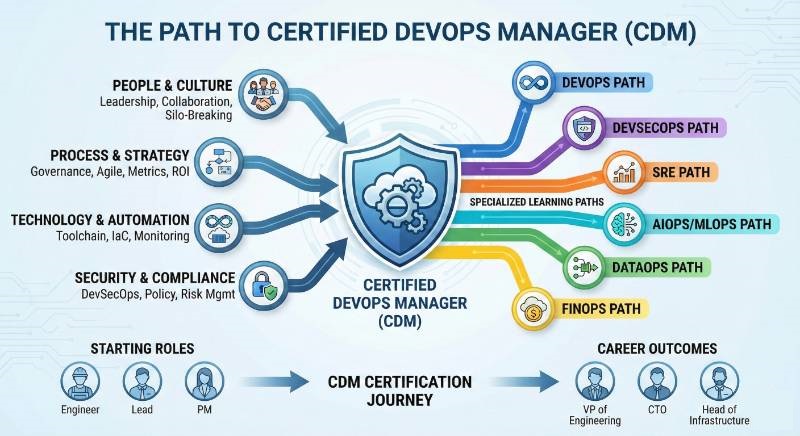
The Certified DevOps Manager (CDM) is a leadership credential that focuses on the orchestration of people, processes, and technology. It teaches you how to design a high-performing organization that delivers software quickly without sacrificing quality or stability.
Who should take it
This program is ideal for Senior Software Engineers, Project Managers, Team Leads, and current IT Managers.
Provider Deep Dive: DevOpsSchool is a premier global training organization dedicated to the “Ops” ecosystem. They are widely recognized for their practitioner-led training approach, which prioritizes real-world scenarios over theoretical concepts. Their programs are designed by experts who have spent years building and scaling infrastructure for Fortune 500 companies.
Skills you’ll gain
- Organizational Design: How to structure teams to reduce friction and eliminate silos.
- Advanced Metrics: Mastering the “Four Key Metrics” (Lead Time, Change Fail Rate, MTTR, and Deployment Frequency).
- Strategic Automation: Deciding what to automate to get the highest return on investment.
- Compliance and Governance: Managing security and regulatory requirements within an automated pipeline.
- Conflict Resolution: Learning to manage the cultural shift that often causes friction between Dev and Ops teams.
Real-world projects you should be able to do
- Transformation Roadmap: Create a step-by-step 12-month plan to move a legacy organization toward a DevOps model.
- Toolchain Selection: Design a complete CI/CD stack tailored to a specific company’s budget and technical needs.
- Incident Response System: Build a robust on-call and post-mortem process that focuses on learning rather than blaming.
Preparation Plan
Success requires a structured approach. Choose the timeline that fits your current workload:
- 7–14 Days (The Fast Track): Best for current Team Leads. Focus on the CALMS framework (Culture, Automation, Lean, Measurement, Sharing) and high-level strategy.
- 30 Days (The Balanced Track): Best for Senior Engineers. Spend two weeks on the technical side of the toolchain and two weeks on leadership and management principles.
- 60 Days (The Comprehensive Track): Best for those new to the DevOps world. This includes deep reading of case studies, hands-on labs, and participating in community discussions to understand common industry pain points.
Common Mistakes
- Ignoring the Culture: Many managers think DevOps is just about buying a tool. It’s actually about how people talk to each other.
- Data Overload: Tracking too many metrics can confuse a team. Focus on the few that truly move the needle.
- Micromanagement: DevOps thrives on engineer autonomy. A manager’s job is to clear the path, not to watch every keystroke.
Best next certification after this
- Master in DevOps Engineering (MDE): To deepen technical mastery.
- Certified DevSecOps Manager: To specialize in the security-leadership intersection.
- Executive Leadership in DevOps: For those aiming for VP or CTO roles.
Choose Your Path: 6 Specialized Learning Paths
As you grow, you might want to specialize. Here are the six most common paths in the modern technical landscape:
1. The DevOps Path
The classic route. You focus on the entire software delivery life cycle (SDLC). You ensure that developers can ship code easily and operations can keep the system stable.
2. The DevSecOps Path
The “Shift Left” approach. Here, you focus on baking security into every part of the pipeline. You aren’t just a manager; you are a guardian of the company’s data and compliance.
3. The SRE (Site Reliability Engineering) Path
This path is for those who love reliability. You treat operations like a software problem. You manage error budgets and ensure that systems are highly available and scalable.
4. The AIOps/MLOps Path
The future-focused path. You use artificial intelligence to manage IT operations and build automated pipelines specifically for machine learning models.
5. The DataOps Path
Data is the new oil, and DataOps is the refinery. This path focuses on ensuring that data pipelines are as fast, reliable, and automated as software pipelines.
6. The FinOps Path
The “Cloud Financial Management” route. You focus on the cloud bill. You help the company maximize the value of every dollar spent on AWS, Azure, or GCP.
Role → Recommended Certifications
If you are currently in one of these roles, here is your path to the top:
- DevOps Engineer: Start with CDE (Engineer) → CDP (Professional) → CDM (Manager).
- SRE: Focus on SRE Certified Professional → CDA (Architect).
- Platform Engineer: CDP (Professional) → Kubernetes Master → CDM (Manager).
- Cloud Engineer: CDP (Professional) → Multi-Cloud Specialist → CDM (Manager).
- Security Engineer: CDE (Engineer) → DevSecOps Professional → Certified DevSecOps Manager.
- Data Engineer: DOCP (DataOps Professional) → MDE (Master).
- FinOps Practitioner: FinOps Manager → CDM (Manager).
- Engineering Manager: Go straight to Certified DevOps Manager (CDM) to validate your skills.
Top Institutions for Training and Certification
Choosing where to learn is as important as what you learn. These institutions are recognized for their excellence in training for the Certified DevOps Manager (CDE/CDM) programs:
- DevOpsSchool: This is the primary authority in the field. They provide over 120 hours of live training and emphasize “Learning by Doing.” Their certifications are globally recognized and never expire.
- Cotocus: Known for their specialized technical bootcamps. They offer excellent lab environments where you can practice setting up complex infrastructures in a safe setting.
- Scmgalaxy: A fantastic community resource that provides a wealth of free tutorials and deeply technical workshops on version control and CI/CD tools.
- BestDevOps: They specialize in corporate training, helping entire teams transition to a DevOps model through customized workshops and leadership coaching.
- Specialized Schools: For domain-specific needs, check out devsecopsschool (Security), sreschool (Reliability), aiopsschool (AI/ML), dataopsschool (Data pipelines), and finopsschool (Cloud costs).
FAQs: General Career & Certification
1. Is DevOps still relevant in 2026?
Yes, it is more relevant than ever. As AI begins to write more code, the need for humans to manage the systems that deploy and monitor that code has increased significantly.
2. How long does the certification last?
Certifications from DevOpsSchool are valid for a lifetime. There are no annual renewal fees, which is a major advantage for professionals.
3. Do I need to be a coding expert to be a DevOps Manager?
No. You need to understand the logic of code and how it interacts with systems, but your primary job is strategy and people management.
4. What is the difference between an Architect and a Manager?
An Architect designs the technical blueprint of the system. A Manager designs the human and process blueprint of the organization.
5. How much time should I study each day?
Most working professionals find that 1–2 hours a day is the “sweet spot” to avoid burnout while making consistent progress.
6. Is there an order I must follow?
While you can jump into the Manager track if you have experience, we generally recommend starting with the Engineer level to understand the tools your team uses.
7. Are these certifications recognized globally?
Yes. These programs are designed to meet international standards and are highly valued by hiring managers in the US, Europe, and Asia.
8. Can this help me transition from a non-tech role?
Yes, especially for Project Managers or Business Analysts who want to work more closely with engineering teams.
9. What is the most difficult part of the CDM exam?
The scenario-based questions. You have to prove you can solve “people problems” like a high-performing leader.
10. What kind of salary hike can I expect?
While it varies by region, many professionals see a 30% to 50% increase in their total compensation after moving into a certified management role.
11. Is there a community for after-training support?
Yes, most of these institutions have large alumni networks on LinkedIn and Discord for ongoing learning.
12. What tools are covered in the CDM program?
While the focus is on management, you will learn the strategic use of Git, Jenkins, Docker, Kubernetes, Terraform, and various monitoring tools.
FAQs: Certified DevOps Manager (Specific)
1. Is the CDM exam proctored?
Yes, it is an online-proctored exam to ensure the integrity and value of the certification.
2. Are there any hidden fees for the exam?
No, the exam fee is typically included in the training package provided by DevOpsSchool.
3. What happens if I don’t pass the first time?
Most providers offer at least one free retake, but with a 99% success rate, most students pass on their first attempt.
4. Can I take this training on weekends?
Yes, institutions like DevOpsSchool offer flexible schedules, including weekend-only batches for busy professionals.
5. Does the CDM cover FinOps?
It covers the basics of cloud financial management, as every manager needs to understand how their team affects the company’s bottom line.
6. Is there a practical lab in the manager exam?
The exam focuses on scenario analysis, but the training includes several hands-on projects to ensure you can actually implement what you learn.
7. How does this help with “remote team” management?
The course includes specific modules on managing distributed teams, which is a critical skill in the post-2020 world.
8. Can I get a refund if I don’t like the training?
Most reputable institutions have a clear refund policy if requested within the first few sessions.
Next Steps: Moving Forward
Once you complete your CDM, your journey doesn’t end. Based on industry data for software engineers, you should look toward these three paths:
- Same Track: Master in DevOps Engineering (MDE). This is the ultimate “black belt” for those who want to be recognized as the top 1% in the field.
- Cross-Track: Certified DevSecOps Manager. In a world of increasing cyber threats, combining DevOps leadership with security expertise makes you indispensable.
- Leadership Track: Executive Program in DevOps Transformation. This is for those looking to influence the boardroom and drive change at the highest levels of the company.
Conclusion
The jump from a technical role to a management role is one of the most significant milestones in a career. It requires a new set of tools—not just software, but frameworks for thinking and leading. The Certified DevOps Manager program is more than just a certificate; it is a transformation of how you see the world of technology.
If you are ready to stop managing tasks and start leading a movement, the path is clear. Choose your institution, pick your timeline, and start your journey today.
Would you like me to help you compare two of the specialized paths (like SRE vs. Platform Engineering) to see which fits your background better?
