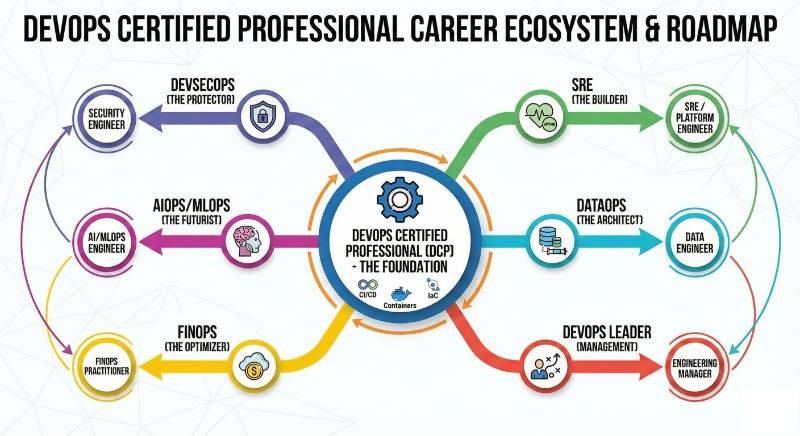
The landscape of software engineering has shifted. We are no longer in an era where “knowing a bit of Linux” or “writing some scripts” is sufficient to lead a production environment. Today, the industry demands a holistic approach to the software delivery lifecycle. Whether you are a working engineer in Bangalore or a manager in London, the DevOps Certified Professional (DCP) designation has become the gold standard for validating cross-functional expertise.
This guide provides a comprehensive roadmap for mastering the DevOps ecosystem, specifically focusing on the DevOps Certified Professional (DCP) program.
The Evolution of the DevOps Professional
In the current tech climate, DevOps is no longer just a “role”—it is the backbone of business agility. Companies are moving beyond basic CI/CD to integrate security (DevSecOps), reliability (SRE), and financial accountability (FinOps).
The DevOps Certified Professional (DCP) program is designed to create “T-shaped” professionals: individuals who have deep technical expertise in automation and broad knowledge across the entire delivery pipeline.
Master Certification Matrix
Choosing the right certification requires understanding the hierarchy and specializations within the field. The following table outlines the key tracks available under the professional umbrella.
| Track | Level | Who it’s for | Prerequisites | Skills Covered | Recommended Order |
| Core DevOps | Professional | SDEs, Admins, QA | Basic Linux/Git | CI/CD, K8s, Terraform, Docker | 1st |
| DevSecOps | Specialist | Security Eng, DevOps | DCP or 2+ yrs Exp | Vault, Sonar, SCA, DAST, OPA | 2nd |
| SRE | Specialist | Ops, SREs, SDEs | DCP or Cloud Cert | SLOs, Error Budgets, Toil, Obs | 2nd |
| DataOps | Specialist | Data Engineers | SQL/Python Basics | Data Pipelines, Orchestration | 3rd |
| AIOps | Advanced | Senior Engineers | Python/ML Basics | AI-driven Monitoring, MLOps | 4th |
| DevOps Leader | Management | Leads, Managers | 5+ yrs Experience | Culture, Scaling, Metrics | 4th |
Detailed Certification Breakdown
1. DevOps Certified Professional (DCP)
What it is
The flagship certification that covers the end-to-end DevOps lifecycle. It focuses on the “Big 5” of DevOps: Culture, Automation, Lean, Measurement, and Sharing (CALMS).
Who should take it
Software Engineers, System Administrators, and Quality Assurance professionals who want to transition into high-paying DevOps roles or master modern delivery pipelines.
Skills you’ll gain
- Mastery of Source Code Management (Git) and branching strategies.
- Continuous Integration and Deployment (Jenkins, GitLab CI).
- Containerization and Orchestration (Docker & Kubernetes).
- Infrastructure as Code (Terraform & Ansible).
- Observability and Monitoring (Prometheus & Grafana).
Real-world projects you should be able to do
- Automate a multi-tier application deployment to a Kubernetes cluster with zero downtime.
- Provision a complete AWS/Azure environment using Terraform and configure it with Ansible.
Preparation plan
- 30 Days Plan: Spend 1 hour daily on theory and 2 hours on hands-on labs. Focus heavily on Kubernetes (K8s) objects and Jenkins pipeline-as-code.
Common mistakes
- Focusing only on tools and ignoring the “why” behind DevOps principles.
- Skipping the “Infrastructure as Code” labs to focus only on CI/CD.
Best next certification after this
- DevSecOps Certified Professional (DSOCP).
2. DevSecOps Certified Professional (DSOCP)
What it is
A specialized certification focused on “Shifting Left.” It teaches how to integrate security into every phase of the CI/CD pipeline without compromising speed.
Who should take it
Security Engineers and DevOps practitioners who want to specialize in automated security compliance and threat modeling.
Skills you’ll gain
- SAST/DAST/IAST tool integration.
- Secrets management and encryption (HashiCorp Vault).
- Container security scanning and Image hardening.
- Compliance as Code (Open Policy Agent).
Real-world projects you should be able to do
- Build a pipeline that automatically blocks deployments if a critical vulnerability is found in the code or dependencies.
- Implement centralized secrets management for a distributed microservices architecture.
Preparation plan
- 14 Days Plan: Intensive focus for experienced DevOps engineers. Deep dive into security tool CLI and policy definitions.
Common mistakes
- Viewing security as a “checkpoint” at the end of the pipeline rather than an integrated process.
Best next certification after this
- SRE Certified Professional (SRECP).
3. SRE Certified Professional (SRECP)
What it is
Based on the Site Reliability Engineering principles pioneered by Google, this cert focuses on reliability, scalability, and the management of large-scale systems.
Who should take it
Operations engineers and developers responsible for the performance and uptime of production systems.
Skills you’ll gain
- Designing and implementing SLIs, SLOs, and SLAs.
- Incident response and Blameless Post-mortems.
- Automation of “Toil” (repetitive manual tasks).
- Advanced Observability and distributed tracing.
Real-world projects you should be able to do
- Define error budgets for a service and implement automated alerting based on SLO burn rates.
- Conduct a “Game Day” or Chaos Engineering experiment to test system resilience.
Preparation plan
- 60 Days Plan: This is a mindset shift. Spend 30 days reading SRE textbooks/documentation and 30 days building monitoring and self-healing stacks.
Common mistakes
- Treating SRE as just “Advanced DevOps” without understanding the mathematical aspects of error budgets.
Best next certification after this
- AIOps Certified Professional.
Choose Your Path: 6 Learning Journeys
Depending on your career goals, you should follow one of these structured paths:
- The DevOps Path (The All-Rounder): Start with DCP → Kubernetes Master → Terraform Associate.
- The DevSecOps Path (The Protector): Start with DCP → DSOCP → Cloud Security Professional.
- The SRE Path (The Builder): Start with DCP → SRECP → Observability Specialist.
- The AIOps/MLOps Path (The Futurist): Start with DCP → MLOps Specialist → AIOps Expert.
- The DataOps Path (The Architect): Start with DCP → DataOps Professional → Big Data Specialist.
- The FinOps Path (The Optimizer): Start with DCP → FinOps Certified Practitioner → Cloud Architect.
Role → Recommended Certifications
| If your role is… | Recommended Certification Sequence |
| DevOps Engineer | DCP + Certified Kubernetes Administrator (CKA) |
| SRE | DCP + SRECP + Prometheus Certified Associate |
| Platform Engineer | DCP + Terraform Associate + Kubernetes Master |
| Cloud Engineer | DCP + AWS/Azure Solutions Architect Professional |
| Security Engineer | DSOCP + Certified Cloud Security Professional (CCSP) |
| Data Engineer | DataOps Professional + MLOps Specialist |
| FinOps Practitioner | DCP + FinOps Certified Practitioner |
| Engineering Manager | DevOps Leader + FinOps Foundation |
Top Training Institutions for DCP (CDE)
When pursuing the DevOps Certified Professional (DCP) or Certified DevOps Engineer (CDE), choosing an institution that offers lab-based training is critical.
- DevOpsSchool: The primary provider for DCP. They offer a “work-experience-based” training model with lifetime access to their library and live projects.
- Cotocus: A premium training provider specializing in corporate digital transformation and advanced Kubernetes training for senior engineers.
- Scmgalaxy: A vast community and training resource focused on the technical nuances of Source Code Management, CI/CD, and automation tools.
- BestDevOps: Known for their hands-on approach and career placement assistance, focusing on job-ready skills for the Indian and global markets.
- Devsecopsschool: The global leader in niche security automation training, covering everything from Vault to DevSecOps pipelines.
- Sreschool: Dedicated solely to the Site Reliability Engineering track, focusing on observability, incident management, and system resilience.
- Aioppsschool: Specializes in the intersection of AI and Operations, teaching engineers how to use machine learning to predict and prevent outages.
- Dataopsschool: Focuses on the unique challenges of data delivery pipelines, integrating DevOps practices into Big Data and Analytics.
- Finopsschool: Provides specialized training for managing cloud spend and implementing financial accountability in engineering teams.
Next Steps for Career Growth
Once you have secured your primary certification, how do you continue to grow?
- Same-Track Progression: Move toward “Master” level certifications. If you have the DCP, aim for the Master in DevOps Engineering (MDE).
- Cross-Track Expansion: If you are a core DevOps engineer, bridge the gap by taking an SRE or DevSecOps cert. This makes you indispensable.
- Leadership Track: For those with 10+ years of experience, the Certified DevOps Architect (CDA) or Certified DevOps Manager (CDM) is the logical next step.
FAQs: General DevOps Certification
Q1: How difficult is the DCP exam?
The exam is challenging because it is not just multiple-choice; it includes a lab-based assessment where you must solve real infrastructure problems.
Q2: How much time should I dedicate to study?
For a working professional, 10–12 hours a week for 2 months is the sweet spot for a comprehensive understanding.
Q3: Are there any prerequisites for DCP?
While not mandatory, having a basic grasp of Linux commands and Git will significantly speed up your learning.
Q4: Is there a specific sequence for these certifications?
Yes. Always start with the core DCP. Specialized tracks like SRE or AIOps assume you already understand basic CI/CD and containerization.
Q5: What is the career outcome of getting certified?
In addition to a global credential, most professionals see a salary increase of 35% to 60% and gain access to “Senior” and “Lead” roles.
Q6: Can I take the certification online?
Yes, the training and the certification exam are both available in a 100% online, proctored format.
Q7: Does this certification cover multiple clouds?
The DCP is “Cloud-Native,” meaning the skills apply to AWS, Azure, and GCP equally.
Q8: Is the lab environment provided?
Top institutions like DevOpsSchool provide a dedicated lab environment (Virtual Machines/K8s clusters) as part of the training.
Q9: What is the validity of the DCP certificate?
The certification is valid for a lifetime, though it is recommended to refresh your skills with “delta” modules every 2-3 years.
Q10: Is there coding involved?
You don’t need to be a competitive programmer, but you must be comfortable with YAML, JSON, and basic scripting (Bash/Python).
Q11: How do these certifications compare to AWS/Azure specific certs?
Cloud-specific certs teach you their tools; DCP teaches you the industry-standard tools (Terraform, K8s, Jenkins) that work across all clouds.
Q12: Is there job assistance?
Many of the listed institutions offer resume building, LinkedIn optimization, and interview preparation as part of the package.
FAQs: DevOps Certified Professional (DCP) Specifics
Q1: What is the primary focus of the DCP (CDE) training?
It focuses on building a seamless “Code to Cloud” pipeline. You learn to automate every step a piece of code takes from a developer’s laptop to a production user.
Q2: What are the key tools covered in the DCP program?
The curriculum typically covers Git, Jenkins, Docker, Kubernetes, Ansible, Terraform, and monitoring tools like Prometheus.
Q3: Does the DCP certification include real-world projects?
Yes. A core requirement is the completion of industrial projects, such as building a self-healing infrastructure or a zero-downtime deployment pipeline.
Q4: Why is DevOpsSchool the provider for this?
DevOpsSchool has a long-standing reputation for technical depth and is one of the few providers that offers a dedicated community for ongoing technical support.
Q5: Is the DCP certification recognized by MNCs?
Yes, it is highly regarded by companies like TCS, Cognizant, Wipro, and global tech giants who require standardized DevOps skills across their teams.
Q6: Can a fresher take the DCP certification?
Yes, but they will need to spend extra time on the Linux and Networking fundamentals provided in the early modules of the course.
Q7: How is the DCP exam structured?
It consists of a mix of theoretical questions and a practical lab assignment where you must demonstrate your ability to configure tools.
Q8: What happens after I pass the DCP?
You receive a digital certificate and a badge that can be shared on LinkedIn. You also gain access to an alumni network of DevOps professionals.
Conclusion
The transition from a traditional engineer to a DevOps Certified Professional is the single most impactful move you can make for your career in 2026. The DCP program isn’t just about collecting a certificate; it’s about mastering a new way of thinking—one that prioritizes speed, security, and reliability.
By following the roadmaps and choosing the specialized tracks outlined in this guide, you aren’t just keeping up with the industry; you are staying ahead of it. Whether you aim to be a Platform Engineer, an SRE, or a DevOps Manager, your journey starts with a solid foundational certification.
