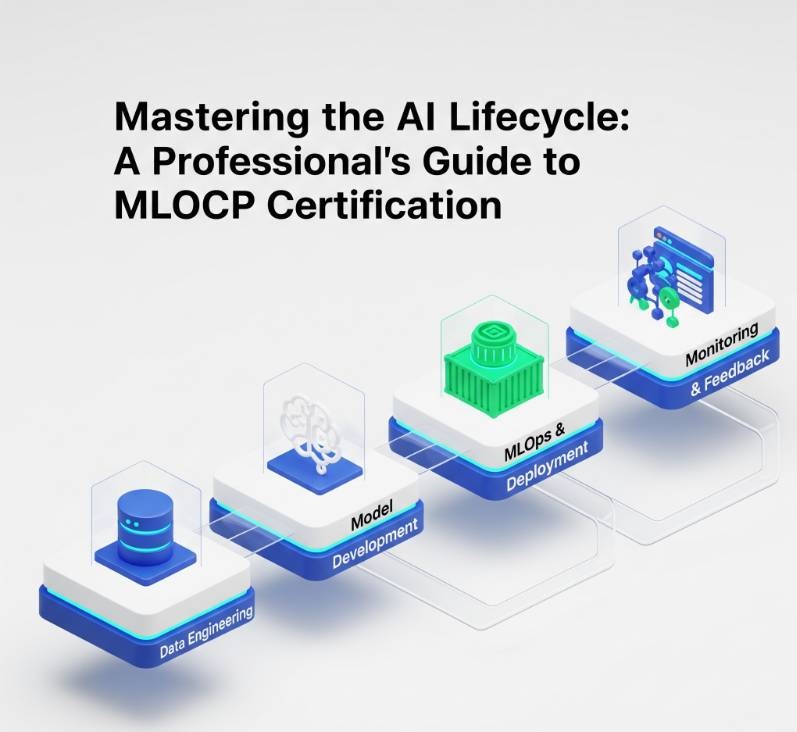
The bridge between a successful machine learning experiment and a scalable production system is often broken. In my years of experience navigating the shifts from monolithic architectures to microservices, and now to AI-driven applications, I’ve seen one consistent truth: a model that stays on a laptop is a liability, not an asset.
Machine Learning Operations (MLOps) has emerged as the most critical discipline for the modern era of software engineering. It isn’t just about “DevOps for ML”; it is a fundamental rethinking of how we handle data, code, and infrastructure simultaneously. For engineers and managers in India and across the global tech landscape, the MLOps Certified Professional (MLOCP) designation is the gold standard for proving you can handle this complexity.
Why MLOps is the New Global Standard
Traditional software follows a linear path: code is written, tested, and deployed. In Machine Learning, we face a “triangle of change.” When you deploy an ML model, you aren’t just managing the code; you are managing the data and the model itself. If the data changes in the real world (data drift), your code might be perfect, but your system will fail.
The industry is moving away from “manual ML” toward automated, reproducible pipelines. Organizations are looking for professionals who can automate the training, deployment, and monitoring of these models. This is where the MLOCP certification becomes your most valuable asset.
Master Mapping: MLOps and the “Ops” Ecosystem
To understand where you fit, you must see the full landscape. Below is the master table of certifications provided by DevOpsSchool, designed to help you navigate your career progression.
| Certification Track | Level | Who It’s For | Prerequisites | Skills Covered | Recommended Order |
| MLOps (MLOCP) | Professional | Software Engineers, Data Engineers, SREs | Basic Python, Linux, and SDLC knowledge | ML Pipelines, Model Serving, Feature Stores, Kubeflow, DVC | 2nd (Post-DevOps) |
| DevOps (CPDO) | Professional | Developers, SysAdmins, QA | Linux basics, Scripting | CI/CD, Jenkins, Docker, Kubernetes, Terraform | 1st (Foundational) |
| DataOps (CPDA) | Professional | Data Engineers, ETL Developers | SQL, Data Modeling | Data Orchestration, Quality, Governance, Airflow | 1st or 2nd |
| DevSecOps (CPDS) | Professional | Security Engineers, DevOps | DevOps fundamentals | SAST/DAST, Container Security, Compliance as Code | 3rd (Specialization) |
| SRE (CSRE) | Expert | Senior Engineers, Lead Devs | High-level Linux, Coding | SLOs, Error Budgets, Chaos Engineering, Monitoring | 3rd (Advanced) |
| FinOps (CPFO) | Professional | Managers, Cloud Architects | Cloud awareness | Cloud Cost Optimization, Unit Economics, FinOps Lifecycle | 3rd (Management) |
MLOps Certified Professional (MLOCP)
This certification is the cornerstone for anyone building the AI infrastructure of tomorrow. It focuses on the “Operationalization” of Machine Learning.
What it is
The MLOps Certified Professional (MLOCP) is an industry-recognized program that validates an individual’s ability to design, implement, and manage automated ML lifecycles. It moves beyond model training to focus on the engineering rigors of deployment, scalability, and long-term reliability.
Who should take it
- Software Engineers: Who want to pivot into AI-infrastructure roles.
- Data Engineers: Who need to understand how their data feeds into live model pipelines.
- DevOps Engineers: Seeking to specialize in a high-paying, niche domain.
- Engineering Managers: Who need to oversee data science teams and ensure their output reaches production efficiently.
Skills you’ll gain
- Automated Pipeline Orchestration: Learning to use tools like Kubeflow and MLflow to automate the journey from data ingestion to model deployment.
- Model Serving Architectures: Mastering the difference between batch processing and real-time REST API model serving.
- Infrastructure as Code (IaC) for ML: Using Terraform or CloudFormation to spin up GPU-enabled clusters for heavy training workloads.
- Model Monitoring & Observability: Setting up alerts for “Concept Drift” and “Prior Probability Shift” to ensure models remain accurate over time.
- Data & Model Versioning: Using DVC (Data Version Control) to ensure every model version is tied to the exact dataset version used to train it.
- Containerization for Data Science: Packaging complex ML environments into Docker containers to eliminate the “works on my machine” problem.
Real-world projects you should be able to do after it
- The Continuous Training (CT) Loop: Build a pipeline that detects when model accuracy drops below a threshold, automatically triggers a new training job on new data, and pushes the model to a staging environment.
- Feature Store Implementation: Create a centralized repository where data scientists can store and retrieve “features” for both training and low-latency production serving.
- Distributed Training Cluster: Setup a Kubernetes-based cluster using the TF-Job or PyTorch-Operator to train a large-scale neural network across multiple nodes.
Preparation plan
7–14 Days (The Fast Track)
- Requirement: Already working in DevOps or Data Engineering.
- Focus: Deep dive into MLOps-specific tools like MLflow. Focus on the integration points between CI/CD and ML models. Practice the command-line interface (CLI) for your chosen MLOps stack.
30 Days (The Professional Track)
- Week 1: Fundamentals of ML lifecycle and Dockerizing ML models.
- Week 2: Pipeline orchestration with Kubeflow or Airflow.
- Week 3: Model serving (Seldon, KServe) and Monitoring.
- Week 4: Capstone project and practice exams.
60 Days (The Career Pivot)
- First 30 Days: Build a strong foundation in Python, Linux, and basic DevOps (Git, Jenkins).
- Next 30 Days: Follow the Professional Track, spending extra time on hands-on labs to understand how infrastructure reacts to data-heavy workloads.
Common mistakes
- Manual Deployment: Thinking that “copying a model file to a server” is MLOps. It isn’t. Everything must be versioned and automated.
- Ignoring the Data Scientist: Building an infrastructure that is so rigid the data science team can’t use it. MLOps is about collaboration.
- Underestimating Costs: ML training is expensive. Failing to implement resource quotas or auto-scaling can lead to massive cloud bills.
Best next certification after this
- SRE (Site Reliability Engineering): To learn how to make your ML systems “five-nines” reliable.
- DataOps Certified Professional: To master the data engineering side that feeds your MLOps pipelines.
Choose Your Path: 6 Learning Tracks
Based on your career goals, you should follow one of these distinct paths:
- DevOps Path: Focuses on the core CI/CD, automation, and infrastructure skills needed for any modern tech role.
- DevSecOps Path: For those who want to specialize in automated security, compliance, and vulnerability management.
- SRE Path: The path for those who love high-scale systems, reliability engineering, and incident response.
- AIOps/MLOps Path: The specialized track for operationalizing AI and using AI to improve system operations.
- DataOps Path: Focuses on the “Data Supply Chain”—ensuring data quality and speed for analytics and ML.
- FinOps Path: A management-heavy track focused on cloud economics, cost optimization, and financial accountability.
Role → Recommended Certifications
| Role | Recommended Certification | Why? |
| DevOps Engineer | MLOps (MLOCP) | Adds AI infrastructure to your existing automation toolkit. |
| SRE | AIOps Certified | Helps automate incident detection using machine learning. |
| Platform Engineer | SRE (CSRE) | Essential for building internal developer platforms. |
| Cloud Engineer | FinOps (CPFO) | Critical for managing multi-cloud costs and efficiency. |
| Security Engineer | DevSecOps (CPDS) | Shifts security to the left, integrating it into the pipeline. |
| Data Engineer | DataOps (CPDA) | Standardizes the way data is delivered to the business. |
| FinOps Practitioner | FinOps (CPFO) | Professionalizes the cost-management function. |
| Engineering Manager | DevOps Leader | Provides the strategic view needed to scale engineering teams. |
Next Certifications to Take
Once you have mastered the MLOCP, consider these three directions to broaden your expertise (referencing industry standards for software engineers):
- Same Track (Deepening): AIOps Certified Professional. Move from managing ML models to using AI to run your entire IT infrastructure.
- Cross-Track (Broadening): DataOps Certified Professional. Learn the upstream data engineering practices that ensure your ML models are fed high-quality data.
- Leadership (Career Growth): Certified DevOps Architect. Transition from being a “doer” to a “designer,” creating the high-level blueprints for an entire organization’s technical strategy.
Training & Certification Support Institutions
Choosing the right partner for your MLOCP journey is vital. These institutions provide the hands-on labs and expert mentorship required to pass the certification and, more importantly, do the job in the real world.
- DevOpsSchool: The primary provider for the MLOCP. They offer deep-dive, instructor-led training with a massive library of real-world scenarios. Their curriculum is updated constantly to match the evolving MLOps landscape.
- Cotocus: A premier institution specializing in corporate upskilling. They focus on bringing entire engineering teams up to speed on MLOps and DevSecOps, making them a favorite for enterprise-level training.
- Scmgalaxy: A community-driven platform with years of history in configuration management. They provide excellent foundational resources and bootcamps that bridge the gap between traditional SCM and modern MLOps.
- BestDevOps: Known for their practical, “no-nonsense” approach to training. They focus on the most popular tools in the market, ensuring students are job-ready from day one.
- devsecopsschool: The go-to place for adding the security layer to your Ops knowledge. Essential if your MLOps work involves sensitive or regulated data.
- sreschool: Dedicated to the discipline of Site Reliability Engineering. They help MLOps professionals learn how to scale their model-serving infrastructure to millions of users.
- aiopsschool: Focused on the application of AI within the operations domain, providing a perfect follow-up to the MLOCP certification.
- dataopsschool: Specializes in the data lifecycle. Their training is crucial for understanding how to build the robust data pipelines that MLOps depends on.
- finopsschool: Provides the financial and cloud-economic training necessary for managers to keep ML training costs under control.
FAQs: Navigating Your MLOps Career Path
1. How difficult is the MLOCP exam?
It is a professional-level exam. If you have a background in DevOps or Data Engineering, it is manageable with 4 weeks of study. If you are new to “Ops,” you will need closer to 8 weeks to master the infrastructure components.
2. Is there a specific sequence I should follow?
While not mandatory, I highly recommend having a “DevOps Foundation” or “CPDO” certification first. Understanding CI/CD and Containers makes learning MLOps much smoother.
3. Does this certification require heavy math?
No. Unlike a Data Science degree, the MLOCP focuses on the engineering and operational side. You need to understand how models behave, but you won’t be asked to derive complex algorithms by hand.
4. What is the value of MLOCP in the current job market?
The “MLOps Engineer” role is currently one of the highest-paying titles in tech. This certification provides a verifiable credential that separates you from generalists.
5. How long is the certification valid?
Typically, these certifications are valid for 2-3 years, reflecting the fast pace of change in the AI/ML world.
6. Can a Software Engineer without an ML background take this?
Yes, but you should spend a week learning the “Machine Learning Lifecycle” (training, validation, testing) so you understand what the data scientists are trying to achieve.
7. Are there any prerequisites for MLOCP?
A basic understanding of Linux, Python, and Git is expected. Familiarity with Docker is a significant advantage.
8. What are the career outcomes?
Most graduates move into roles like MLOps Engineer, AI Infrastructure Engineer, or Lead Data Engineer. Managers often use it to gain the technical credibility needed to lead AI transformation projects.
9. Is the training provided by DevOpsSchool hands-on?
Yes, the MLOCP training is heavily focused on labs. You will spend a significant portion of your time actually building pipelines and deploying models.
10. How does MLOps differ from AIOps?
MLOps is about operationalizing Machine Learning models. AIOps is about using Artificial Intelligence to improve and automate general IT operations.
11. Is Python the only language used?
Python is the primary language for MLOps, though you will also use YAML for configuration and occasionally Shell scripting for automation.
12. Why should I choose DevOpsSchool for this certification?
They provide a unique blend of community support, expert-led sessions, and a curriculum that is built on years of real-world consulting experience in the “Ops” field.
Technical FAQs: MLOps Certified Professional (MLOCP)
Here are answers to the most common questions I hear from engineers considering this path.
1. Is coding required for the MLOCP certification?
Yes. You don’t need to be a core Java developer, but you must be comfortable with Python. You will need to write glue code, manage configuration files (YAML), and understand scripting for automation.
2. How does MLOCP differ from a general Data Science certificate?
Data Science certificates focus on model building, statistics, and algorithms. MLOCP focuses on taking that finished model and deploying, scaling, monitoring, and maintaining it in a production environment.
3. I am a DevOps engineer. How hard is the transition to MLOps?
You have a head start on CI/CD, containers, and infrastructure. The challenge will be understanding the unique characteristics of data (drift, versioning) and the specific workflows of data science teams.
4. What are the main prerequisites before starting MLOCP?
You should have a foundational understanding of Linux command line, basic Python programming, and the core concepts of Docker/containerization.
5. Is this certification tied to a specific cloud provider like AWS or Azure?
The MLOCP generally focuses on cloud-agnostic principles and open-source tools (like Kubernetes, MLflow, Kubeflow), which can then be applied across any major cloud provider.
6. How much time does it realistically take to prepare?
For a working professional with some related background, 4 to 8 weeks of consistent evening/weekend study is a realistic timeframe to absorb the material and practice the labs.
7. Will this certification help me get a job in India or globally?
Yes. The shortage of skilled MLOps engineers is a global phenomenon. Companies in India serving global clients are desperately looking for proof of practical skills in this area.
8. What is the immediate career outcome after passing?
You become eligible for roles specifically titled “MLOps Engineer” or “Machine Learning Infrastructure Engineer,” which often command higher salaries than generalist DevOps or software engineering roles due to specialization.
Conclusion
The transition from a “code-first” world to a “data-first” world is the biggest shift I have witnessed in my career. The engineers who thrive in this new era will be those who can bridge the gap between data science and production-grade engineering.
The MLOps Certified Professional (MLOCP) is your roadmap to this future. It isn’t just about learning a few tools; it’s about adopting a mindset of automation, reliability, and continuous improvement for the most complex systems we have ever built. Whether you are looking to secure your next promotion or lead a global team, the path starts with mastering the operations of machine learning.
