Introduction
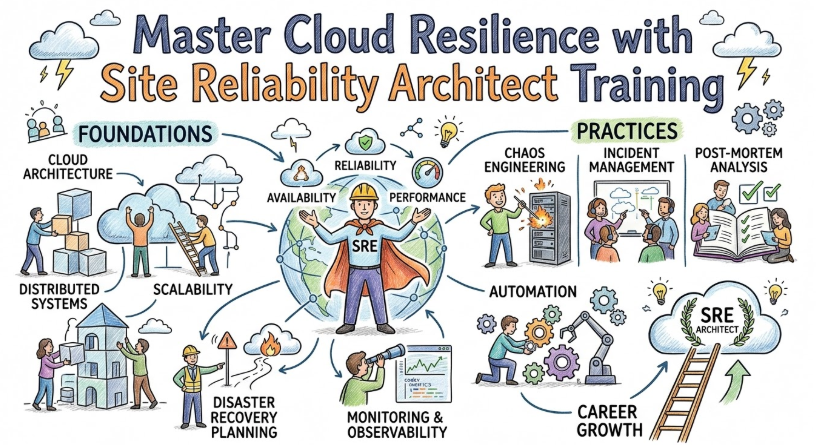
The role of a Site Reliability Architect has become the backbone of modern digital infrastructure. As organizations move toward complex, cloud-native environments, the need for professionals who can design systems that are both scalable and resilient is at an all-time high. This guide is designed for engineers and technical leaders who want to move beyond basic operations and master the architectural principles of reliability. By following the Certified Site Reliability Architect path, professionals can transition from reactive troubleshooting to proactive system design. This comprehensive overview will help you evaluate how this certification aligns with your career goals at SREschool and provides a clear roadmap for achieving architectural mastery in the SRE domain.
What is the Certified Site Reliability Architect?
The Certified Site Reliability Architect represents the pinnacle of expertise in the intersection of software engineering and systems design. It is not merely a theoretical exercise but a validation of an engineer’s ability to build production-grade systems that withstand the pressures of high-traffic environments. This certification exists to bridge the gap between knowing how to use tools and knowing how to design resilient frameworks. It focuses on the strategic implementation of SRE principles, ensuring that reliability is “baked in” from the initial design phase rather than being an afterthought during the deployment cycle.
Who Should Pursue Certified Site Reliability Architect?
This certification is tailored for seasoned professionals who are responsible for the long-term health of enterprise platforms. Senior DevOps engineers, SREs, and Cloud Architects will find the curriculum directly applicable to their daily challenges. It is also highly beneficial for Engineering Managers and Technical Leads who need to understand the trade-offs between feature velocity and system stability. Whether you are operating in the Indian tech ecosystem or within a global enterprise, this certification provides the architectural vocabulary and framework required to lead high-performing platform teams and oversee complex migrations.
Why Certified Site Reliability Architect is Valuable and Beyond
In an era where downtime translates directly to massive financial loss, the demand for architects who specialize in reliability is permanent. This certification ensures longevity in your career because it focuses on first principles rather than fleeting tool sets. While specific technologies may change, the architectural patterns of load balancing, failover, and observability remain constant. Investing time in this path provides a significant return by positioning you as a high-value asset capable of reducing operational overhead and improving the overall end-user experience for enterprise-scale applications.
Certified Site Reliability Architect Certification Overview
The program is delivered via the official curriculum and is hosted on the SREschool.com platform. It utilizes a practical assessment approach that requires candidates to demonstrate their understanding of complex system interactions. The certification is structured to guide a learner from foundational concepts to advanced architectural decision-making. It is owned and managed by industry experts who ensure the content stays aligned with current enterprise practices, focusing on the actual ownership of the reliability lifecycle rather than just passing a multiple-choice exam.
Certified Site Reliability Architect Certification Tracks & Levels
The certification path is divided into progressive tiers to match the natural evolution of an engineer’s career. It starts at the Foundation level, where the core vocabulary of SLIs, SLOs, and Error Budgets is established. From there, it moves into Professional and Advanced tracks where the focus shifts toward cross-functional integration with FinOps, Security, and Data operations. These levels allow professionals to specialize in areas like automated incident response or cost-optimized reliability, providing a clear trajectory from a specialized contributor to a broad-reaching technical architect.
Complete Certified Site Reliability Architect Certification Table
| Track | Level | Who it’s for | Prerequisites | Skills Covered | Recommended Order |
| Reliability | Foundation | Junior SREs/DevOps | Basic Linux & Cloud | SLIs/SLOs, Toil Reduction | 1 |
| Architecture | Professional | Senior Engineers | 3+ Years Experience | Distributed Systems Design | 2 |
| Strategy | Advanced | Leads & Architects | Professional Cert | Governance & Scaling | 3 |
Detailed Guide for Each Certified Site Reliability Architect Certification
What it is This certification validates a professional’s understanding of the core tenets of Site Reliability Engineering. It ensures the candidate can speak the language of reliability and understands how to measure system health effectively.
Who should take it It is ideal for software engineers transitioning into SRE roles, junior DevOps practitioners, and system administrators. It is the perfect entry point for anyone looking to formalize their understanding of modern operations.
Skills you’ll gain
- Defining and measuring Service Level Indicators (SLIs)
- Creating meaningful Service Level Objectives (SLOs)
- Identifying and eliminating operational toil through automation
- Understanding the lifecycle of an incident and basic post-mortem analysis
Real-world projects you should be able to do
- Designing a monitoring dashboard that tracks user-centric reliability metrics
- Automating a repetitive manual deployment task using CI/CD pipelines
- Conducting a blameless post-mortem for a simulated service outage
Preparation plan
- 7–14 days: Focused review of the official SRE handbook and core terminology.
- 30 days: Implementation of basic monitoring and alerting in a lab environment.
- 60 days: Full immersion into error budget management and automation scripts.
Common mistakes
- Focusing too much on specific tools (like Prometheus) rather than the underlying concepts.
- Ignoring the cultural aspect of SRE, such as the importance of blamelessness.
- Failing to understand the mathematical relationship between availability and downtime.
Best next certification after this
- Same-track option: Certified Site Reliability Architect – Professional
- Cross-track option: Certified DevSecOps Professional
- Leadership option: Engineering Management Foundation
Choose Your Learning Path
DevOps Path
The DevOps path focuses on the seamless integration of development and operations through the lens of architectural reliability. Engineers on this path learn how to build CI/CD pipelines that are not just fast, but resilient. They focus on infrastructure as code (IaC) and ensuring that every architectural change is versioned and testable. This path is essential for those who want to ensure that software delivery does not compromise system stability.
DevSecOps Path
The DevSecOps path emphasizes that reliability is impossible without security. This learning track integrates security protocols directly into the SRE architectural framework. Practitioners learn how to automate security scanning and compliance checks within the reliability lifecycle. It is designed for engineers who believe that a truly reliable system must be secure by design, preventing outages caused by vulnerabilities or unauthorized access.
SRE Path
This is the core architectural path dedicated to the science of reliability. It deep dives into distributed systems, traffic management, and cascading failure prevention. Engineers learn how to manage massive scale while maintaining strict performance targets. This path is for those who want to become specialists in keeping global-scale systems online 24/7, focusing heavily on automation and self-healing infrastructure.
AIOps Path
AIOps introduces artificial intelligence and machine learning to the world of operations. This path is for engineers who want to use data-driven insights to predict outages before they happen. You will learn how to implement automated remediation and intelligent alerting systems that reduce the cognitive load on human operators by filtering out the noise.
MLOps Path
As machine learning models become core components of business applications, ensuring their reliability is paramount. The MLOps path focuses on the lifecycle of ML models, from training to deployment and monitoring. You will learn how to architect pipelines that ensure model performance doesn’t drift and that the underlying infrastructure can support heavy computational loads.
DataOps Path
The DataOps path applies SRE principles to data pipelines and big data infrastructure. Reliability in this context means data integrity, availability, and low latency for analytical workloads. Architects on this path learn how to design data platforms that are resilient to schema changes and processing spikes. It is vital for organizations that rely on real-time data for their core business decisions.
FinOps Path
The FinOps path focuses on the economic side of reliability architecture. It teaches engineers how to design systems that are not only reliable but also cost-efficient. By understanding the cloud cost models, architects can make informed decisions about redundancy and resource allocation. This path ensures that the pursuit of high availability does not lead to unsustainable cloud expenditures.
Role → Recommended Certified Site Reliability Architect Certifications
| Role | Recommended Certifications |
| DevOps Engineer | Foundation + Professional |
| SRE | Foundation + Professional + Advanced |
| Platform Engineer | Architecture Track |
| Cloud Engineer | Foundation + FinOps Track |
| Security Engineer | DevSecOps Integration |
| Data Engineer | DataOps Specialization |
| FinOps Practitioner | FinOps Track |
| Engineering Manager | Foundation + Strategy Track |
Next Certifications to Take After Certified Site Reliability Architect
Same Track Progression
Once the architectural foundations are mastered, the natural next step is to move into deep-dive specializations within SRE. This involves focusing on advanced topics like global traffic steering, multi-region failover strategies, and kernel-level performance tuning. Staying within the track allows you to become a subject matter expert that organizations rely on for their most critical infrastructure challenges.
Cross-Track Expansion
For those who want to be more versatile, expanding into DevSecOps or MLOps is a strategic move. A Site Reliability Architect with deep security knowledge or the ability to manage AI workloads is incredibly rare and valuable. This expansion helps you understand the broader business context and ensures you can lead multi-disciplinary teams across the entire technology stack.
Leadership & Management Track
If your goal is to move into executive leadership, such as a VP of Infrastructure or CTO, the transition to the management track is essential. This involves taking certifications that focus on team building, budget management, and strategic planning. You will learn how to translate technical reliability metrics into business value, helping the organization understand the ROI of engineering investments.
Training & Certification Support Providers for Certified Site Reliability Architect
DevOpsSchool DevOpsSchool provides comprehensive training programs that cover the entire spectrum of modern IT operations. Their curriculum is designed by industry veterans and focuses on practical, hands-on labs that simulate real-world production environments. They offer extensive support for candidates pursuing reliability certifications, ensuring that learners understand both the tools and the cultural shifts required for success.
Cotocus Cotocus is known for its specialized consulting and training services that help organizations adopt cloud-native technologies. Their approach to SRE training is highly architectural, focusing on how different components interact in a distributed system. They provide deep insights into container orchestration and microservices management, making them a preferred choice for senior engineers looking to level up their skills.
Scmgalaxy Scmgalaxy serves as a massive knowledge hub for the DevOps and SRE community. They provide a wealth of resources, including tutorials, forums, and practice exams that help candidates prepare for certification. Their focus is on community-driven learning, ensuring that the information provided is based on the actual experiences of working professionals across various industries.
BestDevOps BestDevOps offers targeted training modules that focus on the most in-demand skills in the current market. Their SRE programs are streamlined to provide the most value in the shortest amount of time, focusing on the core principles that drive system reliability. They are an excellent resource for professionals who need to gain specific skills quickly to meet project requirements.
devsecopsschool.com This provider focuses exclusively on the intersection of security and operations. Their curriculum is essential for any Site Reliability Architect who wants to ensure their designs are resilient against security threats. They provide detailed training on automated security testing and how to build “security as code” into the reliability framework.
sreschool.com As the primary host for the Site Reliability Architect program, this site provides the most direct and authoritative path to certification. The content is meticulously curated to cover every aspect of the SRE role, from basic monitoring to complex architectural design. It serves as the central platform for professionals dedicated to mastering the art of reliability.
aiopsschool.com This provider is at the forefront of integrating artificial intelligence into IT operations. Their training programs are essential for architects who want to understand the future of automated system management. They cover topics like predictive analytics and automated incident response, helping engineers stay ahead of the curve in a rapidly changing field.
dataopsschool.com Focusing on the reliability of data systems, this provider offers specialized training for data engineers and architects. They teach how to apply SRE principles to data pipelines, ensuring that data is always accurate and available. This is a critical niche for any organization that relies on big data for its competitive advantage.
finopsschool.com This site provides the necessary training to bridge the gap between engineering and finance. It teaches architects how to manage the costs of their reliability designs, ensuring that high availability is achieved economically. This training is increasingly important as cloud budgets become a primary concern for executive leadership.
Frequently Asked Questions (General)
- How difficult is the Certified Site Reliability Architect exam?
The exam is designed to be challenging and requires a deep understanding of both theory and practical application. It is not a simple memorization test; it requires the ability to solve architectural problems. - What are the prerequisites for the Foundation level?
A basic understanding of Linux systems, cloud computing concepts, and at least one programming or scripting language is recommended. - How long does it take to prepare for the certification?
Depending on your experience level, preparation can take anywhere from 30 to 90 days of consistent study and hands-on practice. - Is there a practical component to the assessment?
Yes, the certification process often includes lab-based scenarios where you must demonstrate your ability to implement reliability patterns in a controlled environment. - What is the ROI of this certification for an individual?
Professionals often see significant salary increases and access to more senior roles, as this certification validates a high-level, specialized skill set. - How often do I need to recertify?
Typically, recertification is required every two to three years to ensure that your skills remain aligned with the latest industry standards and technologies. - Can I take the exam online?
Yes, the certification is designed to be accessible globally through secure online proctoring platforms. - Is this certification recognized by major tech companies?
The curriculum is based on industry-standard SRE practices pioneered by leading tech firms, making the skills highly transferable and recognized globally. - What is the difference between SRE and DevOps certifications?
DevOps focuses on the broad integration of dev and ops, while SRE is a specific implementation of DevOps that focuses heavily on reliability through engineering. - Does the certification cover specific cloud providers like AWS or Azure?
While the principles are cloud-agnostic, the practical applications often use major cloud providers to demonstrate architectural patterns. - Are there study groups available for candidates?
Yes, many of the training providers host forums and community groups where candidates can collaborate and share knowledge. - What happens if I fail the exam?
Most programs offer a retake policy after a mandatory waiting period, allowing you to focus on the areas where you need improvement.
FAQs on Certified Site Reliability Architect
- What specific architectural patterns are covered in this program?
The program covers patterns such as circuit breakers, bulkheads, load shedding, and data replication strategies. These are essential for building systems that can gracefully handle partial failures without collapsing. - How does this certification handle the concept of Error Budgets?
It provides a deep dive into how to negotiate and manage error budgets between product and engineering teams, using them as a tool to balance innovation with stability. - Is automation a major focus of the Site Reliability Architect path?
Yes, automation is a core pillar. The program teaches how to identify candidates for automation and how to build robust, self-healing systems that reduce human intervention. - Does the program include training on incident response?
It covers the entire incident lifecycle, including how to set up on-call rotations, manage communications during an outage, and conduct effective post-mortems. - How does the certification address observability versus monitoring?
The curriculum distinguishes between simple monitoring and deep observability, teaching how to design systems that provide meaningful insights into internal states via logs, metrics, and traces. - Are distributed systems concepts a requirement?
Yes, a significant portion of the advanced track is dedicated to the challenges of distributed systems, including consistency models and network latency. - What role does capacity planning play in the curriculum?
The program teaches how to use historical data and trend analysis to predict future resource needs, ensuring the system can handle growth without performance degradation. - How is security integrated into the reliability architecture?
It emphasizes that a reliable system must be resilient to attacks, covering basics of secure design and automated vulnerability management within the SRE workflow.
Final Thoughts: Is Certified Site Reliability Architect Worth It?
From the perspective of a senior mentor, the answer is a definitive yes, provided you are looking for more than just a badge for your profile. This certification is about changing your mindset from a “fixer” to a “designer.” In the current landscape, the engineers who can articulate why a system failed and how to redesign it to never fail that way again are the ones who lead the industry. If you are committed to the discipline of engineering reliability and want to be recognized as a leader in the field, this path offers the structure and validation necessary to reach the highest levels of your career.
