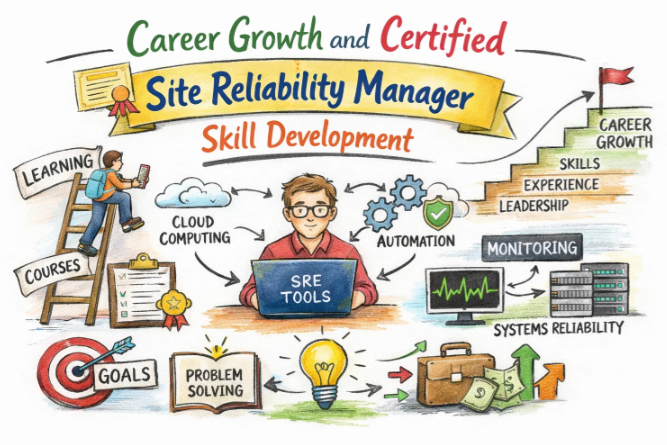
The transition from a technical individual contributor to a leadership role is one of the most significant shifts in an engineering career. The Certified Site Reliability Manager program is designed specifically for those navigating this change within the high-stakes world of reliability engineering. This guide is built for engineers and aspiring leaders who need to understand how to manage modern production environments effectively.
As systems grow in complexity, the need for managers who understand both the code and the cultural nuances of reliability has never been higher. This certification provides a structured path to mastering the balance between feature velocity and system stability. By following this guide, you will gain clarity on whether this path aligns with your professional goals and how it can accelerate your growth within the SREschool ecosystem.
Deciding on the right certification requires an objective look at the industry landscape. This guide helps you evaluate the practical benefits of becoming a certified manager in the SRE domain. We will explore how this credential bridges the gap between technical expertise and organizational leadership, ensuring you make an informed decision for your career progression.
What is the Certified Site Reliability Manager?
The Certified Site Reliability Manager represents a professional standard for those tasked with leading SRE teams and managing the reliability of complex systems. It exists because technical skill alone is not enough to maintain large-scale production environments; it requires a deep understanding of team dynamics, risk management, and incident response orchestration. This program emphasizes real-world application over abstract theory, focusing on the actual challenges faced in modern data centers and cloud environments.
Unlike general management courses, this certification is grounded in production-focused learning. It covers the specific methodologies required to implement SRE principles at a departmental level, rather than just at a task level. The curriculum aligns with modern engineering workflows, ensuring that managers can speak the same language as their developers while satisfying the stability requirements of the enterprise.
In an enterprise setting, this certification serves as a validation of a professional’s ability to oversee high-availability systems. It covers the governance of Service Level Objectives (SLOs) and the implementation of error budgets across multiple product lines. It is built for the reality of 24/7 operations, where downtime has a direct impact on business viability and customer trust.
Who Should Pursue Certified Site Reliability Manager?
This certification is primarily intended for senior software engineers and Site Reliability Engineers who are moving into lead or management roles. It is also highly beneficial for existing engineering managers who have inherited SRE responsibilities but lack a formal framework for managing reliability. Cloud professionals and platform engineers looking to broaden their strategic impact will find the curriculum particularly relevant to their daily operations.
For security and data professionals, pursuing this certification offers a way to integrate reliability into their specialized domains. Understanding how to manage reliability from a leadership perspective allows these professionals to better collaborate with SRE teams during cross-functional projects. It provides a common framework for discussing risk, which is essential for any high-growth technology organization.
The relevance of this certification spans both the Indian and global markets. In India’s rapidly maturing tech ecosystem, companies are looking for leaders who can scale systems reliably while managing large, distributed teams. Globally, the demand for managers who can navigate the complexities of cloud-native infrastructure is at an all-time high, making this a versatile credential for any ambitious engineering leader.
Why Certified Site Reliability Manager is Valuable and Beyond
The demand for reliable systems is not a trend; it is a fundamental requirement of the digital economy. As enterprise adoption of cloud-native technologies continues to accelerate, the need for managers who can oversee these environments grows proportionally. This certification provides the longevity required for a career in technology by focusing on core management principles that remain relevant even as specific tools and platforms change.
One of the primary values of this program is its ability to help professionals stay relevant in an era of rapid automation and shifting architectures. While individual tools may come and go, the need for incident management, capacity planning, and reliability culture is permanent. Investing in this certification ensures that your skills are tied to high-level organizational outcomes rather than just a specific software version.
From a career perspective, the return on time investment is significant. Organizations are increasingly looking for specialized management credentials to filter for roles that oversee critical infrastructure. By holding this certification, you demonstrate a commitment to professional excellence and a mastery of the disciplines required to keep modern businesses running smoothly under pressure.
Certified Site Reliability Manager Certification Overview
The program is delivered via the official Certified Site Reliability Manager page and is hosted on SREschool.com. It is structured to provide a comprehensive look at the management layer of reliability engineering, moving beyond basic monitoring to deep organizational strategy. The assessment approach is designed to test your ability to make high-level decisions regarding system architecture, team resource allocation, and incident response protocols.
The certification ownership lies with a body of experts who have managed production systems at scale. This ensures that the structure remains practical and reflects the actual needs of the industry. The program is broken down into modules that cover the lifecycle of a reliability manager, from setting initial objectives to conducting post-incident reviews at an executive level.
In practical terms, the certification validates that you can lead a team through the complexities of modern software delivery. It focuses on the governance of SRE practices, ensuring that reliability is not just a checkbox but a core part of the business strategy. This approach makes the credential highly respected by hiring managers and CTOs who need leaders they can trust with their most critical assets.
Certified Site Reliability Manager Certification Tracks & Levels
The certification is organized into three distinct levels to accommodate professionals at different stages of their leadership journey. The Foundation level introduces the core concepts of SRE management, focusing on the vocabulary and basic frameworks needed to support a team. This level is ideal for aspiring leads who want to understand the fundamentals of reliability leadership before taking on full management responsibilities.
The Professional level is the core of the program, designed for active managers who oversee SRE or DevOps teams. At this stage, the focus shifts to advanced incident management, error budget governance, and hiring strategies for reliability engineers. It provides the tools necessary to manage the tension between speed and stability in a fast-paced development environment.
The Advanced level is reserved for those looking to reach executive leadership or principal management roles. This track covers long-term reliability roadmaps, cross-departmental alignment, and the financial aspects of reliability engineering, such as cost optimization and resource planning. These levels allow for a clear career progression, mapping directly to the growth of an individual from a team lead to a director-level professional.
Complete Certified Site Reliability Manager Certification Table
| Track | Level | Who it’s for | Prerequisites | Skills Covered | Recommended Order |
| Management | Foundation | Aspiring Leads | 3+ years SRE/DevOps | SLO Basics, Team Support | 1 |
| Management | Professional | Active Managers | 5+ years Experience | Error Budgets, Incident Ops | 2 |
| Management | Advanced | Directors/Heads of SRE | Professional Level | Financial Ops, Org Culture | 3 |
| SRE Core | Specialist | Senior SREs | Technical Background | Advanced Automation, Scaling | 1 |
| Platform | Specialist | Platform Leads | Cloud Architecture | Internal Dev Platforms | 2 |
Detailed Guide for Each Certified Site Reliability Manager Certification
What it is
This certification validates a professional’s understanding of the fundamental principles required to lead a reliability-focused team. It covers the core terminology and the basic relationship between development and operations from a leadership perspective.
Who should take it
This is designed for senior engineers, team leads, or those transitioning into their first management role. It is for individuals who want to ensure they have a solid grasp of SRE theory before applying it to team management.
Skills you’ll gain
- Understanding the SRE management framework.
- Ability to define Service Level Indicators (SLIs).
- Knowledge of basic incident response roles.
- Strategies for supporting technical team members.
Real-world projects you should be able to do
- Draft a basic SLO document for a small service.
- Create a team on-call rotation that prevents burnout.
- Facilitate a simple blameless post-mortem.
Preparation plan
- 7-14 Days: Review official documentation and core SRE management vocabulary.
- 30 Days: Participate in study groups and complete foundational practice assessments.
- 60 Days: Implement basic SRE tracking on a small project to gain practical context.
Common mistakes
- Focusing too much on technical tools rather than management processes.
- Underestimating the importance of culture and “soft” management skills.
Best next certification after this
- Same-track option: Certified Site Reliability Manager – Professional
- Cross-track option: DevOps Foundation
- Leadership option: Technical Team Lead Certification
Choose Your Learning Path
DevOps Path
The DevOps learning path for a manager focuses on the integration of development cycles with operational stability. It emphasizes the “Shift Left” philosophy, where reliability is considered early in the software development lifecycle. Managers on this path learn how to foster collaboration between silos and automate the delivery pipeline to reduce manual errors. This path is ideal for those overseeing full-stack teams in high-velocity environments.
DevSecOps Path
The DevSecOps management path prioritizes the union of reliability and security. Managers learn how to treat security vulnerabilities as reliability risks, integrating automated security testing into the SRE framework. This path covers the governance of compliance and the management of secure supply chains without sacrificing system performance. It is suited for leaders in regulated industries like finance or healthcare where security is paramount.
SRE Path
The pure SRE path is dedicated to the deep technical management of distributed systems. This path focuses on the mathematical and engineering aspects of reliability, such as advanced telemetry, automated remediation, and chaos engineering. Managers here learn how to direct a team of specialists to build systems that are inherently self-healing. This is the primary path for those working at massive scale in cloud-native organizations.
AIOps Path
The AIOps path explores the management of artificial intelligence tools within operations. Managers learn how to oversee the implementation of machine learning models that predict and prevent system failures before they occur. This path focuses on data-driven decision-making and the management of large-scale observability platforms that utilize AI. It is designed for forward-thinking leaders who want to leverage automation to manage extreme complexity.
MLOps Path
The MLOps management path addresses the specific reliability needs of machine learning production environments. Managers on this track learn how to manage the lifecycle of models, including versioning, data drift, and deployment stability. It bridges the gap between data science and operational engineering, ensuring that AI products are as reliable as traditional software. This path is essential for teams focused on delivering production-grade AI services.
DataOps Path
The DataOps path focuses on the reliability and quality of data pipelines. Managers learn how to apply SRE principles to data engineering, ensuring that data is delivered accurately and on time to downstream consumers. This includes managing data observability, automated testing for data flows, and incident response for pipeline failures. It is ideal for leaders overseeing data warehouses or real-time analytics platforms.
FinOps Path
The FinOps management path combines reliability with financial accountability. Managers learn how to balance the cost of cloud infrastructure with the performance and reliability requirements of the business. This path covers cloud cost optimization, budget forecasting, and the management of resource efficiency. It is a critical path for leaders who need to demonstrate the business value and cost-effectiveness of their SRE initiatives.
Role → Recommended Certified Site Reliability Manager Certifications
| Role | Recommended Certifications |
| DevOps Engineer | CSRM Foundation, DevOps Specialist |
| SRE | CSRM Foundation, Professional SRE |
| Platform Engineer | CSRM Professional, Platform Specialist |
| Cloud Engineer | CSRM Foundation, Cloud Architect |
| Security Engineer | CSRM Foundation, DevSecOps Leader |
| Data Engineer | CSRM Foundation, DataOps Specialist |
| FinOps Practitioner | CSRM Professional, FinOps Certified |
| Engineering Manager | CSRM Professional, CSRM Advanced |
Next Certifications to Take After Certified Site Reliability Manager
Same Track Progression
Once you have mastered the management aspect of reliability, the logical next step is to pursue the Advanced level of the CSRM program. This ensures a complete mastery of the management lifecycle, from team lead to executive leadership. Continuing on this track allows you to refine your strategic planning and organizational design skills, making you a top-tier candidate for Director of Engineering or VP of Infrastructure roles.
Cross-Track Expansion
To become a more well-rounded leader, consider expanding into adjacent fields like Cloud Architecture or FinOps. Broadening your expertise ensures that you understand the underlying infrastructure and financial constraints that your SRE teams operate within. This cross-pollination of skills makes you a more effective manager because you can advocate for your team while understanding the pressures faced by other departments.
Leadership & Management Track
For those looking to move into general executive management, certifications like the ITIL Strategic Leader or specialized MBA modules for technology can be beneficial. These programs focus on the broader business context, including corporate strategy and organizational behavior. Combining these with your CSRM background creates a powerful profile of a leader who understands both the technical “how” and the business “why.”
Training & Certification Support Providers for Certified Site Reliability Manager
DevOpsSchool
DevOpsSchool is a prominent training organization that provides extensive resources for those pursuing reliability and management certifications. They offer a variety of instructor-led courses and self-paced learning modules designed to help professionals master modern operational tools. Their curriculum is known for being comprehensive, covering everything from basic automation to advanced container orchestration. With a focus on hands-on labs, they ensure that students can apply what they learn to real-world scenarios immediately. This makes them a reliable choice for engineers looking to build a strong foundation in DevOps and SRE practices before moving into management roles.
Cotocus
Cotocus specializes in delivering high-quality technical training with a focus on emerging technologies and professional certifications. They provide tailored learning paths for individuals and corporate teams, ensuring that the training aligns with specific career goals. Their instructors are often industry practitioners who bring a wealth of practical experience to the classroom. Cotocus is particularly well-regarded for its focus on cloud-native technologies and site reliability engineering principles. By offering deep dives into complex architectural topics, they help managers understand the technical hurdles their teams face, which is essential for effective leadership in a modern engineering environment.
Scmgalaxy
Scmgalaxy is a well-established community and training platform that has been supporting software professionals for years. They offer a vast library of tutorials, blog posts, and formal training programs focused on configuration management, SRE, and DevOps. The platform is known for its practical approach, providing step-by-step guides that solve real production problems. For a prospective Certified Site Reliability Manager, Scmgalaxy serves as a valuable resource for staying updated on the latest industry trends and toolsets. Their commitment to community-driven learning makes them an excellent support provider for those who value peer-to-peer knowledge sharing and practical problem-solving.
BestDevOps
BestDevOps focuses on providing streamlined and efficient training paths for busy professionals. They understand the time constraints faced by working engineers and managers, offering focused courses that deliver maximum value in a short period. Their training materials are designed to be concise and actionable, avoiding unnecessary fluff. This approach is ideal for those who need to gain specific skills quickly to support their certification goals. BestDevOps provides a range of resources that help candidates prepare for the rigors of professional assessments, making them a popular choice for those looking to advance their careers without taking extensive time away from work.
devsecopsschool.com
DevSecOpsSchool is a specialized provider that focuses on the critical intersection of security and operations. As the industry moves toward more secure software delivery, their training programs become increasingly essential for modern managers. They offer certifications and courses that teach leaders how to integrate security into every stage of the SRE lifecycle. This includes automated threat modeling, secure coding practices, and compliance as code. For a manager, understanding these concepts is vital for protecting organizational assets while maintaining high system reliability. Their expertise makes them a leading choice for those following a security-focused leadership path.
sreschool.com
SREschool.com is the primary platform for reliability-focused education and the direct host of the Certified Site Reliability Manager program. They provide a dedicated environment for mastering the art and science of site reliability engineering. The platform offers a range of levels, from introductory courses to advanced management certifications, all designed by industry experts. Because they are the primary host, their materials are perfectly aligned with the certification requirements. This ensures that students receive the most relevant and up-to-date information possible. Their focus on the specific needs of SREs makes them an indispensable resource for anyone in the field.
aiopsschool.com
AIOpsSchool is at the forefront of the movement toward AI-driven operations. They provide specialized training for managers who want to implement machine learning and artificial intelligence in their production environments. Their courses cover the strategic deployment of AI tools for incident prediction, anomaly detection, and automated remediation. As systems become too complex for human management alone, the skills taught at AIOpsSchool become increasingly valuable. For a site reliability manager, understanding these tools is key to scaling operations and maintaining high availability in the future. They provide the roadmap for the next generation of operational leadership.
dataopsschool.com
DataOpsSchool addresses the growing need for reliability in data engineering and analytics pipelines. They offer training that applies the principles of SRE to the data world, ensuring that information flows smoothly and accurately across the organization. For managers overseeing data teams, their curriculum provides a framework for reducing errors and improving the speed of data delivery. They cover topics like data observability, pipeline automation, and data quality testing. By providing these specialized skills, DataOpsSchool helps leaders ensure that their data infrastructure is as resilient and reliable as their software products, which is a critical requirement today.
finopsschool.com
FinOpsSchool provides the essential training needed to manage the financial aspects of cloud operations. As cloud costs continue to rise, managers must be able to demonstrate fiscal responsibility alongside technical excellence. FinOpsSchool teaches leaders how to optimize cloud spend, forecast budgets, and create a culture of financial accountability within engineering teams. This training is vital for any site reliability manager who wants to have a seat at the executive table. By bridging the gap between engineering and finance, they provide the tools necessary to manage modern infrastructure in a cost-effective and sustainable manner.
Frequently Asked Questions (General)
- What is the average time required to complete this certification?
Most candidates complete the foundation level in 30 days, while professional and advanced levels typically require 60 to 90 days of dedicated study and practical application. - Do I need a computer science degree to pursue this?
While a degree is helpful, it is not a strict requirement. Significant professional experience in SRE, DevOps, or systems engineering is much more valuable for this management-focused track. - Is there a technical exam involved in the management certification?
Yes, the exam includes scenarios that test your ability to make technical decisions and understand architectural trade-offs, even if you are not writing code daily. - How does this certification differ from a standard DevOps cert?
This program focuses specifically on the management and leadership aspects of reliability, whereas many DevOps certifications focus more on tool proficiency and individual tasks. - Can I skip the foundation level if I have experience?
Experienced managers can often move directly to the professional level, but the foundation level is recommended to ensure alignment with the specific terminology and frameworks used in the program. - What is the renewal process for the certification?
The certification is typically valid for two to three years, after which you must demonstrate continued professional development or pass a recertification assessment to remain active. - Are there any prerequisites for the professional level?
Candidates are generally expected to have at least five years of experience in a technical or operational role, with some time spent in a lead or supervisory capacity. - Is this certification recognized internationally?
Yes, the standards taught in the program are based on global SRE principles and are recognized by major technology companies and enterprises around the world. - What kind of salary impact can I expect after getting certified?
While individual results vary, managers with specialized certifications in SRE often command higher salaries due to the niche expertise required for the role. - Does the course cover specific cloud providers like AWS or Azure?
The principles are cloud-agnostic, meaning they apply to any environment, though examples may use popular providers to illustrate practical implementation. - Is there a community or forum for certified managers?
Yes, the program typically includes access to a private community of fellow managers for networking, peer support, and knowledge sharing. - Can this certification help me move into a Director role?
The advanced level is specifically designed to prepare professionals for Director and VP-level roles by focusing on organizational strategy and executive alignment.
FAQs on Certified Site Reliability Manager
- How does CSRM help in managing on-call rotations?
The program provides frameworks for creating sustainable on-call schedules that reduce burnout while ensuring system coverage, which is a critical management responsibility in SRE. - What role does CSRM play in budget management?
CSRM teaches you how to manage “error budgets,” which are used to balance the need for new features with the necessity of maintaining system stability. - Does the certification cover hiring and team building?
Yes, the professional and advanced levels include modules on how to identify, interview, and hire high-performing reliability engineers for your team. - How does CSRM address incident response leadership?
The certification trains you to act as an Incident Commander or a high-level orchestrator during major outages, focusing on communication and strategic resolution. - Can CSRM help with cross-departmental conflict?
A major focus of the management track is learning how to negotiate between development and operations teams to ensure shared goals and reduced friction. - Is automation strategy a part of the CSRM curriculum?
Yes, managers learn how to prioritize automation efforts to reduce “toil” and improve the overall efficiency of their engineering teams. - How does the certification handle post-incident reviews?
It provides a structured approach to conducting blameless post-mortems that focus on systemic improvements rather than individual mistakes. - What is the focus on Service Level Objectives?
CSRM teaches you how to define, monitor, and report on SLOs to ensure that the team is meeting its commitments to the business and its users.
Final Thoughts: Is Certified Site Reliability Manager Worth It?
When you reach a certain point in your career, the question shifts from “How do I build this?” to “How do I ensure this stays running for millions of users?” This shift is exactly what the Certified Site Reliability Manager program addresses. It is a rigorous, practical, and highly relevant credential for anyone who wants to lead in the modern engineering landscape.
In my experience, the most successful managers are those who can bridge the gap between technical reality and business expectations. This certification gives you the vocabulary, the frameworks, and the confidence to do exactly that. It isn’t just about adding a line to your resume; it’s about gaining the mental models required to navigate the high-pressure world of reliability leadership.
If you are committed to a career in engineering management and want to specialize in one of the most critical domains in technology, this path is well worth the investment. It provides a structured way to grow your impact and ensure that you are leading your team toward long-term success. Focus on the learning, apply the principles to your daily work, and the career growth will follow naturally.
