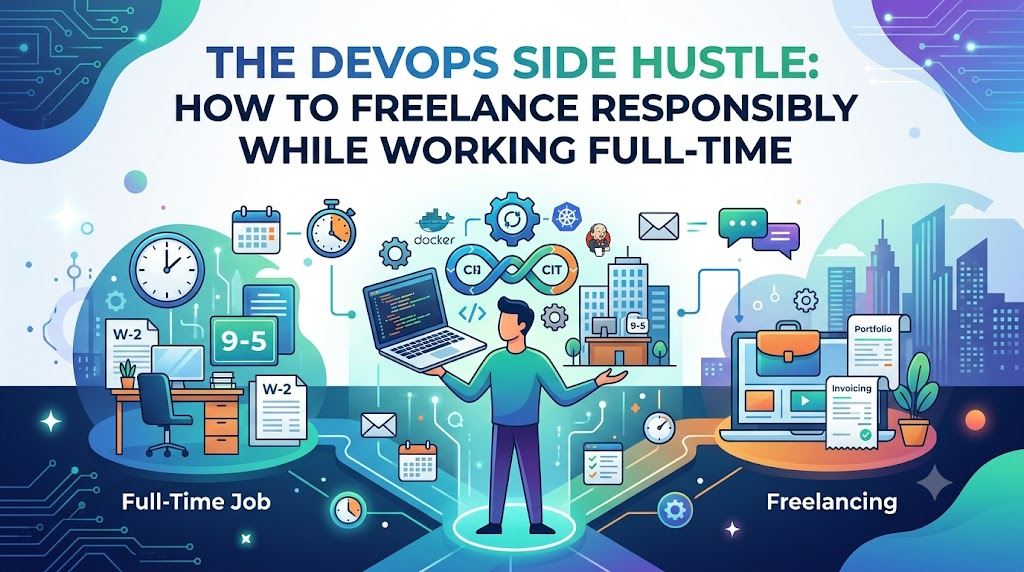
Balancing a full-time career with outside consulting has become an appealing path for many engineers. Cloud practitioners, system administrators, and site reliability engineers often seek freelance engagements to test new tools, diversify their income, and take ownership of end-to-end architectures.
However, learning how to balance DevOps freelancing with a full-time job comes with distinct operational hurdles. DevOps is rarely a predictable 9-to-5 discipline. A standard full-time role often demands incident response, release coordination, infrastructure migrations, and periodic on-call rotations. Meanwhile, freelance clients expect prompt delivery, robust automation, and proactive troubleshooting.
Attempting to run a DevOps side hustle without structured boundaries can quickly lead to split attention, strained client relationships, security risks, or professional burnout. Managing both commitments simultaneously is viable under the right circumstances, but it demands strict project selection, proactive communication, deliberate time management, and a clear understanding of your employer’s policies.
Why DevOps Professionals Choose Freelancing
DevOps engineers operate at the intersection of development, infrastructure, quality assurance, and security. Because this skillset remains in demand across companies of all sizes, independent consulting offers several compelling advantages alongside clear trade-offs.
Key Motivations
- Exposure to Diverse Toolchains: Full-time roles often center on a static stack—such as a legacy Jenkins installation or a specific cloud provider. Freelancing allows engineers to gain hands-on experience with alternative ecosystems like GitHub Actions, GitLab CI/CD, Terraform, ArgoCD, AWS, Azure, or Google Cloud.
- Accelerated Professional Growth: Delivering end-to-end solutions independently builds broader architectural confidence than working on a small slice of an enterprise platform.
- Income Diversification: Taking on part-time DevOps projects provides supplementary revenue and cushions against market fluctuations.
- Consulting and Communication Skills: Direct client work teaches project scoping, commercial negotiation, stakeholder management, and requirement gathering.
- Testing Independent Consulting: Freelancing while employed lets you test the market and refine your workflows before deciding whether to pursue full-time independent consulting.
The Realities and Trade-offs
Freelance engagements are not passive income streams. They introduce administrative responsibilities, irregular invoicing, client management, and less personal downtime. Balancing outside work requires giving up leisure hours and exercising continuous self-discipline. Understanding these realities upfront prevents taking on commitments that undermine your primary career or personal well-being.
Check Your Employment Contract and Company Policies First
Before looking for freelance clients, review your current employment agreement, employee handbook, and company policies. Operating transparently within contractual boundaries protects your reputation and legal standing.
Key Clauses to Review
- Moonlighting and Secondary Employment: Some organizations strictly prohibit outside employment, while others permit it with prior written disclosure or management approval.
- Conflict of Interest: Engaging with direct competitors of your employer, or servicing clients within the same market vertical, often constitutes a conflict of interest.
- Confidentiality and Non-Disclosure Agreements (NDAs): You are legally obligated to protect your employer’s proprietary code, operational designs, internal data, and business strategies.
- Intellectual Property (IP) Assignment: Many employment contracts state that software, automations, or technical designs created during your employment—or using employer resources—belong to the employer.
- Non-Solicitation Provisions: Contracts often bar employees from soliciting their employer’s clients, vendors, or colleagues for private business ventures.
- Working Hours and Availability: You cannot perform freelance tasks or communicate with private clients during hours for which your employer pays you.
Strict Resource Isolation
Never use an employer-issued laptop, company software licenses, corporate cloud accounts, internal code repositories, or communication channels (such as company Slack or Teams) for freelance work. Maintain completely separate hardware, personal email addresses, cloud tenancies, and version control accounts for all independent consulting.
Note: Employment laws, non-compete enforceability, and intellectual property statutes vary significantly across countries, states, and individual contracts. If any term in your agreement is ambiguous, consult a qualified legal professional before accepting outside work.
Choose Freelance Projects That Fit Your Available Time
Project selection is the single most critical factor in running a sustainable remote DevOps freelancing practice. Taking on the wrong project can destabilize both your primary job and your freelance standing.
       UNSUITABLE FOR PART-TIME                   SUITABLE FOR PART-TIME
┌──────────────────────────────────────┐  ┌──────────────────────────────────────┐
│ • 24/7 on-call rotations             │  │ • Asynchronous CI/CD pipeline builds│
│ • Real-time production firefighting  │  │ • IaC templates & code reviews       │
│ • Mid-day scheduled deployments      │  │ • Observability & dashboard setups   │
│ • Vague, open-ended scopes           │  │ • Containerization & migrations      │
└──────────────────────────────────────┘  └──────────────────────────────────────┘
Well-Suited Projects for Part-Time Freelancing
Choose projects with defined deliverables, asynchronous workflows, and minimal real-time operational dependencies:
- CI/CD Pipeline Construction: Migrating builds from legacy systems to modern platforms (e.g., Jenkins to GitHub Actions or GitLab CI) with offline testing.
- Infrastructure as Code (IaC) Development: Writing modular Terraform or OpenTofu code, creating Ansible playbooks, or performing static analysis on existing codebases.
- Containerization Support: Writing and optimizing Dockerfiles, configuring multi-stage builds, or packaging applications for container registries.
- Monitoring and Observability Setups: Configuring Prometheus exporters, Grafana dashboards, or log aggregation pipelines against development environments.
- Architecture Reviews and Audits: Evaluating security configurations, cloud cost optimization opportunities, or backup policies.
- Documentation and Runbooks: Authoring technical runbooks, disaster recovery steps, and onboarding guides.
Projects to Avoid While Employed Full-Time
- Primary On-Call / SRE Duties: Agreeing to handle live infrastructure incidents during regular business hours creates immediate conflicts with your day job.
- High-Touch Production Deployments: Projects requiring deployments during standard weekday business hours.
- Unclear, Open-Ended Scopes: Clients who cannot define acceptance criteria often demand endless revisions and unscheduled meetings.
Project Evaluation Checklist
Before sending a proposal or signing a statement of work, evaluate the project against these criteria:
- Scope Clarity: Is the final deliverable documented with measurable acceptance criteria?
- Schedule Feasibility: Does the delivery date account for your primary job’s workload and personal commitments?
- Operational Demands: Does this engagement require real-time support, mid-day meetings, or SLA-backed incident response?
- Access Requirements: Can the client provide dedicated access, credentials, and isolated testing environments?
- Technical Complexity: Does the project align with your existing core competencies, or will it require unbilled research time?
- Commercial Agreement: Are payment milestones, review cycles, and invoicing terms clearly agreed upon in writing?
Build a Realistic Weekly Schedule
A sustainable DevOps time management strategy requires treating your time as a finite operational resource. High-performing engineers often cap their freelance commitments at 8 to 15 hours per week. Exceeding this limit consistently risks performance degradation in your full-time job and increases the chance of burnout.
Sample Weekly Schedule (Illustrative Example)
The following schedule illustrates how an engineer might distribute 8 to 10 hours of freelance work across a standard week without sacrificing sleep or personal recovery:
| Day | Planned Activity | Time Allocation | Focus Area |
| Monday | Project review & triage | 30 minutes | Review pull requests, check issues, plan weekly priorities. |
| Tuesday | Deep technical block | 1.5 – 2 hours | Focused IaC development, pipeline scripts, or automation. |
| Wednesday | Complete rest | 0 hours | Dedicated family time, exercise, and recovery (no freelance work). |
| Thursday | Deep technical block | 1.5 – 2 hours | Testing configurations, staging deployments, writing unit tests. |
| Friday | Administrative wrap-up | 30 – 60 minutes | Client status update, deliverable review, invoicing. |
| Saturday | Core delivery block | 2 – 3 hours | Complex architecture setup, refactoring, or documentation. |
| Sunday | Personal rest & planning | 15 – 30 minutes | Light review of the upcoming week’s calendar; recharge. |
This timetable is an illustrative template. Always adjust your hours based on your personal energy levels, family responsibilities, and the varying intensity of your full-time role.
Use Time Management Techniques That Work
To balance dual commitments, you must run your freelance work with the same operational rigor applied to enterprise engineering environments.
1. Time Blocking
Carve out dedicated calendar blocks for specific activities. Guard your deep-work windows against casual distractions. Treat an evening freelance development block with the same discipline as an internal engineering meeting.
2. Task Prioritization
Differentiate between urgent operational tasks and important long-term deliverables using an Eisenhower-style framework:
- Full-Time Urgent/Important: Incidents and primary job deliverables always take precedence.
- Freelance Important/Non-Urgent: Writing clean Terraform modules, documenting changes, setting up pipelines.
- Low-Value Distractions: Frequent email checks, unscheduled phone calls, or tweaking scripts without clear requirements.
3. Breaking Work into Small Deliverables
Deconstruct large projects into incremental milestones:
- Discovery & Access: Validate repository permissions and cloud sandbox credentials.
- Draft Configuration: Write core templates or pipeline configurations.
- Staging Validation: Test runs in an isolated staging or non-production environment.
- Documentation & Handover: Provide runbooks and transfer operational ownership.
4. Limiting Context Switching
Context switching incurs a heavy cognitive cost. Avoid checking freelance communications during your full-time workday. Designate two fixed touchpoints—such as 8:00 AM and 6:30 PM—to handle freelance client emails and tickets.
5. Weekly Retrospective and Planning
Every Sunday, review your upcoming week across both workloads. If your full-time employer has a scheduled production release or an on-call rotation coming up, scale back freelance commitments accordingly.
Set Clear Expectations With Freelance Clients
Misunderstandings arise when clients assume you are available throughout standard working hours. Honest, proactive communication establishes healthy boundaries from day one.
Establishing the Ground Rules
- Asynchronous Communication: Clarify that you work primarily on an asynchronous schedule and respond to messages within a defined window (e.g., within 12 to 24 hours).
- Meeting Windows: Schedule client check-ins during early mornings, evenings, or lunch breaks (if your employer’s policies allow personal appointments during breaks).
- Delivery Buffers: Always add a 25–30% time buffer to your project estimates to accommodate unexpected production incidents at your day job.
- Out-of-Scope Requests: Require written change orders for any requests not specified in the original agreement.
Professional Script: Communicating Availability
When onboarding a new client, communicate your operating model clearly and professionally:
“Thank you for outlining the project goals. To ensure focused delivery, I run my engineering consulting on an asynchronous schedule. My core build, testing, and implementation windows are during dedicated morning and evening blocks, alongside Saturday mornings.
I monitor our shared communication channel daily and reply to all updates within 24 business hours. If we need a synchronous discussion, we can schedule a brief call between 7:30 AM – 8:30 AM or after 6:00 PM EST. This approach lets me dedicate uninterrupted focus to building stable, thoroughly tested automation for your platform.”
Automate and Standardize Your DevOps Workflow
As an independent freelance DevOps engineer, automation is essential to keeping overhead low. Standardizing your approach across engagements saves hours of repetitive manual effort.
- Modular Infrastructure as Code: Maintain a library of generic, tested Terraform/OpenTofu templates for common patterns: VPC topologies, secure S3 buckets, Kubernetes node groups, or IAM least-privilege roles.
- Reusable Pipeline Scaffolding: Build standard baseline workflows for GitHub Actions, GitLab CI, or Jenkins that include linting, security scanning (e.g., Trivy, Checkov), testing, and packaging stages.
- Configuration Baselines: Use standard Ansible playbooks or cloud-init scripts for baseline server hardening, logging agents, and access management.
- Documentation Boilerplates: Maintain standardized architecture decision records (ADRs), environment runbooks, and handover checklists to complete deliverables quickly.
Automations require active maintenance, testing, and continuous security patching. Never copy proprietary templates or internal scripts from your employer into client environments.
Protect Security, Confidentiality, and Client Data
DevOps engineers frequently handle administrative privileges, cloud credentials, and sensitive configurations. Strict security hygiene is mandatory.
┌────────────────────────────────┐       ┌────────────────────────────────┐
│      FULL-TIME EMPLOYMENT      │       │      FREELANCE ENGAGEMENTS     │
├────────────────────────────────┤       ├────────────────────────────────┤
│ • Employer-issued laptop       │       │ • Personal, encrypted machine  │
│ • Corporate SSO / Cloud IAM    │  ≠≠≠  │ • Client-specific IAM accounts │
│ • Company Git repositories     │       │ • Isolated GitHub/GitLab orgs  │
│ • Internal credentials & code  │       │ • Client secrets managers      │
└────────────────────────────────┘       └────────────────────────────────┘
                 STRICT HARDWARE & DATA SEPARATION
Essential Security Practices
- Strict Environment Isolation: Keep separate browser profiles, terminal configurations, SSH keys, and GPG keys for every client and your employer.
- Hardware Separation: Perform freelance tasks exclusively on personal hardware featuring full-disk encryption and up-to-date operating systems.
- Principle of Least Privilege: Request only the minimum IAM roles needed to complete the task. Encourage clients to use role-based access control (RBAC) rather than sharing root or administrator accounts.
- Secrets Management: Never store client access keys, tokens, or private certificates in local plaintext files or personal repositories. Use dedicated secrets managers (such as AWS Secrets Manager, HashiCorp Vault, or encrypted password managers).
- Audit Logs and Change Records: Ensure that all changes applied to client infrastructure are tracked via version control and verifiable audit trails.
- Prompt Access Offboarding: When a contract or milestone concludes, formally ask the client to revoke your access credentials and delete any cached local session tokens.
Avoid Burnout and Protect Your Work-Life Balance
Managing two demanding roles can take a physical and mental toll. When schedules get crowded, rest, exercise, and personal relationships are often the first things sacrificed. Over time, chronic exhaustion degrades performance in both positions.
Warning Signs of Imbalance
- Persistent fatigue and reliance on stimulants to complete standard tasks.
- Declining quality, missed details, or late delivery in your full-time position.
- Dread or anxiety when receiving notifications from freelance clients.
- Difficulty concentrating during daytime architectural discussions.
- Complete loss of personal time, hobbies, and physical activity.
Sustainable Protective Measures
- Enforce Hard Workload Limits: Cap your weekly freelance commitments and decline extra work once you hit that ceiling.
- Schedule Non-Negotiable Rest: Designate at least one full day every week entirely free of screen-based work.
- Pause Client Onboarding: When your primary employer enters critical delivery cycles, freeze new freelance inquiries.
- Evaluate Return on Energy: Periodically ask yourself whether the extra income and technical exposure justify the personal trade-offs. If an engagement causes chronic stress, wind it down professionally.
Manage Money, Payments, and Freelance Administration
Running a freelance practice involves business responsibilities that technical engineers often overlook.
- Gross Revenue vs. Net Income: Freelance revenue is not pure take-home pay. Depending on your tax jurisdiction, you must set aside money for income tax, self-employment tax, social contributions, and business expenses.
- Milestone-Based Billing: For project-based work, structure payments around concrete milestones (e.g., 30% upfront deposit, 40% upon staging verification, 30% upon final sign-off and handover).
- Time Tracking: Track your hours accurately—even on fixed-price projects—to calculate your true effective hourly rate and improve future project estimates.
- Invoicing Software: Use dedicated accounting platforms (e.g., Wave, QuickBooks, FreshBooks) to generate professional invoices, record expenses, and log tax receipts.
- Business Registration: Research local regulations regarding sole proprietorships or limited liability structures (such as an LLC in the US or private limited entities in other regions).
Note: Tax codes, reporting rules, and corporate structures differ across countries and municipalities. Work with a certified accountant or tax professional to ensure full compliance.
Build Skills Without Overloading Your Schedule
To remain competitive as a freelance cloud engineer, you need to continuously refresh your technical toolkit. However, trying to master every emerging framework while working full-time is an easy route to exhaustion. Instead, focus your professional development on targeted, high-impact capabilities:
- Infrastructure as Code & GitOps: Advanced patterns in Terraform, OpenTofu, and tools like ArgoCD or Flux.
- Container Orchestration: Core Kubernetes administrative workflows, Helm packaging, and service mesh fundamentals.
- Cloud Architecture Fundamentals: Mastering core networking, identity management, and security across AWS, Azure, or GCP.
- Observability & Telemetry: Prometheus, Grafana, OpenTelemetry, and structured log management.
- Automated Security (DevSecOps): Static code analysis, container vulnerability scanning, and automated compliance auditing.
Structured Learning and Skill Development
Focus on project-based learning where you build concrete architectures in an isolated personal sandbox. If you prefer structured learning paths to master these disciplines, educational platforms like DevOpsSchool offer targeted courses covering tools such as Docker, Kubernetes, Jenkins, Terraform, and AWS. Structured courses can help shorten the learning curve on complex infrastructure topics, leaving you with more bandwidth to focus on client delivery.
When Should You Decline a Freelance Project?
Knowing when to say “no” protects your professional reputation and your health.
DECISION MATRIX: SHOULD YOU ACCEPT?
┌────────────────────────────────────────────────────────┐
│ 1. Does the deadline fit your available evening/       │
│    weekend hours with buffer?                    ──► NO  ──► DECLINE
│                   │ YES
│ 2. Is the project free of 24/7 on-call requirements? ──► NO  ──► DECLINE
│                   │ YES
│ 3. Are the deliverables clearly defined in writing?  ──► NO  ──► DECLINE
│                   │ YES
│ 4. Is the project fully compliant with your employer's │
│    policies and free of IP conflicts?            ──► NO  ──► DECLINE
│                   │ YES
│                  ACCEPT
└────────────────────────────────────────────────────────┘
Situations Warranting a Polite Rejection
- The client requires real-time support during your daytime job hours.
- The timeline is aggressive and leaves no margin for full-time job fluctuations.
- The client resists signing a clear statement of work or demands free preliminary setup.
- The project involves direct competitors of your full-time employer.
- The client’s systems operate under complex regulatory standards (e.g., strict HIPAA or PCI-DSS requirements) that you cannot thoroughly audit or support part-time.
Professional Script: Declining a Project Gracefully
“Thank you for detailing the project scope and discussing the goals for your infrastructure migration. After reviewing the timeline and real-time operational availability required for this deployment, I have concluded that I cannot take on this engagement without compromising the delivery standards your team deserves.
My current consulting capacity is fully committed to asynchronous architecture and automation projects. If your team has upcoming needs around modular Infrastructure as Code or CI/CD pipeline automation with flexible delivery schedules, I would be happy to reconnect then. I wish you every success with the deployment.”
A Practical 30-Day Plan to Start DevOps Freelancing Responsibly
This structured four-week roadmap helps you establish a freelance practice without destabilizing your existing career:
Week 1: Review and Prepare
- Carefully review your employment contract, intellectual property assignment agreements, and moonlighting policies.
- Audit your weekly schedule honestly to determine your true discretionary time (aim for 6–10 hours max).
- Inventory your technical strengths and identify 2–3 specific, well-defined service offerings.
Week 2: Define Your Freelance Scope
- Define a focused service catalog (e.g., “GitHub Actions CI/CD Pipeline Setup” or “Terraform AWS Baseline Architecture”).
- Create an independent portfolio featuring sanitized, non-confidential code samples in a personal GitHub account.
- Draft standardized client communication templates, service agreements, and payment terms.
Week 3: Prepare Your Workflow
- Configure a dedicated, encrypted personal computer and set up isolated client browser profiles.
- Build reusable, modular Infrastructure as Code and CI/CD templates.
- Set up a simple bookkeeping and time-tracking tool.
Week 4: Start Small and Review
- Evaluate potential opportunities, selecting one small, low-risk, asynchronous project with a flexible delivery date.
- Confirm project scopes, staging environments, access permissions, and written sign-offs before writing code.
- Conduct an end-of-month review to evaluate your stress levels, sleep quality, and full-time job performance before taking on additional work.
Common Mistakes to Avoid
Balancing two roles requires proactive risk management. Avoid these frequent pitfalls:
| Common Mistake | Operational Impact | Corrective Action |
| Accepting Too Many Projects | Overlapping deadlines cause missed milestones and chronic fatigue. | Limit yourself to one active project at a time until your workflow is consistent. |
| Underestimating Overhead | Meetings, emails, debugging, and invoicing consume unbilled hours. | Add a 25–30% buffer to your time estimates and quote based on total project scope. |
| Accepting On-Call Roles | Production incidents interrupt your primary job responsibilities. | Explicitly exclude daytime on-call availability and 24/7 SLAs in your service contract. |
| Using Company Hardware | Creates legal liability and risks intellectual property forfeiture. | Perform all freelance work on personal, separate hardware and accounts. |
| Ignoring Employer Policies | Disregarding moonlighting or conflict rules can result in termination. | Read policies thoroughly and secure formal written approval where required. |
| Mixing Credentials | Risk of applying changes to the wrong infrastructure or leaking client keys. | Use strict directory-level credentials, distinct SSH keys, and isolated browser profiles. |
| Promising Rush Deadlines | Eliminates your safety margin when day-job incidents occur. | Set conservative delivery dates that account for day-job schedule variations. |
| Skipping Runbooks | Clients demand ongoing, unscheduled support to explain how systems work. | Deliver comprehensive, clear documentation and runbooks as part of project sign-off. |
| Sacrificing Sleep | Diminishing cognitive capacity leads to production mistakes in both roles. | Maintain a hard stop for evening work (e.g., shutting down all screens by 10:00 PM). |
| Neglecting Tax Reserves | Unexpected tax liabilities at year-end disrupt personal finances. | Automatically deposit 25–35% of every freelance payment into a dedicated tax account. |
Frequently Asked Questions
1. Can I work as a freelance DevOps engineer while holding a full-time job?
Yes, provided your employment contract and company policies permit outside professional activities. It requires that the work does not create a conflict of interest, use employer resources, or interfere with your full-time duties and performance.
2. How many hours should I spend on DevOps freelancing each week?
A sustainable range for most engineers is between 6 and 12 hours per week. Committing beyond 15 hours regularly increases the risk of fatigue, errors, and burnout.
3. Which DevOps freelance projects are suitable for beginners?
Clearly bounded, asynchronous tasks with minimal operational risk are best. Good options include writing Dockerfiles, setting up basic CI/CD test automation, creating simple Terraform templates, and drafting architecture documentation.
4. How can I find time for freelance work after office hours?
Use time blocking. Dedicate 1 to 2 evening hours a few nights a week or a focused block on weekend mornings. Protect rest days to ensure you maintain consistent energy for your primary job.
5. How should I communicate my availability to freelance clients?
Be direct and transparent from the initial discovery conversation. State that you work asynchronously during morning and evening windows and maintain an agreed response-time SLA (such as within 24 business hours).
6. Can I use my office laptop for freelance DevOps projects?
No. Using company equipment, networks, licenses, or accounts for independent business ventures creates serious legal, contractual, and intellectual property risks. Keep your freelance activities on separate, personal hardware.
7. How can I avoid conflicts of interest with my employer?
Avoid working for direct competitors, clients, or vendors of your employer. Additionally, ensure your freelance projects focus on different business verticals and do not utilize any intellectual property or code patterns developed at your day job.
8. Which DevOps skills are useful for freelancing?
Modular Infrastructure as Code (Terraform/OpenTofu), CI/CD pipeline automation (GitHub Actions, GitLab CI), container management (Docker, Kubernetes), monitoring (Prometheus, Grafana), and strong technical writing are consistently in demand.
9. How can I prevent burnout while freelancing?
Set a strict ceiling on weekly client hours, avoid taking on emergency on-call responsibilities, protect at least one full day each week for rest, and pause client intake when your primary job becomes demanding.
10. How should I price and manage freelance projects?
Fixed-price milestones with clear acceptance criteria are generally preferable to hourly billing for part-time work. They allow you to focus on delivering value without tracking every minute, while reducing client friction over working speed.
11. When should I consider moving from full-time employment to freelancing?
Transitioning to full-time independent consulting makes sense only when you have built a consistent client pipeline, developed reliable administrative systems, and accumulated at least 6 to 12 months of living and operational expenses in reserve.
12. How can DevOps professionals improve their skills while working full-time?
Focus on targeted, project-based exercises in personal cloud sandboxes. If you prefer structured learning to master tools efficiently, training platforms like DevOpsSchool provide courses on core DevOps practices, containerization, and cloud automation.
Conclusion
Learning how to balance DevOps freelancing with a full-time job is ultimately an exercise in disciplined operational management. Successful freelancing does not require working late into every night or sacrificing your health. Instead, it relies on selecting projects with clear scopes, respecting your employment contract, securing client environments, and maintaining realistic delivery schedules. By setting firm boundaries, communicating asynchronously, and focusing on quality automation over billable volume, you can diversify your income and expand your technical expertise without jeopardizing your full-time career. Take an honest look at your current weekly schedule. Define your core technical strengths, review your company policies, and start with a single, well-scoped project to build your freelancing practice on a solid, sustainable foundation.
