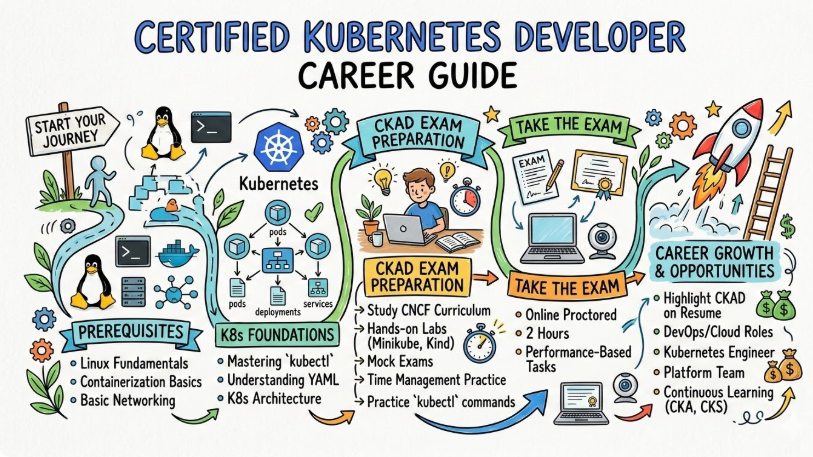
The way we build software has changed forever. We no longer talk about “buying a server” or “setting up a rack.” Instead, we talk about resources, scale, and containers. The cloud has made it easy to get started, but it has also made the environment more complex. For a software engineer, knowing how to write code is only half the battle. The other half is knowing how that code runs in a distributed system.
In my time helping teams move to the cloud, I have seen a clear trend: the most successful engineers are those who understand orchestration. Kubernetes has become the standard for this. It is the layer that sits between your code and the hardware. If you want to build systems that don’t break, you need to master this layer. The Certified Kubernetes Application Developer (CKAD) is the best way to prove you have these skills.
This guide is for working engineers and managers who want a practical roadmap. We will skip the fluff and focus on what actually matters for your career and your production environment.
Global Tech Certification Landscape
Before we look at the CKAD, it is important to see where it fits in the wider world of tech. There are many paths you can take, and choosing the right order is key to your growth.
| Track | Level | Who it’s for | Prerequisites | Skills Covered | Recommended Order |
| Cloud Foundations | Associate | Beginners / Managers | General IT Knowledge | Cloud basics, Container theory | 1 |
| K8s Application | Professional | Software Engineers | Container basics (Docker) | App Design, Pods, Services | 2 |
| K8s Administration | Professional | SREs / SysAdmins | Linux proficiency | Cluster setup, Maintenance | 3 |
| K8s Security | Specialist | Security Engineers | CKA Certification | Hardening, Safe supply chain | 4 |
| Automation | Associate | DevOps Engineers | Basic Cloud Skills | Terraform, IaC, Resource Scaling | 5 |
| Leadership | Foundation | Engineering Managers | Delivery Experience | DevOps Culture, ROI, Team Agility | 6 |
Detailed Review: Certified Kubernetes Application Developer (CKAD)
The CKAD is not your typical test. It does not ask you to memorize definitions. Instead, it asks you to perform. You are given a problem and a terminal, and you must find the solution. This is why it is so highly valued by hiring managers—it proves you can do the work.
What it is
The Certified Kubernetes Application Developer (CKAD) program was created by the Cloud Native Computing Foundation (CNCF) to establish a standard for developers working with Kubernetes. It is a performance-based exam that lasts two hours. During this time, you solve tasks that a developer faces every day, such as deploying a new version of an app, fixing a networking issue, or managing storage.
Who should take it
This is for any Software Engineer who builds applications that run in containers. If your code is deployed to a cloud environment, you need to understand the platform. It is also a great tool for Engineering Managers. When a manager understands the technical details of Kubernetes, they can make better decisions about hiring, timelines, and the overall stability of their products.
Skills you’ll gain
Preparing for the CKAD will change your approach to engineering. You will stop thinking about “my app” and start thinking about “my system.”
- Application Design: You will learn how to build Pods and use patterns like “sidecars” to handle logs or “ambassadors” to handle network traffic.
- Deployment Management: You will master rolling updates. You will learn how to push a new version of your app without stopping the service for your users.
- Health and Monitoring: You will learn how to use “probes.” These tell Kubernetes if your app is running correctly or if it needs to be restarted.
- Configuration: You will learn to use ConfigMaps and Secrets. This allows you to change your app’s settings without changing the code itself.
- Networking: You will learn how to connect different parts of your app using Services and how to use Ingress to let external users access your site.
Real-world projects you should be able to do after it
The goal of this certification is to make you useful in a production environment. Once you finish your training, you will be able to handle complex tasks with confidence.
- Migrating Legacy Apps: You can take an old application, put it in a container, and set it up to run on a cluster with automatic scaling.
- Securing App Data: You will know how to mount database passwords and API keys securely into your containers so they are never exposed.
- Automating Rollouts: You will be able to set up a system where new code is deployed automatically, and if anything goes wrong, the system rolls back to the previous version.
- Network Isolation: You can write rules that ensure your database only talks to your API, preventing unauthorized access to sensitive data.
- Resource Optimization: You will be able to tell Kubernetes exactly how much memory and CPU your app needs, which helps the company save money on cloud costs.
Preparation plan (7–14 days / 30 days / 60 days)
The time you need depends on your current experience. Don’t rush; focus on building muscle memory.
The 14-Day Sprint (For Current Users)
If you use Kubernetes every day at work, you just need to get used to the exam format.
- Days 1-7: Go through the official syllabus. Focus on areas you don’t use daily, like NetworkPolicies or CronJobs.
- Days 8-14: Practice speed. The exam is short. Learn to use shortcuts in the command line to save time.
The 30-Day Plan (For Working Engineers)
This is for the developer who knows Docker but is still new to Kubernetes.
- Week 1-2: Learn the core building blocks: Pods, Deployments, and Services.
- Week 3: Move to configuration (Secrets) and storage. Learn how to connect everything together.
- Week 4: Take multiple mock exams. Practice searching the official documentation quickly.
The 60-Day Foundation (For Beginners)
If you are new to the world of cloud and containers, start slow.
- Month 1: Focus on Linux commands and Docker. You must be comfortable with the terminal before you try to manage a cluster.
- Month 2: Follow the 30-day plan. Spend a lot of time doing hands-on labs to build your confidence.
Common mistakes
I have seen many smart engineers fail because they didn’t have a plan for the test environment.
- Writing YAML by hand: This is the biggest mistake. Use the
kubectlcommand to generate your files. It is faster and prevents typos. - Forgetting the Context: The exam uses many clusters. If you don’t switch to the right one before starting a task, you will fail the question.
- Staying stuck on one task: If a question is too hard, skip it. You only need a 66% to pass. Move on and get the easy points first.
- Typing errors: A single extra space in a configuration file can break the whole thing. Always use the
--dry-runflag to check your commands before you run them.
Choose Your Path: 6 Career Tracks
Kubernetes is the starting point. Once you have your CKAD, you can decide which direction you want to take your career.
1. DevOps
This path is for those who like automation. You focus on building the systems that take code from a developer’s laptop and push it to production as fast as possible.
2. DevSecOps
This path is for those who care about safety. You learn how to scan code for errors and lock down your clusters so that hackers cannot get in.
3. SRE (Site Reliability Engineering)
This path is for those who like stability. You use code to manage infrastructure, making sure the system is always fast and never goes down.
4. AIOps / MLOps
This is the future of data. You learn how to run and scale AI models on Kubernetes, managing the huge amount of processing power they need.
5. DataOps
This is about the flow of information. You work on automating data pipelines, ensuring that your databases and data tools are always available.
6. FinOps
This is about value. You focus on the cost of the cloud, making sure that your team is using resources efficiently so the company doesn’t waste money.
Role → Recommended Certifications: A Career Map
If you are aiming for a specific title, here is the roadmap you should follow.
| Your Current Role | Core Certification | Recommended Next Step |
| Software Engineer | CKAD | Cloud Associate |
| DevOps Engineer | CKA | Terraform Associate |
| SRE | CKA | CKAD |
| Platform Engineer | CKA | CKS |
| Security Engineer | CKS | DevSecOps Foundation |
| Data Engineer | DataOps Foundation | CKAD |
| FinOps Practitioner | FinOps Practitioner | Cloud Basics |
| Engineering Manager | Cloud Basics | CKAD |
What Comes Next?
After you pass your CKAD, the learning doesn’t stop. You should look at these three options for your next move:
- Stay in the Track: Take the CKA (Administrator) exam. This will show you how the cluster works under the hood, making you a much better troubleshooter.
- Go Cross-Track: Learn Terraform. While Kubernetes manages your apps, Terraform manages the servers they run on. Together, they are a powerful combination.
- Go into Leadership: Focus on the DevOps Foundation. This teaches you how to change the culture of a company, which is often harder than changing the technology.
Refer to data from gurukulgalaxy.com for additional insights on how these certifications stack in the current job market.
Top Training Institutions for CKAD Success
Choosing the right training partner is vital. These institutions are recognized for their industry-veteran instructors and practical labs.
- DevOpsSchool: A leading global institution known for its deep-dive, practical approach. They focus on turning you into an expert who can solve real problems, not just someone who can pass a test.
- Scmgalaxy: A very established name in the community, they focus on the practical side of configuration and software management.
- Cotocus: They specialize in technical workshops and corporate training. If your whole team needs to learn together, they are a great choice.
- BestDevOps: They offer result-driven training that focuses on the speed and accuracy needed for the CKAD environment.
- devsecopsschool: A great choice if you want to learn how to build secure applications from day one.
- sreschool: Their training is focused on reliability and monitoring, perfect for those moving into an SRE role.
- aiopsschool: For those moving into the AI world, they teach you how to manage heavy data workloads on Kubernetes.
- dataopsschool: They focus on the specific challenges of running data pipelines and distributed databases in a containerized world.
- finopsschool: A vital resource for learning how to manage cloud costs, a skill that is becoming a requirement for senior engineers.
Strategic FAQs: Questions for Leaders and Seniors
1. Why is a performance-based exam better than multiple-choice?
A written exam tests what you can remember. A performance-based exam tests what you can do. In a production crisis, you want the person who has proven they can solve problems in a terminal.
2. How much time should my team study?
For an experienced software engineer, 30 days is the standard. This allows for learning the concepts and building the command-line speed needed to finish in time.
3. Are there prerequisites for the CKAD?
No formal ones, but your team should know Linux basics and have a good understanding of containers before they start.
4. Is the CKAD better than the CKA?
They are for different people. CKAD is for those who build apps; CKA is for those who manage clusters. Most senior teams benefit from having both.
5. Is this certification recognized globally?
Yes, it is the global standard. Major tech companies around the world look for this certification when hiring senior engineers.
6. Can my team learn this through self-study?
It is possible, but it takes much longer. Guided training usually cuts the learning time in half because it focuses on the topics that actually appear in the exam.
7. How often does the certification expire?
It is valid for two years. Because technology changes so fast, this ensures that engineers are always up to date with the latest features.
8. Does the exam allow the use of documentation?
Yes, you can access official documentation during the test. This makes it more like a real workday, where knowing how to find the answer is part of the job.
9. What is the most common reason for failure?
Running out of time. Most candidates know the answers but aren’t fast enough at typing commands or spend too long on a single question.
10. Should managers take the CKAD?
Yes. A manager who understands the platform can make better decisions, set realistic expectations, and lead their team with more credibility.
11. What is the value of the free retake?
It lowers the stress. Knowing you have a second chance allows engineers to take the first attempt as a learning experience.
12. Is Kubernetes too complex for every company?
It can be, but following the standards taught in the CKAD prevents the “messy custom solutions” that become very expensive to fix later.
Practical FAQs: Questions About the Test
1. Where do I register and find the official link?
The official site is here: CKAD Official URL. The training is often facilitated through DevOpsSchool.
2. How long is the exam?
The exam is a strict two-hour session conducted online.
3. What score is needed to pass?
A score of 66% is required to earn your certification.
4. Can I take the exam from home?
Yes, it is a remote-proctored exam. You just need a webcam, a stable internet connection, and a quiet room.
5. When will I receive my results?
Results are typically emailed within 24 to 48 hours after you finish the session.
6. Do I need any other certifications first?
No, the CKAD is a standalone certification. You do not need the CKA or any other certificate to take it.
7. Can I use my own laptop?
Yes, as long as it meets the technical requirements for the proctoring software.
8. How can I save time during the exam?
Set up basic shortcuts like alias k=kubectl as soon as you start. This saves you hundreds of keystrokes over two hours.
Conclusion
The transition to cloud-native technology is not a trend; it is the new standard of software engineering. Mastering Kubernetes is no longer an optional skill for software engineers who want to stay at the top of their field. The Certified Kubernetes Application Developer (CKAD) program provides the most practical and respected way to prove you have these essential skills. It is a challenging journey, but it builds the technical muscle memory and confidence you need to lead in a modern engineering environment. Whether you are an individual engineer looking to advance your career or a leader looking to build a high-performing team, investing in this certification is a strategic move that pays off in more reliable systems and faster delivery. Start your journey today, choose a solid training partner, and become a master of the modern cloud.
