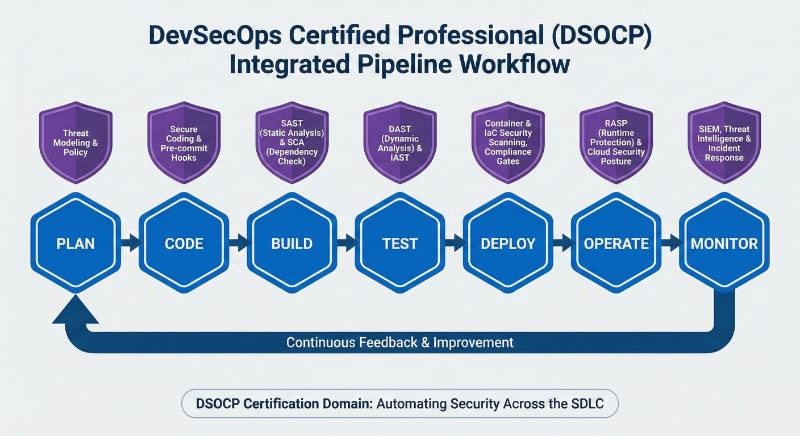
In today’s fast-paced software world, speed is everything—but speed without security is a disaster waiting to happen. The traditional approach of “building first and securing later” is obsolete. Modern organizations need professionals who can embed security directly into the development pipeline, ensuring that every release is both rapid and robust. This has given rise to the DevSecOps Certified Professional (DSOCP), a certification designed to validate your expertise in integrating security practices into DevOps workflows. whether you are a developer looking to secure your code or an operations engineer aiming to automate compliance, this guide creates a clear path for you to master the tools and strategies that top companies are hiring for right now.
Certification Overview: DevSecOps Certified Professional (DSOCP)
This table gives you a quick snapshot of the certification.
| Feature | Details |
| Certification Name | DevSecOps Certified Professional (DSOCP) |
| Track | Security & Automation |
| Level | Professional / Intermediate to Advanced |
| Who is it for? | DevOps Engineers, SREs, Security Professionals, Software Engineers, Cloud Engineers |
| Prerequisites | Basic knowledge of Linux, Git, and fundamental DevOps concepts (CI/CD) |
| Skills Covered | DevSecOps Architecture, SAST/DAST, Container Security, Compliance as Code, Cloud Security |
| Recommended Order | Take this after a fundamental DevOps certification |
Deep Dive: DevSecOps Certified Professional Online Training
What is it?
The DevSecOps Certified Professional (DSOCP) is a hands-on training and certification program designed to bridge the gap between DevOps and Security. It doesn’t just teach you theory; it focuses on the practical implementation of security checks within a CI/CD pipeline. You will learn how to embed security at every stage of the software development lifecycle (SDLC), from planning to monitoring.
Who should take it?
- DevOps Engineers who need to integrate security into their pipelines.
- Security Engineers who want to understand automation and modern CI/CD tools.
- Developers who want to write secure code and understand vulnerabilities.
- QA Engineers moving into security testing.
Skills you’ll gain
- Automated Security Testing: Implementing SAST (Static Application Security Testing) and DAST (Dynamic Application Security Testing).
- Container Security: Securing Docker images and Kubernetes clusters.
- Infrastructure as Code (IaC) Security: Scanning Terraform and Ansible scripts for vulnerabilities.
- Compliance Automation: Automating checks for standards like GDPR, HIPAA, or CIS benchmarks.
- Vulnerability Management: Using tools like SonarQube, Trivy, and OWASP ZAP effectively.
- Secret Management: managing passwords and keys securely using Vault.
Real-world projects you should be able to do after it
- Build a fully automated CI/CD pipeline with integrated security gates (Jenkins/GitLab CI).
- Deploy a secure Kubernetes cluster with runtime security monitoring.
- Perform automated vulnerability scanning on a live web application.
- Audit and secure AWS/Azure cloud infrastructure using automated tools.
Preparation Plan
The 7–14 Day “Intensive” Plan (For experienced DevOps folks)
- Focus: Gap analysis. Skim areas you know (like basic CI/CD) and deep dive into the security tooling integrations.
- Daily: dedicated 3–4 hours to hands-on labs.
The 30-Day “Working Professional” Plan (Recommended)
- Focus: Steady progression. Week 1: Concepts and Culture. Week 2: SAST/DAST integration. Week 3: Container & Cloud Security. Week 4: Final projects and review.
- Daily: 1–2 hours of study after work or early morning.
The 60-Day “Thorough” Plan (For those newer to DevOps)
- Focus: Mastering the basics first. Ensure you fully grasp standard DevOps tools before trying to secure them. Spend extra time on the foundational labs.
- Schedule: 3–4 sessions per week, 2 hours each.
Common mistakes
- Focusing only on tools: Tools change; the mindset of “Security as Code” is what matters.
- Ignoring culture: DevSecOps is 50% culture. Don’t forget the human aspect of collaboration.
- Skipping the basics: Don’t rush into scanning if you don’t understand how the CI/CD pipeline works first.
Best next certification after this
- Certified SRE Professional: To master reliability alongside security.
- Certified Kubernetes Security Specialist (CKS): For a deep dive into K8s security.
Choose Your Path
The IT world is vast. Here are 6 distinct learning paths you can choose from.
- DevOps Path: Focuses on speed, automation, and culture.
- Goal: Bridge the gap between Dev and Ops.
- DevSecOps Path: Focuses on integrating security into DevOps.
- Goal: “Shift Left” on security to catch issues early.
- SRE (Site Reliability Engineering) Path: Focuses on reliability, scalability, and uptime.
- Goal: Treat operations as a software problem.
- AIOps / MLOps Path: Focuses on AI for IT operations or Ops for Machine Learning.
- Goal: Automate complex decisions and manage ML lifecycles.
- DataOps Path: Focuses on the flow of data.
- Goal: Reduce the cycle time of data analytics.
- FinOps Path: Focuses on cloud financial management.
- Goal: Get maximum business value for every dollar spent on cloud.
Role → Recommended Certifications
Use this map to decide which certification fits your current or desired job role.
| Role | Recommended Certifications |
| DevOps Engineer | Certified DevOps Engineer (CDE), Certified Kubernetes Administrator (CKA) |
| SRE | Certified Site Reliability Engineer (CSRE), Certified Chaos Engineering Professional |
| Platform Engineer | Certified DevOps Architect (CDA), Certified Kubernetes Application Developer (CKAD) |
| Cloud Engineer | AWS Certified Solutions Architect, Google Cloud Professional Architect |
| Security Engineer | DevSecOps Certified Professional (DSOCP), Certified Kubernetes Security Specialist (CKS) |
| Data Engineer | Certified DataOps Engineer (CDOE), Certified DataOps Architect (CDOA) |
| FinOps Practitioner | Certified FinOps Engineer, Certified FinOps Architect |
| Engineering Manager | Certified DevOps Manager (CDM), Certified SRE Manager |
Top Institutions for Training & Certification
These institutions provide training and support for the DevSecOps Certified Professional (DSOCP).
One of the oldest and most popular providers for DevOps and Cloud training. They offer comprehensive, hands-on courses with a focus on real-world projects and community support. Their “Masters” programs are particularly well-regarded for depth.
Cotocus
Known for their corporate training and consulting services. They provide specialized training modules that are tailored to industry requirements, making them a good choice for professionals looking to upskill quickly.
Scmgalaxy
A community-driven platform that offers extensive resources, tutorials, and training. They are excellent for foundational knowledge and have a strong focus on Source Code Management (SCM) and build tools.
BestDevOps
Focuses on curating the best DevOps practices and tools. Their training programs are designed to be concise and effective, often targeting specific toolsets or certifications for quick career advancement.
devsecopsschool
A niche provider dedicated entirely to DevSecOps. If your sole focus is security within the pipeline, their specialized curriculum covers advanced security automation topics in great detail.
sreschool
Dedicated to Site Reliability Engineering. They offer focused training on observability, reliability, and incident management, which are crucial for SRE roles.
aiopsschool
Focuses on the emerging field of Artificial Intelligence for IT Operations. Their courses cover how to use AI/ML to automate IT processes and improve system performance.
dataopsschool
Provides training specifically for Data Operations. They teach you how to apply DevOps principles to data pipelines, ensuring data quality and speed of delivery.
finopsschool
Specializes in Cloud Financial Management. Their courses help you understand cloud costs and how to optimize them, a critical skill for modern cloud engineers and managers.
Frequently Asked Questions (General)
1. Is DevSecOps difficult to learn?
It requires effort, but it is not impossible. If you have a background in Linux or basic scripting, you will find it easier. The key is consistent practice.
2. How much time does it take to get certified?
Typically, it takes 4 to 8 weeks of dedicated study, depending on your prior experience.
3. Do I need to know coding?
You don’t need to be a developer, but you must be comfortable with reading code and writing scripts (Bash, Python, YAML).
4. Is this certification recognized globally?
Yes, the skills you gain (Jenkins, Docker, Kubernetes Security) are the global standard for DevSecOps roles.
5. What is the salary impact?
DevSecOps professionals often earn 20-30% more than traditional DevOps engineers due to the specialized security skillset.
6. Can a fresher take this course?
It is recommended to have some IT foundation first. A “Certified DevOps Engineer” course might be a better starting point for absolute beginners.
7. What are the prerequisites?
Basic understanding of the Linux command line, Git, and general cloud concepts (AWS/Azure).
8. How does this differ from a regular DevOps certification?
DevOps focuses on speed and deployment. DevSecOps focuses on securing that speed. This course adds the “Security” layer to the standard DevOps pipeline.
9. Will I get hands-on experience?
Yes, the best training programs, especially the DSOCP, are heavily focused on labs and projects.
10. Do I need a degree?
No. In this field, skills and certifications often carry more weight than a formal university degree.
11. Is it better to take an online or classroom course?
Online is flexible and great for working professionals. Classroom offers more direct interaction. Choose what fits your schedule.
12. What happens if I fail the exam?
Most providers offer a retake option or allow you to review the materials and try again after a cooling-off period.
FAQs: DevSecOps Certified Professional (DSOCP)
1. What tools are covered in the DSOCP?
The course typically covers tools like SonarQube, OWASP ZAP, Trivy, Clair, Falco, HashiCorp Vault, and various cloud-native security tools.
2. Is the exam multiple-choice or practical?
The DSOCP emphasizes practical knowledge, so expect scenario-based questions that test your ability to apply concepts, not just memorize definitions.
3. Does this certification expire?
Most technical certifications are valid for 2-3 years, after which you may need to renew or take a more advanced level to stay current with new tools.
4. Can I take this training on weekends?
Yes, many providers like DevOpsSchool offer weekend batches specifically designed for working professionals.
5. Is job assistance provided?
Top institutes often provide interview preparation, resume reviews, and job leads, though a job guarantee is rare.
6. Do I need my own cloud account?
Yes, having a free-tier AWS or Azure account is highly recommended for practicing the cloud security labs.
7. What is the passing score?
This varies, but typically you need to score around 65-70% to pass the certification exam.
8. How do I verify my certification?
Upon passing, you will receive a digital badge and a unique certificate ID that employers can verify on the provider’s website.
Next Certifications to Take
Once you have conquered the DSOCP, here are your best next moves:
- Same Track (Expert): Certified DevSecOps Architect. Deepen your knowledge in designing secure systems at scale.
- Cross-Track (Broaden Skills): Certified MLOps Manager. Move into the world of AI/ML operations to diversify your profile.
- Leadership (Management): Certified DevOps Manager (CDM). Perfect if you want to move from a technical role to leading a team.
Conclusion
The DevSecOps Certified Professional (DSOCP) is more than just a credential; it is a strategic career move that positions you at the intersection of development, operations, and security. As cyber threats become more sophisticated, the demand for professionals who can build secure, automated pipelines will only continue to grow. By earning this certification, you aren’t just learning tools—you are proving that you can deliver value faster and safer than the competition. Don’t let the industry evolve without you. Start your journey today, master the art of DevSecOps, and become the security champion your organization needs to thrive in the digital age.
