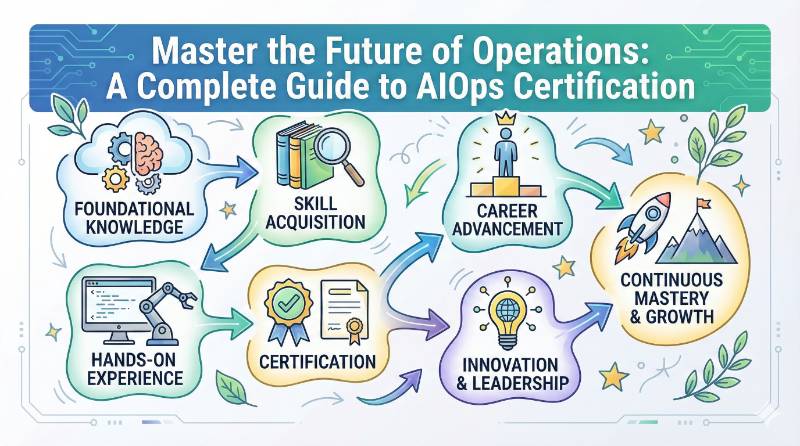
The field of IT operations has reached a point where human effort alone is no longer enough to manage the massive scale of modern systems. As someone who has watched the industry shift from physical hardware to complex cloud-native environments, it is clear that Artificial Intelligence is the only way to maintain stability. AIOps (Artificial Intelligence for IT Operations) represents this critical evolution, combining big data and machine learning to automate and enhance how we handle infrastructure.
For software engineers, SREs, and IT managers, understanding AIOps is no longer optional. It is the bridge to the next stage of your career. This guide is designed to help you navigate the AIOps Certification Training Course and understand the broader certification landscape that is currently shaping the global tech market.
The Landscape of AIOps Certifications
Understanding which certification fits your career level is the first step toward mastery. The table below outlines the primary tracks available for engineers and leaders looking to specialize in intelligent operations.
AIOps Certification Master Table
| Track | Level | Who it’s for | Prerequisites | Skills Covered | Recommended Order |
| Foundational AIOps | Beginner | Junior Engineers, Managers | Basic IT & Cloud knowledge | ML Basics, Alerting, Monitoring | 1 |
| Professional AIOps | Intermediate | SREs, DevOps Engineers | 2+ years in Ops | Anomaly Detection, Event Correlation | 2 |
| MLOps & Integration | Advanced | Data Engineers, SREs | Python & DevOps skills | Model Lifecycle, CI/CD for ML | 3 |
| AIOps Strategy | Expert | Engineering Managers, CTOs | 5+ years Leadership | ROI, Governance, Ethics, Roadmap | 4 |
Deep Dive: AIOps Certification Training Course | AIOps
The AIOps Certified Professional (AIOCP) is the benchmark certification for professionals who want to lead the transformation from manual to automated operations.
What it is
The AIOps Certification Training Course is a technical program that teaches you how to implement AI and Machine Learning models within your IT infrastructure. It focuses on turning raw system data into actionable intelligence, allowing systems to predict and fix issues before they impact the end-user.
Who should take it
- DevOps Professionals who want to build smarter automation pipelines.
- Site Reliability Engineers (SREs) aiming to eliminate manual toil through predictive analytics.
- Software Engineers who want to understand how their applications behave in production at scale.
- Engineering Managers who need to oversee the deployment of intelligent monitoring tools across their organization.
Skills you’ll gain
- Advanced Log Analytics: Learning to extract patterns from millions of log lines using machine learning.
- Intelligent Alerting: Designing systems that suppress “noise” and only notify humans of genuine incidents.
- Predictive Maintenance: Using time-series data to forecast when a resource (like a database or server) will likely fail.
- Root Cause Analysis (RCA): Utilizing AI to automatically map dependencies and find the source of an outage.
- Self-Remediation: Writing scripts that automatically take corrective action based on AI-detected anomalies.
Real-world projects you should be able to do
- Automated Incident Manager: Build a system that identifies related alerts across different services and groups them into a single incident.
- Traffic Pattern Predictor: Develop a model that predicts holiday traffic surges and scales infrastructure preemptively.
- Security Anomaly Detector: Create a tool that flags unusual user behavior or network traffic as a potential breach.
Preparation Plan
- 14-Day Sprint: Focus on the core vocabulary of AIOps and the basic math behind machine learning (regression and clustering).
- 30-Day Path: Spend time in the lab. Use tools like Prometheus and ELK stack to ingest data and run basic Python scripts to analyze it.
- 60-Day Deep Dive: Implement a full project where you build a “self-healing” loop for a microservice environment.
Common Mistakes
- Ignoring Data Quality: Attempting to run AI on unorganized or “dirty” data will lead to false positives.
- Tool-First Mentality: Choosing a tool before understanding the operational problem you are trying to solve.
- Skipping the Basics: Trying to master AIOps without a strong foundation in Linux, Docker, or Python.
Best next certification after this
- MLOps Certified Professional: This is the natural progression, focusing on the deployment and management of the machine learning models themselves.
Choose Your Path: 6 Specialized Learning Paths
AIOps is a versatile discipline. Depending on your interest, you can follow one of these six career trajectories:
- The DevOps Path: Integrating AI into the software delivery lifecycle. This path focuses on predicting build failures and optimizing deployment frequencies.
- The DevSecOps Path: Using AI for proactive security. This involves automating threat detection and identifying vulnerabilities in code using machine learning.
- The SRE Path: The gold standard for reliability. Here, AIOps is used to maintain Service Level Objectives (SLOs) and minimize the “Mean Time To Repair” (MTTR).
- The AIOps/MLOps Path: A specialized role focused on the intersection of data science and infrastructure. You will manage the pipelines that power the AI models.
- The DataOps Path: Focuses on the “health” of the data. You ensure that the data fed into AIOps systems is accurate, timely, and secure.
- The FinOps Path: Using AI to control cloud costs. This involves predicting spending spikes and automatically identifying underutilized resources to save money.
Role → Recommended Certifications Mapping
To help you plan your career, here is a mapping of current job roles to the certifications that will provide the most value:
| Current Role | Primary Recommendation | Secondary Growth Path |
| DevOps Engineer | AIOps Certified Professional | Master in DevOps Engineering |
| SRE | AIOps Foundation | SRE Professional |
| Platform Engineer | AIOps Professional | Certified Kubernetes Administrator |
| Cloud Engineer | AIOps Certified Professional | Cloud Solutions Architect |
| Security Engineer | DevSecOps Certified Professional | AIOps for Security |
| Data Engineer | DataOps Certified Professional | MLOps Specialist |
| FinOps Practitioner | FinOps Certified Professional | AI-Driven Cost Optimization |
| Engineering Manager | Certified DevOps Manager | AIOps Strategy & ROI |
Top Institutions for AIOps Training and Certification
Selecting the right training provider is essential for gaining hands-on skills. The following institutions are recognized for their excellence in the AIOps Certification Training Course | AIOps (CDE):
- DevOpsSchool: This is a top-tier institution known for its deep technical curriculum and expert-led sessions. They provide extensive labs and real-world case studies, making them a preferred choice for engineers in India and abroad. Their training is highly practical and mentor-driven.
- Cotocus: Cotocus specializes in high-end consulting and training for modern IT operations. Their AIOps program is designed for enterprise-level professionals who need to implement complex automation strategies in production environments.
- Scmgalaxy: A popular community hub that offers a wealth of free and paid resources. Their AIOps training is highly regarded for its accessibility and strong community support, making it ideal for self-starters and continuous learners.
- BestDevOps: This provider focuses on career transitions. If you are a traditional systems administrator or developer looking to move into AIOps, their structured and easy-to-follow courses are an excellent starting point.
- DevSecOpsSchool: For those who want to focus exclusively on the security aspects of automation. They offer specialized tracks that show you how to use AIOps to build robust, automated security frameworks.
- Sreschool: Dedicated to the art of reliability. Their courses focus on how AIOps can be used to meet strict availability requirements and manage high-traffic systems without manual intervention.
- AIOpsSchool: A niche institution that focuses solely on the AIOps ecosystem. Their curriculum is highly specialized, covering everything from data science basics to advanced operational AI tools.
- DataOpsSchool: This school focuses on the data lifecycle. They teach you how to build the high-speed data pipelines required to feed modern AIOps engines.
- FinOpsSchool: If you are interested in the financial side of the cloud, this institution provides the best training on using AI to predict, manage, and optimize cloud infrastructure spending.
Next Certifications to Take
After completing your AIOps certification, you should consider expanding your expertise in one of these three directions:
- Same Track (Deep Expertise): MLOps Certified Professional. Learn how to handle model drift, retraining, and the deployment of AI models at scale.
- Cross-Track (Broad Skills): DevSecOps Certified Professional. As AI becomes more central to operations, securing that AI and using it for defense is a highly sought-after skill.
- Leadership (Career Growth): Certified DevOps Manager. If you aspire to lead teams, this certification helps you understand the business value, team dynamics, and strategic implementation of automation.
FAQs about AIOps Certification Training Course
1. Is AIOps a replacement for DevOps? No. AIOps is an enhancement to DevOps. It adds a layer of intelligence to existing DevOps practices like CI/CD and monitoring.
2. What coding languages do I need to know? Python is the most important language for AIOps. However, basic knowledge of Go, Bash, and SQL will also be very helpful.
3. How difficult is the certification exam? It is designed for professionals. It requires a solid grasp of both operational concepts and machine learning foundations.
4. Can I get a job in AIOps without previous Ops experience? It is possible, but difficult. Most AIOps roles require at least a basic understanding of how servers, networks, and applications work.
5. How does AIOps help with “Alert Fatigue”? AIOps uses “Event Correlation” to group hundreds of related alerts into a single incident, so engineers don’t have to sift through noise.
6. Is there a big market for AIOps in India? Yes, the demand for AIOps professionals in India is growing rapidly, especially in the fintech, e-commerce, and IT services sectors.
7. Do I need to learn Big Data for AIOps? You need to understand the concepts of big data—specifically how to ingest and process large volumes of information quickly.
8. What is “Self-Healing” in AIOps? It refers to a system that can detect an error and automatically run a script or a command to fix it without a human being involved.
9. How long is the AIOps certification valid? Most certifications in this field are valid for 2 to 3 years. Keeping up with new tools and techniques is essential for recertification.
10. What tools are most common in AIOps? Common tools include the ELK stack, Splunk, Moogsoft, BigPanda, and open-source options like Prometheus combined with AI plugins.
11. Is this certification suitable for managers? Yes. Managers need to understand the capabilities and limitations of AIOps to make informed decisions about tool investments and team structure.
12. What is the first step to starting? The first step is to get familiar with the basic terminology of machine learning and how it applies to logs and metrics.
FAQs: AIOps Certification Training Course | AIOps
1. What is the passing score for the AIOCP exam? Usually, a score of 70% or higher is required to pass the certification exam.
2. Are there any labs included in the training? Yes, the best programs include hands-on labs where you work with real data sets and AIOps tools.
3. Can I take the exam online? Most providers offer proctored online exams so you can get certified from anywhere in the world.
4. What is the cost of the certification? The cost varies depending on the provider and the level of training (self-paced vs. instructor-led). It is best to check the official links provided.
5. Is there post-training support? Many institutions, like DevOpsSchool, offer community access and job placement assistance after you clear the exam.
6. Does the course cover specific AIOps tools? Yes, the course covers a mix of open-source tools and enterprise platforms to give you a well-rounded skill set.
7. Can I renew my certification? Yes, you can renew it by taking an updated exam or earning continuing education credits in the field.
8. Is the course material updated regularly? AIOps is a fast-moving field, so reputable institutions update their curriculum at least once or twice a year to include the latest trends.
Conclusion
The transition toward intelligent operations is the most significant change we have seen in IT since the cloud first emerged. By pursuing the AIOps Certification Training Course | AIOps, you are positioning yourself at the forefront of this change. You are moving from a role where you simply “keep the lights on” to a role where you “architect the future.”
Whether you are a software engineer, an SRE, or a manager, the skills you gain through these certifications will be your greatest asset in the years to come. The era of manual operations is ending; the era of intelligent, self-healing systems is here.
