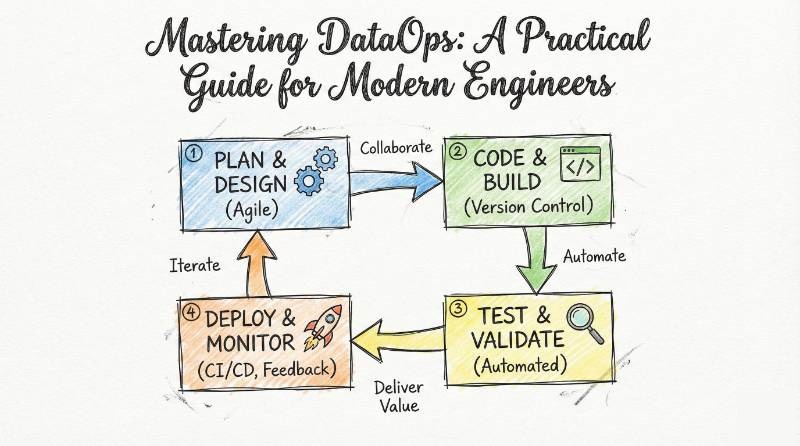
Modern business relies entirely on the speed of information. In the past, data was often treated like a static library, where files sat on shelves until someone needed to look at them. However, in today’s high-velocity digital world, data has become a living, breathing stream that must be managed with precision and automation. Because of this massive shift, the old manual methods of data handling are no longer effective, leading to the rise of the DataOps movement.
For software engineers and technical managers, the ability to build automated data systems is now a top-tier skill. Specifically, the DataOps Certified Professional (DOCP) program provides the framework needed to master these complex environments. By earning this credential, you prove that you can bridge the gap between raw data engineering and high-speed operational delivery. This guide is designed to serve as your strategic roadmap to mastering this critical domain.
Choose Your Path: 6 Strategic Learning Tracks
Before focusing on DataOps, it is vital to see how it fits into the broader technology landscape. Depending on your career goals, you might find yourself gravitating toward one of these six primary areas of expertise.
1. The DevOps Path
First and foremost, DevOps is the bedrock of modern engineering. It focuses on breaking down silos between developers and IT operations through automation and CI/CD. Most successful engineers start here to understand the core principles of speed and reliability.
2. The DevSecOps Path
Security must be a continuous process rather than a final check. Consequently, this path teaches you how to embed automated security protocols into every stage of the pipeline. It ensures that your deployments are not just fast, but also completely secure.
3. The SRE (Site Reliability Engineering) Path
SREs act as the ultimate guardians of system uptime. They apply a software engineering mindset to infrastructure problems, focusing heavily on scalability and error budgets. If you enjoy solving high-stakes availability puzzles, this is the track for you.
4. The AIOps / MLOps Path
Artificial Intelligence requires its own unique set of operational standards. While MLOps focuses on the lifecycle of machine learning models, AIOps uses AI to monitor and fix IT infrastructure automatically. These tracks are ideal for those working at the intersection of data science and automation.
5. The DataOps Path
This is our primary focus for today. DataOps applies the agility of DevOps to the complexity of data pipelines. Furthermore, it ensures that high-quality data is delivered to the right person at the exact moment they need it. It is the missing link in many modern data architectures.
6. The FinOps Path
Cloud costs can quickly become unmanageable for large organizations. To solve this, FinOps practitioners bring financial accountability to cloud spending. They ensure that every dollar invested in infrastructure is optimized for maximum business impact.
Role → Recommended Certifications Mapping
To help you align your training with your career stage, refer to the mapping table below.
| Your Current Role | Recommended Certification Journey |
| DevOps Engineer | Certified DevOps Professional (CDP) |
| SRE / Systems Engineer | SRE Certified Professional (SREC) |
| Platform Engineer | Certified DevOps Architect (CDA) |
| Cloud Engineer | AWS/Azure/Google DevOps Specialist |
| Security Engineer | DevSecOps Certified Professional (DSOCP) |
| Data Engineer | DataOps Certified Professional (DOCP) |
| FinOps Practitioner | Certified FinOps Professional |
| Engineering Manager | Certified DevOps Manager (CDM) |
Complete Certification Master Table
The following table provides a comprehensive overview of the professional tracks available through DevOpsSchool and its network of partners.
| Track | Level | Who it’s for | Prerequisites | Skills Covered | Order |
| DevOps | Foundation | Beginners | Basic Linux | Git, Docker, CI/CD | 1st |
| DevOps | Professional | Engineers | 2+ yrs Experience | Kubernetes, Terraform | 2nd |
| DataOps | Professional | Data Pros | SQL & Python | Airflow, Kafka, dbt | Specialist |
| SRE | Professional | Ops Experts | DevOps basics | Observability, SLAs | Advanced |
| DevSecOps | Professional | Security Pros | CI/CD basics | Vault, SonarQube | Advanced |
| MLOps | Professional | Data Scientists | Python, ML | Model CI/CD, MLFlow | Specialist |
| AIOps | Professional | Managers/SREs | Ops knowledge | ELK, Prometheus, AI | Specialist |
Deep Dive: DataOps Certified Professional (DOCP)
What it is
The DataOps Certified Professional (DOCP) is a technical program designed to validate your mastery over the automated data lifecycle. Specifically, it confirms that you can build and maintain high-quality data pipelines that are both scalable and resilient.
Who should take it
This certification is highly recommended for Data Engineers, Software Developers, and Database Administrators. Additionally, Technical Managers will find it invaluable for overseeing complex digital transformations within their organizations.
Skills you’ll gain
- Workflow Orchestration: Mastering tools like Apache Airflow to manage intricate data dependencies and schedules.
- Real-Time Data Streaming: Learning to use Apache Kafka for high-velocity data ingestion.
- Automated Data Quality: Implementing rigorous testing frameworks to ensure data integrity before production.
- Infrastructure as Code (IaC): Gaining the ability to deploy entire data stacks using Docker, Kubernetes, and Terraform.
- Governance and Compliance: Understanding how to maintain data lineage and security in a modern cloud environment.
Real-world projects you should be able to do
- Design and implement a fully automated ETL pipeline from a raw API source to a cloud data warehouse.
- Create a live observability dashboard that tracks pipeline health and alerts the team to failures.
- Build a scalable data lake architecture that supports both batch processing and streaming data.
- Implement a “Data-as-Code” system that allows for automated versioning and testing of data schemas.
The DOCP Preparation Plan
Success in the DOCP exam requires a blend of conceptual understanding and hands-on lab practice. Choose the timeline that fits your experience level.
The Accelerated Sprint (7–14 days)
This path is ideal for those who already have a strong background in DevOps or Data Engineering. First, focus your energy on the unique toolsets of the DataOps world, such as Airflow and Snowflake. Furthermore, spend several hours a day on intensive labs to get comfortable with the technical syntax. Ultimately, your goal is to apply your existing automation knowledge to data-specific challenges.
The Professional Deep Dive (30 days)
This is the most popular choice for working engineers who need to balance study with a full-time job. Start by spending the first two weeks mastering data ingestion and transformation strategies. Moreover, dedicate the final two weeks to orchestration and monitoring frameworks. By building one small project every weekend, you will ensure the concepts are firmly rooted in your mind.
The Strategic Roadmap (60 days)
If you are moving into a leadership role or coming from a non-automated background, choose this 60-day plan. In addition to technical labs, you should spend significant time studying the DataOps Manifesto and governance case studies. Consequently, you will develop a holistic view of how DataOps impacts the entire organization, which is vital for long-term career growth.
Common Mistakes to Avoid
- Treating DataOps as “Just DevOps”: Remember that data has “state” and quality issues that simple code deployments do not have; do not ignore them.
- Making Manual Changes in Production: If you are still manually updating databases or spreadsheets, you aren’t doing DataOps. Everything must be in the code.
- Over-Engineering Your Pipelines: Avoid building complex real-time streaming systems if a simple daily batch process actually meets the business requirement.
- Neglecting Monitoring and Observability: A pipeline is only good if you know it is working. Always build automated alerts and monitoring from the very start.
Next Certifications to Take
After you achieve your DOCP, you should continue your growth by exploring these three directions.
- Same Track (Advanced): Pursue the Certified DataOps Architect to learn how to design complex, enterprise-wide data systems.
- Cross-Track (Broadening): Enroll in the MLOps Certified Professional program to bridge the gap between raw data and machine learning models.
- Leadership (Growth): Look into the Certified DevOps Manager (CDM) to learn how to lead high-performing technical teams and manage large-scale budgets.
Top Institutions for DataOps Training
Selecting the right training provider is crucial for your success. These institutions are recognized leaders in providing help for the DataOps Certified Professional (DOCP).
- DevOpsSchool: This institution is a global leader in technical training, offering immersive, tool-centric courses with lifetime access to materials. Their curriculum is heavily focused on hands-on labs and real-world project scenarios, making them the top choice for working professionals.
- Cotocus: Known for its boutique training style, Cotocus provides high-quality lab environments that simulate complex enterprise architectures. Their instructors focus on practical application, ensuring that students are ready for real-world challenges immediately.
- Scmgalaxy: This is a massive community-driven platform that provides thousands of resources, tutorials, and expert-led sessions. They offer extensive support for students, helping them navigate the complexities of SCM and DevOps with ease.
- BestDevOps: They specialize in intensive bootcamps designed to take an engineer from a beginner to an expert in a short timeframe. Their focus is on high-impact, job-ready skills that can be applied to enterprise projects right away.
- devsecopsschool: While they focus on security, their DataOps integration courses are world-class. They teach you how to build pipelines that are not only fast but also completely secure from external threats.
- sreschool: This institution focuses on the reliability aspect of the data lifecycle. They are the go-to choice for learning how to make your DataOps systems self-healing and highly available for global users.
- aiopsschool: As data and AI converge, this school helps you stay ahead of the curve. They provide specialized training on using AI to monitor, optimize, and secure your automated data workflows.
- dataopsschool: A dedicated branch that focuses purely on the data lifecycle. Their curriculum is deep and covers everything from data governance to advanced pipeline orchestration for big data environments.
- finopsschool: For the cost-conscious professional, this school is essential. They teach you how to manage the massive cloud costs often associated with big data and DataOps projects effectively.
General Career & Strategy FAQs
- Is DataOps different from Data Engineering?Yes, because while Data Engineering focuses on building, DataOps focuses on the automation, quality, and speed of that building process.
- How much coding is required for success?You don’t need to be a software architect, but a solid grasp of SQL and Python is definitely required for automation tasks.
- Is the DOCP certification recognized globally?Absolutely, the DOCP is recognized by major tech firms across India, the US, and Europe as a mark of technical excellence.
- Can a technical manager benefit from this?Definitely, because understanding the “how” of DataOps allows managers to set more realistic goals and hire the right talent.
- Will this certification help with salary hikes?Yes, DataOps is a high-demand niche; certified professionals often see significant increases in their market value.
- Are there any specific hardware requirements?No, most training labs are cloud-based, so you only need a standard laptop and a reliable internet connection.
- Is the final exam mostly theory?No, the DOCP emphasizes practical application, meaning you will be tested on your ability to configure and troubleshoot tools.
- Does it cover cloud-native tools?Yes, the program covers how to implement these strategies across major cloud providers like AWS, Azure, and Google Cloud.
- What is the role of the DataOps Manifesto?It serves as the philosophical foundation for the movement, prioritizing individuals and interactions over tools and processes.
- Can I transition from a non-tech role?It is possible, but you should first take a foundation course in Linux or Python before attempting the DOCP.
- How does DataOps support AI initiatives?DataOps ensures that the data being fed into AI models is accurate and timely, which is critical for the success of any AI project.
- Is there a community for DOCP holders?Yes, institutions like Scmgalaxy and DevOpsSchool provide access to exclusive alumni networks for ongoing support and networking.
FAQs: DataOps Certified Professional (DOCP)
- What is the specific goal of the DOCP certification?The goal is to produce experts who can significantly reduce the time it takes to deliver high-quality, reliable data to the business.
- Which specific tools are covered in the curriculum?You will primarily work with industry standards such as Apache Airflow, Kafka, Docker, Kubernetes, and dbt.
- Is the DOCP certification recognized in India?Yes, it is highly valued in tech hubs like Bangalore, Hyderabad, and Pune where data-driven enterprises are scaling rapidly.
- How difficult is the DOCP certification exam?It is considered moderately difficult because it requires a mix of theoretical knowledge and hands-on technical skill.
- Does the DOCP include Data Governance?Yes, a significant portion of the course is dedicated to data lineage, security, and maintaining compliance throughout the lifecycle.
- Should I take DevOps before DataOps?While not strictly required, having a “DevOps Foundation” background will make the transition into DataOps much smoother.
- What specific job roles can I apply for?Common roles include DataOps Engineer, Senior Data Pipeline Engineer, and Data Platform Architect.
- Does the exam involve writing code?Yes, you will likely be required to write scripts and configuration files as part of the practical lab assessment.
Conclusion
The era of manual, error-prone data management is officially coming to a close. As organizations race to become truly “AI-first,” the demand for professionals who can build reliable data foundations is reaching an all-time high. The DataOps Certified Professional (DOCP) is more than just a credential; it is a commitment to a modern, automated, and high-quality way of managing information.
Whether you are an engineer looking to future-proof your career or a manager trying to bring order to your team’s data chaos, mastering DataOps is the single most strategic move you can make today.
