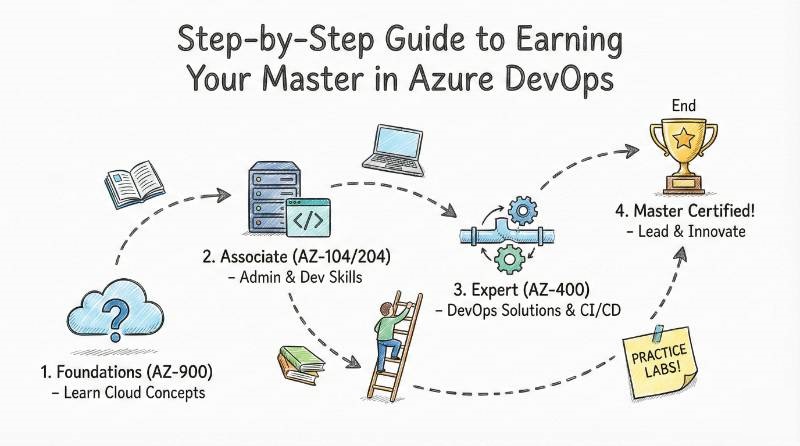
As more organizations embrace DevOps practices to bridge the gap between development and operations, professionals skilled in Azure DevOps tools are in high demand. The Master in Azure DevOps certification empowers individuals to master DevOps workflows using Microsoft Azure, with a focus on automation, continuous integration (CI), continuous delivery (CD), and infrastructure management. These are critical elements of modern software development and operational efficiency.
This guide will provide you with all the essential details you need about the Master in Azure DevOps certification, including prerequisites, the learning journey, real-world applications, and the career benefits that follow.
The Architecture of the Master Program
The Master in Azure DevOps program, provided by DevOpsSchool, is an integrated learning track. It combines core administration with advanced automation.
| Track | Level | Who it’s for | Prerequisites | Skills Covered | Recommended Order |
| Azure Fundamentals | Foundational | New Entrants, Managers | None | Cloud concepts, Security, Governance | 1st |
| Azure Administrator | Associate | Systems/Cloud Engineers | AZ-900 | Networking, Identity, Storage | 2nd |
| Azure DevOps Expert | Expert | DevOps/SREs | AZ-104 or AZ-204 | CI/CD, IaC, Instrumentation | 3rd |
Master in Azure DevOps (CDE)
What it is
The Master in Azure DevOps certification is designed to equip professionals with a deep understanding of Azure’s suite of tools for implementing DevOps practices. It focuses on automating workflows, facilitating CI/CD, managing infrastructure, and ensuring the seamless delivery of software. Mastery of these processes using Azure tools, such as Azure Pipelines, Azure Repos, and Azure Artifacts, is vital for those aspiring to become proficient in DevOps.
Azure DevOps is indispensable for teams aiming to adopt agile, continuous delivery, and automated processes. This certification ensures that you are equipped to handle complex projects in a cloud-first environment.
Who should take it
- DevOps Engineers: Those looking to deepen their knowledge of Azure DevOps tools and enhance automation processes.
- Software Engineers: Developers seeking to improve their deployment cycles and integrate DevOps practices into their development workflows.
- Cloud Engineers: Individuals focused on managing cloud-native applications and services using DevOps methodologies.
- Engineering Managers: Leaders aiming to streamline their team’s DevOps processes and optimize workflows.
- IT Professionals: Anyone looking to shift into DevOps or cloud-related roles.
Skills you’ll gain
- Pipeline Management: Setting up and managing CI/CD pipelines using Azure DevOps.
- Infrastructure as Code: Automating cloud resource provisioning with tools like Azure Resource Manager (ARM), Terraform, and Azure CLI.
- Version Control: Managing code repositories effectively using Azure Repos and Git.
- Automated Testing: Integrating automated testing into your CI/CD pipelines for streamlined testing.
- Monitoring: Implementing and managing real-time monitoring for applications and infrastructure using Azure Monitor and Log Analytics.
- Release Automation: Managing the release cycle by automating the deployment process and monitoring updates.
Real-world projects you can lead
- Automating Continuous Integration and Delivery: Designing and implementing CI/CD pipelines to streamline deployment workflows.
- Infrastructure Management with Azure: Automating infrastructure creation and management using tools like ARM templates and Terraform.
- End-to-End DevOps Pipeline: Building a fully integrated DevOps pipeline from development to production.
- Testing Automation: Incorporating unit and integration tests into your CI/CD pipeline.
- Cloud Resource Management: Deploying and maintaining cloud-based infrastructure while managing all stages of the DevOps lifecycle.
Preparation Plan
7-Day Plan:
- Day 1-2: Understand the fundamentals of Azure DevOps, focusing on core tools like Azure Pipelines, Repos, and Artifacts.
- Day 3-4: Dive into version control and pipeline creation—set up your first CI/CD pipeline.
- Day 5: Learn the integration of automated tests within Azure DevOps to ensure consistent quality.
- Day 6: Master infrastructure as code using tools like Azure Resource Manager (ARM) and Terraform.
- Day 7: Complete mock exams and hands-on projects to reinforce your learning.
30-Day Plan:
- Week 1-2: Focus on understanding Azure DevOps services, pipeline management, and repository management.
- Week 3: Study how to automate deployment and infrastructure as code using Terraform and Azure CLI.
- Week 4: Deep dive into building testing pipelines and hands-on DevOps project execution.
60-Day Plan:
- Week 1-2: Begin with Azure fundamentals and DevOps basics.
- Week 3-4: Study DevOps tools in Azure, focusing on setting up pipelines, version control, and monitoring.
- Week 5-6: Implement an entire DevOps pipeline, test, and refine your practices with real-time deployments.
Common Mistakes to Avoid
- Skipping Hands-On Practice: DevOps is about applying concepts in real environments. Make sure to practice the tools and processes regularly.
- Ignoring Security Aspects: Security should be integrated into your DevOps pipeline (DevSecOps). Ensure security checks are part of the deployment process.
- Lack of Version Control Mastery: Familiarity with Git and Azure Repos is crucial—don’t skip this.
- Not Using Automation Enough: DevOps is all about automation; try to automate as much as possible in your workflow.
- Underestimating Monitoring: Never ignore the need for robust monitoring. Understanding how to use Azure Monitor effectively will help you optimize deployments.
Best next certification after this
Once you’ve completed Master in Azure DevOps, consider advancing your career with these certifications:
- Certified Kubernetes Administrator (CKA): Deepen your container orchestration expertise and scale your cloud applications.
- Azure Solutions Architect Expert: Move into a cloud architecture role with a focus on building large-scale solutions on Azure.
- Certified Cloud Security Professional (CCSP): Learn how to secure cloud environments and implement security best practices across DevOps pipelines.
Choose Your Path: 6 Specialized Domains
Once you hold the Master title, you can pivot into these high-growth tracks:
- DevOps: Focused on the core speed and quality of software delivery.
- DevSecOps: Where security is integrated into every automated step.
- SRE (Site Reliability Engineering): Focused on system uptime, scaling, and resilience.
- AIOps/MLOps: Using Azure ML to automate data models and intelligent systems.
- DataOps: Applying automation to big data and analytics pipelines.
- FinOps: Managing and optimizing cloud costs for better business outcomes.
Mapping Roles to Certifications
| Role | Recommended Certifications |
|---|---|
| DevOps Engineer | Master in Azure DevOps, Certified Kubernetes Administrator |
| SRE | Site Reliability Engineering (SRE) Professional |
| Platform Engineer | Master in Azure DevOps, Cloud Solutions Architect |
| Cloud Engineer | Microsoft Certified: Azure Fundamentals, Master in Azure DevOps |
| Security Engineer | Certified Cloud Security Professional, DevSecOps Certification |
| Data Engineer | DataOps Certified Professional, Azure Data Engineer |
| FinOps Practitioner | FinOps Certified Professional |
| Engineering Manager | Master in Azure DevOps, Project Management Certification |
Top Institutions for Expert Training
To reach the master level, you need more than just videos; you need high-touch mentorship and lab-intensive environments:
DevOpsSchool
DevOpsSchool is a leading name when it comes to DevOps training. Their Master in Azure DevOps course covers all the essential aspects of DevOps using Azure, from CI/CD to cloud automation and security practices (DevSecOps). The program is designed for both beginners and advanced professionals, offering hands-on labs and live sessions to ensure you gain practical experience. The curriculum is structured to include real-world projects, allowing learners to apply their knowledge immediately. DevOpsSchool’s courses are ideal for those who want to understand the complete Azure DevOps pipeline and work in cloud-based environments.
Cotocus
If you’re looking for a comprehensive and structured approach to learning Azure DevOps, Cotocus is a great option. Their Master in Azure DevOps training program combines theory with practical sessions, ensuring you gain a solid understanding of all the tools Azure DevOps has to offer. Cotocus provides real-world case studies, which makes the training highly applicable to the actual challenges you might face in the field. The emphasis is on learning automation, continuous integration, and deployment using Azure Pipelines, along with infrastructure as code using ARM templates and Terraform.
Scmgalaxy
Scmgalaxy takes a more hands-on approach to training, making it an excellent choice for those who prefer practical, project-based learning. Their Master in Azure DevOps program focuses on automating everything from code commits to deployment in cloud environments. The course includes practical labs where learners can practice creating CI/CD pipelines, automating infrastructure, and deploying applications in Azure. By the end of the program, you’ll have worked on real projects that simulate industry scenarios, giving you the confidence to implement what you’ve learned in the workplace.
BestDevOps
BestDevOps offers an interactive, comprehensive learning experience that provides both theoretical and practical knowledge. Their Master in Azure DevOps certification program covers all core Azure DevOps tools, with a particular focus on automation and project management. The training emphasizes building fully automated CI/CD pipelines and securing cloud-based applications through DevSecOps practices. BestDevOps ensures that you leave the program with hands-on experience, making you job-ready for DevOps roles in the Azure ecosystem.
DevSecOpsSchool
For professionals interested in security within DevOps, DevSecOpsSchool is a leading institution that focuses on DevSecOps practices. Their Master in Azure DevOps training program integrates security throughout the DevOps pipeline. This unique training is perfect for those who want to ensure that the software is secure from development to deployment. The curriculum includes secure coding practices, vulnerability scanning, and compliance checks, all using Azure DevOps tools. DevSecOpsSchool ensures you are well-equipped to handle the security challenges that come with automated pipelines.
SRE School
If your focus is on ensuring system reliability and performance, SRE School offers specialized training in Site Reliability Engineering (SRE). Their Master in Azure DevOps certification integrates SRE principles with Azure DevOps tools, teaching you how to maintain high availability and reliability in cloud applications. The course covers performance monitoring, incident management, and scaling applications using Azure DevOps practices, making it a great choice for professionals looking to optimize cloud-based systems and ensure their operational stability.
AIOpsSchool
AIOpsSchool offers a unique program that blends Artificial Intelligence (AI) with DevOps practices. Their training focuses on using AI-driven approaches to improve automation, detect anomalies, and optimize DevOps workflows. Through the Master in Azure DevOps program, you will learn how to implement AI-powered solutions within your DevOps pipeline using Azure. This is an excellent option for those interested in exploring the intersection of machine learning and IT operations to automate and enhance their workflows.
DataOpsSchool
For data professionals who want to bring DevOps principles into data workflows, DataOpsSchool provides specialized training in DataOps. Their Master in Azure DevOps certification focuses on the application of DevOps practices to data engineering, streamlining data pipelines, and automating data workflows. The course will help you learn to manage large volumes of data more efficiently while ensuring data quality, security, and compliance, all through Azure DevOps tools.
FinOpsSchool
FinOpsSchool focuses on Financial Operations (FinOps), teaching professionals how to optimize cloud costs while managing DevOps practices. Their Master in Azure DevOps program is perfect for professionals working with cloud environments who need to keep costs under control without compromising performance. The training will provide you with the knowledge to balance cloud spending and performance using Azure DevOps tools and best practices for cost optimization in the cloud.
FAQs: Value & Outcomes (Focus on Career Impact)
1. Difficulty: How hard is the Master in Azure DevOps program?
It is a challenging track. The theory is manageable, but the hands-on labs require focus. You aren’t just memorizing facts; you are learning how to build complex systems.
2. Time: How much time will it really take me?
I suggest planning for about 100 to 120 hours total. For most working professionals, this means about 2 to 3 months of steady study and practice.
3. Prerequisites: Can I do this with a non-technical background?
It is possible, but it takes more work. If you follow the 60-day plan, it gives you enough time to learn the basic technical foundations before you start with automation.
4. Sequence: What is the best order to take the exams?
The best path is: Fundamentals (AZ-900) → Administrator (AZ-104) → DevOps Expert (AZ-400). Following this order ensures you don’t have any gaps in your knowledge.
5. Value: Is Azure better than AWS for my career?
Both are good, but Azure is used by almost all Fortune 500 companies. If you are working in a large enterprise environment, Azure skills are often more valuable because they integrate with other Microsoft tools.
6. Career Outcomes: What kind of job roles can I apply for?
You will be ready for roles like Senior DevOps Engineer, Site Reliability Engineer (SRE), and Cloud Architect.
7. Value: What kind of salary hike can I expect?
While it varies, I have seen certified professionals get a 30% to 60% increase in their salary because these skills are in very high demand.
8. Difficulty: Is the lab part harder than the exam?
Usually, yes. Passing a test is one thing, but making a pipeline work in a real lab is where you really prove you are a “Master.”
9. Global Value: Is this certification valid outside of India?
Yes. These are global certifications. Whether you are in India, the US, or Europe, companies recognize and respect these credentials.
10. Prerequisites: Is there an age or experience limit to start?
Never. I have seen people with 15 years of experience transition to DevOps just as successfully as new graduates. Your past experience actually helps you understand the “why” better.
11. Value: Does it help me move into a leadership role?
Yes. It shows you have a deep understanding of the whole software lifecycle. This is exactly what companies look for when they hire Technical Leads or Engineering Managers.
12. Career Outcomes: Can I use these skills for freelancing?
Definitely. Many small and medium businesses need experts to help them set up their cloud and automation. Being a “Master” gives you the authority to consult on these projects.
FAQs on Master in Azure DevOps (CDE)
1. How is the Master program different from the AZ-400 exam?
The exam tests your knowledge; the Master program builds your skills using extra tools like Terraform and Kubernetes.
2. Who is the provider of the Master in Azure DevOps (CDE)?
It is a flagship program provided by DevOpsSchool in collaboration with global trainers.
3. Where can I find the official details?
Visit Master in Azure DevOps .
4. Is this suitable for managers?
Yes. It provides the technical depth managers need to drive efficient engineering teams.
5. Are the sessions live?
Most programs at DevOpsSchool are live and instructor-led for maximum interaction.
6. Does it cover Infrastructure as Code?
Yes, IaC with Terraform and ARM/Bicep is a central part of the curriculum.
7. Is there placement support?
Yes, top-tier institutes provide resume reviews and interview preparation as part of the package.
8. Can I start with no prior cloud knowledge?
The program is built to take you from the very beginning (Fundamentals) to the expert level.
Testimonials
“The Master program at DevOpsSchool turned my theoretical knowledge into a practical career. The lab environments are exactly like real production.” — Karan M., Cloud Architect.
“As a manager, I needed to bridge the gap between our developers and our operations team. This program gave me the roadmap.” — Sonia L., Engineering Lead.
Conclusion
Mastering Azure DevOps is about more than just earning a certificate; it’s about gaining the vision to lead technical transformations. In my experience, those who invest the time to truly understand the flow of software delivery are the ones who define the future of their organizations.
The road from a beginner to an expert is demanding, but the professional rewards—in terms of stability and impact—are unmatched. Start your journey today, commit to the process, and become the master of your technical destiny.
