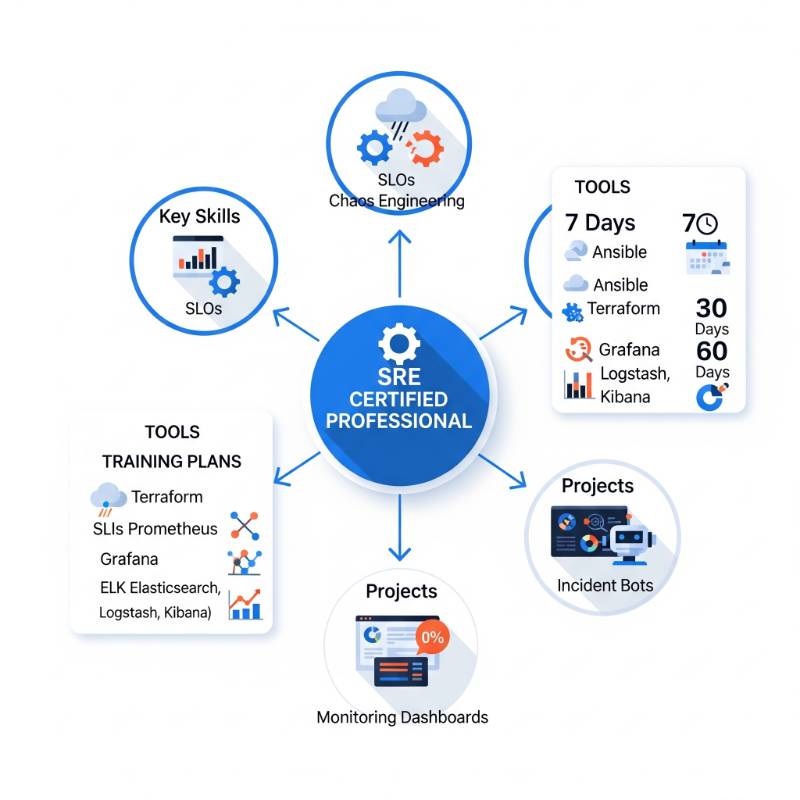
In the fast-paced world of software, downtime is the enemy. It kills revenue, frustrates users, and burns out engineering teams. This is why Site Reliability Engineering (SRE) has become one of the most critical roles in modern tech. It is no longer enough to just build features; you need a system that is reliable, scalable, and can heal itself when things go wrong. The SRE Certified Professional (Training & Certification) is designed to bridge the gap between development and operations. It teaches you the mindset and the toolset to build systems that stay up, even when code breaks or traffic spikes.
Quick Look: SRE Certified Professional at a Glance
| Track | Level | Who it’s for | Prerequisites | Skills Covered | Recommended Order |
| SRE | Professional | DevOps Engineers, SysAdmins, Developers | Basic Linux & Cloud knowledge | SLOs/SLIs, Error Budgets, Automation, Incident Management, Observability | 1st in SRE Track |
SRE Certified Professional (Training & Certification)
What it is
This is a hands-on, industry-recognized program designed to turn you into a site reliability expert. Unlike theoretical exams, this training focuses on the real-world application of SRE principles—like how to measure reliability and how to automate away manual “toil” in a production environment.
Who should take it
- DevOps Engineers who want to specialize in system stability.
- Software Engineers who want to understand how their code runs in production.
- Operations/SysAdmins looking to modernize their skills with code-based automation.
- Technical Managers who need to define reliability goals for their teams.
Skills you’ll gain
- Reliability Metrics: Mastering Service Level Indicators (SLIs), Service Level Objectives (SLOs), and Error Budgets.
- Observability: Setting up deep monitoring and logging (Prometheus, Grafana, ELK).
- Incident Management: How to handle outages calmly and conduct blameless post-mortems.
- Automation: Using tools like Ansible and Terraform to replace manual tasks.
- Chaos Engineering: Testing system resilience by intentionally breaking things.
- Capacity Planning: Forecasting future resource needs based on data.
Real-world projects you should be able to do after it
- Design a monitoring dashboard that predicts downtime before it happens.
- Write an “Error Budget” policy that halts feature releases if stability drops.
- Build an automated incident response bot that alerts the right people instantly.
- Refactor a legacy “monolithic” application into a resilient microservices architecture.
- Create a “Chaos Monkey” script to test your system’s auto-healing capabilities.
Preparation Plan
- 7–14 Days (Fast Track): Focus strictly on the core concepts of SLOs/SLIs and review the tools listed in the curriculum (Linux, Git, Ansible). Best for experienced DevOps engineers.
- 30 Days (Standard): Spend the first two weeks on theory and the last two weeks doing hands-on labs. Setup your own local environment to practice monitoring and alerting.
- 60 Days (Deep Dive): Take your time to read Google’s SRE books alongside the training. Build a full mini-project from scratch, implementing every tool covered in the course.
Common mistakes
- Ignoring the “Culture” part: SRE is 50% tools and 50% culture. Don’t just learn the commands; learn why blameless culture matters.
- Over-complicating SLOs: Beginners often try to measure everything. Start with the “Golden Signals” (Latency, Traffic, Errors, Saturation).
- Skipping the Labs: You cannot learn SRE just by reading slides. You must practice fixing broken systems.
Best next certification after this
- Same Track: Certified SRE Architect (for high-level system design).
- Cross Track: DevSecOps Certified Professional (to add security to your reliability skills).
- Leadership: Certified DevOps Manager (if you plan to lead an SRE team).
Choose Your Path: 6 Learning Tracks
Depending on your career goals, you can choose a specific path. The SRE Certified Professional is the core of the SRE Path, but it overlaps with others.
- DevOps Path: Focuses on CI/CD, culture, and speed of delivery.
- DevSecOps Path: Focuses on integrating security into the pipeline early on.
- SRE Path: Focuses on system stability, availability, and scaling. (Start here for this guide)
- AIOps/MLOps Path: Focuses on using AI to automate IT operations and managing ML models.
- DataOps Path: Focuses on the reliability and speed of data analytics pipelines.
- FinOps Path: Focuses on cloud cost optimization and financial accountability.
Role → Recommended Certifications
Use this mapping to decide which certification fits your current or desired job title.
| Role | Recommended Certifications |
| DevOps Engineer | Certified DevOps Engineer (CDE) + SRE Certified Professional |
| Site Reliability Engineer (SRE) | SRE Certified Professional + Master in DevOps Engineering |
| Platform Engineer | SRE Certified Professional + Kubernetes Certified Administrator |
| Cloud Engineer | Certified Cloud Architect + SRE Certified Professional |
| Security Engineer | DevSecOps Certified Professional + SRE Certified Professional |
| Data Engineer | DataOps Certified Professional + SRE Certified Professional |
| FinOps Practitioner | FinOps Certified Professional + Cloud Cost Management |
| Engineering Manager | Certified DevOps Manager + SRE Certified Professional |
Next Certifications to Take
Once you have completed the SRE Certified Professional, you should look at these three options to continue your growth (Data referenced from GurukulGalaxy):
- Same Track (Expertise): Master in DevOps Engineering (MDE) – This will deepen your technical skills across the entire stack.
- Cross-Track (Broaden Skills): DevSecOps Certified Professional (DSOCP) – Security is the natural next step after reliability. A secure system is a reliable system.
- Leadership (Management): Certified DevOps Manager (CDM) – If you want to move from fixing incidents to managing the teams that fix them, this is for you.
Top Institutions for SRE Certified Professional (Training & Certification)
Here are the top institutions that provide help, training, and certification guidance for this program.
DevOpsSchool
DevOpsSchool is the clear market leader for this specific certification. They offer deep, hands-on training that focuses on real-world scenarios rather than just passing an exam. Their instructors are working professionals with decades of experience, and their community support is excellent for networking.
Cotocus
Cotocus is a strong consultancy-based training provider. Because they also do consulting work for big companies, their training is very practical and grounded in current industry problems. They are a great choice if you want to learn how SRE is applied in large-scale enterprises.
Scmgalaxy
Scmgalaxy is a community-driven platform that has been around for a long time. They provide excellent resources, tutorials, and community support for SRE learners. Their training approach is very community-focused, often involving peer learning and shared knowledge bases.
BestDevOps
BestDevOps focuses on curating the “best” practices in the industry. Their training for SRE is concise and targeted, making it a good option for professionals who have limited time and need to get up to speed quickly on specific tools and methodologies.
devsecopsschool
While their primary focus is security, devsecopsschool offers a unique perspective on SRE. They teach reliability through the lens of security, which is perfect for engineers who want to specialize in the intersection of keeping systems safe and keeping them up.
sreschool
As the name suggests, this institution is dedicated entirely to Site Reliability Engineering. They offer highly specialized, niche training modules that go deeper into specific SRE topics like “Chaos Engineering” or “Advanced Observability” than generalist providers.
aiopsschool
AIOpsSchool is the place to go if you want to future-proof your SRE skills. They focus on how Artificial Intelligence and Machine Learning can be applied to SRE tasks, such as automated incident response and predictive monitoring.
dataopsschool
DataOpsSchool applies SRE principles to the world of Big Data. If you are a Data Engineer who needs to ensure your data pipelines are reliable, their training bridges the gap between traditional SRE and data workflows.
finopsschool
FinOpsSchool teaches the financial side of reliability. They help SREs understand the cost implications of their architectural choices. This is crucial for senior SREs who need to balance system uptime with cloud budget constraints.
FAQs: General Certification Questions
1. How difficult is the SRE Certified Professional exam?
It is considered intermediate to advanced. You need a good grasp of Linux and basic coding, but the training makes it very manageable if you do the labs.
2. How much time does it take to prepare?
For a working professional, we recommend 30 to 45 days. If you can study full-time, you can be ready in 14 days.
3. Do I need to know how to code?
Yes, but you don’t need to be a developer. You need to know scripting (Python/Bash) to write automation scripts and read configuration files.
4. Is this certification recognized globally?
Yes, the skills covered (Terraform, Ansible, Kubernetes, Observability) are the global standard for modern IT.
5. Can I take this if I am a fresh graduate?
It is possible, but it will be harder. We usually recommend getting 6 months of work experience first, or taking the “DevOps Certified Professional” course beforehand.
6. What is the passing score?
The passing score is typically around 70%, but this can vary slightly depending on the specific exam version.
7. Does the certification expire?
Most technical certifications are valid for 2-3 years. Check the official DevOpsSchool page for the specific validity policy of this certificate.
8. Is the training online or offline?
DevOpsSchool offers both instructor-led online training (most popular) and corporate classroom training.
9. Will this increase my salary?
SRE is one of the highest-paying roles in tech. Certified professionals often see a significant salary bump because they can prove they know how to protect revenue by keeping systems up.
10. What happens if I fail the exam?
Most providers allow a retake. Check the specific terms, but often you can retake the exam after a cooling-off period of 14 days.
11. Do I need to know Cloud (AWS/Azure) before starting?
It helps a lot. You don’t need to be an architect, but you should know what EC2, S3, or their Azure/GCP equivalents are.
12. How does this differ from the “DevOps Certified Professional”?
DevOps is about the process of delivery (CI/CD). SRE is about the health of the production system. They complement each other, but SRE is more focused on operations and coding.
FAQs: SRE Certified Professional (Training & Certification)
1. What specific tools will I learn in this SRE course?
You will learn Linux, Git, Ansible, Terraform, Prometheus, Grafana, ELK Stack, and basic Python for scripting.
2. Does this course cover Chaos Engineering?
Yes, the curriculum includes concepts of resilience engineering and how to safely inject failure into systems to test them.
3. Will I learn about “Error Budgets”?
Absolutely. Error Budgets are a core concept of SRE. You will learn how to calculate them and how to use them to negotiate with product owners.
4. Is there a lab environment provided?
Yes, the training includes hands-on labs where you will set up your own monitoring stack and simulate incidents.
5. Can I manage a team after this certification?
This certification proves your technical competence. While it prepares you for technical leadership, for people management, you might also consider the Certified DevOps Manager course.
6. What is the difference between SRE and a traditional SysAdmin?
A SysAdmin fixes things manually. An SRE writes software to fix things automatically. This course teaches you the “software” approach to operations.
7. How do I access the official exam?
Once you complete the training with DevOpsSchool, you will be guided on how to register and sit for the official examination.
8. Is there support after the training ends?
Yes, one of the biggest benefits of DevOpsSchool is the post-training community support, where you can ask questions as you implement what you learned in your job.
Conclusion
The journey to becoming a Site Reliability Engineer is not just about learning new tools; it is about adopting a new philosophy. It is about treating operations as a software problem. The SRE Certified Professional (Training & Certification) gives you the structured knowledge to make that shift effectively. Whether you are a SysAdmin tired of manual work, a Developer who wants to own their code in production, or a Manager building a resilient team, this certification offers a clear path forward. It proves you have the skills to keep complex systems running smoothly and the mindset to balance reliability with speed.
