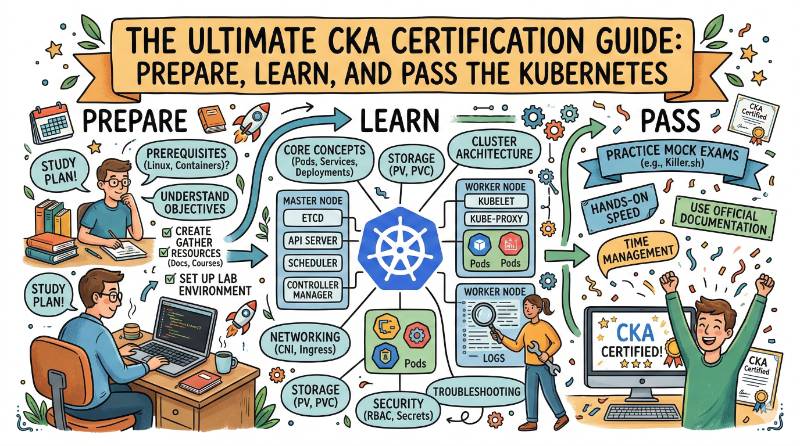
The way we build and run software has changed more in the last few years than in the previous two decades. In the past, we talked about physical servers and long setup times. Today, everything is about speed, scale, and the cloud. If you are an engineer or a manager, you have likely heard of Kubernetes. It has become the standard tool for managing how software runs today.
Whether you are in India or working for a global company, the industry is looking for people who can handle these complex systems. Just knowing the name is not enough. You need to show you have the skills to build and fix these systems. This is why the Certified Kubernetes Administrator (CKA) Certification Training Course is so important. It is a badge of honor that tells the world you are ready for modern infrastructure.
In this guide, I will walk you through the world of Kubernetes certifications. We will look at why it matters, how to prepare, and where it can take your career. If you want to stay relevant in the world of DevOps, SRE, or Cloud Engineering, this is your roadmap.
The Master Certification Map for Software Engineers
Before we dive deep into one course, it is important to see the whole picture. The world of tech is big. There are different paths like security, reliability, and data. Knowing where you stand helps you choose the right next step.
The following table lists the top certifications that help engineers grow. This data is based on industry needs for modern software roles.
Master Certification Overview Table
| Track | Level | Who it’s for | Prerequisites | Skills Covered | Recommended Order |
| Kubernetes | Intermediate | SysAdmins, DevOps, SREs | Basic Linux & Docker | Cluster Setup, Networking, Storage | 1st (Core) |
| DevOps | Professional | Software Engineers | 2+ years experience | CI/CD, Pipelines, Automation | 2nd (After CKA) |
| DevSecOps | Advanced | Security Engineers | DevOps Basics | Security Auditing, Hardening | 3rd (Specialized) |
| SRE | Professional | Ops Engineers | Ops Basics | SLOs, Incident Response | 2nd (After CKA) |
| MLOps | Advanced | ML Engineers | Python, ML basics | Model Scaling, AI Ops | 3rd (Specialized) |
| DataOps | Intermediate | Data Engineers | Data Basics | Data Flow, Pipeline Agility | 3rd (Specialized) |
| FinOps | Management | Managers, Leads | Cloud Basics | Cost Control, Cloud Budgeting | 2nd (For Leads) |
Focus: Certified Kubernetes Administrator (CKA) Certification Training Course
The CKA is unique. It is not a test where you just pick an answer from a list. It is a practical test. You get a terminal, and you have to fix things. It proves you can actually do the work. When I mentor engineers, I tell them that a CKA shows you can handle the pressure of a real production environment.
What it is
The Certified Kubernetes Administrator (CKA) Certification Training Course is a hands-on program. It is designed to ensure that you have the skills to do the daily work of a Kubernetes administrator. You will learn how to build a cluster from scratch, how to make sure it is safe, and how to fix it when it breaks. The final goal is to pass a performance-based exam where you solve real problems in a live system.
Who should take it
This certification is built for the “doers” in the tech world.
- Working Engineers: Those who currently manage servers and want to move into modern cloud roles.
- Software Engineers: Developers who want to understand how their code is actually deployed and run in the real world.
- IT Managers: Leaders who need to understand the technology their teams use so they can make better decisions.
- System Administrators: Professionals moving away from managing physical hardware to managing virtual, automated systems.
Skills you’ll gain
By the end of this training, you will feel at home inside a complex cluster. You will stop guessing and start knowing exactly why a system is working or failing.
Core Skills Gained:
- Building Clusters: You will learn to use
kubeadmto create clusters that are ready for production. - Advanced Networking: You will understand how different parts of the system talk to each other and how to manage external traffic.
- Safe Storage: You will learn how to make sure data stays safe even if a part of the system stops working.
- Security & Access: You will master how to give the right people the right access using RBAC.
- Expert Troubleshooting: You will gain the “detective skills” to find and fix errors in pods, nodes, and networks.
Real-world projects you should be able to do
The best part of this training is being able to do things that help your company work better and faster. Here are a few things you will be ready to handle:
- Production Setup: Build a multi-node, secure cluster for a real business application.
- Team Isolation: Set up different “rooms” (namespaces) for different teams so they don’t mess up each other’s work.
- Recovery Plan: Create a plan to back up the cluster’s memory and restore it quickly if everything fails.
- Live Fixes: Find out exactly why a web application is down and fix the network or storage issue in minutes.
Preparation plan (7–14 days / 30 days / 60 days)
How much time you need depends on your current level. Here is how you should plan your study.
7–14 Days (The Quick Review)
This is only for people who already use Kubernetes every day at work.
- Focus: Read the official documentation carefully.
- Practice: Do timed labs for the most common tasks like etcd backup.
- Goal: Get your speed up so you don’t run out of time during the test.
30 Days (The Regular Path)
This is the most common choice for working engineers.
- Week 1-2: Focus on how to install clusters and how networking works.
- Week 3: Learn about storage and how to keep data safe.
- Week 4: Spend all your time on fixing broken clusters and taking mock tests.
60 Days (The Deep Study)
This is for people who are new to containers or Linux.
- Month 1: Spend time learning Linux commands and how Docker works.
- Month 2: Follow the 30-day plan above, but take more time to understand the “why” behind each step.
Common mistakes
I have seen many smart engineers fail because of simple errors.
- Typing too much: If you try to write every file from scratch, you will run out of time. Use shortcuts.
- Using the wrong cluster: The test has many clusters. If you fix a problem in the wrong one, you get zero points.
- Getting stuck: If a problem is too hard, skip it! Come back later. You don’t need 100% to pass.
- Searching too much: You can use the official website, but if you don’t know where to find things, you will waste too much time.
Career Roadmap: What is the best next step?
Getting your CKA is a huge win, but the tech world never stops moving. You should always look at the next step to keep your career growing.
Best next certification after this (3 options)
- Same Track (Specialization): Certified Kubernetes Security Specialist (CKS). Now that you can run a cluster, learn how to protect it. This is very high-paying work.
- Cross-Track (Broad Skills): HashiCorp Certified Terraform Associate. This helps you build the servers that Kubernetes runs on. It makes you a “complete” engineer.
- Leadership (Manager Path): FinOps Certified Practitioner. If you want to lead a team, you must show you can manage the cloud bill. Companies love people who save them money.
Choose Your Learning Path
Modern tech is split into different areas. Depending on what you enjoy, you can choose one of these 6 paths after your CKA.
- DevOps Path: Focus on making software move from a developer’s computer to the cloud as fast as possible.
- DevSecOps Path: Make sure that security is checked at every single step of the building process.
- SRE Path: Focus on keeping things online. You will learn how to handle huge traffic without the system breaking.
- AIOps/MLOps Path: Learn how to run large AI models on top of your Kubernetes clusters.
- DataOps Path: Focus on how data moves through a company, making sure it is clean and fast.
- FinOps Path: This is for the business side of tech. You help the company understand and reduce their cloud costs.
Role → Recommended Certifications Mapping
If you have a specific job in mind, here is what you should aim for:
- DevOps Engineer: CKA, Terraform Associate, Certified DevOps Engineer.
- SRE: CKA, CKS, SRE Foundation.
- Platform Engineer: CKA, CKS, CKAD.
- Cloud Engineer: CKA, AWS/Azure Solutions Architect.
- Security Engineer: CKS, DevSecOps Professional.
- Data Engineer: DataOps Professional, CKA.
- FinOps Practitioner: FinOps Practitioner, CKA.
- Engineering Manager: FinOps Practitioner, SRE Foundation, Cloud Practitioner.
Recommended Training Institutions
Choosing the right place to study is very important. You need a place that gives you real labs and mentors. Here are the top schools for the Certified Kubernetes Administrator (CKA) Certification Training Course.
- DevOpsSchool: This is a top-rated choice for many. They focus on hands-on learning and offer deep training that covers everything from basics to advanced tasks. Their mentors help you get ready for both the exam and real job interviews.
- Cotocus: They are known for providing very high-quality technical training. Their courses are built for people who are already working and need to gain skills quickly. They focus on enterprise-level Kubernetes use.
- Scmgalaxy: This institution has a very large community of engineers. They provide a lot of free resources along with their paid training, making it a great place to stay updated on the latest DevOps trends.
- BestDevOps: They aim to provide the best possible path into a DevOps career. Their CKA training is very practical and avoids confusing words, making it easier for anyone to learn.
- devsecopsschool: If you want to focus on security from day one, this is your best bet. They teach Kubernetes administration through the lens of safety and auditing, which is a very valuable skill.
- sreschool: This school is all about reliability. They teach you how to manage Kubernetes so that it never goes down. It is the perfect place for someone aiming to be an SRE at a big tech firm.
- aiopsschool: For those interested in the future of AI, this school shows you how to use Kubernetes to power machine learning projects. It is a very specialized and high-demand path.
- dataopsschool: This institution focuses on the data side of things. They teach you how to set up clusters that can handle massive amounts of information without slowing down.
- finopsschool: If you are a manager or a lead, this school helps you understand the money side. They teach you how to manage a Kubernetes cluster while keeping the finance team happy.
General Career FAQs
1. Is the CKA certification worth it?
Yes. It is one of the most respected certifications today because it is 100% practical. It proves you can actually do the job.
2. How long does it take to prepare?
Most working professionals need 4 to 8 weeks of study to feel confident for the exam.
3. Do I need to know how to code?
You don’t need to be a software developer, but you must be comfortable with the Linux command line.
4. Can I take the exam from home?
Yes, the exam is proctored online. You need a quiet room and a good internet connection.
5. How much can I earn after CKA?
In India and globally, CKA-certified engineers often see a significant jump in their salary, sometimes as much as 20% to 50%.
6. Is CKA better than AWS or Azure certifications?
They are different. Cloud certs teach you a specific provider. CKA teaches you a tool that works on every cloud, making you more flexible.
7. Does the certification expire?
Yes, it is valid for three years. The tech moves fast, so you need to stay updated.
8. Is the exam hard?
It is challenging because of the time limit. You have to solve 15 to 20 problems in just two hours.
9. Can I use the documentation during the test?
Yes! You can open one tab of the official Kubernetes documentation. Knowing how to search is a key skill.
10. What is the difference between CKA and CKAD?
CKA is for the admins who build and fix the cluster. CKAD is for developers who build apps that run on the cluster.
11. Is it recognized in India?
Yes, almost every major IT company in India looks for CKA-certified engineers for their cloud and DevOps teams.
12. What happens if I fail?
Most exam vouchers from the Linux Foundation include one free retake, so you can learn from your mistakes and try again.
Specific CKA Training FAQs
1. Does the training cover the entire syllabus?
Yes, a good training program covers cluster setup, networking, storage, security, and troubleshooting.
2. Are the labs provided?
Top schools like DevOpsSchool provide cloud-based labs so you can practice without installing anything on your own computer.
3. Do I get a certificate after the course?
You get a training certificate from the school, which helps with your resume, but you still need to pass the official CNCF exam.
4. Is the training live or recorded?
Most providers offer both. Live sessions are better for asking questions, while recordings are great for reviewing later.
5. Do I need to know Docker?
Yes, basic knowledge of containers and Docker is a must before you start with Kubernetes.
6. Will the training help me with my job?
Absolutely. The training uses real-world scenarios so you can use what you learn immediately at your workplace.
7. How much does the official exam cost?
The exam usually costs around $395, but you can often find discounts or bundle it with your training.
8. What version of Kubernetes is used?
The exam and training usually follow the most recent stable version of Kubernetes.
Conclusion
The Certified Kubernetes Administrator (CKA) Certification Training Course is more than just a certificate; it is a way to change your professional life. We have moved into a time where knowing how to manage cloud systems is the most important skill an engineer can have. Whether you are in India or anywhere else, the demand for people who can handle these complex clusters is only going to grow. It takes hard work and a lot of practice in the lab, but the rewards are well worth it. You will gain the confidence to lead teams, fix big problems, and earn more respect in the industry. Don’t wait for the world to pass you by; start your journey today and see where this expertise can take you.
