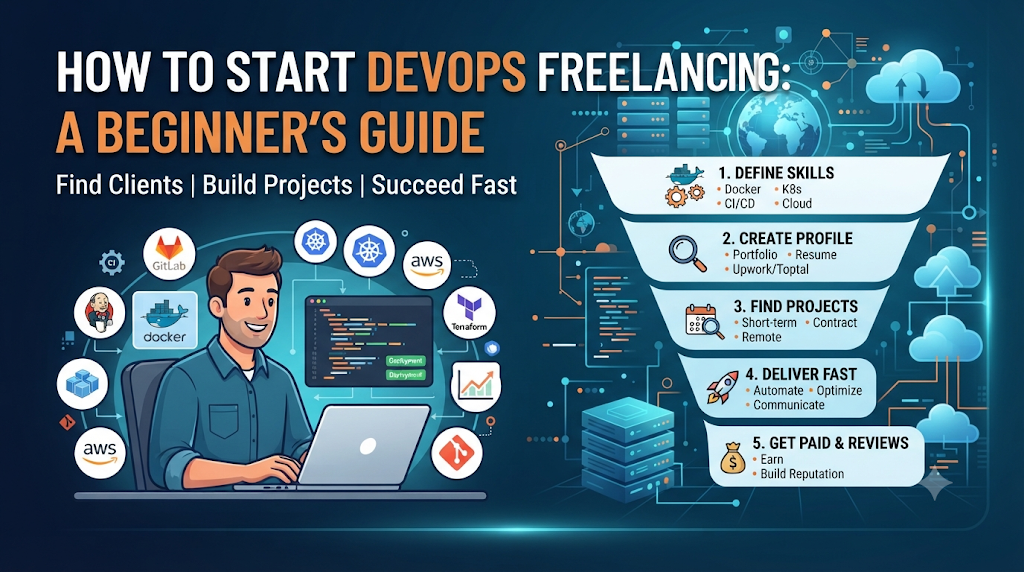
Introduction
The demand for cloud automation, continuous integration, and streamlined deployments continues to grow across organizations of all sizes. However, not every business needs or can afford a full-time, dedicated operations team. Many startups, growing development teams, and small enterprises frequently encounter specific technical bottlenecks—such as a broken deployment pipeline, a missing container setup, or an unorganized infrastructure configuration—that require expert intervention for a limited duration.
For aspiring and working engineers, these scenarios create an ideal entry point. Entering the world of independent consulting does not require managing critical enterprise infrastructure or complex production systems right away. Instead, focusing on short-term assignments allows professionals to apply their skills to manageable tasks, build client trust, and establish professional credibility.
For professionals looking to strengthen the practical foundation required for these engagements, structured training providers such as DevOpsSchool offer targeted learning paths designed to build real-world cloud engineering and automation skills. By combining solid technical preparation with a clear service-oriented approach, engineers can successfully transition into independent work.
1. Why Short-Term DevOps Projects Are a Practical Starting Point
Consider an illustrative scenario: a growing software startup has built a promising web application, but every software update requires manual file transfers and server restarts, leading to frequent deployment errors. Another small development team wants to adopt automated builds using GitHub Actions, but none of the developers have the time to configure the workflow. A local business needs a basic, repeatable cloud infrastructure setup using code rather than manual console clicks.
In each of these cases, the organization does not need a multi-month enterprise transformation. They need a focused, short-term intervention to solve a specific problem.
For engineers, short-term projects offer several distinct advantages:
- Lower Risk Profile: Because these assignments usually target development, testing, or staging environments rather than live production systems, the operational risk is significantly lower.
- Manageable Time Commitments: Projects typically last from a few days to a couple of weeks, making them easy to balance alongside other professional responsibilities.
- Clear Deliverables: The scope is usually well-defined, focusing on a single tool, script, or pipeline configuration.
- Rapid Skill Validation: Successful completion provides immediate proof of competence, making it easier to secure subsequent, larger engagements.
2. Understand What Short-Term DevOps Work Looks Like
Before offering services, it is helpful to understand the typical scope and nature of short-term assignments. Clients seeking freelance support usually look for help with specific, well-bounded tasks.
Common types of short-term freelance engagements include:
- Setting up a basic CI/CD pipeline: Configuring automated testing and deployment for a single application repository.
- Dockerizing an existing application: Writing Dockerfiles and
docker-composeconfigurations to ensure consistent local and staging environments. - Writing or improving Terraform configurations: Creating modular infrastructure-as-code scripts for basic cloud resources like virtual servers, storage buckets, and networking components.
- Automating repetitive Linux administration tasks: Writing shell or Python scripts to handle routine backups, log rotations, or software updates.
- Configuring development and staging environments: Provisioning identical sandbox environments to mirror production settings.
- Troubleshooting deployment failures: Diagnosing and fixing broken build scripts, permission errors, or environment misconfigurations.
- Creating basic monitoring dashboards: Setting up lightweight application health checks and alerting mechanisms using open-source tools.
- Reviewing pipeline security configurations: Identifying hardcoded secrets, permission gaps, or outdated dependencies in configuration files.
- Improving build and deployment documentation: Translating tribal knowledge into clear, step-by-step developer guides.
These assignments generally require practical problem-solving, adherence to best practices, and the ability to work independently within a predefined timeline.
3. Find Your First Freelance Service Before Finding Clients
One of the most common mistakes new freelancers make is advertising themselves as general experts who can handle any cloud or automation task. Prospective clients usually look for specialists who can solve a specific, pressing problem.
To stand out, define a focused service offering based on your current technical strengths. Evaluate your background by looking at:
- Existing technical knowledge: Which tools and platforms do you use comfortably every day?
- Hands-on project experience: What configurations or pipelines have you successfully built in past work or personal practice?
- Independent execution: Which tasks can you complete end-to-end without requiring constant supervision?
- Timeline feasibility: What problems can realistically be solved within a one-to-two-week window?
- Skill gaps: Which areas require further study or practice before offering them commercially?
Instead of marketing broad consulting, package your skills into concrete service descriptions. Examples include:
- “Automated CI/CD Pipeline Setup for Node.js Applications using GitHub Actions”
- “Dockerization and Local Environment Standardization for Small Development Teams”
- “Basic Cloud Infrastructure Provisioning Using Terraform and AWS”
Having a clearly defined service makes it easier to write proposals, estimate effort, and communicate value to prospective clients.
4. Build the Technical Foundation Clients Expect
While short-term projects do not require mastery of every enterprise tool on the market, clients expect a dependable baseline of technical competence. Successful execution relies heavily on understanding core workflows rather than just memorizing tool commands.
Key technical areas to master include:
- Linux administration and troubleshooting: Navigating the filesystem, managing system services, inspecting logs, and understanding file permissions.
- Git and version control: Branching strategies, resolving merge conflicts, and managing repository workflows.
- Bash or Python scripting: Writing readable, maintainable scripts for automation and data manipulation.
- Docker and container basics: Writing efficient Dockerfiles, understanding image layers, and managing local container networks.
- One major cloud platform: Familiarity with core services (such as compute instances, object storage, and basic networking) on platforms like AWS, Google Cloud, or Microsoft Azure.
- CI/CD tools: Building automated workflows using platforms like GitHub Actions, GitLab CI, or Jenkins.
- Terraform fundamentals: Writing declarative infrastructure code, managing state files, and executing plan-and-apply cycles.
- Basic networking and security: Understanding IP addressing, security groups, firewall rules, and secure credential handling.
- Logging and monitoring fundamentals: Knowing how to inspect application logs and track basic resource utilization metrics.
Beginners should adopt a strict rule: only accept assignments involving tools and workflows they have practiced thoroughly and can operate safely.
5. Create a Portfolio That Demonstrates Real Work
Clients hiring a freelancer for the first time want proof of capability. When formal client references are not yet available, a practical portfolio of demonstration projects serves as tangible evidence of skill.
Instead of theoretical exercises, build three realistic demonstration projects that mirror actual client needs:
Project A: Automated Application Deployment
- Problem Statement: A development team needs an automated build and test pipeline for a sample web application.
- Architecture Diagram: A simple flow from GitHub push to automated test execution and artifact staging.
- Source Code and Configuration: Workflow definition files (e.g., GitHub Actions YAML) and application configuration scripts.
- Setup Instructions: Step-by-step documentation on repository setup, secret configuration, and trigger conditions.
- Testing and Verification Steps: Evidence of successful pipeline runs and error handling.
- Limitations and Design Decisions: Notes on security considerations and assumptions made during development.
Project B: Infrastructure Automation
- Problem Statement: A business needs a repeatable, code-based setup for a basic web server environment.
- Architecture Diagram: Virtual private cloud, public subnet, security group, and compute instance layout.
- Source Code and Configuration: Modular Terraform scripts for resource provisioning.
- Setup Instructions: Clear prerequisites, initialization commands, and execution steps.
- Testing and Verification Steps: Validation outputs and resource verification checks.
- Limitations and Design Decisions: Explanation of state management and cleanup procedures.
Project C: Containerized Application Setup
- Problem Statement: A multi-tier application needs to be containerized for consistent deployment across developer laptops.
- Architecture Diagram: Application container communicating with a database container via a custom bridge network.
- Source Code and Configuration: Optimized Dockerfile and
docker-compose.yml. - Setup Instructions: Commands to build, start, and inspect the containerized environment.
- Testing and Verification Steps: Health checks and endpoint validation.
- Limitations and Design Decisions: Volume management and environment variable handling.
When publishing these projects in a public repository or personal portfolio, ensure no sensitive credentials, private API keys, or proprietary client code are exposed.
6. Where to Discover Short-Term DevOps Opportunities
Finding the right assignments involves targeting platforms and communities where small businesses and development teams actively seek technical help.
Effective channels include:
- Freelance marketplaces: Global and regional platforms featuring project-based IT listings.
- Professional networking platforms: Searching for posts or updating profile headlines to highlight specific automation services.
- Startup and technology communities: Discord servers, Slack workspaces, and forums where founders discuss infrastructure challenges.
- Software development agencies: Smaller digital agencies often require freelance DevOps engineers to handle deployment setup for client web applications.
- Direct outreach to small businesses: Identifying local or online businesses with active web applications that may benefit from deployment automation.
- Open-source communities: Contributing to infrastructure or tooling projects to demonstrate active technical engagement.
- Referrals from professional contacts: Informing former colleagues and tech peers about your freelance availability.
When searching job boards or community posts, look for specific keywords such as CI/CD setup, Docker deployment, Terraform automation, cloud troubleshooting, and pipeline optimization rather than applying randomly to vague IT listings.
7. How to Evaluate a Project Before Accepting It
Not every inquiry represents a suitable project. Before agreeing to an assignment, evaluate the opportunity thoroughly to ensure it aligns with your skill level and capacity.
Ask prospective clients the following guiding questions:
- What specific business or technical problem needs to be solved?
- What does the current infrastructure or deployment setup look like?
- Which cloud platform, operating systems, and tools are involved?
- What level of access and administrative permissions will be provided?
- What exact deliverables are expected at the completion of the project?
- What is the expected delivery timeline?
- Who within the client organization will test, review, and approve the work?
- Are there external dependencies or legacy systems that could impact the timeline?
Watch out for red flags such as unclear requirements, impossibly short deadlines, expectations of round-the-clock availability, or clients who treat a fixed-scope project as open-ended, free ongoing support.
8. Turn a Client Requirement into a Clear Project Proposal
A professional proposal protects both the freelancer and the client by establishing clear expectations. It transforms a vague discussion into a structured plan of action.
A well-structured proposal should include:
- Brief understanding of the client’s problem: A short summary demonstrating that you understand their current operational bottleneck.
- Proposed technical approach: A high-level explanation of how you plan to solve the problem.
- Specific deliverables: A bulleted list of exact items you will hand over (e.g., workflow files, infrastructure scripts, documentation).
- Estimated timeline: A realistic schedule outlining milestones and expected completion dates.
- Required client inputs: Access credentials, documentation, or feedback required from the client.
- Project cost or pricing model: Clear pricing details with payment terms.
- Testing and acceptance criteria: How success will be verified before final handover.
- Exclusions and support boundaries: What is explicitly not included in the project scope.
Illustrative Proposal Excerpt
- Client Problem: Manual deployments of the web application lead to frequent downtime and inconsistent environment states.
- Proposed Solution: Implement a GitHub Actions workflow that automatically runs test suites and deploys updates to a staging server upon merging to the main branch.
- Deliverables:
- Validated
.github/workflows/deploy.ymlconfiguration file. - Setup documentation detailing required repository secrets and runner configurations.
- A 30-minute walkthrough session demonstrating a test deployment.
- Validated
- Timeline: 5 business days from receipt of repository access.
- Investment: Fixed project fee based on agreed scope.
Proposals that focus on the client’s desired outcome rather than listing unrelated technical jargon are far more likely to win approval.
9. Scope, Pricing, and Time Management
Establishing clear financial and operational boundaries is essential for successful freelancing.
Common pricing approaches include:
- Fixed-price projects: Best for well-defined tasks with clear deliverables (e.g., setting up a specific pipeline). This provides price certainty for the client.
- Hourly engagements: Suitable for advisory work, debugging sessions, or open-ended troubleshooting where the scope is difficult to predict.
- Milestone-based payments: Splitting a larger project into smaller phases, with a payment released upon the completion of each milestone.
When estimating effort, break down the work into logical phases:
- Discovery and Access: Reviewing existing environments and verifying permissions.
- Implementation: Writing code, scripts, or configuration files.
- Testing: Validating the setup in a non-production environment.
- Documentation: Writing clear handover guides.
- Client Feedback and Handover: Addressing minor adjustments and transferring ownership.
Pricing varies based on skill level, project complexity, client location, and the specific responsibilities involved. Always account for discovery and testing time rather than just estimating raw coding hours.
10. Deliver the Project Like a Professional
Technical execution is only part of successful freelancing. Managing the delivery process professionally ensures client satisfaction and positive referrals.
Follow a disciplined workflow for every short-term assignment:
- Confirm the written scope: Ensure both parties have agreed to the scope and deliverables in writing before starting work.
- Complete requirement discovery: Review existing systems and identify any hidden technical complexities.
- Obtain approved and secure access: Never use shared credentials or overly permissive admin accounts when scoped access is possible.
- Review the existing environment: Document the baseline state before making any modifications.
- Create an implementation plan: Outline the sequence of changes you intend to make.
- Make changes in a controlled manner: Apply configurations incrementally and track every modification.
- Test the results: Verify that the automated process or infrastructure script behaves as expected under test conditions.
- Share progress and blockers: Communicate proactively if unexpected technical hurdles arise.
- Document the final configuration: Provide clean, readable documentation so the client’s team can maintain the work.
- Complete handover and obtain client approval: Walk the client through the deliverables, confirm satisfaction, and secure formal sign-off.
11. Protect Yourself and the Client During Freelance Work
Operating independently requires strict adherence to security and professional standards. Handling client environments carries inherent responsibilities.
Key safeguards include:
- Written agreements and payment terms: Ensure payment schedules and scope boundaries are documented before work begins.
- Confidentiality requirements: Respect the privacy of client infrastructure details, source code, and business data.
- Ownership of source code and deliverables: Clearly state that all written scripts and configurations belong to the client upon final payment.
- Secure credential handling: Use secure secret-sharing methods rather than sending passwords or keys via plain text email or chat.
- Least-privilege access: Request only the minimum permissions necessary to complete the assigned task.
- Backup and recovery planning: Always ensure a fallback or rollback plan exists before modifying any configuration.
- Approval before production changes: Never make direct changes to live production environments unless explicitly authorized and tested.
- Change tracking and audit records: Maintain a clear log of modifications made during the engagement.
- Clear support and maintenance boundaries: Define when project support ends and how ongoing maintenance or future updates will be billed.
Adhering to these practices builds immediate trust and protects both parties from operational misunderstandings.
12. Common Mistakes New DevOps Freelancers Should Avoid
Avoiding common pitfalls helps ensure a smooth transition into freelance work:
- Accepting projects beyond current ability: Taking on complex enterprise migrations without prior experience leads to project failure and reputational damage. Prevention: Stick to well-defined, manageable assignments that match your verified skill set.
- Applying without understanding requirements: Bidding on projects before reading the technical specifications. Prevention: Ask clarifying questions and review environment details before submitting a proposal.
- Promising unrealistic delivery dates: Succumbing to pressure to quote impossible turnaround times. Prevention: Build buffer time into estimates to account for unexpected technical delays.
- Quoting without estimating work: Providing flat prices off-the-cuff without breaking down the required tasks. Prevention: Always perform a quick discovery assessment before quoting a fixed fee.
- Starting without a written scope: Working based on casual chat conversations alone. Prevention: Always secure written agreement on scope and deliverables.
- Ignoring testing and documentation: Delivering code without verification or usage guides. Prevention: Treat documentation and testing as mandatory components of every deliverable.
- Taking on too many projects simultaneously: Overcommitting time and missing deadlines. Prevention: Limit active freelance projects until you understand your throughput.
- Providing unlimited unpaid support: Answering ad-hoc questions indefinitely after project closure. Prevention: Define warranty periods and subsequent hourly consulting rates clearly.
- Failing to communicate delays: Going silent when encountering a technical blocker. Prevention: Notify the client early, explain the blocker, and propose a solution.
13. A 30-Day Action Plan to Find Your First Small Project
A structured roadmap can help organize your efforts during your first month of independent work.
Week 1 – Skills and Service Selection
- Review your technical strengths and identify tools you use with high confidence.
- Select one or two focused freelance services (e.g., CI/CD setup or Dockerization).
- Identify any minor knowledge gaps and review relevant documentation or training materials.
Week 2 – Portfolio Development
- Build one practical demonstration project following the guidelines in Section 5.
- Document the architecture, setup steps, and verification process clearly.
- Publish your portfolio summary in a clean, accessible format.
Week 3 – Profile and Proposal Preparation
- Create or refine your profiles on relevant professional and freelance platforms.
- Draft a concise service description highlighting the problems you solve.
- Prepare a reusable proposal and project-scope template.
Week 4 – Client Outreach
- Search for relevant short-term assignments using targeted keywords.
- Contact suitable prospects or respond to relevant project listings.
- Submit tailored, outcome-focused proposals.
- Track responses, refine your messaging, and adjust your approach based on feedback.
Note: This roadmap provides a structured path for preparation and outreach; it is not a guarantee of securing a paid project within 30 days.
14. Turning One Small Project into Future Opportunities
Successfully delivering your first short-term project opens the door to ongoing professional relationships and steady growth.
To maximize momentum:
- Request genuine client feedback: Ask satisfied clients for testimonials or reviews to strengthen your portfolio.
- Build a case study (with permission): Document the problem, approach, and results achieved, keeping sensitive client details confidential.
- Maintain professional relationships: Check in periodically with past clients to see if they need assistance with new updates or optimizations.
- Receive referrals: Satisfied clients often know other teams facing similar infrastructure challenges.
- Offer clearly defined follow-up services: Propose periodic health checks, security audits, or pipeline maintenance packages.
- Develop a specialization: Gradually expand your service offerings as you master more advanced tools and cloud services.
- Move from one-time assignments to repeat engagements: Transition successful project clients into long-term advisory or part-time consulting relationships.
Growth in freelancing happens organically through reliable execution, clear communication, and consistent quality.
15. Frequently Asked Questions
Can beginners get short-term DevOps freelance projects?
Yes, provided they focus on manageable, well-defined tasks (such as setting up basic CI/CD pipelines or containerizing applications) rather than attempting to manage complex production infrastructure.
Which DevOps skills are useful for small freelance assignments?
Core skills include Linux administration, Git, basic scripting (Bash or Python), Docker, Terraform, and familiarity with at least one major cloud platform like AWS, Google Cloud, or Azure.
Where can I find DevOps freelance opportunities?
Opportunities can be found on freelance marketplaces, professional networking platforms, tech community servers, software development agencies, and through direct outreach to small businesses.
Do I need a professional portfolio before applying?
While not strictly mandatory, having a portfolio of practical demonstration projects significantly increases credibility when you do not yet have formal freelance client references.
How should I estimate the cost of a small DevOps project?
Break the project down into discovery, implementation, testing, and documentation phases. Consider project complexity, required timeline, and your target hourly or fixed-rate structure.
Can I start freelancing part-time?
Yes. Many professionals begin freelancing part-time alongside full-time roles, taking on small weekend or evening projects to build experience and evaluate demand.
How can I build trust with my first freelance client?
Communicate clearly, establish a written scope, adhere to agreed deadlines, provide clean documentation, and handle client environments with strict security and professionalism.
16. Final Thoughts: Start Small, Deliver Well, and Build Trust
Entering the world of DevOps freelancing does not require tackling massive enterprise migrations on day one. Success begins with a clear, focused service offering, solid foundational technical skills, realistic project selection, and disciplined execution.
By taking on manageable short-term assignments, communicating professionally, and delivering dependable results, engineers can build credibility, improve their technical acumen, and create a sustainable path toward independent consulting success.
