Introduction
The transition from traditional monitoring to intelligent, automated operations is no longer a luxury; it is a necessity for modern enterprise stability. The Certified AIOps Engineer program is designed to bridge the gap between legacy IT operations and the future of autonomous systems. This guide is written for professionals who realize that manual intervention cannot scale with the complexity of cloud-native architectures and microservices. By following this roadmap, you will understand how to leverage artificial intelligence and machine learning to predict outages before they happen.
Navigating the landscape of emerging technologies can be daunting for even the most seasoned engineers. Whether you are coming from a background in site reliability engineering, platform engineering, or traditional systems administration, this guide provides a structured approach to mastering the AIOps domain. We have partnered with AIOps School to ensure the insights provided here are grounded in industry-standard practices and real-world production requirements. By the end of this article, you will have a clear understanding of the certification path, the skills required, and the long-term career impact of becoming a specialist in this field.
What is the Certified AIOps Engineer?
The Certified AIOps Engineer program is a comprehensive professional validation that focuses on the application of AI and ML techniques to IT operations. It moves beyond the theoretical aspects of data science and dives deep into the practicalities of production-grade infrastructure management. This certification exists because modern distributed systems generate a volume of telemetry data—logs, metrics, and traces—that exceeds human cognitive capacity to process in real-time.
It represents a fundamental shift in how organizations approach incident management and system observability. Rather than relying on static thresholds and manual alerts, an AIOps engineer learns to build systems that can identify patterns, detect anomalies, and even initiate self-healing protocols. This certification aligns perfectly with the evolving needs of DevOps and SRE teams who are tasked with maintaining high availability in increasingly volatile and complex cloud environments.
Who Should Pursue Certified AIOps Engineer?
This certification is primarily intended for mid-to-senior level engineers who are already comfortable with cloud infrastructure and DevOps methodologies. Site Reliability Engineers (SREs) will find it particularly beneficial, as it provides the mathematical and algorithmic tools needed to reduce “toil” and improve Mean Time To Recovery (MTTR). Cloud Architects and Platform Engineers will also gain significant value by learning how to bake intelligence into the foundational layers of their internal developer platforms.
While the core audience consists of hands-on practitioners, Engineering Managers and Technical Leaders should also consider this path to better understand the strategic implementation of AIOps within their organizations. For professionals in India and across the global tech hubs, this certification serves as a powerful differentiator. As companies look to optimize their operational costs and improve system reliability, individuals who can demonstrate a mastery of automated, intelligent operations will be in high demand across the financial, healthcare, and e-commerce sectors.
Why Certified AIOps Engineer is Valuable and Beyond
The value of this certification lies in its focus on longevity and technical adaptability. Tools and specific cloud providers may change, but the underlying principles of data-driven operations remain constant. By mastering AIOps, you are effectively future-proofing your career against the eventual obsolescence of manual scripting and basic monitoring. Enterprises are rapidly adopting AIOps platforms to manage their hybrid-cloud footprints, and they require engineers who can architect these complex integrations.
Furthermore, the return on time investment is substantial because it shifts your role from a “firefighter” to an “architect of intelligent systems.” This transition naturally leads to higher-level strategic roles and better compensation packages. As the industry moves toward “NoOps” or autonomous operations, being a certified expert in this field ensures you are leading the change rather than reacting to it. It provides the credentials necessary to lead high-impact projects that directly affect an organization’s bottom line by reducing downtime and operational overhead.
Certified AIOps Engineer Certification Overview
The Certified AIOps Engineer program is delivered through the official portal at Certified AIOps Engineer and is hosted by the AIOps School platform. This program is structured to provide a logical progression from foundational concepts to complex architectural implementations. Unlike academic courses, the assessment approach here is heavily weighted toward practical application and the ability to solve real-world operational challenges using AI-driven tools.
The certification is owned and maintained by industry experts who actively manage large-scale production environments. This ensures that the curriculum stays relevant to the actual challenges faced by modern enterprises. The structure includes modular learning paths, rigorous assessments, and hands-on laboratory exercises. By completing this program, engineers demonstrate not just that they know the definitions of AIOps terms, but that they can actually deploy and manage an intelligent operations stack in a professional setting.
Certified AIOps Engineer Certification Tracks & Levels
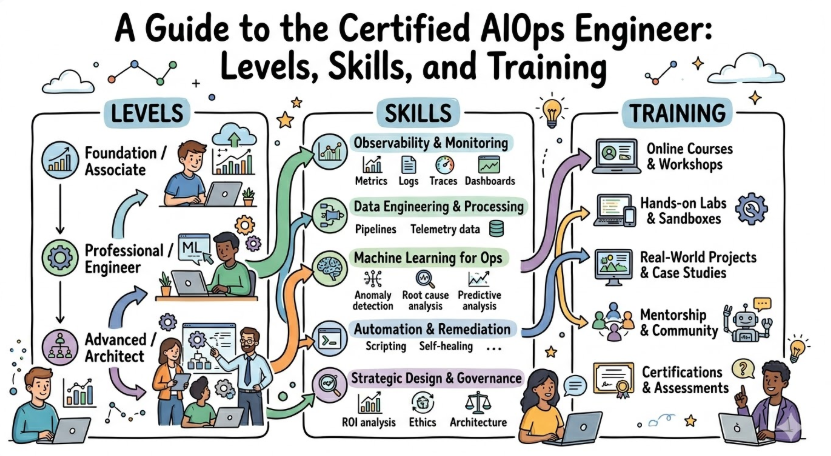
The program is divided into three distinct levels to accommodate various career stages and technical depths. The Foundation level focuses on the “What” and “Why,” covering the basics of data ingestion, noise reduction, and event correlation. This is the entry point for most engineers looking to pivot into the space and provides the necessary vocabulary and conceptual framework to understand how ML models interact with infrastructure telemetry.
The Professional level moves into the “How,” focusing on the deployment of specific AIOps platforms and the customization of anomaly detection algorithms. At this stage, engineers learn to integrate AIOps with existing CI/CD pipelines and ITSM tools. The Advanced level is reserved for those who wish to become architects, focusing on the design of autonomous self-healing systems and the ethical governance of AI within the IT ecosystem. This level aligns with senior leadership and principal engineering roles where strategic decision-making is paramount.
Complete Certified AIOps Engineer Certification Table
| Track | Level | Who it’s for | Prerequisites | Skills Covered | Recommended Order |
| AIOps Core | Foundation | Junior/Mid DevOps & SREs | Basic Linux & Cloud | Data Ingestion, Event Correlation | 1 |
| AIOps Implementation | Professional | Senior Engineers/Architects | Foundation Cert | ML Model Deployment, Anomaly Detection | 2 |
| Autonomous Ops | Advanced | Principal Engineers/Tech Leads | Professional Cert | Self-healing Systems, AI Governance | 3 |
| Data Analytics | Specialist | Data Engineers | Basic Python/SQL | Telemetry Pipelines, Feature Engineering | Optional |
| Strategic AIOps | Leadership | Managers & Directors | Industry Experience | ROI Analysis, Change Management | Optional |
Detailed Guide for Each Certified AIOps Engineer Certification
Certified AIOps Engineer – Foundation
What it is
This level validates a candidate’s understanding of the core pillars of AIOps, including data collection from diverse sources and the basics of noise reduction in alerting systems.
Who should take it
It is suitable for DevOps engineers, systems administrators, and recent graduates who want to establish a strong theoretical and practical baseline in intelligent operations.
Skills you’ll gain
- Understanding the AIOps lifecycle and architecture.
- Identifying different types of IT data (metrics, logs, traces).
- Learning basic event correlation techniques to reduce alert fatigue.
- Configuring foundational monitoring tools for AI readiness.
Real-world projects you should be able to do
- Setting up a unified telemetry pipeline for a multi-service application.
- Implementing basic deduplication logic on a high-volume stream of alerts.
Preparation plan
- 7–14 days: Focus on core definitions, AIOps pillars, and reading the official study guide.
- 30 days: Engage with lab environments to practice data ingestion and basic dashboarding.
- 60 days: Complete mock exams and deep-dive into case studies of enterprise AIOps adoption.
Common mistakes
- Underestimating the importance of data quality before applying ML.
- Skipping the fundamental concepts of SRE and monitoring.
Best next certification after this
- Same-track option: Certified AIOps Engineer – Professional.
- Cross-track option: Certified SRE Professional.
- Leadership option: ITIL 4 Specialist: High-velocity IT.
Certified AIOps Engineer – Professional
What it is
This certification validates the ability to implement and manage AIOps platforms, including the tuning of machine learning models for anomaly detection and root cause analysis.
Who should take it
Senior DevOps engineers and SREs who are responsible for the reliability and performance of production systems at scale.
Skills you’ll gain
- Deploying and configuring enterprise-grade AIOps tools.
- Applying supervised and unsupervised learning to infrastructure data.
- Automating incident response workflows using AIOps insights.
- Integrating AIOps with existing ITSM and ChatOps frameworks.
Real-world projects you should be able to do
- Building an automated root cause analysis engine for a microservices outage.
- Designing a predictive scaling model for a seasonal e-commerce application.
Preparation plan
- 7–14 days: Review Foundation concepts and start exploring AIOps platform documentation.
- 30 days: Perform intensive hands-on labs focused on ML model integration and tuning.
- 60 days: Architect a full-stack AIOps solution in a sandbox environment and troubleshoot common integration issues.
Common mistakes
- Relying too heavily on default model settings without understanding the underlying data.
- Failing to align AIOps outputs with business-critical KPIs.
Best next certification after this
- Same-track option: Certified AIOps Engineer – Advanced.
- Cross-track option: Certified MLOps Professional.
- Leadership option: Digital Transformation Specialist.
Certified AIOps Engineer – Advanced
What it is
This level validates the highest expertise in designing autonomous systems that can self-detect, self-diagnose, and self-heal without human intervention.
Who should take it
Principal engineers, Chief Technology Officers, and lead architects who are responsible for the long-term technical vision of an organization.
Skills you’ll gain
- Designing large-scale autonomous operation frameworks.
- Implementing advanced reinforcement learning for infrastructure management.
- Establishing governance and ethical guidelines for AI-driven IT.
- Calculating and demonstrating the ROI of advanced AIOps implementations.
Real-world projects you should be able to do
- Architecting a zero-touch incident remediation system for a global enterprise.
- Developing a custom ML model to predict long-term capacity requirements across hybrid-cloud environments.
Preparation plan
- 7–14 days: Research current trends in autonomous operations and read academic whitepapers on AI in IT.
- 30 days: Experiment with custom model development and high-level architectural design.
- 60 days: Prepare a comprehensive architectural proposal for an autonomous NOC and defend it against peer review.
Common mistakes
- Over-engineering solutions for simple problems that could be solved with basic automation.
- Ignoring the cultural and organizational changes required for autonomous operations.
Best next certification after this
- Same-track option: Fellowship in Artificial Intelligence Operations.
- Cross-track option: Chief Technology Officer Certification.
- Leadership option: Executive Leadership Program in AI.
Choose Your Learning Path
DevOps Path
For those in DevOps, the focus is on integrating intelligence into the CI/CD pipeline. You will learn how to use AIOps to analyze build logs, predict deployment failures, and optimize resource allocation in Kubernetes clusters. This path ensures that the “Ops” part of DevOps is as automated and intelligent as the “Dev” part. It is about moving from manual gatekeeping to automated, AI-driven quality assurance.
DevSecOps Path
In the security-focused path, AIOps is used to identify sophisticated threats that bypass traditional signature-based detection. You will learn to use ML to detect behavioral anomalies in user activity and network traffic. This path is critical for professionals who want to build resilient systems that can automatically quarantine compromised components. It bridges the gap between security monitoring and intelligent incident response.
SRE Path
The Site Reliability Engineering path emphasizes the reduction of toil through intelligent automation. You will focus on using AIOps to manage error budgets, predict SLO violations, and automate the “drills” for disaster recovery. This is about making the SRE role more strategic by removing the burden of manual log analysis during an outage. It empowers SREs to build more reliable systems with less human effort.
AIOps Path
This is the pure specialization path for those who want to be the primary architects of intelligent operations. It covers the full spectrum from data collection to autonomous remediation. You will become the bridge between the data science team and the infrastructure team, ensuring that ML models are properly productionized. This path is ideal for those who want to lead the transformation of a traditional NOC into an AI-driven command center.
MLOps Path
The MLOps path focuses on the lifecycle of the machine learning models that power AIOps. You will learn how to manage model versioning, monitoring for model drift, and ensuring the continuous integration of new training data. This is a technical path that requires a strong understanding of both software engineering and data science. It is essential for ensuring that the “AI” in AIOps remains accurate and effective over time.
DataOps Path
DataOps focuses on the quality and reliability of the data pipelines that feed the AIOps engine. Without clean, consistent data, even the best AI models will fail. You will learn how to build resilient data architectures that can handle the massive scale of infrastructure telemetry. This path is perfect for engineers who enjoy working with high-volume data streams and want to ensure the integrity of the operational platform.
FinOps Path
The FinOps path uses AIOps to optimize cloud spending and predict future costs. You will learn how to use ML to identify underutilized resources and automate the procurement of reserved instances or spot capacity. This path is highly valued by management, as it directly impacts the organization’s profitability. It combines technical cloud knowledge with financial intelligence to create a sustainable cloud strategy.
Role → Recommended Certified AIOps Engineer Certifications
| Role | Recommended Certifications |
| DevOps Engineer | AIOps Foundation, AIOps Implementation |
| SRE | AIOps Foundation, AIOps Implementation, SRE Professional |
| Platform Engineer | AIOps Implementation, Autonomous Ops |
| Cloud Engineer | AIOps Foundation, Cloud Specialist |
| Security Engineer | AIOps Foundation, DevSecOps Specialist |
| Data Engineer | AIOps Foundation, Data Analytics Specialist |
| FinOps Practitioner | AIOps Foundation, FinOps Specialist |
| Engineering Manager | AIOps Foundation, Strategic AIOps |
Next Certifications to Take After Certified AIOps Engineer
Same Track Progression
Once you have completed the core levels of the Certified AIOps Engineer program, you should look toward deep specialization. This might include certifications in specific AIOps platforms or advanced degrees in Artificial Intelligence. The goal is to move from a generalist understanding to becoming a recognized authority on autonomous infrastructure. This often involves contributing to open-source AIOps projects or speaking at industry conferences to solidify your expert status.
Cross-Track Expansion
Broadening your skills is essential for staying versatile in a rapidly changing market. After mastering AIOps, a logical step is to explore DevSecOps or FinOps. Understanding how AI can be applied to security and cost management makes you a more holistic architect. This cross-pollination of skills allows you to solve complex business problems that span multiple departments, increasing your value to the organization significantly.
Leadership & Management Track
For those looking to transition out of hands-on engineering, the leadership track is the natural evolution. This involves certifications in IT management, digital transformation, and executive leadership. Your background in AIOps will give you a unique perspective on how to lead technology teams in an era where automation is the primary driver of efficiency. You will be well-equipped to manage the cultural shift required to adopt AI at an enterprise level.
Training & Certification Support Providers for Certified AIOps Engineer
DevOpsSchool
DevOpsSchool is a leading provider of comprehensive training programs that cover the entire DevOps and AIOps ecosystem. They offer instructor-led sessions that are designed to take a student from a basic understanding to advanced implementation skills. Their curriculum is updated frequently to reflect the latest tools and industry shifts. Students benefit from extensive lab environments and real-world project simulations that prepare them for the rigors of production environments. They have a strong presence in India and provide excellent support for those seeking to pass their certification exams on the first attempt.
Cotocus
Cotocus focuses on the intersection of technical training and specialized consulting, making their courses highly practical for working professionals. They emphasize a “learning by doing” approach, where students are encouraged to solve actual engineering problems using AIOps methodologies. Their trainers are often active consultants who bring fresh, relevant insights from the field into the classroom. This ensures that the training is not just theoretical but grounded in the actual challenges of modern enterprise IT. They offer flexible learning options, including self-paced and live online bootcamps.
Scmgalaxy
Scmgalaxy is a community-driven platform that provides a wealth of resources for software configuration management and DevOps professionals. They offer specialized tracks for AIOps that are focused on the automation of the software delivery lifecycle. Their platform is an excellent place for engineers to find tutorials, whitepapers, and peer support. They host regular webinars and workshops that dive into specific technical challenges, making it an ideal resource for continuous learning after you have achieved your initial certification. Their focus is on building a robust community of practice.
BestDevOps
BestDevOps is known for its high-quality, curated training content that focuses on the most critical skills needed in today’s job market. Their AIOps courses are streamlined to remove “fluff” and focus on the core competencies required for certification. They offer excellent mentorship programs where students can get one-on-one guidance from experienced industry veterans. Their training modules are designed to be digestible for busy professionals who need to balance their learning with a full-time job. They provide a strong foundation for anyone looking to enter the AIOps space.
devsecopsschool.com
DevSecOpsSchool is the go-to provider for engineers who want to integrate security into their automated workflows. Their AIOps training includes specific modules on using AI for threat hunting, vulnerability management, and automated compliance. They emphasize the “Shift Left” philosophy, where security is baked into the development process from the beginning. This is an essential provider for anyone working in highly regulated industries like finance or healthcare. Their training helps engineers build systems that are not only intelligent but also inherently secure and compliant.
sreschool.com
SRESchool focuses exclusively on the principles of site reliability engineering and how they can be enhanced through AIOps. Their courses cover essential SRE topics like SLIs, SLOs, and error budgets, all within the context of intelligent automation. They teach students how to build observability stacks that go beyond simple monitoring to provide actionable insights. This provider is ideal for engineers who want to master the art of maintaining high availability in complex systems. Their curriculum is deeply rooted in the practices pioneered by major tech giants like Google and Netflix.
aiopsschool.com
AIOpsSchool is the primary host and authority for the Certified AIOps Engineer program. They provide the most direct and comprehensive path to achieving this certification. Their platform is built specifically to support the unique requirements of AIOps training, including high-scale telemetry simulations and ML model playgrounds. By training directly with the source, students ensure they are getting the most accurate and up-to-date information available. They offer a structured path from Foundation to Advanced levels, with a focus on producing industry-ready engineers who can lead AIOps initiatives.
dataopsschool.com
DataOpsSchool addresses the critical need for robust data management in the AIOps lifecycle. Their training focuses on the engineering of data pipelines, ensuring data quality, and managing data at scale. They teach students how to apply DevOps principles to data workflows, resulting in faster and more reliable data delivery. This is a vital resource for anyone who wants to ensure their AIOps implementation is built on a solid data foundation. Their courses bridge the gap between traditional data engineering and modern automated operations.
finopsschool.com
FinOpsSchool provides specialized training on the financial management of cloud resources, enhanced by AI and ML. They teach engineers and managers how to use AIOps to bring accountability and optimization to cloud spending. Their curriculum covers the “Inform, Optimize, and Operate” phases of the FinOps lifecycle. This training is essential for organizations looking to maximize the value of their cloud investments while keeping costs under control. Students learn how to use automated tools to predict spending patterns and identify cost-saving opportunities in real-time.
Frequently Asked Questions (General)
- What is the typical timeframe to complete the Foundation level?
Most professionals with a background in IT can complete the Foundation level within four to six weeks of dedicated study. - Are there any mandatory prerequisites for the Foundation exam?
No, there are no mandatory prerequisites, but a basic understanding of Linux, cloud computing, and monitoring is highly recommended. - How long does the certification remain valid?
The certification is typically valid for two years, after which a recertification or progression to a higher level is required. - Is this certification recognized globally?
Yes, the skills and methodologies taught in the program are based on global industry standards and are recognized by major tech employers. - What kind of salary increase can I expect after becoming certified?
While it varies by region and experience, many engineers see a 15% to 25% increase in compensation when moving into specialized AIOps roles. - Do I need to be a data scientist to pass the exam?
No, you do not need to be a data scientist. The focus is on the application of ML tools, not building them from scratch. - Are the exams proctored or open-book?
Most professional-level exams are proctored online to maintain the integrity and value of the certification. - Can I take the training online?
Yes, all support providers listed offer comprehensive online training options, including live sessions and self-paced modules. - What tools will I learn to use?
You will learn the concepts behind popular tools like ELK, Prometheus, and various proprietary AIOps platforms. - How does this differ from a standard DevOps certification?
Standard DevOps focuses on culture and CI/CD pipelines, while AIOps focuses specifically on using AI to manage and scale operations. - Is there a community for certified professionals?
Yes, AIOpsSchool maintains a private community for certified engineers to network and share knowledge. - Does the certification involve coding?
Yes, basic scripting in Python or similar languages is often required for the Professional and Advanced levels.
FAQs on Certified AIOps Engineer
- Why is AIOps specifically important for microservices?
Microservices create too many dependencies for humans to track. AIOps uses ML to map these dependencies automatically and identify the true source of failures. - How does AIOps help with alert fatigue?
It uses event correlation and deduplication to group hundreds of related alerts into a single actionable incident, allowing engineers to focus on the real problem. - Can AIOps prevent outages?
While it can’t prevent every failure, its predictive analytics can identify “soft failures” or trends that lead to outages, allowing for proactive intervention. - What role does data quality play in the certification?
A significant portion of the training is dedicated to data cleaning and normalization, as poor data leads to inaccurate AI models. - Is AIOps only for large enterprises?
No, any organization with complex cloud environments can benefit from the efficiency and automation that AIOps provides. - How does this certification help with career progression?
It validates your ability to lead high-value automation projects, making you a candidate for senior architect and leadership roles. - What is the focus of the hands-on labs?
Labs focus on real-world scenarios like diagnosing a cascading failure or optimizing resource allocation in a Kubernetes cluster. - How is the ROI of an AIOps engineer calculated?
It is calculated based on the reduction in MTTR, the decrease in manual “toil” hours, and the prevention of costly downtime.
Final Thoughts: Is Certified AIOps Engineer Worth It?
If you are looking for an honest assessment from a mentor’s perspective: the industry is moving in this direction whether you are ready or not. The volume of data we manage is only going to increase, and the traditional methods of infrastructure management are becoming obsolete. Investing in an AIOps certification is not about chasing a buzzword; it is about acquiring the specific skill set required to manage the next generation of computing.
The most successful engineers I have seen are those who anticipate the shift toward autonomous systems. By becoming a Certified AIOps Engineer, you are positioning yourself at the forefront of this evolution. It is a challenging path that requires a blend of operational expertise and analytical thinking, but the professional rewards—in terms of job security, compensation, and the ability to work on cutting-edge technology—are well worth the effort. My advice is to start with the Foundation level, understand the core pillars, and then build your expertise based on the needs of your current or future organization.
