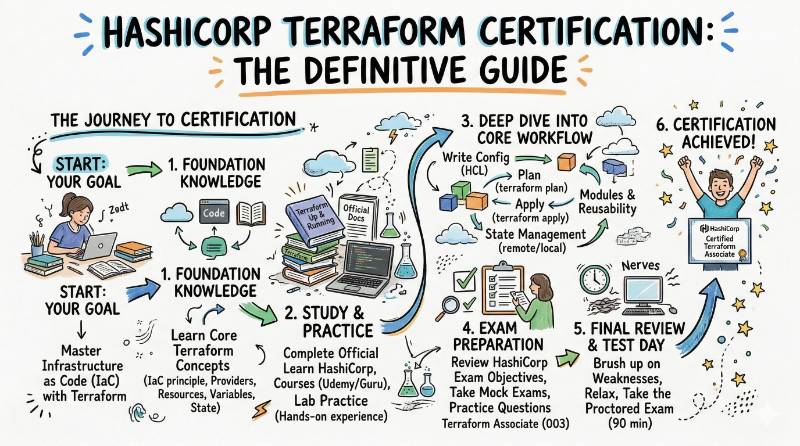
In the earlier days of cloud computing, managing infrastructure was often an artisan’s job. Each server was hand-crafted, and each network was manually tuned. But as systems grew, this approach became a liability. To build at a global scale, we had to move from “craftsmanship” to “industrial automation.” This is where Infrastructure as Code (IaC) changed the game.
HashiCorp Terraform has emerged as the industry’s assembly line. It allows teams to define, deploy, and manage entire cloud ecosystems using simple, version-controlled code. Whether you are an engineer in a growing Indian tech hub or a manager for a global enterprise, Terraform is the tool that ensures your infrastructure is reliable and cost-effective.
For software engineers and leadership, this shift toward automation is no longer just a trend. It is a core requirement for any business that needs to move fast without breaking its systems. By using Terraform, the gap between writing software and deploying it is bridged, making the entire lifecycle more efficient and reliable.
The Strategic Importance of Automation
The transition from manual setups to automated workflows is seen as a major turning point for technology teams. When infrastructure is handled as code, the risk of human error is virtually eliminated. It is often noted that manual changes lead to inconsistencies, which are hard to track and fix. Automation solves this by ensuring that every environment—whether for testing or production—is identical.
From a management perspective, this approach offers better visibility into costs and resources. For engineers, it means more time can be spent on solving complex problems rather than performing repetitive tasks. The ability to launch complex systems with high precision is what defines a successful technical career in today’s market.
Expanding Skills with Observability Engineering
Building the infrastructure is only the first step. Once a system is running, it must be understood from the inside. This is why the Master in Observability Engineering Certifications Program is highly recommended. While Terraform is used to build the house, observability is what allows teams to see how the house is performing in real-time.
Through this specialized program, skills are gained in monitoring, logging, and tracing. It is acknowledged that even the best-automated systems can fail. When they do, observability provides the data needed to find the root cause quickly. Combining automation knowledge with observability expertise creates a well-rounded professional who can handle both the creation and the maintenance of modern systems.
Professional Certification Comparison
Choosing a clear starting point is essential for career growth. The following table provides a summary of the primary certification track.
| Track | Level | Who it’s for | Prerequisites | Skills covered | Recommended order |
| Infrastructure Automation | Associate | Engineers & Managers | Cloud Basics | HCL, State, Modules, CLI | Primary Step |
Hashicorp Certified Terraform Associate
What it is
The Hashicorp Certified Terraform Associate is a professional-level credential that confirms an individual’s proficiency in the core concepts of the tool. It is focused on the open-source version of the software. It verifies that the holder can effectively use the command-line interface, understand the internal state of the infrastructure, and follow best practices for resource management.
Who should take it
This certification is designed for software developers, systems administrators, and DevOps professionals who want to formalize their automation skills. It is also an excellent choice for engineering managers who need to speak the same language as their technical teams. If a career move toward platform engineering or site reliability is desired, this credential is often seen as a mandatory first step.
Skills you’ll gain
The training program is built to move a professional beyond basic tasks and into the realm of architectural design. A deep understanding of how infrastructure behaves under different conditions is developed.
A strong grasp of the configuration lifecycle is achieved. Knowledge of how to manage sensitive data and state files is also mastered.
- Mastery of the HashiCorp Configuration Language syntax is achieved.
- Advanced techniques for managing and securing the state file are learned.
- The ability to build and implement reusable modules for large-scale projects is gained.
- Knowledge of how to connect and interact with diverse cloud providers is mastered.
- Proficiency in using core commands like plan and apply in a professional workflow is established.
Real-world projects you should be able to do
After the training is completed, several high-value tasks can be performed. These projects reflect the actual needs of modern production environments.
Infrastructure is built with a focus on high availability and security. Environments are managed so they can be destroyed and recreated at a moment’s notice.
- A multi-tier cloud network is deployed across several regions using code.
- Automated provisioning of auto-scaling web clusters is achieved.
- Integration of infrastructure updates into an automated delivery pipeline is managed.
- Disaster recovery sites are launched automatically during system failures.
Preparation plan
A structured and disciplined approach to studying is the most effective way to ensure success.
- 7–14 days: This path is utilized by those who already have significant hands-on experience. The focus is placed on the official exam objectives and reviewing less-used commands.
- 30 days: This is the most common path. The first two weeks are spent on foundational concepts, while the final two weeks are dedicated to daily practice labs.
- 60 days: This path is recommended for those new to the cloud. The first month is spent learning general cloud and networking concepts, followed by a month of intense focused practice.
Common mistakes
Identifying and avoiding common errors is a key part of the preparation journey.
Errors often occur when the logic of the tool is misunderstood. These mistakes can lead to downtime if not handled correctly.
- Neglecting the importance of the state file can lead to catastrophic errors in production.
- Hardcoding sensitive values instead of using dynamic variables is a common security risk.
- Forgetting to perform a plan before an apply can cause unexpected changes to the system.
- Using overly complex logic for simple tasks often makes the code difficult to maintain.
Best Next Certification After This
Once the foundational automation certification is achieved, growth can continue in three distinct directions:
- Same Track: Further specialization in the Hashicorp ecosystem, such as mastering security automation through Vault, is encouraged.
- Cross-Track: Expanding into container orchestration with Kubernetes is seen as a logical next step for cloud professionals.
- Leadership: Focus on certifications that bridge the gap between technical execution and business strategy for large enterprises is recommended.
Choose Your Path: 6 Strategic Learning Journeys
Infrastructure automation is a foundational skill that allows professionals to branch out into various specializations:
- DevOps Path: Focuses on the seamless integration of automation into the software delivery lifecycle.
- DevSecOps Path: Prioritizes the embedding of security policies directly into the infrastructure code.
- SRE Path: Centers on building highly available and resilient systems that can handle large amounts of traffic.
- AIOps/MLOps Path: Automates the complex infrastructure required for artificial intelligence and machine learning models.
- DataOps Path: Focuses on managing the data pipelines and storage solutions needed for modern analytics.
- FinOps Path: Uses automation to track, manage, and optimize cloud spending to ensure cost-efficiency.
Role → Recommended Certifications Mapping
Specific certifications are suggested based on intended professional roles:
- DevOps Engineer: Terraform Associate + Kubernetes Specialist.
- SRE: Terraform Associate + Master in Observability.
- Platform Engineer: Terraform Associate + Multi-cloud Architect.
- Cloud Engineer: Terraform Associate + Solutions Architect.
- Security Engineer: Terraform Associate + Security Automation.
- Data Engineer: Terraform Associate + Big Data Specialist.
- FinOps Practitioner: Terraform Associate + Cloud Economics.
- Engineering Manager: Terraform Associate + Strategic Technology Leadership.
Top Institutions for Training and Certification
This institution is highly regarded for its rigorous and practical curriculum. They focus on ensuring that every student gains hands-on experience by solving real-world infrastructure problems in a lab environment.
Cotocus
A focus on corporate and team-based training is maintained here. They are known for helping large organizations transition to modern, automated workflows through intensive, project-based workshops.
Scmgalaxy
This platform is a major source of documentation and community support for engineers. It provides a wealth of resources for those who want to stay updated on the latest industry trends and tools.
BestDevOps
Training programs at this school are designed for quick career transformation. They provide a structured environment where professionals can move from basic concepts to advanced architecture in a short time.
DevSecOpsSchool
The critical intersection of security and automation is explored here. Students are taught how to build systems that are secure by design, using automated policy checks.
Sreschool
Education at this school is centered around the principles of reliability and system performance. It is an ideal choice for those looking to master the art of maintaining large-scale cloud deployments.
Aiopsschool
The future of IT operations is taught at this institution, with a focus on how artificial intelligence can be used to improve system management and automation.
Dataopsschool
Specialized training is provided for managing the complex infrastructure required for big data. They focus on ensuring data integrity and speed through automation.
Finopsschool
The financial management of cloud resources is the primary mission here. Engineers are taught how to build cost-effective infrastructure that aligns with business budgets.
Career-Focused FAQs
- Is the Terraform Associate exam considered difficult?It is a professional-level test that requires a solid grasp of both theory and the practical application of the tool.
- How much time should a working professional dedicate to study?Most individuals find that 30 to 45 days of consistent study is sufficient for success.
- Are there formal prerequisites for the exam?No formal requirements are needed, but a basic understanding of cloud providers is highly recommended.
- In what order should I take these certifications?The Terraform Associate is usually taken first, followed by a certification in container management or observability.
- Is the certification still relevant today?Yes. Automation is the foundation of modern technology, and the demand for skilled engineers is only increasing.
- What career growth can be expected after getting certified?Many professionals see opportunities for senior roles, lead engineering positions, and specialized architecture tasks.
- Can I pass the exam with only theoretical knowledge?It is very difficult. Many questions test your understanding of specific command-line behaviors that are only learned through practice.
- Does the certification expire?Yes, it is typically valid for two years, after which recertification is encouraged to stay current with software updates.
- How does Terraform compare to other tools?It is unique because it works across many different cloud providers with a single, unified language.
- Do I need to be a programmer to learn Terraform?While a coding background is helpful, the language used is designed to be readable and accessible to anyone in the IT field.
- Why is observability mentioned alongside Terraform?They are two halves of the same goal: one builds the system, and the other ensures the system is performing correctly.
- Should an engineering manager pursue this certification?Yes, it provides the technical insight needed to lead teams effectively and manage project timelines.
FAQs on Hashicorp Terraform Training & Certification Program
- Where can I find the official registration link?Detailed information and the registration link can be found at the official certification page.
- What is the format of the exam questions?The exam consists of a variety of multiple-choice, multiple-response, and true/false questions.
- Is hands-on lab access provided during the training?Yes, reputable training providers always include dedicated lab environments for practical learning.
- Can the exam be taken in India?Yes, the exam is available globally as an online proctored test, allowing you to take it from any location.
- What is the passing score for the certification?A score of approximately 70% is generally required to pass the exam and receive the credential.
- Is there a policy for retaking the exam?Yes, if the first attempt is unsuccessful, a retake can be scheduled after a designated waiting period.
- Are Hashicorp certifications recognized globally?Yes, they are recognized by major technology companies worldwide as a proof of automation competence.
- Will this training help me in technical interviews?The practical knowledge gained is directly applicable to technical screening questions for high-level roles.
Conclusion
The journey toward mastery in Hashicorp Terraform is a transformative step for any professional in the technology sector. It is observed that as organizations move deeper into the cloud, the reliance on manual processes is fading away. By becoming an expert in infrastructure automation, an individual is not just learning a tool; they are adopting a more efficient and reliable way of working. This guide has outlined the path from understanding the basics to achieving a professional certification that is recognized worldwide. When combined with a focus on observability and a commitment to continuous learning, the possibilities for career growth are significant. Whether the goal is to become a senior engineer or a strategic manager, the skills gained through this program form the foundation of a successful future in the technology industry.
