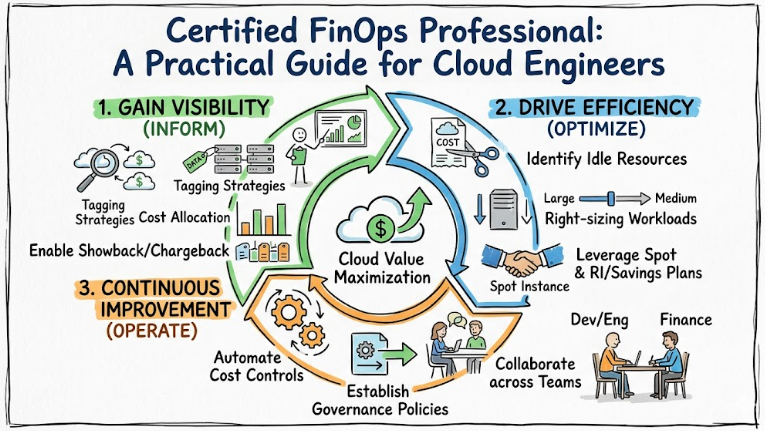
The Certified FinOps Professional program offered through finopsschool is a comprehensive educational framework designed for engineers, finance experts, and business leaders who want to master the art of cloud financial management. This guide is specifically crafted for professionals working in DevOps, cloud-native environments, and platform engineering who need to bridge the gap between technical operations and financial accountability. As cloud spending continues to grow, understanding how to balance performance with cost is no longer optional; it is a core requirement for modern engineering leadership. This guide helps you navigate the various certification levels, understand the real-world application of FinOps principles, and determine which learning path aligns best with your specific career goals in the global market.
What is the Certified FinOps Professional?
The Certified FinOps Professional designation represents a verified level of expertise in the FinOps framework, focusing on the three main phases: Inform, Optimize, and Operate. It exists because traditional financial procurement does not work in the variable, high-speed world of cloud computing. This program moves beyond theoretical knowledge and emphasizes production-focused learning where engineers learn to build cost-aware architectures.
By aligning with modern engineering workflows, this certification ensures that technical teams can communicate effectively with finance departments. It provides the tools to implement unit economics, cloud cost visibility, and automated governance. Enterprise practices today require that every resource provisioned has a clear business value, and this certification validates a professional’s ability to deliver that value.
Who Should Pursue Certified FinOps Professional?
This certification is highly beneficial for a wide range of roles including DevOps engineers, SREs, cloud architects, and platform leads who manage large-scale infrastructure. Security and data professionals also benefit as they learn to account for the cost of data egress and security tooling. It is not just for technical staff; finance managers and procurement specialists who handle cloud billing will find it essential for understanding how engineering decisions impact the bottom line.
In the global market, and specifically within the tech hubs of India, companies are looking for professionals who can manage massive cloud footprints efficiently. Whether you are a beginner looking to enter the cloud space or a seasoned manager aiming to optimize enterprise-wide spending, this path provides the necessary structure. It creates a common language between the people who build systems and the people who pay for them.
Why Certified FinOps Professional is Valuable and Beyond
The demand for FinOps expertise is growing as enterprises realize that moving to the cloud does not automatically save money without proper management. This certification provides longevity to your career because it focuses on principles and cultural shifts rather than just specific cloud provider tools. Even as technology stacks change, the need for financial accountability and resource efficiency remains constant.
Professionals who hold this certification often see a high return on their time investment because they become indispensable during budget planning and architectural reviews. It helps you stay relevant by positioning you as a business-aligned engineer who understands the wider impact of technical choices. Enterprise adoption of FinOps is now a standard practice, making this a stable and high-growth career path.
Certified FinOps Professional Certification Overview
The program is delivered via the official Certified FinOps Professional curriculum and is hosted on the FinOpsSchool website. It utilizes a multi-level assessment approach that tests both conceptual understanding and practical application of the FinOps lifecycle. The ownership of the certification process ensures that the content is updated to reflect changing cloud billing models and industry best practices.
The structure is designed to be practical, moving from foundational concepts to professional-level strategy and eventually to advanced architectural optimization. Candidates are assessed on their ability to identify waste, forecast spending, and implement tagging strategies that provide deep visibility. This ensures that a certified individual can immediately contribute to a company’s cloud center of excellence.
Certified FinOps Professional Certification Tracks & Levels
The certification is structured into three primary levels: Foundation, Professional, and Advanced. The Foundation level is designed to provide a baseline understanding of terms and the cultural shift required for FinOps. It is the entry point for anyone involved in cloud usage, regardless of their technical depth.
As professionals progress to the Professional and Advanced levels, the focus shifts toward specialization in tracks like SRE-focused FinOps or DevOps-integrated cost management. These levels align with career progression, helping a junior engineer move into a lead or architectural role. The advanced tracks focus heavily on automation, policy-as-code, and driving organizational change across large engineering departments.
Complete Certified FinOps Professional Certification Table
| Track | Level | Who it’s for | Prerequisites | Skills Covered | Recommended Order |
| Core FinOps | Foundation | Beginners, Finance, Managers | None | FinOps Lifecycle, Terminology | 1 |
| Engineering | Professional | DevOps, SRE, Cloud Engineers | Foundation | Cost Optimization, Automation | 2 |
| Strategic | Advanced | Directors, Lead Architects | Professional | Governance, Unit Economics | 3 |
| Data | Specialist | Data Engineers, BI Analysts | Foundation | Big Data Costing, Storage ROI | 2 |
| Security | Specialist | DevSecOps, Compliance | Foundation | Tooling ROI, Security Spend | 2 |
Detailed Guide for Each Certified FinOps Professional Certification
Certified FinOps Professional – Foundation
What it is
This level validates a basic understanding of the FinOps framework and the ability to define the six core domains of FinOps. It ensures the candidate understands how cloud spending differs from traditional IT spending.
Who should take it
This is suitable for junior cloud engineers, finance analysts, and project managers who are new to cloud financial management and need a solid vocabulary.
Skills you’ll gain
- Understanding the three phases: Inform, Optimize, and Operate.
- Ability to explain the cloud bill to non-technical stakeholders.
- Knowledge of basic tagging and labeling strategies.
Real-world projects you should be able to do
- Create a basic cloud spend dashboard for a small team.
- Identify unallocated costs in a monthly billing report.
Preparation plan
- 7–14 days: Focus on memorizing the core principles and the FinOps lifecycle.
- 30 days: Review case studies of companies that successfully implemented FinOps.
- 60 days: Not typically required for this level unless combining with practical labs.
Common mistakes
Candidates often overlook the “cultural” aspect of FinOps and focus only on the technical tools.
Best next certification after this
- Same-track: Certified FinOps Professional – Professional
- Cross-track: SRE Foundation
- Leadership: FinOps Certified Practitioner
Certified FinOps Professional – Professional
What it is
This certification validates the ability to implement FinOps at scale, focusing on granular optimization and driving accountability across multiple engineering teams.
Who should take it
It is designed for mid-level engineers and cloud architects who are responsible for managing significant cloud budgets and infrastructure.
Skills you’ll gain
- Advanced rightsizing and instance selection strategies.
- Implementation of automated cost-anomaly detection.
- Development of internal showback and chargeback models.
Real-world projects you should be able to do
- Implement a policy-as-code solution to shut down idle resources.
- Negotiate and manage Reserved Instances or Savings Plans.
Preparation plan
- 7–14 days: Intensive review of advanced billing data and API integration.
- 30 days: Practical application in a sandbox environment to test optimization scripts.
- 60 days: Full preparation including mock exams and architectural design scenarios.
Common mistakes
Focusing too much on one cloud provider instead of maintaining a cloud-agnostic FinOps perspective.
Best next certification after this
- Same-track: Certified FinOps Professional – Advanced
- Cross-track: DevSecOps Engineering
- Leadership: Engineering Manager Roadmap
Choose Your Learning Path
DevOps Path
In this path, the focus is on integrating financial metrics directly into the CI/CD pipeline. Engineers learn to treat cost as a first-class metric alongside performance and security. By mastering these skills, DevOps professionals can ensure that every code deployment is cost-optimized from the start. This path leads to a career as a FinOps-aware DevOps lead.
DevSecOps Path
The DevSecOps path emphasizes the financial impact of security tools and compliance requirements. Professionals learn to balance the cost of high-availability security clusters with the actual risk profiles of the applications. This ensures that security is both robust and affordable. It is ideal for those managing security budgets in highly regulated industries.
SRE Path
For SREs, FinOps is about the relationship between reliability and cost. This path teaches how to set Service Level Objectives (SLOs) that account for the cost of maintaining 99.99% uptime versus 99.9%. Professionals learn to manage the cost of observability and logging infrastructure. It is a critical path for maintaining the financial health of complex, distributed systems.
AIOps Path
This path focuses on using artificial intelligence to automate financial operations and predict spending patterns. Professionals learn to implement machine learning models that can identify cost anomalies faster than manual reviews. It bridges the gap between data science and financial management. This is suitable for those looking to build the next generation of automated FinOps platforms.
MLOps Path
The MLOps path addresses the unique and often massive costs associated with training and deploying machine learning models. It covers GPU utilization, data storage for training sets, and the cost of inference at scale. This path is essential for organizations where AI initiatives are driving significant portions of the cloud bill. It ensures AI projects remain financially viable.
DataOps Path
DataOps professionals focus on the cost of data lifecycle management, from ingestion to archiving. This path covers the economics of data lakes, warehouses, and the egress charges associated with moving data between regions. It is designed for data engineers who need to optimize the cost of large-scale analytics platforms. It helps in making informed decisions about storage tiers and processing power.
FinOps Path
This is the pure specialization path for those who want to lead a FinOps Center of Excellence. It covers the full spectrum of cultural, financial, and technical skills needed to manage enterprise-wide cloud spending. Professionals learn high-level strategy, stakeholder management, and complex negotiation. It is the ultimate goal for those dedicated to the FinOps profession.
Role → Recommended Certified FinOps Professional Certifications
| Role | Recommended Certifications |
| DevOps Engineer | Certified FinOps Professional (Foundation & Professional) |
| SRE | Certified FinOps Professional (Professional) |
| Platform Engineer | Certified FinOps Professional (Advanced) |
| Cloud Engineer | Certified FinOps Professional (Foundation) |
| Security Engineer | Certified FinOps Professional (Specialist Track) |
| Data Engineer | Certified FinOps Professional (Data Specialist) |
| FinOps Practitioner | All Levels (Foundation, Professional, Advanced) |
| Engineering Manager | Certified FinOps Professional (Foundation & Strategic) |
Next Certifications to Take After Certified FinOps Professional
Same Track Progression
Deep specialization within the FinOps domain involves moving toward the Advanced level where you focus on organizational change and unit economics. This allows you to consult at the highest levels of an enterprise, helping them align their business strategy with their cloud spend. You will master the art of forecasting and long-term financial modeling.
Cross-Track Expansion
Broadening your skills by taking SRE or DevSecOps certifications helps you understand the technical trade-offs of your financial decisions. For example, a FinOps professional who understands SRE principles can better argue for the costs of high-availability infrastructure. This makes you a more versatile and well-rounded engineer or manager.
Leadership & Management Track
If you aim for leadership roles, transitioning into management certifications after mastering FinOps is a logical step. Understanding the “business of engineering” is a core trait of successful CTOs and VPs of Engineering. This path prepares you to manage large teams and budgets while maintaining a clear focus on corporate profitability.
Training & Certification Support Providers for Certified FinOps Professional
DevOpsSchool
DevOpsSchool offers a highly structured approach to technical education, providing deep dives into the integration of FinOps with existing DevOps workflows. Their curriculum is designed to be practical, ensuring that students can apply what they learn to real-world infrastructure immediately. With a focus on the latest tools and methodologies, they help engineers transition from traditional administration to modern, cost-aware cloud operations. Their support system is geared toward helping professionals in the Indian and global markets stay ahead of industry shifts.
Cotocus
Cotocus is known for its hands-on training modules that emphasize the practical side of cloud management. They provide a supportive environment where professionals can experiment with cost optimization techniques in safe, simulated environments. Their training for FinOps focuses on real-world scenarios that engineers face daily, such as rightsizing and managing multi-cloud environments. By offering personalized guidance, they ensure that every student understands the nuances of cloud billing and financial accountability. It is an excellent choice for those who prefer a more interactive learning experience.
Scmgalaxy
Scmgalaxy provides a vast repository of resources and community-driven knowledge for software configuration and financial management. Their support for FinOps learners includes detailed tutorials, webinars, and forums where professionals can share their experiences and challenges. They focus on the cultural aspects of FinOps, helping organizations build a mindset of shared responsibility. Their content is designed to be accessible and easy to digest, making it a great starting point for those new to the field. They emphasize the importance of visibility and transparency in cloud spending.
BestDevOps
BestDevOps focuses on delivering high-quality, industry-aligned training that helps professionals master the complexities of the FinOps framework. Their courses are built on years of industry experience, ensuring that the content is relevant to current enterprise needs. They provide deep insights into how FinOps principles can be applied to various cloud platforms like AWS, Azure, and Google Cloud. Their training is designed to be comprehensive, covering everything from basic terminology to advanced architectural optimization. They are committed to helping students achieve their certification goals and advance their careers.
devsecopsschool.com
This platform specializes in the intersection of security and operations, providing a unique perspective on FinOps. They help professionals understand how to maintain a high security posture without overspending on redundant or inefficient tools. Their curriculum includes practical labs on cost-effective security architectures and the financial impact of compliance requirements. By focusing on the “Sec” in DevSecOps, they offer a specialized path for security-minded professionals who need to manage budgets. They are a leader in providing specialized technical certification support.
sreschool.com
Sreschool.com focuses on the reliability and scalability aspects of cloud computing, teaching students how to balance these goals with financial constraints. Their training covers the economics of uptime and the cost of observability in large-scale systems. They provide a deep understanding of how SRE principles can be used to drive FinOps success through automated resource management. Their courses are ideal for engineers who want to specialize in high-availability systems while remaining cost-conscious. They offer a clear roadmap for moving from foundational knowledge to expert-level application.
aiopsschool.com
Aiopsschool.com addresses the growing field of artificial intelligence in operations, teaching how to use AI to drive financial efficiency. Their support for FinOps includes training on automated anomaly detection and predictive spending models. They help professionals leverage the power of machine learning to simplify the “Operate” phase of the FinOps lifecycle. Their curriculum is designed for forward-thinking engineers who want to stay at the cutting edge of automation. They provide the tools needed to build self-healing, cost-optimized infrastructure.
dataopsschool.com
This platform is dedicated to the unique financial challenges of data engineering and analytics. They provide detailed guidance on optimizing the cost of data storage, processing, and transfer across cloud environments. Their training helps DataOps professionals implement efficient data lifecycles that minimize waste while maximizing insights. By focusing on the unit economics of data, they empower engineers to build sustainable and scalable data platforms. They offer specialized support for those managing the massive costs associated with big data and enterprise analytics.
finopsschool.com
Finopsschool.com is the primary hub for the Certified FinOps Professional program, offering the most direct and comprehensive path to certification. They provide official study materials, practice exams, and expert-led training sessions that cover every aspect of the FinOps framework. Their focus is entirely on cloud financial management, ensuring that students get the most in-depth and up-to-date information available. As the hosting site for these certifications, they are the definitive source for those looking to validate their expertise. They support a global community of practitioners dedicated to the art of FinOps.
Frequently Asked Questions (General)
- How difficult is the Certified FinOps Professional exam?
The exam is moderately difficult as it requires both a solid understanding of financial concepts and practical knowledge of cloud infrastructure. - How much time is needed to prepare for the foundation level?
Most professionals can prepare for the foundation level in 7 to 14 days of dedicated study. - What are the prerequisites for the professional level?
You should typically have the foundation certification and at least a year of experience working in a cloud environment. - Is there a high return on investment for this certification?
Yes, as companies are actively seeking professionals who can reduce their cloud bills, often leading to salary increases. - In what order should I take the certifications?
It is highly recommended to start with the Foundation level before moving to Professional or Specialist tracks. - Does this certification cover multiple cloud providers?
Yes, the principles are cloud-agnostic and apply to AWS, Azure, Google Cloud, and others. - Is there a heavy focus on math?
While you need to understand basic financial formulas and unit economics, it does not require advanced mathematics. - How often do I need to renew the certification?
Certification validity usually lasts for two to three years, after which a refresher or higher-level exam is required. - Can a non-technical person pass this certification?
The Foundation level is designed to be accessible to finance and business roles, though technical knowledge helps. - Are there any hands-on labs in the exam?
Higher-level exams often include scenario-based questions that simulate real-world architectural and financial decisions. - How does this help my career in India?
The Indian tech sector is heavily focused on cloud migration, making cost optimization a top priority for local and global firms. - Is FinOps just about cutting costs?
No, it is about making informed decisions to maximize the business value of every dollar spent in the cloud.
FAQs on Certified FinOps Professional
- What is the primary goal of the Certified FinOps Professional program?
The goal is to provide a standardized framework for managing the variable costs of cloud computing through collaboration and accountability. - How does this certification differ from a standard Cloud Architect cert?
While an architect focuses on performance and design, a FinOps professional focuses on the financial efficiency and ROI of those designs. - Can I use this certification to move into a management role?
Yes, it demonstrates a strong understanding of the business side of engineering, which is a key requirement for technical leadership. - What are the three phases of FinOps covered in the exam?
The phases are Inform (visibility), Optimize (identifying savings), and Operate (aligning business goals with technical execution). - Is FinOps a technical role or a financial role?
It is a cross-functional role that requires an understanding of both technical infrastructure and financial management. - What is ‘Unit Economics’ in the context of this certification?
Unit economics involves measuring the cloud cost per business metric, such as cost per customer transaction or cost per user. - How does FinOps help with cloud governance?
It provides the framework for setting policies and guardrails that prevent uncontrolled spending without slowing down engineering teams. - Why is the cultural shift emphasized so much?
FinOps only works if engineering, finance, and business teams collaborate and take ownership of their respective cloud usage and costs.
Final Thoughts: Is Certified FinOps Professional Worth It?
From a career mentorship perspective, becoming a Certified FinOps Professional is one of the smartest moves you can make in the current cloud-native landscape. It moves you away from being a “cost center” and positions you as a strategic partner who understands how technology drives business profit. The reality of modern engineering is that budget is a constraint just like latency or disk space; mastering this constraint makes you a much more effective principal engineer or manager. If you are looking for a way to differentiate yourself in a crowded market, this path provides the specialized knowledge that enterprises are desperately seeking. It is a practical, high-value investment in your long-term career stability and growth.
