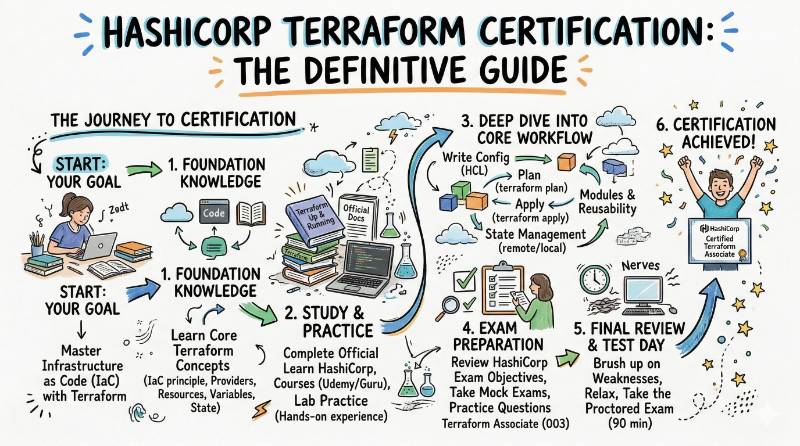
In the earlier days of cloud computing, managing infrastructure was often an artisan’s job. Each server was hand-crafted, and each network was manually tuned. But as systems grew, this approach became a liability. To build at a global scale, we had to move from “craftsmanship” to “industrial automation.” This is where Infrastructure as Code (IaC) changed the game.
HashiCorp Terraform has emerged as the industry’s assembly line. It allows teams to define, deploy, and manage entire cloud ecosystems using simple, version-controlled code. Whether you are an engineer in a growing Indian tech hub or a manager for a global enterprise, Terraform is the tool that ensures your infrastructure is reliable and cost-effective.
As someone who has navigated the shift from physical data centers to cloud-native architectures, I see Terraform as the essential foundation. This guide is designed to help you navigate the HashiCorp certification landscape and understand how it connects to other vital skills like the Certified Kubernetes Application Developer (CKAD).
The Terraform Certification Landscape
The HashiCorp certification program is built to validate that an engineer doesn’t just know the commands, but understands the lifecycle of automated infrastructure.
Official Certification Matrix
| Track | Level | Who it’s for | Prerequisites | Skills Covered | Recommended Order |
| Infrastructure Automation | Associate | Software Engineers, DevOps, SREs, Cloud Admins | Basic Cloud Awareness | HCL Syntax, State, Modules, Workspaces, Terraform Cloud | 1st |
Deep Dive: HashiCorp Certified: Terraform Associate
This credential is the global benchmark for anyone involved in cloud operations. It proves you have the technical discipline to manage resources across any major cloud provider.
What it is
The HashiCorp Certified: Terraform Associate is a professional-level validation of your competency with Terraform’s open-source features. It tests your ability to write HashiCorp Configuration Language (HCL), manage the critical “State” file, and use the Terraform CLI to build and version infrastructure safely. It also introduces the benefits of Terraform Cloud for team collaboration.
Who should take it
- Software Engineers: Who want to understand the environment their code lives in.
- DevOps & SRE Professionals: Who need to standardize deployments across multiple teams.
- Cloud Architects: Who are designing scalable, repeatable systems.
- Engineering Managers: Who need to understand the technical risks and benefits of automation.
Skills you’ll gain
Gaining this certification means moving from a “scripting” mindset to an “engineering” mindset.
- Declarative Infrastructure: Learning to describe the final state you want, rather than the steps to get there.
- State Management Mastery: Understanding how Terraform tracks resources and how to protect that data in a team environment.
- Modular Architecture: Learning to package infrastructure into reusable, versioned components.
- Safe Execution: Using the “Plan” and “Apply” workflow to ensure changes are predictable and reversible.
Real-world projects you should be able to do after it
Once you are certified, you should be capable of handling high-impact tasks:
- Multi-Region Networking: Building a secure, connected network across AWS, Azure, or GCP in minutes.
- Auto-Scaling Clusters: Deploying compute clusters that grow and shrink based on traffic, all managed through code.
- Disaster Recovery Sites: Creating a standby environment that can be spun up instantly if a primary region fails.
- Policy-as-Code Implementation: Using Terraform Cloud to ensure no one can deploy an insecure database or an open storage bucket.
Preparation Plan
- 7-Day Sprint (For those with experience): Focus heavily on the “State” commands and the nuances of Terraform Cloud. Take three full-length practice exams to identify knowledge gaps.
- 30-Day Plan (Recommended): Spend the first two weeks building three small projects (a VPC, a Load Balancer, and an S3 bucket). Spend the final two weeks reading the official documentation and practicing CLI flags.
- 60-Day Journey (For beginners): Spend the first month learning a specific cloud provider (like AWS). You cannot automate what you do not understand manually. Spend the second month focusing on HCL syntax and modular design.
Common Mistakes
Many talented engineers struggle with the exam because they rely on bad habits:
- Neglecting the State File: Not understanding how to move, refresh, or protect the state file is the leading cause of production outages and exam failure.
- Hardcoding Values: Beginners often put IDs and passwords in their code. Professionals use variables and data sources.
- Skipping the ‘Plan’ phase: Many try to run “Apply” without checking the “Plan” first. In a professional setting, this is how accidental deletions happen.
The Next Step: Beyond Infrastructure
Infrastructure is the foundation, but the applications are what drive the business. After you master Terraform, the logical next step is to master how those applications are deployed. I highly recommend focusing on the Certified Kubernetes Application Developer (CKAD). While Terraform builds the cluster, CKAD ensures you can run scalable, containerized applications on top of it.
Choose Your Path: 6 Specialized Learning Tracks
Once you have mastered Terraform, you can pivot into one of these specialized domains:
1. The DevOps Path
Focus on the end-to-end delivery of software. Use Terraform to build the road, and CI/CD tools to move the traffic.
- Core Goal: Speed and Repeatability.
2. The DevSecOps Path
Integrate security into the code itself. Use Terraform to ensure every resource is encrypted and compliant by default.
- Core Goal: Security by Design.
3. The SRE (Site Reliability Engineering) Path
Focus on uptime and reliability. Use Terraform to manage monitoring and automated failover systems.
- Core Goal: System Resilience.
4. The AIOps/MLOps Path
Automate the massive compute power needed for AI models. Use Terraform to spin up GPU clusters on demand.
- Core Goal: Scalable Intelligence.
5. The DataOps Path
Manage the lifecycle of data pipelines and warehouses like Snowflake or BigQuery through code.
- Core Goal: Predictable Data Flow.
6. The FinOps Path
Optimize your cloud bill. Use Terraform to ensure resources are right-sized and automatically shut down when not in use.
- Core Goal: Financial Accountability.
Role → Recommended Certifications
| Professional Role | Recommended Certification Path |
| DevOps Engineer | Terraform Associate, CKA, AWS DevOps Engineer Pro |
| SRE | Terraform Associate, CKAD, Google Professional Cloud DevOps |
| Platform Engineer | Terraform Associate, CKA, CKS (Security Specialist) |
| Cloud Engineer | Terraform Associate, Azure Administrator, AWS SysOps |
| Security Engineer | Terraform Associate, CKS, Security Specialty |
| Data Engineer | Terraform Associate, Google Professional Data Engineer |
| FinOps Practitioner | Terraform Associate, FinOps Certified Practitioner |
| Engineering Manager | Terraform Associate, PMP, AWS Cloud Practitioner |
Next Certifications to Take
Based on industry trends for modern software engineers, here are three directions you can take after your Terraform Associate:
- Same Track (Automation): Certified Kubernetes Administrator (CKA). Deepen your infrastructure skills in the world of containers.
- Cross-Track (Application): Certified Kubernetes Application Developer (CKAD). Learn to build and deploy the applications that live on your infrastructure.
- Leadership (Strategy): AWS or Azure Solutions Architect Professional. Shift your focus to high-level design and organizational strategy.
Training Institutions for CKAD (CDE)
If you are looking to bridge the gap between Terraform and Kubernetes, these institutions offer specialized training for the Certified Kubernetes Application Developer (CKAD):
- DevOpsSchool: A premier training provider that offers hands-on, project-based learning. They focus on real-world scenarios that prepare you for the rigors of production environments.
- Cotocus: Known for their intensive bootcamps, they provide deep dives into container orchestration and microservices deployment strategies.
- Scmgalaxy: A massive resource hub and community for DevOps enthusiasts. They provide extensive documentation and expert-led sessions on the entire CI/CD toolchain.
- BestDevOps: They specialize in simplifying complex technical topics, making them a great choice for engineers looking to get certified on their first attempt.
- devsecopsschool: Focuses specifically on the “Sec” in DevSecOps, teaching you how to build secure containers and Kubernetes environments from day one.
- sreschool: Dedicated to the principles of reliability. They teach you how to use Kubernetes to build systems that stay up under pressure.
- aiopsschool: Tailors Kubernetes training for AI and Machine Learning workloads, helping you manage the heavy-duty compute needed for modern models.
- dataopsschool: Focuses on the unique challenges of running data-intensive applications and databases within a Kubernetes cluster.
- finopsschool: Teaches you the financial side of Kubernetes—how to manage resource requests and limits to keep your cloud bill in check.
FAQs: Certified Kubernetes Application Developer (CKAD)
1. Is the CKAD exam multiple choice?
No. It is a performance-based exam. You are given a set of problems to solve in a live Kubernetes cluster using the command line.
2. How long should I study for the CKAD?
For most working engineers, 4–6 weeks of consistent practice is the sweet spot to feel comfortable with the speed required.
3. Do I need to be a senior developer?
No. However, you should be comfortable with the Linux command line and understand basic application logic.
4. Why take CKAD after Terraform?
Terraform builds the house; CKAD shows you how to run the business inside it. They are the two most powerful skills in the cloud-native world.
5. What is the hardest part of the exam?
Most people say it is the time limit. You have to be fast and accurate with your commands to finish all the tasks.
6. Does the certification expire?
Yes, it is valid for 3 years. This ensures you stay up-to-date with the fast-moving Kubernetes ecosystem.
7. Can I use documentation during the test?
Yes, you are allowed one tab open to the official Kubernetes documentation, which is why knowing where to find information is a key skill.
8. Is the exam available in India?
Yes, the exam is proctored online and can be taken from anywhere in the world.
General FAQs
1. How long is the Terraform Associate exam?
The exam lasts 60 minutes.
2. What is the format of the Terraform exam?
It consists of multiple-choice, multiple-response, and “drag and drop” questions. There are no live coding labs in the Associate level.
3. Is there a passing score?
HashiCorp does not publish the exact passing score, but it is generally estimated to be around 70%.
4. Do I need to know a specific cloud provider like AWS?
No. The exam is cloud-agnostic. However, having basic knowledge of any cloud (AWS, Azure, or GCP) makes the examples much easier to understand.
5. Can I take the exam from home?
Yes, the exam is proctored online. You just need a quiet room, a webcam, and a stable internet connection.
6. How much does the exam cost?
The fee is approximately $70 USD, making it one of the most affordable professional certifications.
7. Is Terraform better than CloudFormation or ARM?
Terraform is generally preferred because it works with any provider. This makes your skills portable if your company moves from AWS to Azure.
8. How often is the exam updated?
HashiCorp updates the exam periodically to reflect new features in the latest stable versions of Terraform.
9. Are there prerequisites for the Associate exam?
No formal prerequisites are required, but 6 months of cloud experience is highly recommended.
10. What happens if I fail?
You can retake the exam, but you will have to pay the registration fee again.
11. Is Terraform Cloud covered in the exam?
Yes. You should understand the basic features of Terraform Cloud, such as remote runs, workspaces, and team management.
12. Does the certificate expire?
Yes, the Terraform Associate certification is valid for 2 years.
Conclusion
Mastering HashiCorp Terraform is a significant milestone in any cloud career. It marks the transition from manual, reactive tasks to a professional, proactive approach to infrastructure. By earning this certification, you aren’t just learning a tool; you are learning the language of the modern cloud. However, the true “Domain Expert” knows that infrastructure is only half the battle. By combining your Terraform skills with a deep understanding of Kubernetes—specifically through the Certified Kubernetes Application Developer (CKAD) program—you position yourself at the very top of the global engineering market. Whether you decide to follow the path of an SRE, a Security Engineer, or a FinOps Practitioner, the ability to automate through code will be your greatest asset. Start with the basics, build your own projects, and never stop exploring the vast possibilities of the cloud-native ecosystem.
