Introduction
Modern businesses depend on software, cloud platforms, and digital services. They need reliable systems to serve customers and support daily operations. However, managing these systems can become difficult as a business grows.
Software teams must build, test, release, and maintain applications. They also need to manage cloud infrastructure, security, automation, and system performance. These tasks require strong technical skills and practical experience.
Hiring a full-time DevOps engineer may not suit every business. Startups and small companies may not have enough work for a permanent role. Large companies may also need extra support for specific projects.
A DevOps freelancer can help solve these challenges. They can improve deployment processes, automate manual tasks, manage cloud environments, and support system reliability. Businesses can hire them for short-term projects or ongoing technical support.
However, choosing the right professional requires careful planning. A poor hiring decision can lead to security risks, system downtime, wasted money, and technical problems. The right freelancer should understand your business goals and have the skills to meet them.
This guide explains how to hire the right DevOps freelancer for your business. It covers required skills, hiring steps, technical evaluation, pricing, security, and common mistakes.
What Is a DevOps Freelancer?
A DevOps freelancer is an independent technical professional who helps businesses improve software development and IT operations. They work with different organizations based on project needs and agreed contracts.
Their work connects software development, system administration, cloud computing, automation, and operations. They help teams release software faster while keeping systems stable and secure.
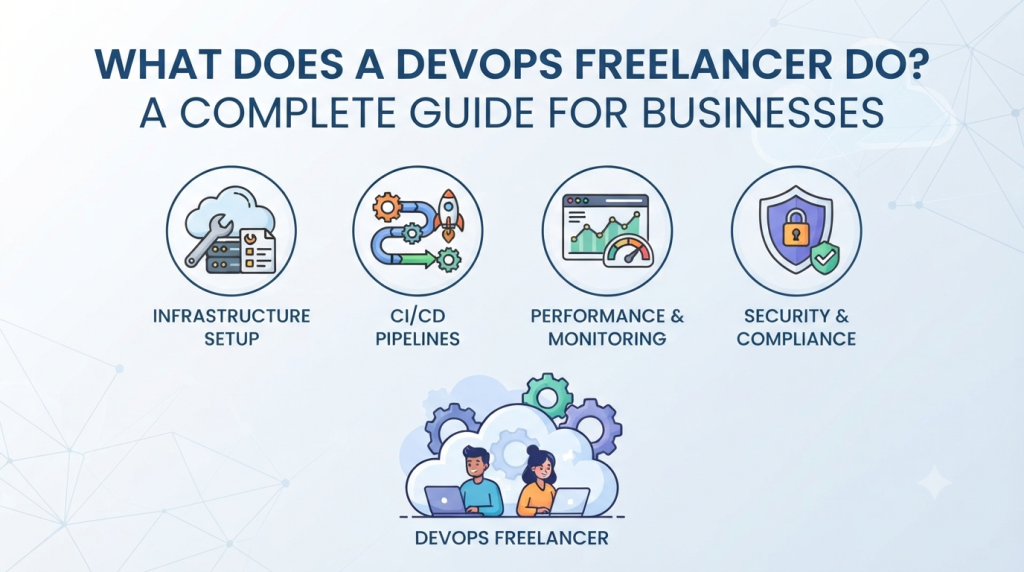
A freelance DevOps engineer may work on tasks such as:
- Building automated CI/CD pipelines.
- Managing AWS, Azure, or Google Cloud infrastructure.
- Creating Docker containers.
- Deploying and managing Kubernetes clusters.
- Automating infrastructure with Terraform.
- Setting up monitoring and alerting systems.
- Improving application security.
- Troubleshooting deployment and infrastructure issues.
- Supporting cloud migration projects.
- Improving system performance and reliability.
Some freelancers focus on one technical area. Others provide broader DevOps consulting and implementation support.
For example, a startup may hire a freelancer to create a deployment pipeline. An established company may need an SRE specialist to improve application uptime. A business moving to the cloud may need an AWS or Azure consultant.
The right choice depends on the problem your business wants to solve.
Why Should Businesses Hire a DevOps Freelancer?
Hiring a DevOps freelancer gives businesses access to technical skills without always creating a permanent position. It can also help internal teams complete important projects.
1. Access to Specialized Technical Skills
DevOps includes many technologies and practices. One engineer may not have deep experience with every platform.
A freelancer can bring focused skills in areas such as Kubernetes, Terraform, cloud security, CI/CD, or SRE. Businesses can select someone whose experience matches their project.
This approach is useful when an organization needs a specialist for a limited period.
2. Flexible Hiring Options
Businesses can hire freelancers for a short assignment, a fixed project, or ongoing support. They can also engage a professional for a specific number of hours each week.
This flexibility helps companies manage changing workloads. It also allows teams to bring in extra expertise during migrations, product launches, or infrastructure upgrades.
3. Faster Project Support
An experienced freelancer may already understand the tools and methods needed for a project. This can reduce the time spent on basic training.
However, the business must still provide clear requirements, access, and project information. Fast hiring does not guarantee fast delivery.
4. Better Control Over Project Costs
A freelancer can be hired for a defined scope instead of adding a permanent salary commitment. Businesses can agree on hourly, daily, monthly, or project-based pricing.
The total cost still depends on project complexity and experience. A low initial quote may become expensive if the work needs repeated corrections.
5. Support for Internal Teams
A DevOps freelancer can work with developers, testers, system administrators, and cloud teams. They can help remove technical bottlenecks and improve team workflows.
They may also document processes and train internal staff. This helps the company maintain the systems after the contract ends.
6. Help During Critical Projects
Some projects require skills that a company does not use every day. Examples include Kubernetes migration, cloud architecture reviews, disaster recovery planning, and CI/CD redesign.
A specialist can support these tasks while the internal team continues its regular work.
When Does Your Business Need a DevOps Freelancer?
Before hiring, identify the business problem. Do not hire someone simply because other companies use DevOps tools.
Your organization may need a freelancer in the following situations.
Slow Software Deployments
If developers deploy software manually, releases may take too much time. Manual steps can also create mistakes.
A DevOps freelancer can review the current process and build automated pipelines. These pipelines can run tests, build packages, and deploy approved changes.
Frequent Production Issues
Repeated application failures can affect users and revenue. The causes may include poor monitoring, weak infrastructure design, or missing recovery processes.
An experienced professional can investigate these problems. They can also improve alerts, logs, incident response, and system reliability.
Cloud Infrastructure Problems
Cloud resources need proper configuration and ongoing management. Poorly managed infrastructure can create security gaps and unexpected costs.
A cloud-focused freelancer can review the environment. They can improve access controls, networking, resource use, and infrastructure automation.
Lack of Automation
Teams may spend hours on repetitive tasks. These tasks can include server setup, software installation, testing, and deployment.
A freelancer can identify suitable tasks for automation. They can create scripts and workflows that reduce manual effort.
Need for DevSecOps Practices
Security should be part of the software delivery process. It should not begin only after an application is ready for release.
A DevSecOps freelancer can help add code scanning, dependency checks, container security, and infrastructure policy checks.
Cloud Migration or Platform Upgrade
Moving applications between environments can be complex. Businesses may need help with planning, testing, data migration, and deployment.
A freelancer with relevant migration experience can help reduce risks and create a clear migration plan.
Step 1: Define Your Business Requirements
The first step is to understand exactly what you need. A clear project definition makes it easier to find the right professional.
Avoid writing a broad requirement such as “We need a DevOps expert.” This does not explain the problem or the expected result.
Instead, describe the current situation and the outcome you want.
For example:
Unclear requirement: We need someone to manage our AWS and DevOps work.
Clear requirement: We need a freelancer to create a CI/CD pipeline for our Node.js application. The pipeline should run tests, build a Docker image, and deploy it to AWS ECS.
The second requirement gives candidates a better understanding of the assignment.
Identify Your Main Project Goals
Write down the problems you want to solve. Common goals include:
- Reduce manual deployment work.
- Improve release speed.
- Automate infrastructure provisioning.
- Improve cloud security.
- Reduce application downtime.
- Improve monitoring and alerting.
- Move applications to cloud platforms.
- Improve disaster recovery.
- Reduce cloud resource waste.
Define the Project Scope
Your project scope should explain what the freelancer will and will not do.
Include details such as:
- Current application architecture.
- Cloud provider and hosting environment.
- Programming languages and frameworks.
- Existing CI/CD tools.
- Infrastructure and deployment needs.
- Development, staging, and production environments.
- Required security controls.
- Expected project duration.
- Final deliverables.
Clear boundaries reduce confusion and help prevent scope creep.
Set Measurable Outcomes
A project should have clear acceptance criteria. These criteria help both sides understand when the work is complete.
For example:
- The pipeline must run automated tests.
- Deployment must work in the staging environment.
- Infrastructure code must be stored in the company repository.
- Monitoring alerts must cover agreed critical services.
- Documentation must explain deployment and rollback steps.
Avoid promising a particular improvement before the freelancer has reviewed your current system. First establish a baseline, then agree on realistic targets.
Step 2: Identify the Right DevOps Specialization
DevOps is a broad field. Different projects need different skills.
A freelancer who is strong in CI/CD may not be the best person for a complex cloud security review. Similarly, a Kubernetes specialist may not be needed for a small application running on a simple hosting platform.
Understand the main specializations before selecting candidates.
DevOps Automation
DevOps automation focuses on reducing manual work across development and operations.
A freelancer in this area may work with:
- Jenkins.
- GitHub Actions.
- GitLab CI/CD.
- CircleCI.
- Ansible.
- Bash.
- Python.
Hire this specialist when your team needs automated builds, tests, deployments, or routine infrastructure tasks.
Cloud DevOps
Cloud DevOps professionals work with cloud infrastructure and services.
Common platforms include:
- Amazon Web Services (AWS).
- Microsoft Azure.
- Google Cloud Platform (GCP).
They may manage cloud networking, compute resources, storage, permissions, deployment environments, and cost controls.
Choose a freelancer who has practical experience with your actual cloud provider.
Kubernetes and Container Management
Container technologies help package and run applications consistently. Kubernetes helps manage containerized workloads across clusters.
Relevant skills include:
- Docker.
- Kubernetes.
- Helm.
- Amazon EKS.
- Azure AKS.
- Google GKE.
- Container registries.
- Ingress and networking.
Do not require Kubernetes automatically. A simpler platform may be more suitable for a small application.
DevSecOps
DevSecOps brings security checks into development and delivery workflows.
A specialist may work with:
- Static application security testing.
- Dependency scanning.
- Container image scanning.
- Secret detection.
- Infrastructure security checks.
- Compliance automation.
- Access management.
This role is useful when security must be built into the software delivery process.
Site Reliability Engineering (SRE)
SRE focuses on system reliability, availability, performance, and incident management.
An SRE freelancer may help with:
- Monitoring and alerting.
- Service Level Indicators (SLIs).
- Service Level Objectives (SLOs).
- Incident response.
- Capacity planning.
- Performance optimization.
- Reliability reviews.
Choose this specialist when your business needs to improve service stability and operational readiness.
Infrastructure as Code (IaC)
Infrastructure as Code allows teams to manage infrastructure through version-controlled configuration.
Common tools include:
- Terraform.
- OpenTofu.
- AWS CloudFormation.
- Pulumi.
- Ansible.
A qualified freelancer should understand reusable modules, state management, access control, and change review.
Step 3: Check the Freelancer’s Technical Skills
Once you understand your project, create a list of required technical skills.
Do not select someone only because their profile contains many tool names. Ask how they have used those tools in real projects.
Linux and Operating System Knowledge
Linux is widely used in cloud and server environments. A DevOps freelancer should understand basic system administration.
Check their knowledge of:
- File permissions.
- Users and groups.
- Processes and services.
- System logs.
- Package management.
- Shell commands.
- Networking basics.
- Disk and memory usage.
Ask how they would investigate a server with high CPU usage or a failed system service.
Scripting and Programming
Automation often requires scripting skills. A freelancer should be comfortable with languages relevant to your environment.
Common choices include:
- Bash.
- Python.
- PowerShell.
- YAML.
- Basic JavaScript or another application language when needed.
Ask the candidate to explain a script they created. Look for clear logic, error handling, and maintainable code.
CI/CD Pipeline Experience
A freelancer should understand the full pipeline process. This includes source control, build steps, tests, artifacts, deployment, and rollback.
Ask questions such as:
- How do you manage secrets in pipelines?
- How do you handle failed deployments?
- How do you separate staging and production?
- How do you prevent untested code from reaching production?
- How do you manage pipeline permissions?
The answers should show practical understanding rather than memorized definitions.
Cloud Platform Knowledge
Check whether the candidate has worked with your cloud platform.
For AWS, relevant services may include EC2, S3, IAM, VPC, ECS, EKS, CloudWatch, and RDS.
For Azure, relevant services may include Virtual Machines, Virtual Networks, Azure Kubernetes Service, Azure Monitor, and Azure DevOps.
For Google Cloud, relevant services may include Compute Engine, Cloud Storage, GKE, Cloud Run, IAM, and Cloud Monitoring.
The freelancer does not need to know every service. They should understand the services your project uses.
Monitoring and Logging
Monitoring helps teams understand system health. Logging helps them investigate events and failures.
Common tools include:
- Prometheus.
- Grafana.
- ELK Stack.
- OpenSearch.
- Datadog.
- New Relic.
- Cloud-native monitoring services.
Ask how the freelancer would monitor application errors, resource usage, service availability, and deployment health.
Step 4: Review Experience and Previous Projects
A technical profile is only one part of the evaluation. You should also review the freelancer’s past work.
Look for projects that match your business requirements.
Review Relevant Case Studies
Ask the freelancer to describe two or three similar projects.
For each project, understand:
- What problem did the client face?
- What was the existing architecture?
- What tools did the freelancer use?
- What work did they personally complete?
- What challenges did they face?
- How did they test the solution?
- What documentation did they provide?
A strong candidate should explain the technical choices clearly.
Ask for Portfolio Evidence
A portfolio can help you understand practical experience.
Possible evidence includes:
- Public code repositories.
- Infrastructure configuration examples.
- CI/CD pipeline samples.
- Technical articles.
- Open-source contributions.
- Project architecture diagrams.
- Redacted case studies.
Do not ask candidates to share confidential client information. They should remove secrets, private data, and sensitive architecture details.
Verify Certifications Carefully
Certifications can show structured learning and knowledge of a platform.
Relevant examples include:
- AWS certifications.
- Microsoft Azure certifications.
- Google Cloud certifications.
- Certified Kubernetes Administrator (CKA).
- Certified Kubernetes Application Developer (CKAD).
- HashiCorp Terraform certifications.
A certification should support practical experience, not replace it. Ask candidates how they have applied the knowledge in real environments.
Understand Individual Contribution
Some candidates may have worked as part of a large engineering team. Their project experience does not always show what they personally handled.
Ask them to explain their own responsibilities. This helps you separate individual contributions from team achievements.
Step 5: Evaluate Communication and Problem-Solving Skills
Technical ability matters, but communication also affects project success.
A freelancer may work with developers, managers, security teams, and business owners. They should explain technical issues in clear language.
Check How They Understand Requirements
During the first discussion, explain your problem. Observe whether the candidate asks useful questions.
A good freelancer may ask about:
- Current infrastructure.
- Application architecture.
- Deployment frequency.
- Existing problems.
- Security requirements.
- Expected traffic.
- Budget limits.
- Project deadlines.
This shows that they want to understand the environment before suggesting a solution.
Look for Clear Technical Explanations
Ask the freelancer to explain a proposed solution without relying on complex jargon.
They should be able to describe the benefits, risks, costs, and limitations of their approach.
Test Their Troubleshooting Approach
Present a realistic problem.
For example:
“Our application deployment fails after the container image is built. How would you investigate it?”
A thoughtful candidate should explain a step-by-step process. They may check pipeline logs, image tags, environment variables, permissions, network access, and deployment events.
The exact answer will depend on your architecture. Focus on the candidate’s reasoning.
Step 6: Conduct a Practical Technical Assessment
A practical assessment can help verify the candidate’s skills. It should match the work you plan to assign.
Avoid long unpaid assignments. Use a short, relevant exercise or a paid discovery task for complex work.
Sample CI/CD Assessment
Ask the freelancer to describe or build a simple pipeline that:
- Checks out application code.
- Installs dependencies.
- Runs automated tests.
- Builds a container image.
- Publishes the image to a registry.
- Deploys to a test environment.
Review the pipeline structure, security, error handling, and documentation.
Sample Infrastructure as Code Assessment
Ask the candidate to create a small Terraform configuration for a test environment.
Review:
- Resource definitions.
- Variable usage.
- Output values.
- State handling.
- Naming conventions.
- Reusability.
- Security settings.
Use a sandbox account and avoid exposing production credentials.
Sample Troubleshooting Assessment
Give the freelancer a sample deployment failure or monitoring alert. Ask them to explain how they would investigate it.
Look for a logical process, useful diagnostic steps, and clear communication.
What Should You Evaluate?
Assess the candidate across several areas:
- Technical correctness.
- Security awareness.
- Problem-solving approach.
- Code quality.
- Documentation.
- Testing methods.
- Communication.
- Understanding of business impact.
A practical assessment should support the interview. It should not become a substitute for reviewing experience and references.
Step 7: Compare Proposals and Pricing
After interviewing candidates, compare their proposals carefully.
Do not select a freelancer only because they offer the lowest price. Poor infrastructure work can create long-term maintenance costs and operational risks.
Hourly Pricing
Hourly contracts are useful when the scope is uncertain or the work involves troubleshooting.
Examples include:
- Infrastructure audits.
- Production issue investigation.
- Technical consulting.
- Ongoing maintenance.
- Architecture reviews.
Agree on an estimated number of hours and a spending limit. Ask for regular time reports.
Fixed-Price Projects
Fixed-price contracts work well when the scope and deliverables are clear.
Examples include:
- Creating a defined CI/CD pipeline.
- Setting up a staging environment.
- Migrating a specified workload.
- Building a monitoring dashboard.
- Automating a known infrastructure setup.
Divide larger projects into milestones. Define what must be delivered and accepted at each stage.
Retainer-Based Engagements
A retainer provides access to a freelancer for an agreed amount of time each month.
It can suit businesses that need regular support but do not require a full-time DevOps engineer.
The agreement should define included hours, response expectations, extra-work rates, and unused-hour policies.
Compare the Full Proposal
Review these details before making a decision:
- Understanding of the project.
- Proposed technical solution.
- Relevant experience.
- Project timeline.
- Milestones.
- Deliverables.
- Testing approach.
- Security plan.
- Documentation.
- Total cost.
- Support after completion.
Ask candidates to explain assumptions and exclusions. This helps prevent unexpected charges later.
Step 8: Check References and Professional Reliability
References can provide useful information about a freelancer’s work habits.
Ask for references from previous clients when the project is important or involves production infrastructure.
You can ask:
- Did the freelancer complete the agreed work?
- Were deadlines managed well?
- Was communication consistent?
- Did the freelancer document the solution?
- How did they handle unexpected problems?
- Would you hire them again?
You should also discuss availability and workload.
Confirm the freelancer’s working hours, time zone, planned leave, and ability to respond during important project periods.
For critical systems, define an escalation process. Do not assume that a freelancer is available around the clock unless the contract says so.
Step 9: Protect Your Business with Proper Security Controls
DevOps freelancers may need access to cloud platforms, repositories, deployment systems, and production environments.
This access must be controlled. A hiring decision should include a security plan before work begins.
Use Individual Accounts
Never share a root account or a common administrator login.
Create a separate identity for the freelancer. This makes it easier to manage permissions and review activity.
Apply Least-Privilege Access
Give the freelancer only the permissions needed for the assigned work.
For example, a freelancer working on a staging deployment may not need access to production databases or billing settings.
Review permissions as the project changes.
Require Multi-Factor Authentication
Enable MFA for cloud accounts, source repositories, and other important systems.
MFA adds another layer of protection if a password becomes exposed.
Protect Secrets and Credentials
Do not send passwords, API keys, or private keys through casual messages.
Use an approved secrets manager or secure credential-sharing process. Rotate credentials when access is no longer needed.
Keep Work in Company-Owned Repositories
The business should own the project repositories, cloud accounts, and deployment resources.
Ask the freelancer to submit work through company-controlled repositories and pull requests.
This protects ownership and makes future maintenance easier.
Review Production Changes
Use code review and change approval for important infrastructure updates.
Test changes in a non-production environment when possible. Keep rollback plans for risky deployments.
Remove Access After the Contract
When the engagement ends:
- Disable the freelancer’s accounts.
- Revoke temporary roles and tokens.
- Rotate relevant secrets.
- Review repository permissions.
- Confirm ownership of code and infrastructure.
- Collect final documentation.
Access removal should be part of the project handover checklist.
Step 10: Create a Clear Contract and Project Agreement
A written agreement protects both the business and the freelancer.
It should explain the work, payment terms, responsibilities, and ownership rules.
Include these details:
Project Scope
Describe the objectives, tasks, deliverables, and excluded work.
Timeline and Milestones
List the expected start date, key milestones, review periods, and completion date.
Payment Terms
Explain the hourly rate or fixed project fee. Include invoice dates, payment schedules, and approval rules for extra work.
Intellectual Property
State who owns the scripts, code, pipeline configurations, infrastructure templates, and documentation created for the project.
Confidentiality
Use an NDA or suitable confidentiality terms when the freelancer may access business information.
Security Responsibilities
Define access rules, data handling requirements, approved devices, and incident reporting expectations.
Support and Maintenance
Clarify whether post-project support is included. Define the duration, scope, response expectations, and additional charges.
A written agreement reduces misunderstandings and creates a shared reference for the project.
Step 11: Start with a Small Project or Paid Discovery Phase
If you are unsure about a candidate, begin with a limited assignment.
A small project helps you evaluate the freelancer before granting broader responsibilities.
For example, you might ask them to:
- Review an existing deployment pipeline.
- Audit a staging environment.
- Create a monitoring dashboard.
- Document the current infrastructure.
- Automate one routine deployment task.
For complex environments, use a paid discovery phase. The freelancer can review the architecture, identify risks, and prepare a project plan.
Evaluate the quality of their work, communication, documentation, and ability to meet agreed deadlines.
If the first assignment goes well, expand the engagement in stages.
Step 12: Measure the Freelancer’s Performance
Do not judge success only by the number of tasks completed. Measure whether the work improves the system and supports business goals.
Choose metrics that match the project.
Deployment Frequency
This measures how often the team releases software. It can help show whether delivery processes are becoming more efficient.
Lead Time for Changes
This measures the time between a code change being committed and its successful release.
Change Failure Rate
This measures the share of deployments that cause failures or require corrective action.
Mean Time to Restore
This measures how long it takes to restore service after an incident.
Infrastructure Reliability
Track uptime, service availability, error rates, and agreed SLO performance.
Automation Coverage
Measure how many important manual tasks have been replaced with reliable automated workflows.
Cloud Cost and Resource Usage
Review cloud spending and resource utilization. Cost improvements should not reduce security or reliability.
Set a baseline before the project begins. Then compare results after implementation.
Where Can Businesses Find the Right DevOps Freelancer?
Businesses can use several channels to find qualified professionals. Each channel has different strengths.
Specialized DevOps Platforms
Specialized platforms focus on DevOps and related technical services. They may help businesses discover professionals by skill, location, or service area.
DevOpsFreelancer.com presents professionals and services across DevOps, DevSecOps, SRE, Kubernetes, AWS, Azure, and DataOps. Its website also describes training, consulting, mentoring, and outsourcing support.
Businesses can explore the platform to identify professionals whose services match their project requirements. They should still verify experience, availability, references, and technical fit before hiring.
General Freelance Marketplaces
Platforms such as Upwork and Freelancer offer access to professionals across many technical fields.
They can work well for clearly defined assignments. Review project history, client feedback, work samples, and contract terms.
Professional Networks
LinkedIn can help businesses connect with experienced engineers and independent consultants.
Review professional history and technical contributions. Contact candidates with a clear project description.
Open-Source Communities
GitHub and technology-specific communities can help identify people with practical experience.
Review public contributions and discussions. Remember that open-source activity does not automatically mean someone is available for paid work.
Professional Referrals
Ask trusted engineers, technology leaders, and business contacts for recommendations.
Referrals can help identify candidates with a known work history. You should still conduct your own technical and security checks.
Why Consider DevOpsFreelancer.com?
DevOpsFreelancer.com presents itself as a platform for businesses seeking DevOps-related freelance support.
Its website describes services and professional categories across several areas.
These include:
- DevOps implementation and automation.
- DevSecOps integration.
- Site Reliability Engineering.
- Kubernetes deployment and management.
- AWS and Azure consulting.
- DataOps services.
- Training, consulting, mentoring, and outsourcing support.
The platform also lists freelancer categories across countries, including India, the United Kingdom, Singapore, Germany, the UAE, Japan, the United States, and Australia.
Businesses can use this information as a starting point when exploring possible professionals.
Before selecting a freelancer, confirm the person’s specific technical experience. Discuss your project scope, expected outcomes, availability, pricing, and security requirements.
Visit the website: https://www.devopsfreelancer.com/
Common Mistakes to Avoid When Hiring a DevOps Freelancer
Hiring mistakes can affect project quality, cost, and security. Avoid these common problems.
1. Hiring Only Based on Price
The cheapest proposal may not offer the best value. Compare experience, deliverables, communication, and long-term maintenance needs.
2. Writing a Vague Project Description
Broad requirements attract candidates with different interpretations of the work.
Define the business problem, technical environment, scope, and expected results.
3. Ignoring Practical Experience
A long list of tools does not prove real-world ability.
Ask about relevant projects and use a short practical assessment where appropriate.
4. Choosing Tools Before Understanding the Problem
Not every application needs Kubernetes or a complex cloud architecture.
Select tools based on actual requirements, scale, skills, and maintenance needs.
5. Giving Too Much Access
Shared administrator credentials create unnecessary risk.
Use individual accounts, MFA, temporary permissions, and least-privilege access.
6. Skipping Documentation
A solution that only the freelancer understands can become difficult to maintain.
Require clear documentation, configuration files, runbooks, and handover sessions.
7. Ignoring Communication
Technical work often involves changing requirements and unexpected issues.
Agree on communication channels, update frequency, meeting schedules, and escalation procedures.
8. Failing to Define Ownership
The company should retain control over its code, cloud accounts, repositories, and project assets.
Put ownership terms in writing before work begins.
9. Expecting Unlimited Availability
Freelancers may work with several clients.
Agree on working hours, support windows, response times, and emergency arrangements.
10. Skipping the Handover
A project is not complete when the code is delivered.
Confirm that your internal team can access, understand, operate, and maintain the solution.
Best Practices for Working with a DevOps Freelancer
Good collaboration helps businesses get better results from freelance engagements.
Follow these practices throughout the project.
Share the Right Technical Information
Provide architecture diagrams, system documentation, repository details, and environment information.
Start with read-only access where possible. Share sensitive information only when required.
Use Version Control
Keep scripts, configuration, and infrastructure code in company-controlled repositories.
Use pull requests and reviews for important changes.
Agree on Regular Updates
Set a practical schedule for progress reports. Ask the freelancer to share completed work, blockers, risks, and next steps.
Keep Tasks Small and Reviewable
Break large projects into manageable tasks. Review deliverables at each milestone.
This makes it easier to identify problems before they affect the entire project.
Make Testing Part of Delivery
Require suitable tests before changes reach production.
Include deployment checks, rollback steps, and monitoring where relevant.
Plan for Knowledge Transfer
Ask the freelancer to explain important systems to your internal team.
Documentation and handover sessions reduce long-term dependency on one person.
Future Trends in DevOps Freelancing
DevOps work continues to change as cloud platforms, automation, and software delivery practices evolve.
Businesses should consider these trends when planning future hiring needs.
Growing Demand for DevSecOps
Organizations increasingly need security throughout the software delivery process.
Freelancers with experience in secure pipelines, vulnerability management, and cloud security can support these needs.
Platform Engineering
Platform engineering focuses on building internal tools and services for development teams.
Specialists may help create self-service environments, reusable templates, and standardized deployment workflows.
AI-Assisted Operations
AI tools can help teams review alerts, summarize incidents, and identify unusual system behavior.
However, businesses still need engineers to validate recommendations and manage operational risk.
FinOps and Cloud Cost Management
Cloud spending needs regular review. FinOps practices help businesses understand and manage cloud costs.
Freelancers may support cost visibility, resource optimization, and spending controls.
Kubernetes and Cloud-Native Skills
Many organizations use containers and cloud-native platforms. Kubernetes remains relevant for workloads that need its orchestration capabilities.
Businesses should hire specialists based on actual architecture needs rather than trends alone.
Greater Focus on Reliability
Customers expect digital services to remain available and responsive.
SRE practices, observability, incident response, and disaster recovery will continue to matter.
Top 10 Frequently Asked Questions
1. How do I hire the right DevOps freelancer?
Start by defining your business problem and project scope. Identify the cloud platforms, tools, and skills required for the work. Review candidate experience, practical projects, references, and communication skills. Conduct a relevant technical assessment and compare proposals before signing an agreement.
2. What skills should a DevOps freelancer have?
The required skills depend on your project. Common skills include Linux, scripting, Git, CI/CD, cloud platforms, Docker, Kubernetes, Terraform, monitoring, and security. A good freelancer should also understand troubleshooting, documentation, and collaboration with development teams.
3. How much does it cost to hire a DevOps freelancer?
The cost depends on experience, location, project complexity, technology, and engagement type. Some freelancers charge hourly rates, while others offer fixed project fees or monthly retainers. Request a detailed proposal with scope, milestones, deliverables, and any extra charges.
4. Should I hire a freelance DevOps engineer or a full-time employee?
A freelancer can suit short-term projects, specialist tasks, audits, and flexible support. A full-time employee may be better when your business needs continuous internal ownership and daily operational work. Some companies use both models to balance specialist support and long-term team knowledge.
5. Where can I find experienced DevOps freelancers?
You can explore specialized platforms, general freelance marketplaces, professional networks, open-source communities, and referrals. DevOpsFreelancer.com lists services and professionals in areas such as DevOps, DevSecOps, SRE, Kubernetes, AWS, and Azure. Always verify a candidate’s experience before hiring.
6. How can I check a DevOps freelancer’s technical skills?
Review relevant project examples and ask about their personal contribution. Discuss how they handle CI/CD, cloud infrastructure, automation, monitoring, and security. You can also use a short practical assessment in a safe test environment.
7. Is it safe to give a freelancer access to cloud infrastructure?
It can be safe when access is properly controlled. Create a separate account, enforce MFA, and provide only the permissions required for the project. Avoid sharing root credentials and review access regularly. Revoke permissions when the work ends.
8. Should I hire a DevOps freelancer on an hourly or fixed-price basis?
Hourly pricing is useful for troubleshooting, consulting, and work with uncertain scope. Fixed pricing is suitable for projects with clear requirements and deliverables. Choose the model that best matches the project’s complexity and level of uncertainty.
9. How long does it take to complete a DevOps project?
The timeline depends on the work, current infrastructure, team availability, and technical risks. A small pipeline improvement may take much less time than a cloud migration or Kubernetes redesign. Ask for milestones and a realistic schedule after the freelancer reviews the requirements.
10. What should happen after a DevOps freelancer completes the project?
The freelancer should hand over code, configuration, documentation, access details, and operational instructions. Your team should review and test the solution. Remove unnecessary access, rotate relevant credentials, and confirm that internal staff can maintain the system. Agree on any ongoing support before the contract ends.
Conclusion
Hiring the right DevOps freelancer can help your business improve software delivery, automate operations, and manage infrastructure more effectively.
The process should begin with a clear understanding of your business problem. Define the project scope, identify the required specialization, and review the candidate’s practical experience.
Evaluate technical skills, communication, problem-solving, and security awareness. Compare proposals based on value and clear deliverables, not only price.
Use written agreements, controlled access, regular reviews, and proper documentation. Start with a limited assignment when you need to assess a candidate before expanding the work.
Most importantly, choose someone who understands your technical environment and business goals. The right freelancer should not only complete tasks. They should help your team build systems that remain secure, reliable, and maintainable.