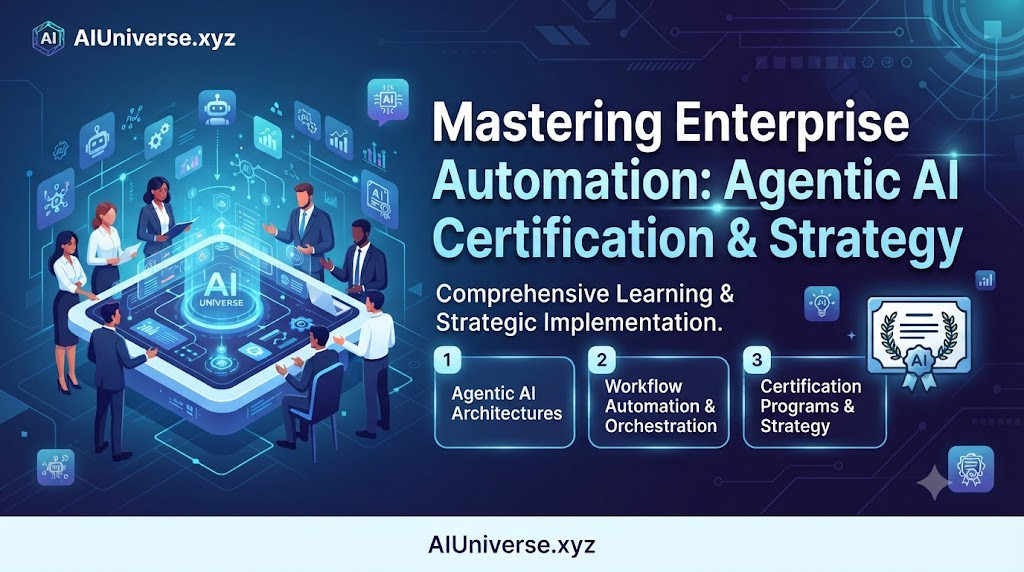
Artificial intelligence is undergoing a seismic shift from passive content generation to true operational autonomy, where systems no longer merely answer prompts but actively reason, execute multi-step tool workflows, self-correct, and achieve complex goals independently. For developers, data scientists, and technology executives, this evolution marks the transition from simple chatbots to resilient multi-agent software architectures capable of driving end-to-end enterprise digital transformations. Enrolling in a structured Agentic AI certification course bridges the gap between basic API scripting and production-grade engineering, providing the architectural grounding, hands-on framework mastery, and telemetry practices required to build and deploy the next generation of autonomous, secure, and observable AI systems.
What is Agentic AI?
Agentic AI refers to artificial intelligence systems designed to autonomously pursue complex, open-ended goals. Unlike passive AI models that wait for a human prompt and return a static response, agentic systems break down a high-level goal into actionable sub-tasks, execute those tasks using internal logic or external tools, monitor the results, adjust their strategy when errors occur, and deliver a completed task with minimal human intervention.
How Agentic AI Differs from Traditional and Generative AI
- Traditional AI (Predictive/Discriminative): Focuses on pattern recognition, classification, and numerical forecasting (e.g., spam detection, fraud scoring). It responds strictly to predefined input formats and mathematical functions.
- Generative AI (Reactive Creation): Synthesizes new text, code, audio, or images based on training data and direct human prompts (e.g., summarizing an article or generating a code snippet). It operates in a single, prompt-response loop without state memory or tool access.
- Agentic AI (Autonomous Action): Combines generative capabilities with reasoning loops, long-term memory, dynamic tool usage, external API execution, and dynamic planning to achieve multi-step objectives autonomously.
The Core Architectural Components
To understand how an agent functions, consider its four primary structural pillars:
                  +-------------------------+
                  |   Agent Control Loop    |
                  +------------+------------+
                               |
        +----------------------+----------------------+
        |                      |                      |
+-------v-------+      +-------v-------+      +-------v-------+
|  Reasoning &  |      | Memory & State|      |  Tool & API   |
|   Planning    |      |  Management   |      |  Execution    |
+---------------+      +---------------+      +---------------+
- Reasoning Engine & Planning Unit: Powered by foundational models (e.g., Large Language Models), this component breaks high-level goals into sub-tasks using techniques like ReAct (Reason + Act), Tree of Thoughts (ToT), or Reflexion loops.
- Memory & Context Management:
- Short-Term Memory: Tracks current conversational state and active tool execution within the context window.
- Long-Term Memory: Utilizes vector databases and retrieval-augmented generation (RAG) to reference historical actions, enterprise data, and domain knowledge across execution cycles.
- Tool Integration & Execution Interface: Enables the agent to interact with external databases, call web REST APIs, execute Python code in sandboxed environments, query legacy software, and interact with operating systems.
- Multi-Agent Coordination Protocol: Coordinates multiple specialized agents (e.g., a Researcher Agent, a Writer Agent, and a Code Reviewer Agent) through defined communication structures to solve enterprise problems.
The Evolution of Artificial Intelligence
Understanding where Agentic AI fits requires mapping the historical trajectory of artificial intelligence across four major structural epochs:
+------------------+     +------------------+     +------------------+     +------------------+
| Rule-Based &     | --> | Machine Learning | --> | Generative AI    | --> | Agentic AI       |
| Symbolic Systems |     | & Deep Learning   |     | Era              |     | Systems          |
| (Pre-2010s)      |     | (2010s - 2020)   |     | (2020 - 2024)    |     | (2024 - Present) |
+------------------+     +------------------+     +------------------+     +------------------+
- Rule-Based & Symbolic Systems (Pre-2010s): Expert systems relied on hardcoded
if-thenlogic. They were brittle, unable to scale, and failed when encountering inputs outside strict parameters. - Machine Learning & Deep Learning (2010s – 2020): Statistical learning algorithms (CNNs, RNNs, Gradient Boosting) extracted features from labeled datasets. Models achieved high accuracy in specific tasks like computer vision, translation, and tabular predictions, but lacked reasoning abilities.
- Generative AI Era (2020 – 2024): Large Transformer models expanded natural language understanding and generation capabilities. While impressive, these systems remained bound to conversational interfaces, suffering from context drift, lack of execution ability, and reliance on user prompts to drive every step.
- Agentic AI Era (2024 – Present): Systems combine generative models with execution loops, vector retrieval, and autonomous decision-making framework layers. The model transitions from a text completion tool into an active execution engine that manages end-to-end workflows.
Why Agentic AI is Transforming Global Industries
The migration toward agentic architecture represents a shift from human-in-the-loop operational bottlenecks to human-on-the-loop supervisory management.
Key factors driving this enterprise transition include:
- Automation of Complex Knowledge Work: Unlike simple Robotic Process Automation (RPA), which handles rigid tabular routines, agentic workflows parse ambiguous unstructured data, manage unexpected system errors, and execute complex workflows like automated software debugging or financial audit reconciliation.
- Hyper-Personalization at Scale: Agents build individual user profiles, reference dynamic long-term memories, and proactively initiate actions—such as rebooking delayed travel reservations—without explicit prompt triggers.
- Contextual Software Engineering: Modern development teams use software development agents that draft feature implementations, write unit test suites, run regression tests, analyze output logs, and open pull requests autonomously.
- Reduction in Cognitive Friction: Workers move from manually toggling across dozens of enterprise SaaS applications to orchestrating autonomous agents that perform multi-system workflows safely and transparently.
Core Features and Capabilities of Agentic Systems
+-----------------------------------------------------------------------+
|                       CORE AGENTIC CAPABILITIES                       |
+-----------------------------------------------------------------------+
|  [Dynamic Planning]   --->   Deconstructs goals & self-corrects       |
|  [Tool Augmentation]  --->   Queries DBs, executes code, calls APIs   |
|  [State Memory]       --->   Retains long-term context via Vector DBs |
|  [Orchestration]      --->   Coordinates multi-agent workflows        |
|  [Guardrails]         --->   Applies safety, policy & access checks   |
+-----------------------------------------------------------------------+
- Dynamic Task Planning: Deconstructs abstract operational objectives into sequenced logic pipelines, evaluating alternative execution paths when intermediate steps fail.
- Tool Execution & API Interoperability: Uses JSON schema descriptions to select, parameterize, and invoke appropriate REST APIs, database queries, web browsers, or sandboxed code interpreters.
- Persistent Memory Management: Integrates ephemerally with prompt context while maintaining long-term episodic and semantic memory using semantic search in vector engines.
- Multi-Agent Communication Protocols: Implements architectural topologies (hierarchical, peer-to-peer, sequential pipeline) allowing multi-agent platforms to collaborate and verify output accuracy.
- Self-Reflection and Error Correction: Uses self-consistency prompting, execution outcome validation, and critique steps to identify logic errors and retry failed code or API calls automatically.
- Configurable Guardrails & Safety Constraints: Operates within deterministic guardrails, system permissions, rate limits, and compliance filters to ensure predictable execution.
Benefits of Completing an Agentic AI Certification Course
Self-taught experimentation using open-source frameworks provides a basic introduction, but enterprise deployment demands rigorous engineering practice. Completing a structured Agentic AI certification course provides clear competitive advantages:
- Architectural Mastery: Learn how to build resilient multi-agent orchestration systems from scratch using production frameworks rather than basic script tutorials.
- Enterprise Tooling Literacy: Gain hands-on practice integrating model execution, vector databases, federated learning platforms, telemetry, guardrails, and testing frameworks into full-stack deployments.
- Standardized Production Practices: Master strategies for controlling token usage costs, lowering API response latencies, preventing agent loop locks, and evaluating non-deterministic system outputs.
- Job Market Advantage: Stand out to technology employers and enterprise recruiters actively searching for professionals qualified in Agentic AI, MLOps, and AIOps frameworks.
- Portfolio Validation: Build a verified GitHub portfolio featuring multi-agent workflow engines, secure tool integration sandboxes, and end-to-end industry applications.
Key Technical and Theoretical Skills You Will Learn
A production-ready curriculum focuses on key theoretical principles, backend engineering practices, and AI architectural concepts:
+-------------------------------------------------------------------------+
|                         TECHNICAL SKILLSET MATRIX                       |
+---------------------------------------+---------------------------------+
| FOUNDATIONAL AGENT ARCHITECTURES      | ENTERPRISE AGENTIC MLOPS        |
| - ReAct, Planning, Reflection Patterns| - Telemetry, Observability, Logs|
| - Multi-Agent Topologies & Orchestr.  | - Context & Evaluation Metrics  |
| - Memory Systems (Episodic/Semantic)  | - Guardrails & Red Teaming      |
+---------------------------------------+---------------------------------+
| CORE DEVELOPER TOOLING                | ADVANCED INFRASTRUCTURE & ETHICS|
| - Advanced Prompting Protocols        | - Federated Learning Models     |
| - Vector Databases & RAG Pipelines    | - Local LLM Edge Deployment     |
| - API Tool Calling & Sandbox Design   | - Privacy, Governance & Audit   |
+---------------------------------------+---------------------------------+
Advanced Prompt Engineering & Tool Routing
- Structuring system instructions to prevent prompt injection and role modification.
- Designing precise function-calling schema definitions and strict JSON output parsing engines.
- Selecting the best prompt management tools to version-control, evaluate, and trace system prompts across multi-agent environments.
Agentic Architectural Frameworks
- Building multi-agent systems with open-source tools like LangChain, LangGraph, AutoGen, CrewAI, and LlamaIndex.
- Designing state-machine graph workflows with conditional branching, execution loops, human approval steps, and parallel agent execution paths.
Memory & Vector Retrieval Systems
- Implementing hybrid retrieval systems that combine sparse (BM25) and dense vector search algorithms.
- Managing state, context compression, dynamic windowing, and memory indexing across long execution chains.
Telemetry, Observability, and Evaluation
- Tracking multi-step agent trajectories with tracing engines like LangSmith, Phoenix, or OpenInference.
- Evaluating agent task completion, tool call selection accuracy, loop efficiency, and hallucination rates.
Who Should Pursue an Agentic AI Certification?
This educational path is tailored for software, data, and business technology professionals looking to build or manage advanced autonomous solutions:
- Software Engineers & Backend Developers: Looking to transition from traditional REST API backend services to dynamic, agent-driven software architectures.
- AI Engineers & Machine Learning Engineers: Moving beyond isolated model training and RAG setups toward autonomous multi-agent systems and production deployments.
- DevOps & Cloud Engineers: Tasked with building, hosting, scaling, monitoring, and securing complex AI agent workloads across multi-cloud environments.
- Data Scientists: Aiming to automate data exploration, feature engineering, predictive analytics, and automated reporting using specialized data agents.
- Enterprise IT Managers, CTOs, and Architects: Preparing to design company-wide AI adoption roadmaps, evaluate platform vendors, and build operational guardrails.
- Business Leaders & Operations Consultants: Seeking to leverage AI consulting services and corporate AI training programs to modernize enterprise operations.
Career Opportunities, Industry Demand, and Salary Trends
Industry demand for specialized AI implementation engineering skills has grown significantly. Companies are moving past proof-of-concept chatbots to deploy autonomous operational systems.
High-Demand Job Roles
- Agentic AI Architect: Designs multi-agent communication topology, governance guardrails, enterprise system integrations, and infrastructure scaling plans.
- AI Systems & Operations Engineer: Manages model routing, latency reduction, telemetry pipelines, vector databases, and system fallback mechanisms.
- MLOps / AIOps Engineer: Focuses on model deployment pipelines, continuous evaluation, edge deployment, platform monitoring, and incident remediation automation.
- Enterprise AI Strategy Consultant: Partners with executive teams through strategic AI consulting services to analyze core workflows, select appropriate technology stacks, and manage enterprise rollouts.
Salary Trends Overview (Estimated Global Averages)
| Role Title | Experience Level | Average Salary Range (USD) | Key Required Skillset |
| Agentic AI Software Engineer | Mid-Level (3-5 yrs) | $135,000 – $185,000 | Python, LangGraph/CrewAI, Vector DBs, REST APIs |
| Senior AI Systems Architect | Senior (6+ yrs) | $190,000 – $260,000 | Multi-agent Topologies, System Architecture, Security |
| MLOps / AIOps Engineer | Mid-to-Senior | $145,000 – $210,000 | Docker, Kubernetes, CI/CD, Observability, Model Deployment |
| Enterprise AI Strategy Lead | Lead / Director | $175,000 – $250,000+ | AI Governance, Enterprise Architecture, ROI Modeling |
Comprehensive Agentic AI Course Curriculum (Sample)
Below is an overview of a practical 12-week course curriculum designed to take engineers from foundational principles to production-level deployments.
+------------------------------------------------------------------+
|                    12-WEEK CURRICULUM ROADMAP                    |
+------------------------------------------------------------------+
| Weeks 1-2  : Foundations of Autonomous Agents & Prompting        |
| Weeks 3-4  : Agent Architectures & Planning (ReAct, Graph State) |
| Weeks 5-6  : Tool Calling, API Integrations & Sandboxing         |
| Weeks 7-8  : Memory Architecture & Hybrid Vector RAG Pipelines   |
| Weeks 9-10 : Multi-Agent System Design & Orchestration           |
| Weeks 11-12: MLOps Observability, Security & Capstone Deployment |
+------------------------------------------------------------------+
Module 1: Foundations of Autonomous Agents & Advanced Prompt Engineering
- Understanding autonomous agent loops: Perception, Reasoning, Execution, Memory.
- Mastering system prompt design strategies, structured outputs, and schema constraints.
- Version-controlling prompts and system test-cases using the best prompt management tools.
Module 2: Agent Architectures, Reasoning & Planning Methods
- Implementing ReAct (Reasoning + Acting), Plan-and-Solve, and self-reflection patterns.
- Building cyclic computational graphs and conditional routing logic using state-machine engines.
Module 3: Tool Augmentation, API Integration & Execution Environments
- Designing structured API parameter definitions and function schemas.
- Securing execution loops using sandboxed code execution environments (e.g., Docker containers, eBPF isolates).
- Handling execution errors, tool rate limits, and fallback strategies.
Module 4: Memory Management, RAG & Context Windows
- Designing persistent state structures across multi-turn interactions.
- Implementing hybrid vector-dense retrieval, re-ranking pipelines, and dynamic context-compression algorithms.
Module 5: Multi-Agent Orchestration Systems
- Building multi-agent communication patterns: Hierarchical, Sequential, and Peer-to-Peer.
- Managing shared memory spaces, delegate task hand-offs, and consensus protocols.
Module 6: Enterprise Infrastructure, MLOps, Security & Capstone Project
- Deploying agent telemetry, evaluation frameworks, and tracing dashboards.
- Enforcing guardrails against context injection, data leakage, and unintended API execution loops.
- Capstone Project: Build, test, and deploy an end-to-end multi-agent enterprise application.
Real-World Hands-on Projects You Should Build
To build a strong portfolio during your Agentic AI certification course, complete projects that mirror real-world industry requirements:
Visual Visualizations Recommendation:
+-----------------------------------------------------------------+
| SUGGESTED GRAPHIC: Certification Journey & Project Workflow     |
| ALT Text: Visual roadmap showing portfolio projects from design  |
| to enterprise execution.                                        |
+-----------------------------------------------------------------+
- Automated Vulnerability Remediation Agent: An operational agent that scans software repositories for open security vulnerabilities, pulls related software updates, updates package dependencies, runs build pipelines, verifies test coverage, and submits pull requests.
- Financial Audit & SEC Filing Analysis Team: A multi-agent network (Researcher, Financial Analyst, Compliance Auditor) that parses quarterly SEC filings, compares balance sheet details against historical trends, runs anomaly checks, and generates audit reports.
- Proactive Customer Operations Resolution Engine: An customer support agent that accesses core CRM systems, checks transactional databases, evaluates logic guidelines, issues customer refunds within defined parameters, and updates support tickets automatically.
- Autonomous Clinical Research Synthesizer: An agent that searches medical publication databases, extracts relevant clinical trial data, evaluates research methodologies, and synthesizes structured summaries while highlighting conflicting trial evidence.
The Tooling Ecosystem: Frameworks, MLOps, and Infrastructure
Building modern agent software requires working with tools across the developer, infrastructure, and deployment stacks:
+-----------------------------------------------------------------------+
|                       AGENTIC AI TOOLING STACK                        |
+-----------------------------------------------------------------------+
|  Orchestration Frameworks : LangGraph, CrewAI, AutoGen, LlamaIndex    |
|  Vector DB & Memory       : Pinecone, Qdrant, Milvus, Weaviate        |
|  Prompt Management        : Prompt Layer, LangSmith, Helicone          |
|  MLOps & Telemetry        : Phoenix, MLflow, Weights & Biases         |
|  Privacy & Decentralization: Federated Learning Frameworks (Flower)   |
+-----------------------------------------------------------------------+
- Orchestration Frameworks:
- LangGraph / LangChain: Graph-based cyclic execution engine ideal for precise control over agentic workflows.
- CrewAI: Role-based, multi-agent development framework focused on simple operational setups.
- Microsoft AutoGen: Framework for event-driven multi-agent conversations and problem-solving.
- LlamaIndex: Specialized for data-centric memory management, complex RAG pipelines, and structured search.
- Vector Databases & Persistent Storage:
- Pinecone, Qdrant, Milvus, and Weaviate provide high-performance similarity search for long-term agent memory.
- Prompt Engineering & Prompt Infrastructure:
- Using the best prompt management tools allows engineering teams to version, track, run regression tests on, and optimize prompt definitions across dev, test, and production stages.
- Decentralized Data & Privacy Frameworks:
- For industries handling sensitive data, integrating federated learning platforms ensures local models learn across distributed systems without centralizing private data.
Cross-Industry Use Cases and Applications
+-------------------------------------------------------------------+
|                  CROSS-INDUSTRY AGENT APPLICATIONS                |
+-------------------------------------------------------------------+
| HEALTHCARE   ---> Autonomous Patient Triage & Record Verification  |
| FINANCE      ---> Real-time Fraud Investigation & Compliance Audit|
| RETAIL       ---> Proactive Inventory Ordering & Supply Planning  |
| TELECOM      ---> Self-healing Network Routing & Defect Diagnostic |
| GOVERNMENT   ---> Automated Claims Verification & Document Audit  |
+-------------------------------------------------------------------+
Healthcare & Life Sciences
- Patient Intake Triage Agents: Process preliminary patient symptoms, cross-reference medical history, highlight safety concerns, and suggest clinical trial fits.
- Automated Claims Verification: Cross-check patient insurance coverage, medical coding records, and clinical logs to speed up claims processing and reduce denials.
Financial Services & Banking
- Real-time Fraud Investigation: Agents track suspicious transaction patterns, pause compromised accounts, send verification requests to customers, and compile compliance audit reports.
- Wealth Management & Portfolio Balancing: Continuously evaluate asset allocations against market shifts, run investment simulations, and prepare customized rebalancing proposals for account managers.
Supply Chain, Logistics, and Manufacturing
- Predictive Procurement: Agents monitor regional warehouse inventory levels, track weather patterns and port delay alerts, recalculate stock safety margins, and issue automated supplier purchase orders.
- Autonomous Quality Inspection: Combine computer vision triggers with historical machine log checks to schedule maintenance before operational failures occur.
Retail & E-Commerce
- Dynamic Supply & Price Adjustment: Continuously analyze competitor pricing updates, dynamic customer demand shifts, and real-time inventory balances to adjust promotional campaigns and product pricing safely within margin parameters.
Corporate AI Training: Upskilling Enterprise Teams
Adopting AI technology successfully requires more than just buying software; it demands systematic team training. Organizations invest heavily in corporate AI training programs to keep their technical and operational workforce up to speed.
Benefits of Corporate AI Training
- Closing the Internal Skill Gap: Bridges the gap between traditional IT maintenance skills and modern AI engineering practices.
- Ensuring Consistent Engineering Standards: Aligns software development teams on security guidelines, prompt management protocols, and shared testing frameworks.
- Accelerating Time-to-Market: Reduces project delivery delays by training engineers on common design patterns, pre-built frameworks, and modern MLOps pipelines.
- Maximizing Technology Investments: Helps organizations extract full value from cloud infrastructure and enterprise software investments.
AI Consulting Services: Driving Business Transformation
Navigating the transition from traditional IT architectures to agent-driven operational models often requires guidance from specialized experts. Leading enterprises leverage AI consulting services to design strategies, validate choices, and avoid implementation errors.
Core Focus Areas of AI Consulting
- AI Readiness Assessment: Evaluating enterprise IT infrastructure, data hygiene, regulatory requirements, and technical team capabilities to identify high-value automation opportunities.
- Architecture & Tooling Selection: Recommending suitable open-source framework patterns, cloud services, vector databases, and governance tools tailored to business security needs.
- Proof-of-Concept Development: Building, testing, and refining working agent pilots to demonstrate measurable business ROI before full deployment.
- Governance & Safety Framework Setup: Designing secure deployment workflows, data protection controls, explicit human oversight points, and audit trails.
The Intersect of Agentic AI, MLOps, and AIOps
Understanding how these three distinct operational domains intersect is essential for building scalable, reliable, and observable modern software architecture.
                  +--------------------------+
                  |  Agentic AI Architectures|
                  |  (Autonomous Decision    |
                  |   & Execution Logic)     |
                  +------------+-------------+
                               |
        +----------------------+----------------------+
        |                                             |
+-------v------------------+               +----------v---------------+
| MLOps Foundations        |               | AIOps Infrastructure     |
| (Model Training, Continuous|             | (IT Telemetry, Anomaly   |
| Deployment & Monitoring) |               | Detection & Remediation) |
+--------------------------+               +--------------------------+
- Agentic AI: Focuses on the autonomous reasoning, tool usage, goal decomposition, and multi-agent execution layers that complete open-ended tasks.
- MLOps (Machine Learning Operations): Provides the foundational infrastructure required to train, evaluate, version, deploy, serve, and monitor machine learning models reliably over time. Completing a specialized MLOps certification course equips engineers to build robust pipeline infrastructure that keeps model endpoints reliable and secure.
- AIOps (Artificial Intelligence for IT Operations): Applies machine learning models and automated agent workflows directly to managing enterprise IT operations—analyzing system logs, predicting hardware degradation, pinpointing root causes, and initiating self-healing incident response workflows. Completing an AIOps certification course prepares cloud engineers to manage autonomous infrastructure systems.
Curated Toolkit: Best AI Tools for Business
Deploying enterprise AI requires selecting reliable tools across every layer of the infrastructure stack. Below is a categorized overview of top-tier tools across the enterprise landscape:
+-------------------------------------------------------------------------+
|                  ENTERPRISE TOOLING MATRIX OVERVIEW                     |
+------------------------------------+------------------------------------+
| CATEGORY                           | LEADING TOOLS                      |
+------------------------------------+------------------------------------+
| Prompt Management & Governance     | PromptLayer, LangSmith, Helicone   |
| MLOps & Model Deployment           | MLflow, Kubeflow, Weights & Biases |
| Observability & Telemetry          | Arize Phoenix, OpenInference       |
| Privacy & Distributed Learning     | Flower, PySyft                     |
| AI-Powered Coding & Development    | GitHub Copilot, Cursor, Replit     |
+------------------------------------+------------------------------------+
Prompt Management & Telemetry
Evaluating, version-controlling, and tracing prompts is critical when building agent systems. The best prompt management tools (such as PromptLayer, LangSmith, and Helicone) allow teams to track prompt version history, measure API costs, evaluate response latency, and conduct regression tests across system iterations.
MLOps Infrastructure Frameworks
Operating production models relies heavily on the best MLOps tools (such as MLflow, Kubeflow, Weights & Biases, and BentoML) to handle model registry versioning, automated deployment pipelines, parameter tracking, and drift detection.
Privacy-First & Distributed Infrastructure
In highly regulated sectors like banking and healthcare, organizations use federated learning platforms (such as Flower or PySyft) to train and refine AI models across distributed data stores without centralizing sensitive underlying customer data.
Selecting the best AI tools for business means evaluating security certifications (SOC2, HIPAA, GDPR), ecosystem compatibility, open API standards, and deployment options (cloud, multi-cloud, on-premises).
Detailed Architectural & Structural Comparison Tables
Architectural Evolution: Traditional vs. Generative vs. Agentic AI
| Feature / Metric | Traditional Machine Learning | Generative AI Systems | Agentic AI Systems |
| Primary Objective | Pattern classification & numerical prediction | Unstructured text/image generation | Autonomous goal achievement & execution |
| User Interaction | Formatted API call / batch prediction | Interactive prompt and response conversational loops | High-level natural language goal definition |
| Execution Capability | Static numerical or categorical outputs | Generates text, audio, images, or raw code | Invokes external APIs, executes code, writes to databases |
| Planning & Reasoning | None (Deterministic execution) | Statistical text prediction | Dynamic plan generation, error-correction loops |
| Memory Structures | Model weights (Fixed upon training) | Context window limits | Hybrid long-term Vector RAG & persistent state |
| Operational Control | Fully deterministic | Human prompt-driven | Human-on-the-loop operational supervision |
Operational Comparison: Agentic AI vs. AI Agents
| Parameter | AI Agents (Basic / Single Task) | Agentic AI (Systemic Ecosystem) |
| Operational Scope | Single isolated process automation (e.g., email parser) | End-to-end multi-agent orchestration across enterprise environments |
| Architecture Complexity | Linear or simple conditional execution rules | Cyclic graphs, self-reflection logic, dynamic fallback systems |
| Tool Usage | Simple predefined API calls | Dynamic, schema-based tool routing, validation, and generation |
| Collaboration | Operates individually | Orchestrates multiple specialized agents with distinct roles |
| Enterprise Governance | Basic application execution logs | Enterprise telemetry, trace auditing, granular permissions |
Domain Scope Matrix: MLOps vs. AIOps vs. Agentic AI
| Domain Matrix | MLOps | AIOps | Agentic AI |
| Primary Focus | AI lifecycle maintenance & deployment | Enterprise IT infrastructure & observability | Autonomous goal execution & task completion |
| Primary Target | ML models, data pipelines, model registries | IT infrastructure, system logs, telemetry metrics | End-to-end business workflows & tool execution |
| Key Metrics | Data drift, model accuracy, inference latency | System uptime, Mean Time to Detect/Resolve (MTTD/MTTR) | Task completion rate, loop efficiency, plan accuracy |
| Core End Users | ML Engineers, Data Scientists, MLOps Leads | Cloud DevOps, SREs, Enterprise System Administrators | AI Software Engineers, Domain Experts, Operations Teams |
| Key Frameworks | MLflow, Kubeflow, Weights & Biases | Datadog, Dynatrace, PagerDuty | LangGraph, CrewAI, AutoGen, LlamaIndex |
Step-by-Step Practical Guides
How to Begin Learning Agentic AI Architecture
+-----------------------------------------------------------------+
|               AGENTIC LEARNING ROADMAP (4 STEPS)                |
+-----------------------------------------------------------------+
| Step 1: Master Foundational Backend Engineering & Python API    |
| Step 2: Study Core LLM Principles, Function Schema & Structured |
| Step 3: Implement Stateful Agent Frameworks (LangGraph/CrewAI)  |
| Step 4: Build Enterprise Telemetry, Safety & Guardrails         |
+-----------------------------------------------------------------+
- Strengthen Core Engineering Foundations: Ensure strong proficiency in modern Python, asynchronous execution patterns, REST APIs, and structured data handling (Pydantic, JSON Schema).
- Master Core Generative AI & Tool Calling Concepts: Study prompt mechanics, structured JSON outputs, function calling schema definitions, and vector embedding mathematics.
- Learn State-Machine Orchestration Frameworks: Build basic cyclic workflows using frameworks like LangGraph or CrewAI. Practice managing state transitions, execution branching, and error handling.
- Integrate Memory & Vector Systems: Set up hybrid vector retrieval pipelines with Pinecone or Qdrant to manage long-term semantic context alongside short-term memory.
- Implement Observability & Safety Infrastructure: Add telemetry tracing using tools like LangSmith or Phoenix, and integrate input/output safety guardrails.
Developing a Strategic Enterprise AI Adoption Roadmap
- Identify High-ROI Use Cases: Map operational workflows to identify areas bottlenecked by manual unstructured data processing, system switching, or high context-switching overhead.
- Conduct Data & Infrastructure Readiness Audits: Ensure target enterprise systems expose documented REST/GraphQL APIs, and establish data governance standards for vector retrieval.
- Establish Guardrails & Security Policies: Define strict execution permissions, role-based access control (RBAC), rate limits, and safety filters prior to deployment.
- Launch a Focused Pilot (PoC): Deploy a single, well-scoped multi-agent workflow in an isolated environment to measure ROI, cost-per-execution, accuracy, and operational stability.
- Expand Through Structured Upskilling & Consulting: Roll out comprehensive corporate AI training programs while engaging specialized AI consulting services to support company-wide deployment.
Practical Checklists for Learners and Enterprises
Learner Skill Verification Checklist
- Proficient in modern Python, Pydantic, and asynchronous coding patterns.
- Fluent in defining tool schemas using JSON Schema conventions.
- Able to build graph-based state machines handling dynamic loop execution.
- Experienced in setting up vector databases (Pinecone, Qdrant) for hybrid RAG retrieval.
- Skilled in instrumenting agent telemetry using OpenInference, Phoenix, or LangSmith.
- Understands core techniques for preventing context drift, prompt injection, and hallucination.
- Has built and deployed at least two functional multi-agent portfolio projects to GitHub.
Enterprise AI Platform Readiness Checklist
- Target application APIs are clearly documented and accessible via secure credentials.
- Granular role-based access controls (RBAC) are defined for all agent actions.
- Sandboxed execution environments are configured for automated dynamic code tasks.
- Centralized telemetry and log monitoring infrastructure is fully set up.
- Budget caps, token usage monitoring, and system rate limits are actively enforced.
- Human-in-the-loop operational approval checkpoints are integrated into high-risk workflows.
Best Practices: Ethics, Governance, and Security
Deploying autonomous software systems in enterprise environments requires strict operational controls, robust safety measures, and compliance guardrails.
+------------------------------------------------------------------+
|                   ENTERPRISE GOVERNANCE TRIAD                    |
+------------------------------------------------------------------+
| SECURE EXECUTIONS ---> Sandboxing, Granular RBAC, System Auditing|
| DATA GOVERNANCE   ---> Differential Privacy, Federated Learning   |
| ETHICAL CONTROLS  ---> Human Oversight, Guardrails, Traceability  |
+------------------------------------------------------------------+
Security & Threat Prevention
- Preventing Prompt Injection: Treat all incoming dynamic tool outputs and user inputs as untrusted data. Isolate context windows using strict delimitation and instruction layers.
- Sandboxed Execution: Run code execution tools within isolated ephemeral containers or microVM environments to prevent access to underlying host systems.
- Granular System Authorizations: Principle of Least Privilege: Assign agents minimal system permissions, scoped API keys, and explicit operational limits.
Privacy, Governance, and Ethical AI
- Human-on-the-Loop Supervision: Design mandatory human approval checkpoints for irreversible real-world actions (e.g., executing financial transfers, sending external emails, modifying records).
- Traceability & Audit Logs: Log every execution trace—including step-by-step reasoning, tool invocations, inputs, and outputs—in persistent, tamper-evident audit stores.
- Privacy-Preserving Architecture: Integrate federated learning platforms and data redaction tools to process sensitive information without exposing raw customer records to central models.
Critical Mistakes to Avoid
For Engineers & Learners
- Relying on Unbounded Conversational Loops: Failing to implement maximum iteration limits (
max_iterations) or loop detection checks, causing agents to get stuck in infinite execution loops that drain API budgets. - Neglecting System Telemetry & Observability: Attempting to debug multi-agent applications using standard print statements rather than dedicated telemetry and tracing tools.
- Over-Engineering Simple Problems: Using complex multi-agent frameworks for straightforward tasks that can be solved more reliably with deterministic scripts or basic API calls.
For Enterprise Organizations
- Deploying Without Granular Execution Guardrails: Giving autonomous agents broad read/write credentials to critical enterprise databases without input sanitization or approval checkpoints.
- Ignoring Team Upskilling: Buying expensive platform software without investing in comprehensive corporate AI training, leading to low team adoption and slow execution.
- Failing to Monitor Operating Costs: Neglecting to monitor token consumption, leading to unexpected API infrastructure costs during automated background executions.
22. Expert Advice for Career & Business Growth
Advice for Students and Early-Career Engineers
Focus on core software engineering fundamentals before specializing in high-level AI abstractions. Frameworks come and go, but strong knowledge of state-machine architecture, API design, database vector indexing, and cloud infrastructure will stay relevant. Build real projects, document your system architectures, and open-source your code on GitHub.
Advice for Senior Software Engineers and Architects
Focus on mastering system orchestration, telemetry, error handling, and reliability. The key challenge with agentic systems isn’t generating text—it’s managing non-deterministic execution in deterministic enterprise environments. Understanding how MLOps and AIOps frameworks intersect with multi-agent orchestration will make you an invaluable architectural leader.
Advice for Enterprise Leaders and Technology Executives
Avoid viewing AI adoption as a purely vendor-driven software purchase. Start with targeted, high-ROI use cases, establish clear security guardrails, engage experienced AI consulting services to design your infrastructure roadmap, and invest in corporate AI training to upskill your internal software teams. Building internal capability ensures long-term operational autonomy and sustained competitive advantage.
Frequently Asked Questions (FAQ)
1. What is an Agentic AI certification course?
An Agentic AI certification course is a structured training program that teaches engineers and IT professionals how to design, build, deploy, and govern autonomous AI agent systems. It covers multi-agent orchestration, dynamic tool usage, memory architectures, telemetry, and enterprise safety controls.
2. How does Agentic AI differ from Generative AI?
Generative AI produces content (text, images, code) directly in response to explicit human prompts within a conversational interface. Agentic AI takes a high-level goal, autonomously breaks it down into sub-tasks, calls external APIs, processes tools, checks for errors, and executes end-to-end workflows with minimal human intervention.
3. What programming languages are required to learn Agentic AI?
Python is the primary language used across the Agentic AI ecosystem due to its native integration with major framework libraries (LangChain, LangGraph, CrewAI, AutoGen, LlamaIndex). A solid grasp of TypeScript/JavaScript is also helpful for building full-stack applications.
4. What are the core prerequisites before enrolling in an Agentic AI certification course?
Learners should have a solid foundation in Python, basic REST API integrations, standard JSON data structures, and fundamental backend development concepts. Prior experience with basic LLM API integrations or prompt engineering is helpful but not mandatory.
5. Why should developers pursue a specialized MLOps certification course alongside Agentic AI?
While Agentic AI focuses on building agent logic and workflows, an MLOps certification course equips engineers to deploy, scale, monitor, version control, and maintain the underlying models and infrastructure pipelines reliably in production environments.
6. What role does an AIOps certification course play in enterprise cloud infrastructure?
An AIOps certification course trains system administrators and DevOps engineers to apply artificial intelligence models directly to managing IT operations—automating log analysis, predicting hardware failures, and orchestrating self-healing cloud infrastructure.
7. How are enterprises incorporating corporate AI training into their organizations?
Organizations run structured corporate AI training programs to upskill software developers, data teams, and cloud engineers. This helps bridge internal skill gaps, ensure consistent security practices, and accelerate the rollout of production AI projects.
8. What value do specialized AI consulting services provide to enterprise companies?
AI consulting services help organizations evaluate operational readiness, select suitable tech stacks, design scalable architectures, build proof-of-concept projects, establish safety guardrails, and minimize risks during enterprise AI adoption.
9. What are the best prompt management tools available for development teams?
Top prompt management tools include PromptLayer, LangSmith, Helicone, and Agenta. These tools allow engineering teams to version control, run regression tests on, trace execution paths for, and evaluate prompts across multi-agent environments.
10. How do federated learning platforms improve privacy in AI development?
Federated learning platforms (such as Flower and PySyft) allow machine learning models to be trained across distributed edge devices or isolated database servers without centralizing sensitive, private underlying data.
11. What are the best AI tools for business productivity and enterprise operation?
Leading tools include LangGraph and CrewAI for agent orchestration, Pinecone and Qdrant for vector storage, PromptLayer for prompt tracking, MLflow for MLOps lifecycle management, and GitHub Copilot or Cursor for AI-assisted software development.
12. Is a background in machine learning required to learn Agentic AI engineering?
No. While understanding model concepts is helpful, Agentic AI engineering focuses primarily on systems engineering, state-machine orchestration, API integration, context management, and cloud architecture rather than training raw neural network parameters from scratch.
13. What career paths open up after completing an Agentic AI certification?
Graduates can pursue roles such as Agentic AI Engineer, AI Systems Architect, MLOps Engineer, AIOps Automation Engineer, Enterprise AI Solution Lead, or Technical AI Strategy Consultant.
14. What are the primary security concerns associated with deploying Agentic AI?
Key security risks include prompt injection attacks, unauthorized API execution, context data leakage, infinite execution loops, and privilege escalation. These are mitigated using sandboxed code execution, strict schema parameters, rate limits, and role-based access control (RBAC).
15. How long does it take to complete a comprehensive Agentic AI certification course?
Most comprehensive professional certification programs run between 8 and 12 weeks, requiring around 6 to 10 hours of study per week focused on technical lectures, hands-on coding labs, and real-world capstone project development.
Conclusion and Strategic Next Steps
The evolution from static, rule-based software to autonomous, agentic systems represents a fundamental shift in software architecture. As enterprises look to automate complex, multi-system workflows, demand for skilled engineers who can design, deploy, and govern resilient multi-agent architectures will continue to grow. Mastering autonomous agents requires going beyond basic prompt engineering. It demands a strong grasp of state-machine logic, tool integration schema design, hybrid vector retrieval, telemetry, safety sandboxing, and modern cloud deployment practices. Whether you are an engineer looking to future-proof your career, an IT professional exploring complementary fields like MLOps and AIOps, or an enterprise leader planning your organization’s automation strategy through corporate AI training and AI consulting services, mastering Agentic AI is one of the most impactful technical investments you can make today.
