Introduction
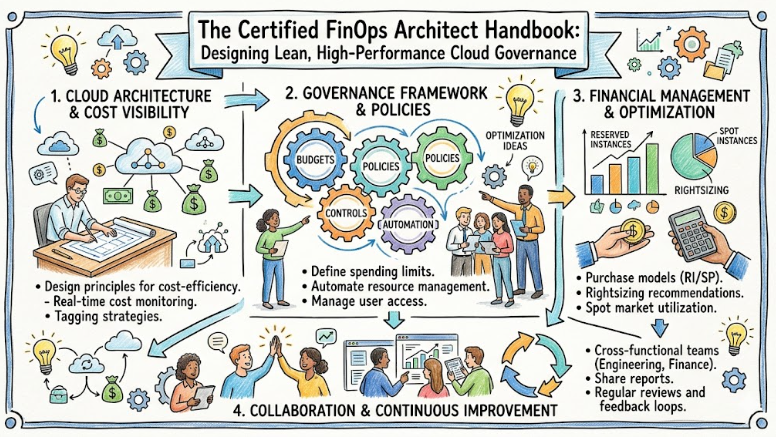
The Certified FinOps Architect represents the pinnacle of cloud financial management for technical leaders. This guide is designed for senior engineers, architects, and managers who need to move beyond basic cost savings and into the realm of building scalable, automated cloud governance frameworks. As cloud environments grow in complexity, the ability to architect for both performance and unit economics has become a non-negotiable skill set. By following this roadmap, professionals can transition from reactive cost-cutting to proactive value engineering, ensuring their career remains at the forefront of the platform engineering and FinOps movement globally, including the rapidly expanding tech hubs in India. You can explore more about these standards at finopsschool.
What is the Certified FinOps Architect?
The Certified FinOps Architect is a professional designation that validates an individual’s ability to design cloud infrastructures with financial accountability baked into the code. Unlike entry-level certifications that focus on terminology, this program emphasizes the architectural patterns required to enable real-time cost visibility and automated optimization. It exists to bridge the gap between pure engineering and business value, ensuring that architects can justify every dollar spent on cloud resources. It aligns with modern enterprise practices by treating cost as a first-class metric, similar to latency or availability.
Who Should Pursue Certified FinOps Architect?
This certification is tailor-made for SREs, Lead DevOps Engineers, and Cloud Architects who have moved past the “how-to” phase and are now focused on “why” and “how much.” It is equally beneficial for Engineering Managers and Technical Leads who oversee large-scale budgets and need to empower their teams with data-driven decision-making tools. For professionals in India and across the global market, this credential signals a level of maturity in handling multi-cloud environments and enterprise-grade financial modeling. Even security and data professionals find value here as they learn to manage the massive costs associated with data egress and high-performance computing.
Why Certified FinOps Architect is Valuable and Beyond
In an era where cloud spending often spirals out of control, the demand for architects who can design lean, efficient systems is at an all-time high. This certification offers long-term career longevity because it focuses on architectural principles that remain constant even as specific cloud tools evolve. Enterprises are moving away from centralized procurement toward decentralized, engineer-led spending, and the Certified FinOps Architect is the person who builds the guardrails for that freedom. Investing time in this path guarantees a high return on effort by positioning the professional as a strategic asset rather than a simple implementer.
Certified FinOps Architect Certification Overview
The program is delivered via the official training portal and is hosted on the main platform. It focuses on a holistic assessment approach, moving away from multiple-choice memorization toward scenario-based architectural challenges. The ownership of the certification lies with an industry-recognized body that ensures the curriculum stays updated with the latest cloud-native trends. The structure is built around three core pillars: Inform, Optimize, and Operate, providing a practical framework that can be applied to any enterprise cloud environment immediately after completion.
Certified FinOps Architect Certification Tracks & Levels
The certification path is divided into logical tiers to support continuous professional development. The foundation level introduces the core lexicon and principles, while the professional level dives into implementation and reporting. The advanced Architect level focuses on the design of automation, policy-as-code, and integration with CI/CD pipelines. These tracks are designed to align with career progression, moving from individual contributors to strategic leaders who can influence organizational policy and financial culture across multiple business units.
Complete Certified FinOps Architect Certification Table
| Track | Level | Who it’s for | Prerequisites | Skills Covered | Recommended Order |
| Core FinOps | Foundation | Beginners, Finance, HR | Basic Cloud Knowledge | Terminology, Lifecycle | 1 |
| Engineering | Professional | DevOps, SRE, SysAdmins | 1-2 Years Cloud Exp | Tooling, Tagging, Rightsizing | 2 |
| Architecture | Advanced | Senior Architects, Leads | Professional Level Cert | Policy-as-Code, Unit Economics | 3 |
| Leadership | Executive | CTOs, Directors, VPs | Management Experience | Change Management, ROI Modeling | 4 |
Detailed Guide for Each Certified FinOps Architect Certification
Certified FinOps Architect – Foundation Level
What it is
This level validates a fundamental understanding of the FinOps framework and the ability to participate in cross-functional cost management discussions.
Who should take it
It is suitable for junior cloud engineers, project managers, and finance professionals who need to speak the same language as the technical teams.
Skills you’ll gain
- Understanding the six pillars of FinOps.
- Ability to navigate cloud billing consoles for major providers.
- Understanding the difference between CAPEX and OPEX in cloud computing.
- Identifying common waste in cloud environments.
Real-world projects you should be able to do
- Audit a basic cloud bill and identify immediate low-hanging fruit for savings.
- Create a basic tagging policy for a development environment.
- Generate monthly cost reports for department stakeholders.
Preparation plan
- 7 Days: Focus on the official glossary and the core lifecycle stages.
- 30 Days: Practice identifying cost anomalies in a sandbox environment.
- 60 Days: Not typically required for this level, but useful for non-technical candidates to learn cloud basics.
Common mistakes
- Overcomplicating the terminology rather than focusing on the cultural shift.
- Ignoring the “Finance” aspect of FinOps and focusing only on technical tools.
Best next certification after this
- Same-track option: Professional FinOps Practitioner.
- Cross-track option: Cloud Digital Leader or equivalent.
- Leadership option: Management Essentials for Engineering.
Certified FinOps Architect – Professional Level
What it is
A technical certification focusing on the implementation of cost optimization strategies and the deployment of monitoring tools.
Who should take it
Active DevOps engineers and SREs who are responsible for maintaining production infrastructure and managing resource utilization.
Skills you’ll gain
- Advanced rightsizing techniques for compute and storage.
- Implementation of automated shutdown schedules and spot instance usage.
- Designing and maintaining multi-cloud cost allocation models.
- Setting up real-time alerting for budget threshold breaches.
Real-world projects you should be able to do
- Migrating a production workload to spot instances without impacting SLA.
- Implementing an automated cleanup script for unattached storage volumes.
- Building a custom dashboard that maps cloud costs to specific microservices.
Preparation plan
- 7 Days: Reviewing cloud-specific cost management APIs.
- 30 Days: Hands-on labs involving Reserved Instances and Savings Plans.
- 60 Days: Deep dive into container cost allocation (Kubernetes FinOps).
Common mistakes
- Focusing solely on cost reduction at the expense of system performance.
- Failing to automate the reporting process, leading to “dashboard fatigue.”
Best next certification after this
- Same-track option: Certified FinOps Architect (Advanced).
- Cross-track option: CKA (Certified Kubernetes Administrator).
- Leadership option: Technical Program Management.
Certified FinOps Architect – Advanced Level
What it is
The highest level of certification, focusing on the strategic design of cost-aware systems and organizational-wide automation.
Who should take it
Principal engineers, chief architects, and technical directors who design the overarching cloud strategy for an enterprise.
Skills you’ll gain
- Architecting policy-as-code for proactive cost governance.
- Designing unit economic models (e.g., cost per transaction).
- Leading cultural transformation and FinOps center of excellence (CoE).
- Advanced negotiation and procurement strategies for cloud commitments.
Real-world projects you should be able to do
- Designing a global cloud governance framework using Terraform or Pulumi.
- Establishing a unit cost metric for the company’s primary product line.
- Orchestrating a successful migration from a legacy pricing model to a value-based model.
Preparation plan
- 7 Days: Reviewing enterprise-level governance whitepapers.
- 30 Days: Studying case studies on large-scale FinOps transformations.
- 60 Days: Developing a mock organizational FinOps roadmap and policy set.
Common mistakes
- Trying to implement advanced automation before the culture is ready.
- Neglecting the communication aspect between engineering and executive leadership.
Best next certification after this
- Same-track option: Fellow or Mentor status within the community.
- Cross-track option: Advanced Cloud Security Specialty.
- Leadership option: Executive MBA or Leadership for Tech Executives.
Choose Your Learning Path
DevOps Path
In this path, the focus is on integrating FinOps into the CI/CD pipeline. Engineers learn how to provide developers with immediate feedback on the cost impact of their code changes. By mastering the architect level, DevOps professionals ensure that “Shift Left” applies to cost just as much as it applies to security. This path leads to roles like Lead DevOps Engineer or Platform Architect.
DevSecOps Path
This track emphasizes the intersection of security compliance and cost management. Professionals learn how security tools and logging impacts the cloud bill and how to optimize security data retention without compromising safety. It is ideal for those who want to ensure that “secure” doesn’t mean “unaffordable.” This leads to roles in Cloud Security Architecture with a focus on efficiency.
SRE Path
Site Reliability Engineers use this certification to balance the “Error Budget” with the “Financial Budget.” The path focuses on how reliability choices, such as multi-region redundancy, affect the bottom line. It provides the tools to make data-driven decisions on where to over-provision and where to lean out. This path is essential for senior SREs aiming for Principal roles.
AIOps Path
This specialization focuses on using machine learning to predict cost trends and automate anomaly detection. As AI becomes a tool for managing cloud scale, this path teaches how to build self-healing systems that optimize themselves for price and performance. It is perfect for engineers moving into automated infrastructure management.
MLOps Path
Machine Learning workloads are notoriously expensive due to GPU requirements. This path teaches how to manage the lifecycle of models—from training to inference—with a strict eye on cost-to-value. It is a critical track for Data Scientists and ML Engineers who need to scale their models in production sustainably.
DataOps Path
Data pipelines often generate hidden costs through egress and storage of dark data. This path focuses on architecting data lakes and warehouses that are financially transparent and efficient. Engineers learn to balance data accessibility with the cost of high-performance storage tiers, making them invaluable to data-driven organizations.
FinOps Path
This is the dedicated track for those who want to specialize exclusively in cloud financial management. It covers the full spectrum from accounting and procurement to deep technical architecture. This path leads directly to roles like Head of FinOps or Cloud Business Office Director, focusing on the bridge between finance and engineering.
Role → Recommended Certified FinOps Architect Certifications
| Role | Recommended Certifications |
| DevOps Engineer | Foundation, Professional |
| SRE | Professional, Advanced |
| Platform Engineer | Professional, Advanced |
| Cloud Engineer | Foundation, Professional |
| Security Engineer | Foundation, Professional |
| Data Engineer | Foundation, Professional |
| FinOps Practitioner | Foundation, Professional, Advanced |
| Engineering Manager | Foundation, Advanced |
Next Certifications to Take After Certified FinOps Architect
Same Track Progression
Once the Architect level is achieved, the next step is often a deeper dive into specific cloud provider specialties, such as AWS Certified Solutions Architect – Professional or Azure Solutions Architect Expert. This solidifies the FinOps principles within a specific technical ecosystem. It allows the professional to apply generic FinOps frameworks to specific, proprietary cloud services with high precision.
Cross-Track Expansion
Expanding into Kubernetes certification (CKA/CKAD) is the most common cross-track move. Since containerization is the primary driver of cloud-native growth, understanding how to apply FinOps to shared clusters is a massive career multiplier. Alternatively, moving into Security (CKS) ensures that the architect can protect the efficient systems they have built.
Leadership & Management Track
For those looking to move into the C-suite or senior management, certifications in ITIL or PMP can complement the technical nature of FinOps. Understanding how financial governance fits into broader IT service management or project portfolios helps in communicating the value of FinOps to non-technical stakeholders. This transition is key for those aiming for VP of Infrastructure or CTO roles.
Training & Certification Support Providers for Certified FinOps Architect
DevOpsSchool
This provider offers extensive resources for those looking to integrate financial management into their DevOps workflows. They focus on practical labs and real-world scenarios that prepare candidates for the complexities of modern enterprise environments. Their curriculum is designed to be hands-on, ensuring that theoretical knowledge is backed by the ability to execute optimization tasks.
Cotocus
Known for its specialized training modules, this provider helps professionals master the specific tooling required for the Architect level. They emphasize the use of automation and policy-as-code, which are critical components of the advanced certification tracks. Their trainers often come with deep industry experience in managing multi-million dollar cloud budgets.
Scmgalaxy
This platform serves as a community hub for sharing best practices and study materials. It is particularly useful for candidates who want to see how other organizations have tackled the cultural challenges of FinOps. They provide a wealth of documentation and community-driven guides that complement the official certification path.
BestDevOps
Focusing on the elite end of the spectrum, this provider offers bootcamps designed for senior engineers. Their approach is fast-paced and geared toward those who already have a strong foundation in cloud architecture but need to add the financial layer to their skill set. They focus on ROI and business value.
devsecopsschool.com
This site bridges the gap between security and finance. Their training highlights how to maintain a strong security posture without overspending on redundant tools or inefficient data logging. It is the go-to resource for those following the DevSecOps path within the FinOps ecosystem.
sreschool.com
Site Reliability Engineering is all about trade-offs, and this provider teaches how to make those trade-offs with financial data. Their courses show how to integrate cost metrics into SLIs and SLOs, making cost a part of the system’s overall health and reliability.
aiopsschool.com
As automation becomes the standard, this provider focuses on the “Ops” side of Artificial Intelligence. They teach how to build systems that can automatically respond to cost anomalies using machine learning, which is a core skill for the future of cloud architecture.
dataopsschool.com
Managing the cost of big data is a unique challenge, and this site provides the specialized knowledge needed for that task. They cover everything from storage tiering to the financial implications of different data processing frameworks like Spark or Snowflake.
finopsschool.com
The primary hosting site and authority on the certification, offering the most direct and up-to-date information. It serves as the foundation for all learning paths, providing the core curriculum, assessment environment, and official certification credentials for professionals worldwide.
Frequently Asked Questions (General)
- How long does it typically take to complete the Architect level?
For an experienced cloud architect, the process usually takes between 60 and 90 days of dedicated study and practice. This allows enough time to move through the foundation and professional levels first. - Are there any specific coding skills required?
While not a “coding” cert, a working knowledge of Python, Go, or Shell scripting is highly recommended for the automation and policy-as-code sections of the curriculum. - What is the typical return on investment for this certification?
Most professionals see an immediate increase in their strategic value within their company, often leading to promotions into architectural or leadership roles with higher compensation. - Do I need to be a cloud expert before starting?
You should have at least a basic understanding of cloud services (compute, storage, networking) before attempting the foundation level to ensure the concepts make sense. - Is the exam based on a specific cloud provider like AWS or Azure?
No, the certification is cloud-agnostic. It focuses on universal principles and patterns that can be applied to any provider or even private cloud environments. - How often does the certification need to be renewed?
To ensure your skills stay current with the fast-moving cloud industry, renewal is typically required every two to three years through continuing education or re-examination. - Is there a community for those who hold this certification?
Yes, there is a global community of practitioners who share insights, templates, and job opportunities, providing significant networking value beyond the credential itself. - Can a finance professional without an engineering background pass this?
They can certainly pass the Foundation level, but the Architect level requires a deep understanding of infrastructure design that may be difficult without technical experience. - How does this certification differ from a standard Cloud Architect cert?
Standard certs focus on “can we build it?” and “will it work?” while the FinOps cert asks “should we build it this way?” and “is it cost-effective?” - Are there any prerequisites for the Professional level?
It is highly recommended to have completed the Foundation level or have equivalent hands-on experience in cloud cost management tools. - What is the most difficult part of the Architect exam?
The scenario-based questions that require you to balance conflicting requirements—like high availability versus extreme cost constraints—are often cited as the most challenging. - Does this certification help in finding jobs in India?
Absolutely. India has one of the largest concentrations of cloud-native development, and companies there are increasingly looking for ways to optimize their massive cloud spends.
FAQs on Certified FinOps Architect
- What makes the Architect level unique compared to the Practitioner level?
The Architect level focuses on “building” and “designing” rather than just “practicing.” It requires the ability to create the automated guardrails that the Practitioners then use. - Can I skip the Foundation level?
While technically possible if you have extensive experience, it is discouraged because the Foundation level establishes the specific lexicon and framework used in higher levels. - Is container cost management covered?
Yes, a significant portion of the advanced curriculum is dedicated to Kubernetes FinOps and how to allocate costs in shared cluster environments. - Does this certification cover multi-cloud strategies?
Yes, architecting for a multi-cloud environment is a core component, as it introduces complexities in billing and normalization that every architect must master. - Is there a focus on specific tools like Terrafrom?
The certification focuses on the concept of “Policy as Code” rather than a specific tool, though Terraform is frequently used in examples and lab scenarios. - How does the certification handle the “Operate” phase?
It teaches how to build continuous improvement loops where cost data informs future architectural designs, creating a self-optimizing ecosystem within the company. - What role does unit economics play in the exam?
Unit economics is a key topic; you must demonstrate an ability to link cloud spend to business outcomes, like the cost per customer or cost per transaction. - Are there any labs included in the training?
Yes, the professional and architect levels include scenario-based labs where you must identify and remediate cost issues in a simulated cloud environment.
Final Thoughts: Is Certified FinOps Architect Worth It?
From a mentor’s perspective, the Certified FinOps Architect is one of the most practical investments a senior professional can make today. We are moving out of the “growth at all costs” era of cloud computing and into an era of “efficient growth.” Engineers who can prove they understand the financial impact of their technical decisions are becoming the most influential people in the room. This certification doesn’t just give you a title; it gives you a framework to solve one of the biggest problems facing modern enterprises. If you want to move from being a resource to being a strategist, this is your path. It is worth every hour of study because it turns you into a professional who speaks the language of both the server room and the boardroom.
