Introduction
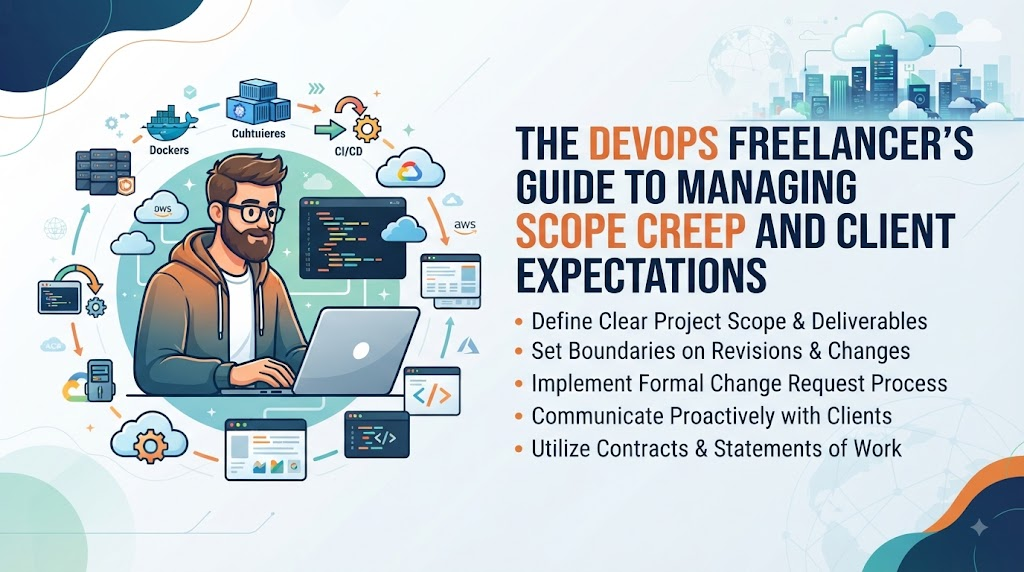
Managing project boundaries is one of the most critical yet challenging aspects of independent consulting, especially in DevOps and cloud infrastructure where technical layers are deeply interconnected. When clients request seemingly small adjustments, those changes often trigger complex cascading effects across continuous integration pipelines, cloud environments, and security configurations. By establishing clear technical boundaries, documenting upfront assumptions, and implementing a transparent change-control process, independent engineers can protect project profitability and timelines while fostering long-term trust and predictability with their clients.
What Is Scope Creep in DevOps Freelance Work?
Scope creep refers to the gradual expansion of project requirements beyond what was originally agreed upon, without any corresponding adjustment to the project timeline, budget, or deliverables. It rarely happens all at once. Instead, it creeps in through small, seemingly harmless additions that accumulate over weeks or months until the original project bears little resemblance to the signed agreement.
In independent consulting, scope creep manifests in several common ways:
- A client asks to add an extra deployment environment, such as a staging or UAT environment, after development has already started.
- Monitoring and alerting are introduced halfway through implementation even though only basic CI/CD was agreed upon.
- The client decides to switch from one cloud provider to another because of a sudden internal policy change.
- Security compliance requirements change, introducing vulnerability scanning or compliance reporting that was never discussed during discovery.
- A requirement to migrate legacy applications to Kubernetes is added to an infrastructure automation project.
- The CI/CD pipeline scope is expanded from a single application to cover ten microservices.
- Documentation requirements grow from a simple deployment checklist to a comprehensive internal training manual.
It is important to distinguish between legitimate project evolution and uncontrolled scope creep. Projects naturally evolve as teams discover better technical solutions during implementation. However, when new requirements are introduced informally without evaluating their impact on time and cost, the project destabilizes.
Why Scope Creep Happens in DevOps Projects
Understanding why scope expansion occurs helps independent engineers prevent it before it damages project profitability and timelines. Scope creep rarely happens because clients are malicious; it usually stems from poor communication, vague initial agreements, or unforeseen technical realities.
Common causes include vague requirements during discovery, poor upfront planning, shifting business priorities within the client organization, unknown technical dependencies, and unmanaged client assumptions. When a project starts without a clear baseline, both parties fill in the blanks differently, leading to misalignment.
| Cause | Example | Risk |
| Unclear Requirements | “Set up our cloud infrastructure” | Misunderstood deliverables and mismatched expectations |
| New Technical Dependency | Realizing the legacy app requires containerization | Unplanned refactoring work eating into profit |
| Changing Priorities | Client pivots from AWS to Azure mid-project | Reworking completed automation scripts from scratch |
| Client Assumptions | Assuming 24/7 post-deployment support is included | Unpaid emergency support obligations |
| Underestimated Work | Assuming security configuration takes one hour | Spending days troubleshooting IAM and firewall rules |
| No Change Process | Accepting requests via casual Slack messages | Complete loss of timeline and budget control |
Define Scope Before Starting the Project
Before writing a single line of Infrastructure as Code or configuring a pipeline, the freelancer and client must align on the exact boundaries of the engagement. This requires clarifying the core business objective, technical objectives, specific deliverables, target environments, technology stacks, and individual responsibilities.
Freelancers must also document explicit assumptions, technical dependencies, out-of-scope items, the project timeline, and formal acceptance criteria. Technical scope must be written in language that both technical stakeholders and business managers can easily understand. If a non-technical project manager cannot read the scope document and understand what is being built, the scope is too ambiguous.
Create a Clear DevOps Statement of Work
A practical Statement of Work protects both parties by establishing a definitive reference point for the project. It should be concise, highly specific, and structured for quick review.
The SOW should contain project objectives, deliverables, technical scope, client responsibilities, freelancer responsibilities, documented assumptions, known dependencies, explicitly excluded items, the timeline, acceptance criteria, and the formal change-management process.
| Item | Included? | Notes |
| CI/CD Pipeline | Yes | Automated build and test for GitHub Actions |
| Production Deployment | Yes | Automated deployment to AWS ECS |
| Monitoring | Yes/No | Basic CloudWatch alarms included; custom Grafana dashboards excluded |
| Security Scanning | Yes/No | Container vulnerability scanning included; full pentest excluded |
| Disaster Recovery | Yes/No | Daily backups configured; multi-region failover excluded |
| Kubernetes Migration | Yes/No | Excluded from current phase; containerization done via ECS |
| Documentation | Yes | Architecture diagram and deployment runbook included |
Define Deliverables Clearly
Vague deliverables are the primary source of conflict in freelance engagements. When deliverables are poorly defined, expectations diverge rapidly.
Compare these two approaches:
- Weak: “Set up DevOps infrastructure.”
- Better: “Create Terraform scripts for AWS VPC, RDS, and ECS environments, configure a GitHub Actions CI/CD pipeline for the primary API repository, and provide a Markdown deployment runbook.”
Deliverables should describe concrete technical outcomes rather than ambiguous effort. Saying you will spend ten hours on security is vague; saying you will configure IAM roles, security groups, and container image scanning defines a verifiable outcome.
Define What Is Out of Scope
Exclusions are just as important as deliverables. Explicitly listing what the project does not include prevents misunderstandings and demonstrates professional maturity.
Common exclusions in DevOps consulting include application code refactoring, major architecture redesigns, managing additional unapproved cloud accounts, handling unplanned legacy migrations, providing 24/7 ongoing support, setting up long-term enterprise monitoring operations, conducting formal security audits, implementing complex disaster recovery failovers, or adding secondary environments outside the agreed plan.
Exclusions should be framed professionally as boundary definitions rather than rejections. This assures the client that while those items are valuable, they belong in a separate phase or change request.
Use Milestones to Control Scope
Milestones break large, complex DevOps engagements into manageable, reviewable phases. This ensures that progress is validated continuously rather than all at once at the end of the project.
Milestone 1: Discovery
↓
Milestone 2: Infrastructure
↓
Milestone 3: CI/CD
↓
Milestone 4: Security & Monitoring
↓
Milestone 5: Production Deployment
↓
Milestone 6: Documentation & Handover
Breaking a project into these discrete steps makes it easy to review completed work, sign off on specific deliverables, and pause or adjust the scope of subsequent phases before committing additional engineering hours.
Establish Acceptance Criteria
Acceptance criteria define the exact conditions that must be met for a deliverable to be considered complete. They remove subjectivity from project review.
Acceptance criteria should cover functional requirements, infrastructure correctness, performance benchmarks, security checks, deployment validation, and documentation completeness.
| Deliverable | Acceptance Criteria |
| CI/CD Pipeline | Successfully builds code, runs automated unit tests, and pushes Docker image to registry on every merge to main branch. |
| Infrastructure | Provisioned via Terraform without manual console modifications; state file stored securely in remote backend. |
| Monitoring | CloudWatch dashboard displays CPU, memory, and HTTP error rates; alarm triggers SNS notification on error spike. |
| Deployment | Zero-downtime rolling update deployed to ECS cluster with automated health check verification. |
| Documentation | Runbook reviewed by client team, containing environment variables, deployment steps, and rollback instructions. |
Distinguish Bugs From New Requirements
During implementation, clients often report issues that need careful categorization. Misclassifying new requests as bug fixes leads to unpaid labor and strained relationships.
- Defect (Bug): Something built does not meet the originally agreed requirement or fails to function as specified in the SOW.
- Change Request: The client wants something new, altered, or expanded that was not part of the original agreement.
| Situation | Bug or New Scope? | Reason |
| Pipeline fails the agreed build | Bug | Fails to meet agreed functionality |
| Client adds another application to pipeline | New Scope | Additional application was not in original SOW |
| Deployment doesn’t match documented requirement | Bug | Deviates from agreed specification |
| Client requests Kubernetes migration after ECS setup | New Scope | Major architectural shift beyond original parameters |
| Monitoring dashboard has missing agreed metric | Bug | Agreed metric was omitted from initial configuration |
Recognize Early Signs of Scope Creep
Scope creep often arrives disguised as casual conversation or minor favors. Recognizing the warning phrases early allows freelancers to address them before they derail the project.
Watch out for phrases like:
- “Can you quickly add…”
- “Since you’re already working on it…”
- “It should only take a few minutes.”
- “We also need this for another application.”
- “Can you include production support?”
- “Can you handle security too?”
- “Can you migrate the database while you’re there?”
Individually, these requests sound trivial. Collectively, they introduce hours of testing, validation, and integration work that consumes the project profit margin.
Create a Change Request Process
A structured change-control process keeps projects organized when requirements inevitably evolve. Instead of reacting emotionally, follow a repeatable workflow.
Client Requests Change
↓
Clarify Requirement
↓
Assess Technical Impact
↓
Estimate Time and Cost
↓
Document Change
↓
Client Approves
↓
Implement
↓
Test
↓
Update Documentation
Never start substantial additional work before the scope adjustment, timeline impact, and cost adjustment are formally agreed upon with the client.
How to Estimate Additional DevOps Work
When a change request is received, accurate estimation prevents underpricing. Freelancers must evaluate engineering effort, testing time, infrastructure changes, security impact, documentation updates, technical dependencies, operational risks, communication overhead, and ongoing support requirements.
| Change | Engineering Work | Testing | Risk | Estimate |
| New Environment | Terraform module duplication & variable adjustments | Integration testing across staging network | Medium | 4 Hours |
| New CI/CD Pipeline | Workflow file creation & secret management | Pipeline dry-run and trigger validation | Low | 3 Hours |
| Kubernetes Migration | Cluster provisioning, Helm charts, manifest creation | Load testing and roll-out validation | High | 16 Hours |
| Monitoring Expansion | Log aggregation and custom metric setup | Alert threshold verification | Low | 5 Hours |
Always account for validation, testing, and team coordination time, not just the raw implementation time in code editors.
Communicating Scope Changes With Clients
Professional communication preserves client trust while protecting project boundaries. When handling new requests, maintain a collaborative and helpful tone.
Example 1: Small Additional Request
“This sounds like a great addition to the platform. Because it falls outside our current scope of work, I can quickly put together a brief change request with the cost and time estimate so we can review it.”
Example 2: Major Technical Change
“This requirement introduces a significant change to our deployment workflow and architecture. I recommend completing our current milestone first so we have a stable baseline, and then evaluating this new workflow as a separate phase.”
Example 3: Urgent Request
“I understand this is urgent and needs immediate attention. It will impact our timeline for the current milestone. We can either swap out a lower-priority task for this week or adjust the milestone timeline accordingly.”
Avoid Scope Creep During Discovery
Discovery is the most effective defense against scope creep. A thorough discovery phase uncovers hidden technical debt and complex requirements before pricing or committing to implementation.
During discovery, review architecture diagrams, code repositories, cloud accounts, existing CI/CD setups, infrastructure configurations, security policies, monitoring setups, team operational responsibilities, and existing documentation. Uncovering a messy legacy setup during discovery allows you to price the project accurately rather than absorbing unexpected refactoring work later.
Document Technical Assumptions
Assumptions form the foundation of project estimates. If an assumption is invalid, the estimate is no longer valid. Documenting assumptions protects you when conditions change.
Common technical assumptions include:
- Cloud provider administrative access will be provided on day one.
- Existing application source code builds and tests successfully without intervention.
- Required third-party API credentials and secrets are readily available.
- DNS management access and domain registrar control are accessible.
- The client provides application configuration requirements promptly.
- Existing legacy infrastructure is reasonably documented.
- Staging environments already exist or are explicitly funded within the project scope.
When assumptions prove incorrect, notify the client immediately and adjust the project plan accordingly.
Manage Client Dependencies
Many DevOps projects stall because of external client dependencies. Tracking these dependencies prevents silent delays from compressing your schedule.
| Dependency | Owner | Required By | Impact if Delayed |
| Cloud Access | Client | Day 1 | Cannot provision infrastructure |
| Repository Access | Client | Day 1 | Cannot configure CI/CD pipelines |
| DNS Access | Client | Milestone 3 | Cannot configure SSL and routing |
| Application Configuration | Client | Milestone 2 | Cannot containerize workloads |
| Security Approval | Client | Milestone 4 | Cannot deploy to production |
| Test Data | Client | Milestone 3 | Cannot validate integration tests |
Track these dependencies in your project tracker so delays are transparent to all stakeholders.
Use Project Documentation to Protect Scope
Written documentation is your best shield against scope creep. Maintain a clear paper trail throughout the engagement.
Essential documents include the scope document, SOW, meeting notes, change requests, decision logs, architecture diagrams, deployment runbooks, and signed acceptance records. Written documentation ensures that verbal agreements are never misremembered and gives both parties a shared source of truth.
Track Scope During the Project
A simple scope tracker keeps everyone aligned. Reviewing this tracker during weekly syncs prevents hidden work from accumulating unnoticed.
| Request | Original Scope? | Status | Impact | Decision |
| New Environment | No | Pending Approval | +4 Hours | Approved as Change Request |
| Additional Pipeline | Yes | In Progress | None | Included in SOW |
| Security Requirement | No | Rejected | N/A | Deferred to Phase Two |
| Monitoring Change | Yes | Completed | None | Included in SOW |
Regular scope reviews ensure transparency and eliminate surprises at invoice time.
Handling Scope Creep in Fixed-Price Projects
Fixed-price projects require strict boundary management. Because the total cost is locked, any uncompensated scope expansion directly reduces your hourly earnings.
To protect fixed-price engagements, ensure your deliverables, acceptance criteria, assumptions, exclusions, and change-request processes are crystal clear in the contract. Avoid absorbing significant additional work simply to keep the client happy; instead, use the formal change process to quote additional time and budget.
Handling Scope Creep in Hourly Projects
Hourly billing does not eliminate scope-management problems. While hourly projects protect you financially for the time worked, unmanaged scope creep can still blow out client budgets, damage trust, and delay other client commitments.
Manage hourly projects by maintaining rigorous time tracking, prioritizing tasks collaboratively, securing client approvals before tackling major new items, establishing weekly or monthly hour caps, and keeping documentation updated so the client understands exactly where engineering hours are spent.
Scope Creep and Emergency DevOps Work
Production incidents and emergency outages frequently create unplanned work. While critical incidents require immediate triage, distinguishing emergency stabilization from long-term improvements is vital.
Focus emergency work entirely on restoring service stability and root cause mitigation. Once stability is achieved, transition any broader architectural improvements, monitoring enhancements, or refactoring tasks into a planned backlog with appropriate estimates and change approvals.
Scope Creep During Production Deployment
Production readiness often exposes hidden requirements that were not visible during development or staging phases. Clients frequently request last-minute additions such as advanced monitoring, strict security hardening, auto-scaling configuration, backup automation, disaster recovery setup, performance tuning, or secondary production environments.
Handling this smoothly requires clear acceptance criteria for production readiness agreed upon before deployment day begins. If additional hardening is requested during deployment, document it as a post-launch optimization phase.
How to Maintain a Healthy Client Relationship
Good scope management should build trust rather than create friction. Maintaining transparency, providing regular updates, keeping thorough documentation, issuing early warnings when roadblocks appear, avoiding unpleasant surprises, and maintaining professional boundaries show your client that you respect their budget as much as your own time. Flexibility is important, but it must be managed deliberately through agreed processes.
Common Scope Management Mistakes by DevOps Freelancers
Independent engineers often fall into predictable traps when managing project scope:
- Starting without discovery: Committing to a fixed price before inspecting the client’s actual codebase and cloud environment.
- Saying yes to everything: Agreeing to every casual request to avoid short-term discomfort, leading to burnout.
- No written scope: Relying on verbal agreements or brief chat messages instead of a formal SOW.
- No exclusions: Failing to state what is not included, leaving room for unrealistic client assumptions.
- No acceptance criteria: Finishing work without a clear definition of done, leading to endless revision cycles.
- Underestimating integration: Forgetting that connecting legacy systems takes longer than building new infrastructure.
- Not tracking client dependencies: Absorbing delays caused by client inaction without adjusting the timeline.
- Doing unpaid additional work: Delivering extra features without invoicing for them.
- Poor communication: Waiting until the end of the project to raise concerns about scope expansion.
- Failing to document changes: Implementing approved changes without updating the project agreement.
DevOps Freelancer Scope Control Checklist
Use this checklist before and during every freelance engagement to keep your projects on track:
- Business objective defined
- Technical objective defined
- Deliverables documented
- Out-of-scope items documented
- Assumptions documented
- Dependencies identified
- Acceptance criteria defined
- Milestones created
- Timeline agreed
- Client responsibilities documented
- Change request process defined
- Communication channel agreed
- Scope tracker maintained
- Additional work estimated
- Client approval documented
- Final handover documented
DevOps Freelance Scope Template
Adapt this reusable template for your own consulting engagements:
Project Name: [Insert Project Name]
Business Objective: [Describe business goal]
Technical Objective: [Describe technical outcome]
Deliverables: [List specific outputs]
In-Scope Work: [Detailed inclusion list]
Out-of-Scope Work: [Detailed exclusion list]
Assumptions: [List technical and operational assumptions]
Dependencies: [List client and third-party dependencies]
Client Responsibilities: [What the client must provide]
Freelancer Responsibilities: [What the freelancer will execute]
Milestones: [Phase breakdown]
Timeline: [Start and end dates]
Acceptance Criteria: [Conditions for completion]
Change Request Process: [How changes will be evaluated]
Support/Handover: [Post-deployment support terms]
Real-World DevOps Freelance Example
Consider a realistic scenario where a fintech startup hires an independent DevOps engineer to build a CI/CD pipeline for their cloud application.
Original Scope
- GitHub repository integration
- Automated build and unit testing workflow
- Automated deployment to a single staging environment
- Basic deployment runbook documentation
New Client Requests Arriving Mid-Project
- Add a production deployment environment with zero-downtime rolling updates
- Migrate application workloads from raw EC2 instances to Kubernetes (EKS)
- Implement automated container security scanning and vulnerability reporting
- Set up comprehensive Grafana monitoring dashboards with Slack alerting
- Configure automated daily database backups and disaster recovery runbook
- Provide 24/7 post-deployment operational support
Recommended Freelancer Response
Instead of absorbing these massive infrastructure additions into the original fixed price, the freelancer evaluates the impact and responds professionally:
“The original scope focused on a staging CI/CD pipeline and basic deployment documentation. Migrating to Kubernetes, setting up production environments, and adding security scanning and monitoring represent significant additional architecture and implementation work. I recommend structuring these new requirements into two additional milestones: Milestone 2 for Kubernetes and Production Deployment, and Milestone 3 for Security and Monitoring. I will prepare a quick estimate for these additions so we can review them together.”
This approach protects the freelancer’s profitability, respects the client’s evolving business needs, and maintains a collaborative relationship.
How to Build a Scope-Control Workflow
Discovery
↓
Scope Definition
↓
Estimate
↓
Agreement
↓
Milestones
↓
Implementation
↓
Change Request
↓
Impact Assessment
↓
Approval
↓
Implementation
↓
Acceptance
↓
Handover
This structured workflow ensures your freelance projects remain organized, professional, and efficient without feeling overly bureaucratic.
Career Value of Scope Management Skills
Technical expertise alone is not enough to build a successful independent consulting practice. Mastering scope management transforms engineers into trusted technical advisors and project leaders.
| Role | Scope Management Skills Value |
| DevOps Freelancer | Protects profit margins and prevents burnout on fixed-price contracts |
| DevOps Consultant | Enhances professional credibility during client discovery and advisory sessions |
| Cloud Engineer | Ensures cloud migration projects stay within resource budgets and timelines |
| SRE | Helps prioritize reliability initiatives against competing operational demands |
| DevSecOps Consultant | Clearly separates security compliance deliverables from standard infrastructure setup |
| Platform Engineer | Manages internal stakeholder requests and platform feature roadmaps effectively |
DevOps Freelancing Learning Roadmap
Building a thriving freelance consulting practice requires combining technical mastery with professional project management skills.
Linux & Networking
↓
Git
↓
DevOps Fundamentals
↓
CI/CD
↓
Cloud
↓
Containers
↓
Infrastructure as Code
↓
Monitoring & Observability
↓
DevSecOps
↓
Project Estimation
↓
Client Communication
↓
Scope Management
↓
Freelance Project Delivery
Mastering each layer of this roadmap ensures you have both the deep technical competence required to execute complex cloud projects and the operational discipline required to manage them profitably.
Frequently Asked Questions (12 Questions)
What is scope creep in DevOps freelancing?
Scope creep is the gradual expansion of project requirements beyond the originally agreed Statement of Work without adjusting timeline, budget, or deliverables.
Why does scope creep happen in DevOps projects?
It happens due to vague initial requirements, unmanaged client assumptions, unforeseen technical dependencies, shifting business priorities, and a lack of formal change-control processes.
How can a DevOps freelancer prevent scope creep?
By conducting thorough discovery, documenting explicit technical assumptions, defining clear deliverables and exclusions, establishing milestones, and using a formal change-request process.
What should be included in a DevOps project scope?
A comprehensive scope should cover business and technical objectives, specific deliverables, target environments, technology stacks, assumptions, dependencies, exclusions, timelines, and acceptance criteria.
How should freelancers handle new client requests?
Evaluate the technical impact, estimate the additional effort and time required, document the change, and present it to the client for approval before starting work.
How do you distinguish a bug from a change request?
A bug is something that fails to meet the originally agreed requirements. A change request is a new or altered requirement that was not part of the initial SOW.
Should additional DevOps work be billed separately?
Yes. Substantial work outside the agreed scope should be estimated, quoted, and billed separately through a formal change request.
How can freelancers handle scope creep in fixed-price projects?
By ensuring strict initial boundaries, clear exclusions, defined acceptance criteria, and refusing to absorb uncompensated work without a signed change request.
Can hourly projects experience scope creep?
Yes. While hourly billing protects your time financially, unmanaged scope creep can still damage client budgets, strain relationships, and delay other project commitments.
How should emergency production work be handled?
Focus immediately on incident stabilization and root cause mitigation, then transition any broader architectural or monitoring improvements into a planned change request.
What should a DevOps freelancer do when the client keeps changing requirements?
Pause informal execution, review the signed SOW with the client, highlight the impact on timeline and budget, and establish a formal change-control process for future requests.
How can good scope management improve client relationships?
Clear scope management builds trust through transparency, eliminates unpleasant surprises, sets predictable expectations, and ensures both parties share a common understanding of project success.
Final Thoughts
Successful DevOps freelancers do not avoid every change; they manage change deliberately. Maintaining a clear scope, realistic estimates, written assumptions, milestones, acceptance criteria, transparent communication, and a simple change-request process allows independent engineers to remain flexible without allowing projects to become uncontrolled. By treating scope management as an essential part of technical delivery, freelancers can protect project quality and profitability while building long-term, trusted relationships with their clients.
