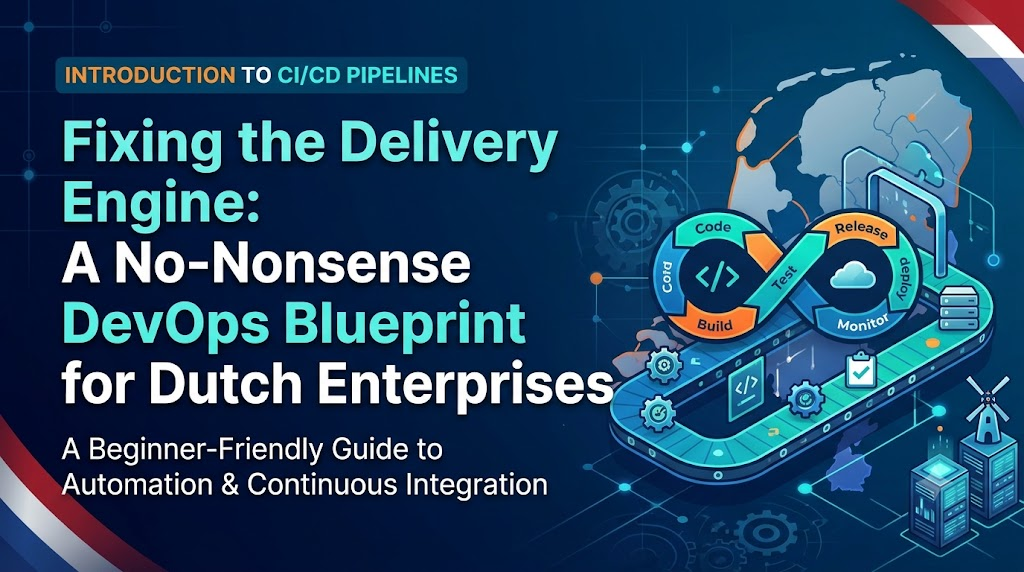
Step into the engineering rooms of tech-forward enterprises in Amsterdam, Utrecht, or the high-tech campuses of Brainport Eindhoven, and you’ll notice a familiar tension. Product engineering squads are writing clean, capable software, yet pushing those features across the release threshold into production feels like navigating an obstacle course.
Operating a modern digital platform in the Netherlands brings a distinct set of operational realities. European compliance mandates—like NIS2 and DORA—leave zero room for unverified code or casual access controls. Meanwhile, multi-cloud invoices continue to tick upward without clear team attribution, and the regional shortage of experienced systems talent makes scaling internal infrastructure teams an ongoing challenge.
When delivery cadences stumble, many organizations react by tacking on more point tools, introducing manual checklist sign-offs, or scheduling longer pre-release triage meetings. In reality, these measures usually just wrap bureaucratic tape around fragile pipelines. Building an agile, dependable delivery system requires clean internal platform design, continuous automated policy checks, and an intentional engineering culture. To modernize these environments without pulling focus from critical roadmap commitments, technical leaders are turning to specialized DevOps Consulting Netherlands to put robust, battle-tested foundations in place.
Diagnosing What’s Actually Stalling Your Releases
Software delivery rarely stalls because of code syntax errors. It breaks down in the messy handover between local development, infrastructure provisioning, and compliance gates. In complex corporate stacks, that friction almost always stems from four core issues:
[ Code Merged to Trunk ]
           │
           ├──► 1. Cognitive Tax: Engineers losing hours to YAML syntax and networking quirks
           │
           ├──► 2. Late-Stage Compliance: Last-minute security reviews freezing production deployments
           │
           ├──► 3. Cluster Fragility: Multi-tenant environments drifting from known baselines
           │
           └──► 4. Unchecked Cloud Bills: Orphaned cloud resources quietly draining operational budgets
- Context-Switching Drag: Expecting application developers to double as container network specialists and pipeline mechanics forces them to spend valuable time wrestling with infrastructure instead of refining core business features.
- The “Eleventh-Hour” Security Wall: Treating compliance audits as an isolated gate right before release creates instant bottlenecks. In heavily regulated European industries, trying to patch security flaws after build completion causes costly delivery freezes.
- Cluster Complexity & Undocumented Drift: Spinning up a container cluster for a quick staging environment is straightforward. Operating multi-tenant production clusters that stay secure, uniform, and observable over multi-year lifecycles takes an entirely different level of discipline.
- Cloud Cost Blind Spots: Cloud flexibility is a double-edged sword. Without enforced resource quotas and cost-tagging discipline, testing environments and over-provisioned compute pools quietly expand without contributing to business value.
The Four Pillars of an Enterprise Delivery Framework
Getting out of reactive incident triage means shifting away from one-off infrastructure patches toward structured, dependable platform engineering disciplines.
+-------------------------------------------------------------------------------+
|                       Sustainable Delivery Operating Model                    |
+---------------------+------------------------------+--------------------------+
| Discipline          | Operational Goal             | Pragmatic Implementation |
+---------------------+------------------------------+--------------------------+
| Internal Platforms  | Free up developer capacity   | Pre-built golden paths   |
| Shift-Left Trust    | Uninterrupted compliance     | Automated policy gates   |
| Pragmatic SRE       | Objective system stability   | Actionable SLOs & SLIs   |
| Active FinOps       | Transparent unit economics   | Tagging & rightsizing    |
+---------------------+------------------------------+--------------------------+
1. Designing Self-Service “Golden Paths”
Modern platform teams treat internal infrastructure like a customer product. Instead of making individual squads build delivery pipelines from scratch, they supply pre-tested, automated blueprints. Developers get a friction-free way to spin up services, test in staging, and ship safely, while platform leads maintain central governance over networking and security baselines.
2. Shifting Security from Checkpoints to Policy-as-Code
Security validation shouldn’t feel like an interrogation at the end of a sprint. By embedding DevSecOps guardrails directly into CI workflows, compliance verification happens automatically on every push. Dependencies are scanned, container layers are vetted, and configuration policies are enforced programmatically—letting developers catch and remediate issues within minutes.
YAML
# Enforcing non-root container execution and resource boundary constraints
apiVersion: admission.k8s.io/v1
kind: ClusterPolicy
metadata:
  name: enforce-container-governance
spec:
  rules:
    - name: prevent-root-and-verify-resources
      match:
        resources:
          kinds: ["Pod"]
      validate:
        message: "Workloads must run without root privileges and define CPU/memory limits."
        pattern:
          spec:
            securityContext:
              runAsNonRoot: true
            containers:
              - resources:
                  limits:
                    cpu: "?*"
                    memory: "?*"
3. Data-Driven Reliability with SRE
High uptime isn’t maintained through optimism; it requires clear operational metrics. Site Reliability Engineering introduces objective criteria. By defining Service Level Indicators (SLIs) and Service Level Objectives (SLOs) tied directly to the real user experience, teams establish a transparent “error budget.” When availability dips below defined thresholds, feature rollouts pause automatically so engineers can focus on platform stability and technical debt.
4. Cost-Conscious Architecture via FinOps
Cloud economics shouldn’t be an end-of-quarter accounting surprise. Embedding FinOps practices into daily engineering brings spending awareness directly to the architecture level. By correlating container sizing with actual workload throughput, teams can easily identify where clusters are over-provisioned, automate node scaling, and hold individual service teams accountable for their cloud consumption.
Running Production Kubernetes with Minimal Friction
For microservice architectures, container orchestration remains the default standard. However, running Kubernetes in demanding production environments requires strict discipline to prevent configuration drift and unexpected outages.
[ Desired State (Git Repo) ] ──► [ Reconciliation Controller ] ──► [ Running Cluster ]
   Single Versioned Source               Automated Drift Sync         Predictable State
To eliminate manual drift across clusters, forward-thinking organizations adopt declarative GitOps workflows. Storing cluster manifests, network policies, and deployment templates inside versioned Git repositories makes every environment change auditable, while rolling back a botched update becomes as straightforward as executing a git revert.
Key habits for maintaining stable production clusters:
- Declare resource limits everywhere: Workloads deployed without explicit CPU and memory reservations risk consuming node capacity and triggering sudden pod evictions during traffic surges.
- Isolate microservices with network policies: Enforce zero-trust network boundaries across namespaces so an issue in a public-facing service cannot compromise internal databases.
- Autoscale on operational demand: Rely on event-driven scalers to adjust workload scale based on real-world events, such as message broker queue sizes, rather than crude CPU thresholds.
Accelerating Transformation with DevOpsSchool.nl
Modernizing infrastructure while keeping critical business applications running is a challenging balancing act. Attempting to refactor pipelines, introduce GitOps, and restructure compliance workflows purely using internal resources can quickly burn out teams already handling demanding product roadmaps.
This is where seasoned external specialists provide immediate traction. Helping technology organizations throughout the Netherlands and across wider Europe, DevOpsSchool.nl provides high-level strategic consulting, hands-on platform engineering, and enterprise enablement tailored to modern cloud architectures.
Whether your company requires seasoned Kubernetes Consulting Services to stabilize multi-cluster setups, Site Reliability Engineering Consulting to implement clear uptime baselines, or DevSecOps Consulting Services to embed automated compliance checks across your release workflows, their advisors work shoulder-to-shoulder with your engineers.
Crucially, long-term velocity depends on internal capability. Through targeted Corporate DevOps Training and comprehensive hands-on bootcamps, DevOpsSchool.nl ensures that your in-house engineering team develops the deep technical confidence needed to maintain, run, and scale their platforms autonomously.
A 4-Stage Modernization Roadmap
Overhauling your software delivery setup shouldn’t be a risky, all-at-once project. Breaking the transformation into clear, structured phases ensures that your team builds durable foundations while maintaining deployment predictability:
| Phase | Core Objective | Key Deliverables | Metric to Track |
| Phase 1: Discovery | Uncover delivery drag | Pipeline inventory, CI/CD audit, security baseline | Lead Time to Change |
| Phase 2: Standardization | Lay down paved paths | Declarative GitOps deployment, baseline IaC modules | Deployment Frequency |
| Phase 3: Resiliency | Integrate SRE & DevSecOps | Policy-as-code guardrails, real-time SLO tracking | Mean Time to Recovery (MTTR) |
| Phase 4: Optimization | Refine unit economics | Granular cost attribution, team-wide upskilling | Cloud Spend per Transaction |
Frequently Asked Questions
Why choose external consulting instead of simply hiring more in-house engineers?
Recruiting experienced infrastructure and cloud engineers across Europe is an uphill battle that often takes months, during which critical delivery initiatives stall. Specialized consultants step in immediately to resolve complex architectural bottlenecks, stand up production-tested platforms, and mentor your existing team—delivering immediate progress while growing internal capabilities.
How does automated DevOps streamline compliance with EU regulations like NIS2 and DORA?
Manual compliance assessments slow down release velocity and leave room for human error. Automated pipelines turn regulatory standards into executable code. By generating software bills of materials (SBOMs), signing container artifacts, and enforcing security policies automatically during every build, your platform produces an auditable verification trail without delaying deployments.
When should an engineering organization introduce FinOps?
The moment multiple product squads independently manage cloud resources. Introducing tagging rules, automated right-sizing, and cost attribution early prevents minor configuration oversights from turning into massive budget drains as your infrastructure footprint scales.
Next Steps for Your Delivery Platform
Transforming your software delivery lifecycle isn’t about chasing every new open-source project; it’s about creating an operating environment where engineers can ship solid software quickly, safely, and predictably.
If your leadership team is currently evaluating its deployment strategy, planning a major container platform upgrade, or looking to build deep in-house engineering capabilities, explore the practical training and consulting pathways available at DevOpsSchool.nl to help chart your next step forward.
