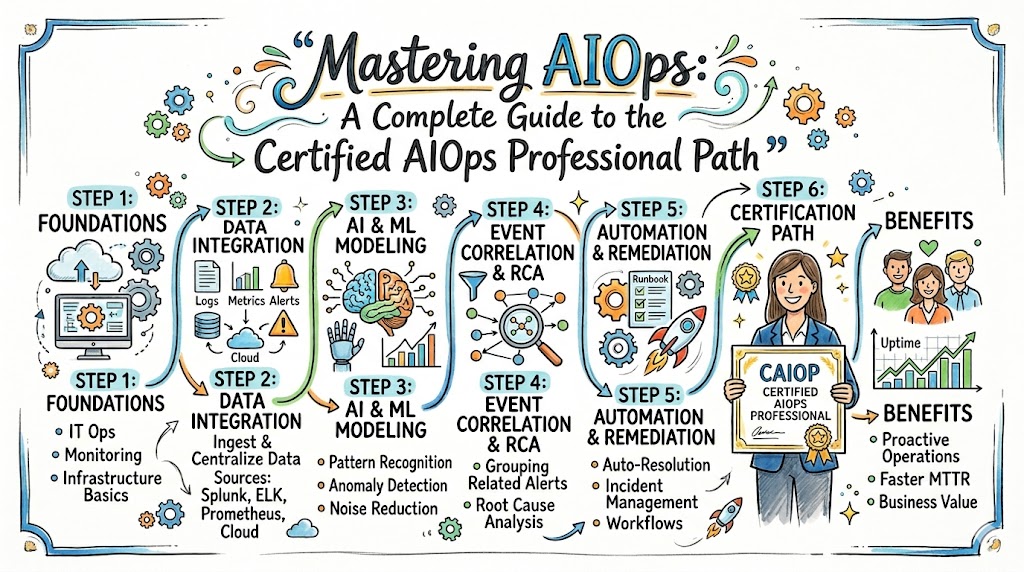
Introduction
The modern engineering landscape is shifting toward intelligent automation, making the Certified AIOps Professional one of the most relevant credentials for today’s workforce. This guide is designed for software engineers, SREs, and IT managers who need to understand how artificial intelligence can be integrated into IT operations. By exploring this roadmap, professionals can learn how to move from reactive troubleshooting to proactive, AI-driven system management. AIOps School provides the foundational and advanced knowledge required to master these complex environments. This guide helps you navigate the various certification paths and decide which level of expertise aligns with your specific career goals in the global market.
What is the Certified AIOps Professional?
The Certified AIOps Professional program is a specialized training and certification track designed to bridge the gap between traditional IT operations and machine learning. It represents a paradigm shift where data-driven insights replace manual intervention in complex, distributed systems. This certification exists because modern cloud-native environments generate more telemetry data than human operators can analyze in real-time.
By pursuing this path, engineers move beyond theoretical AI and focus on production-grade implementation. The curriculum aligns with modern engineering workflows, emphasizing the use of algorithmic analysis to improve system availability and performance. It is deeply rooted in enterprise practices, ensuring that those who earn the credential can manage large-scale infrastructures with efficiency and precision.
Who Should Pursue Certified AIOps Professional?
This certification is highly beneficial for Site Reliability Engineers (SREs), DevOps professionals, and Cloud Architects who are responsible for maintaining system uptime. It is also suitable for Data Engineers and Security professionals who want to understand how anomaly detection and automated remediation work at scale. For beginners, it provides a structured entry point into the world of intelligent automation and data-centric operations.
Experienced engineers will find value in the advanced modules that cover complex event correlation and noise reduction. Engineering managers and technical leaders can also benefit from this track, as it provides the strategic context needed to lead AIOps transformations within their organizations. Whether you are working in the Indian tech hubs or within a global enterprise, this credential validates your ability to handle modern infrastructure challenges.
Why Certified AIOps Professional is Valuable and Beyond
The demand for AIOps expertise is growing as enterprises realize that traditional monitoring tools are no longer sufficient for microservices-based architectures. This certification ensures long-term career longevity by teaching fundamental concepts that remain relevant even as specific tools and platforms change. It focuses on the logic and methodology of AI-driven operations, which is a high-value skill in any technical domain.
Adopting AIOps practices helps professionals stay relevant in an era where automation is the standard, not the exception. For an individual, it represents a significant return on time investment by providing a clear competitive edge during hiring and promotion cycles. For organizations, having certified professionals means faster incident response times and a more resilient digital infrastructure, making this a critical investment for the future.
Certified AIOps Professional Certification Overview
The Certified AIOps Professional program is delivered through AIOps School and is hosted on their dedicated learning platform. The program is structured into clear levels that cater to different stages of professional development, from foundational understanding to expert-level architecture. Each level uses a combination of practical assessments and theoretical exams to ensure a holistic understanding of the subject matter.
The certification is owned and maintained by industry experts who understand the evolving needs of IT operations. It is not just about passing an exam; it is about demonstrating the ability to implement AIOps strategies in real-world scenarios. The structure is designed to be practical, focusing on hands-on labs and case studies that reflect the actual challenges faced by modern engineering teams.
Certified AIOps Professional Certification Tracks & Levels
The program is divided into three primary levels to support gradual career progression. The Foundation level introduces the core concepts of data ingestion, noise reduction, and basic automation. This level is ideal for those new to the field or for managers who need a high-level overview of the AIOps landscape. It sets the stage for more technical explorations in subsequent tiers.
The Professional level dives deeper into machine learning models, event correlation, and predictive analytics. It is designed for hands-on practitioners who need to build and maintain AIOps pipelines. Finally, the Advanced or Specialist level focuses on architecture, governance, and the integration of AIOps across the entire software development lifecycle. This structured approach allows professionals to align their learning with their current role and future aspirations.
Complete Certified AIOps Professional Certification Table
| Track | Level | Who it’s for | Prerequisites | Skills Covered | Recommended Order |
| Operations | Foundation | Aspiring AIOps Engineers | Basic IT Operations | Data Ingestion, Monitoring Basics | 1st |
| Implementation | Professional | DevOps & SRE Teams | Foundation Level | ML Models, Event Correlation | 2nd |
| Architecture | Advanced | Technical Leads & Architects | Professional Level | Strategy, Governance, Scale | 3rd |
| Data | Specialist | Data Engineers | Python/Data Basics | Data Cleaning, Feature Engineering | Optional |
| Management | Leadership | CTOs & Engineering Managers | Management Experience | ROI Analysis, Team Structuring | Optional |
Detailed Guide for Each Certified AIOps Professional Certification
Certified AIOps Professional – Foundation
What it is
This certification validates a candidate’s understanding of the basic principles of AIOps and its role in modern IT management. It covers the fundamental terminology and the primary challenges that AIOps aims to solve.
Who should take it
This is suitable for junior engineers, IT support staff, and non-technical stakeholders who need to understand the impact of AI on operations. No prior AI experience is required.
Skills you’ll gain
- Understanding the AIOps lifecycle
- Knowledge of different data sources (logs, metrics, traces)
- Basic concepts of automated incident response
Real-world projects you should be able to do
- Set up a basic monitoring dashboard with automated alerts
- Identify and categorize common IT operational data types
Preparation plan
- 7 Days: Focus on the official curriculum and terminology.
- 30 Days: Read case studies on AIOps implementation.
- 60 Days: Deep dive into foundational data science concepts for IT.
Common mistakes
- Overcomplicating the initial setup without understanding the data.
- Neglecting the cultural shift required for AIOps adoption.
Best next certification after this
- Same-track option: Certified AIOps Professional – Implementation
- Cross-track option: SRE Foundation
- Leadership option: IT Management Essentials
Certified AIOps Professional – Professional
What it is
The Professional level focuses on the practical application of machine learning algorithms to solve operational problems. It validates the ability to configure and manage AIOps platforms.
Who should take it
This is designed for DevOps engineers and SREs with at least two years of experience who are responsible for system reliability and automation.
Skills you’ll gain
- Implementation of event correlation engines
- Building predictive maintenance models
- Configuring automated remediation workflows
Real-world projects you should be able to do
- Build a noise reduction pipeline that filters out redundant alerts
- Implement a root cause analysis (RCA) automation tool
Preparation plan
- 7 Days: Review machine learning basics relevant to IT.
- 30 Days: Complete all hands-on labs provided by AIOps School.
- 60 Days: Build a mock AIOps environment using open-source tools.
Common mistakes
- Assuming that AIOps tools will work perfectly without fine-tuning.
- Failing to integrate the tool with existing ticketing systems.
Best next certification after this
- Same-track option: Certified AIOps Professional – Specialist
- Cross-track option: MLOps Professional
- Leadership option: Technical Product Manager
Choose Your Learning Path
DevOps Path
The DevOps path focuses on integrating AIOps into the continuous integration and continuous deployment (CI/CD) pipeline. It emphasizes using AI to detect performance regressions early in the development cycle. Engineers on this path learn how to use automated feedback loops to improve code quality and deployment speed. This path is essential for teams looking to achieve high-velocity releases without sacrificing stability or reliability in production environments.
DevSecOps Path
In the DevSecOps path, AIOps is used to enhance security posture through automated threat detection and anomaly analysis. Professionals learn how to apply machine learning to security logs to identify patterns that indicate a potential breach. This path covers the automation of security audits and the implementation of self-healing security protocols. It is a critical track for those responsible for protecting sensitive data in distributed cloud environments.
SRE Path
The SRE path is centered on reliability, using AIOps to manage Service Level Objectives (SLOs) and Error Budgets more effectively. It focuses on predictive analytics to foresee potential outages before they impact the user experience. Engineers learn how to automate incident response and reduce the mean time to resolution (MTTR). This track is ideal for those who want to use data-driven insights to maintain high availability in complex systems.
AIOps Path
The dedicated AIOps path is for specialists who want to master the entire lifecycle of intelligent operations. It covers data collection, processing, and the application of various AI models to operational tasks. This path focuses on the architecture of AIOps platforms and the governance required to manage them at scale. It is perfect for professionals who want to lead AIOps initiatives and define the automation strategy for their entire organization.
MLOps Path
The MLOps path bridges the gap between data science and IT operations by focusing on the deployment and management of machine learning models. It covers the automation of model training, versioning, and monitoring in a production environment. Professionals on this path learn how to treat ML models like any other software artifact, ensuring they are reliable and scalable. This is a vital track for organizations that rely heavily on machine learning for their core business logic.
DataOps Path
DataOps focuses on the automated, collaborative management of data used within an organization, particularly for AIOps and analytics. This path teaches how to improve data quality, reduce cycle times for data delivery, and ensure data consistency across different systems. It is essential for engineers who manage the pipelines that feed AIOps engines. By mastering DataOps, professionals ensure that the AI models are operating on accurate and timely information.
FinOps Path
The FinOps path uses AIOps to optimize cloud spending and improve financial accountability within engineering teams. It focuses on using machine learning to predict cloud costs and identify areas of waste. Professionals learn how to automate cost-allocation and implementation of budget alerts based on usage patterns. This track is increasingly important as cloud environments grow in complexity and cost, requiring more sophisticated management techniques.
Role → Recommended Certified AIOps Professional Certifications
| Role | Recommended Certifications |
| DevOps Engineer | Certified AIOps Foundation + Professional |
| SRE | Certified AIOps Professional + Specialist |
| Platform Engineer | Certified AIOps Advanced + Cloud Certifications |
| Cloud Engineer | Certified AIOps Professional |
| Security Engineer | Certified AIOps Professional (Security Track) |
| Data Engineer | Certified AIOps Data Specialist |
| FinOps Practitioner | Certified AIOps Professional (FinOps Track) |
| Engineering Manager | Certified AIOps Foundation + Leadership Track |
Next Certifications to Take After Certified AIOps Professional
Same Track Progression
Once you have mastered the professional level, the next logical step is to move toward the Advanced or Specialist certifications. These credentials focus on the architectural aspects of AIOps, teaching you how to design multi-cloud automation strategies. You will learn about the governance of AI models and how to manage large-scale data lakes for operational telemetry. This progression solidifies your position as a technical authority within the AIOps domain.
Cross-Track Expansion
For those looking to broaden their skill set, expanding into MLOps or DevSecOps is a highly effective strategy. Understanding how to manage the lifecycle of machine learning models (MLOps) complements your AIOps knowledge perfectly. Similarly, applying AI to security (DevSecOps) makes you a versatile asset in any modern engineering team. Cross-training allows you to handle a wider range of organizational challenges and increases your marketability.
Leadership & Management Track
Experienced engineers may choose to transition into leadership roles by pursuing management-focused certifications. These tracks focus on the ROI of AIOps implementation, team building, and strategic planning. You will learn how to communicate the value of technical initiatives to executive stakeholders and how to lead large-scale digital transformations. This path is ideal for those who want to move from hands-on implementation to high-level organizational influence.
Training & Certification Support Providers for Certified AIOps Professional
DevOpsSchool
DevOpsSchool is a leading platform that provides comprehensive training programs focused on modern automation and cultural transformation. They offer a wide range of courses that help engineers master the tools and methodologies required for successful DevOps implementation. Their curriculum is designed by industry veterans, ensuring that students gain practical, hands-on experience that is immediately applicable in a professional setting.
Cotocus
Cotocus specializes in consulting-led training, focusing on delivering customized learning experiences for corporate teams. They help organizations adopt AIOps and DevOps practices by providing expert guidance and practical workshops. Their approach ensures that training is aligned with the specific business goals and technical challenges of the organization, leading to a higher success rate for digital initiatives.
Scmgalaxy
Scmgalaxy is a vast repository of resources for Software Configuration Management (SCM) and DevOps professionals. They provide in-depth tutorials, community support, and training programs that cover the entire software development lifecycle. Their focus on practical examples and real-world scenarios makes them a valuable resource for engineers looking to deepen their technical expertise in automation.
BestDevOps
BestDevOps offers curated learning paths and certification preparation for a variety of modern technical roles. They focus on providing high-quality content that is updated frequently to reflect the latest industry trends. Their goal is to help professionals navigate the complex landscape of certifications and choose the path that best supports their long-term career growth.
devsecopsschool.com
This platform is dedicated to integrating security into the DevOps lifecycle, providing specialized training in automated security testing and threat modeling. They offer courses that help engineers understand how to use AI and automation to protect their applications and infrastructure. Their focus on the intersection of security and operations is essential for modern cloud-native organizations.
sreschool.com
Sreschool.com provides training focused specifically on Site Reliability Engineering, emphasizing the principles of availability, scalability, and performance. They offer practical courses on monitoring, incident management, and the use of AIOps to maintain system health. Their curriculum is designed to help engineers build more resilient and reliable systems through data-driven practices.
aiopsschool.com
AIOps School is the primary destination for professionals seeking to master artificial intelligence for IT operations. They provide a structured certification program that covers everything from foundational concepts to advanced architecture. Their focus on production-grade AIOps implementation ensures that students are prepared for the challenges of managing modern enterprise infrastructures.
dataopsschool.com
Dataopsschool.com focuses on the management of data pipelines and the automation of data delivery for analytics and AI. They provide training that helps engineers improve data quality and consistency, which is critical for the success of AIOps initiatives. Their courses cover the entire data lifecycle, from ingestion to processing and storage.
finopsschool.com
Finopsschool.com is dedicated to the practice of cloud financial management, teaching professionals how to optimize spending using data and automation. They offer training on cloud cost-allocation, forecasting, and the implementation of FinOps principles within engineering teams. Their focus on the financial impact of technical decisions is vital for modern business operations.
Frequently Asked Questions (General)
- How long does it take to get certified?
The time required depends on your experience level, but most professionals complete the Foundation level in two weeks and the Professional level in 30 to 60 days. - Are there any prerequisites for the Foundation exam?
There are no formal prerequisites for the Foundation level, although a basic understanding of IT operations and monitoring is highly recommended. - What is the format of the certification exam?
The exams typically consist of multiple-choice questions and hands-on laboratory assessments to test both theoretical knowledge and practical skills. - Is this certification recognized globally?
Yes, the program is designed to meet international standards and is recognized by major enterprises across India and the global tech market. - Does the certification expire?
The certification is generally valid for two to three years, after which you may need to renew it or move to a higher level to stay current. - Can I take the exam online?
Yes, the exams are hosted on a digital platform that allows you to take them from any location with a stable internet connection. - How does AIOps differ from traditional monitoring?
Traditional monitoring tells you what is wrong, while AIOps uses AI to tell you why it happened and how to fix it automatically. - Is coding knowledge required?
For the Professional and Specialist levels, some knowledge of scripting languages like Python is necessary to build automation workflows. - What is the return on investment for this certification?
Professionals often see increased job opportunities and higher salary potential due to the high demand for AIOps expertise. - Are there practice exams available?
Yes, AIOps School provides practice materials and sample questions to help candidates prepare for the official certification exams. - Can my company pay for this training?
Many organizations have professional development budgets and will sponsor this certification as it directly benefits their operational efficiency. - How do I start the certification process?
You can begin by visiting the AIOps School website and enrolling in the Foundation course to build your base knowledge.
FAQs on Certified AIOps Professional
- What specific AI models are covered in the professional track?
The track covers anomaly detection, event correlation using clustering, and predictive modeling for system resource utilization. - Does the program focus on specific tools like Moogsoft or Splunk?
While it references industry tools, the program focuses on tool-agnostic principles so that the skills are transferable across any AIOps platform. - How does this certification help with career progression in SRE?
It provides the data science skills necessary to automate complex SRE tasks, moving you from manual toil to high-level engineering. - Is there a community for certified professionals?
Yes, AIOps School maintains a community where certified individuals can share insights, discuss challenges, and network with other experts. - How are the hands-on labs structured?
The labs use real-world datasets and simulated environments where you must solve actual operational problems using AIOps methodologies. - Does the curriculum include cloud-specific AIOps?
Yes, it covers AIOps implementation across major cloud providers like AWS, Azure, and Google Cloud Platform. - What is the passing score for the exams?
The passing score is typically set at 70%, ensuring that candidates have a solid grasp of the material before receiving the credential. - Are there group discounts for corporate teams?
AIOps School offers various packages for organizations looking to certify their entire engineering or operations department.
Final Thoughts: Is Certified AIOps Professional Worth It?
From a mentor’s perspective, the transition to AIOps is not a trend; it is a necessity for anyone managing modern infrastructure. The sheer volume of data in today’s systems makes manual operations unsustainable. If you want to remain a relevant and effective engineer, you must learn how to leverage machine learning to your advantage. This certification provides a structured and practical way to gain those skills without getting lost in the hype.
The Certified AIOps Professional program focuses on what actually works in production, making it a sound investment for your career. It gives you the language to talk to data scientists and the tools to lead your operations team into the future. It is not an easy path, but for those willing to put in the work, the career rewards and the technical satisfaction are well worth the effort.
