Introduction
The technology landscape is shifting rapidly. As cloud adoption hits record highs and automation becomes the backbone of modern software delivery, the demand for skilled DevOps professionals has never been higher. Yet, for many engineers, the challenge is not finding work, but defining the nature of that work. Should you commit to a long-term, stable role in a single organization, or should you embrace the autonomy of the gig economy?
The decision between a DevOps freelancer and a full-time DevOps engineer is a significant crossroad. It dictates not just your income, but your daily stress levels, your learning trajectory, and your work-life balance. Many engineers enter the industry assuming the only path is the traditional nine-to-five, only to discover later that their temperament is better suited for consulting. Conversely, some leap into freelancing before they have the foundational expertise required to survive the volatility of the gig market.
At DevOpsSchool, we have guided thousands of engineers through this exact decision. Understanding the nuance between these two paths is essential for building a sustainable, fulfilling career in cloud automation and systems engineering. This article breaks down the reality of both paths to help you navigate your next career move with confidence.
What Does a DevOps Freelancer Do?
A DevOps freelancer operates as an independent business entity. You are not just an engineer; you are a service provider. Your clients hire you for specific outcomes: setting up a CI/CD pipeline, migrating an on-premise infrastructure to AWS, or fixing a recurring Kubernetes bottleneck.
A freelancer often works with multiple clients simultaneously. One week, you might be designing a Terraform module for a startup; the next, you are auditing security configurations for a mid-sized enterprise. The scope of work is typically defined by a contract or a Statement of Work (SOW), meaning you are judged on deliverables rather than hours spent at a desk.
Real-world scenario: You are hired as a DevOps freelancer to automate a deployment process that currently takes a team of four developers two days to complete manually. Your goal is not to “be part of the team” in the traditional sense, but to build, hand over, and move on.
What Does a Full-Time DevOps Engineer Do?
A full-time DevOps engineer is embedded within a single organization. Your focus is long-term stability, scalability, and the integration of the engineering culture. You are deeply familiar with the legacy systems, the personalities in the dev team, and the specific regulatory requirements of your company.
In this role, you are a custodian of the infrastructure. You are responsible for the uptime, security, and performance of the systems today, tomorrow, and six months from now. You participate in sprint planning, architecture reviews, and post-mortem discussions. You are deeply invested in the growth of the company’s product.
Real-world scenario: You are a full-time engineer at a SaaS company. Your job involves participating in the daily stand-up, managing the transition to a new database cluster, and mentoring junior developers on how to write Dockerfiles that align with organizational security standards.
DevOps Freelancer vs Full-Time DevOps Engineer: Quick Comparison
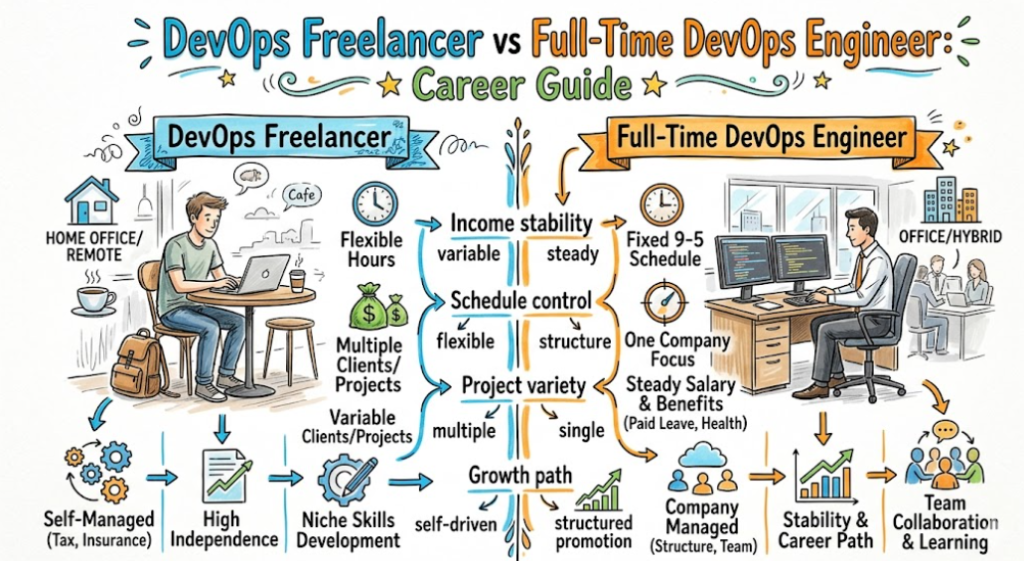
| Area | DevOps Freelancer | Full-Time DevOps Engineer |
| Work Style | Project-based, task-oriented | Role-based, long-term ownership |
| Income | Variable, potentially high | Predictable, steady salary |
| Stability | Low to medium (contract dependent) | High (company growth dependent) |
| Benefits | Self-managed (taxes, health, PTO) | Employer-provided (insurance, 401k/PF) |
| Flexibility | High (choose clients and hours) | Low (fixed office hours/expectations) |
| Team Involvement | Consultative, temporary | Deeply integrated, cultural member |
| Career Growth | Portfolio-based, networking | Ladder-based, internal promotion |
| Responsibility | Deliver results, then exit | Maintain system health, continuous improvement |
Income Comparison: Freelance vs Full-Time DevOps
Income is often the primary driver for engineers choosing a path, but the math is rarely straightforward.
Full-Time: Your salary is predictable. It includes base pay, bonuses, and equity (stocks/RSUs). You know exactly when and how much money will hit your bank account. This provides the mental bandwidth to focus purely on engineering rather than accounting or sales.
Freelance: Your revenue is based on your billable rate. While your hourly rate might be significantly higher than a full-time employee’s effective hourly rate, you are responsible for finding your own leads, billing, and handling periods where you have no work. A successful freelancer often makes more, but the cash flow is cyclical.
Job Stability and Security
Stability is the biggest trade-off.
- Full-Time: You have legal protection, notice periods, and a buffer against short-term economic fluctuations. If a project fails, it is usually a team failure, not a termination of your contract.
- Freelance: You have no “job security” in the traditional sense. You have client security. If a client cancels a contract or runs out of budget, your revenue stream for that client stops immediately. You must build a pipeline of clients to mitigate this risk.
Flexibility and Work-Life Balance
- Freelancing: It offers the freedom to work from anywhere and at any time. If you want to take a month off to travel, you can structure your projects to allow for it. However, the burden of “always-on” communication to please clients can sometimes lead to longer, more irregular hours.
- Full-Time: While you may have a hybrid or remote option, you are still bound to the company’s meeting calendar. You are rarely “off the clock” if an incident occurs, but you also have clear boundaries that an employer is required to respect.
Skills Needed for DevOps Freelancers
Freelancing requires a “T-shaped” skill set with a heavy focus on the horizontal bar of soft skills.
- Technical Mastery: You must be able to solve problems quickly without relying on a senior colleague to ask.
- Client Communication: You need to explain complex technical debt to non-technical stakeholders.
- Proposal Writing: Being able to scope a project and write a clear, professional contract.
- Self-Marketing: Building a LinkedIn presence or portfolio.
- Financial Literacy: Understanding invoicing, taxes, and pricing your services.
Skills Needed for Full-Time DevOps Engineers
Full-time roles emphasize depth, process, and collaboration.
- CI/CD Pipeline Management: Optimizing workflows for a large team.
- Cloud Platform Expertise: Deep knowledge of AWS, Azure, or GCP.
- Monitoring & Observability: Setting up ELK, Prometheus, or Datadog for production.
- Incident Management: Collaborating during outages (on-call rotations).
- Team Collaboration: Using Jira, Confluence, and Git best practices to manage code reviews.
Daily Work Life Comparison
A Day in the Life of a DevOps Freelancer
You wake up, check your emails for client feedback, and start on a specific task: migrating a legacy database. You don’t have stand-ups with other teams. You focus on deep work for 4 hours, update your client on your progress, and then spend the afternoon marketing your services or learning a new tool like Terraform or Kubernetes to stay ahead of the curve.
A Day in the Life of a Full-Time DevOps Engineer
You start the day with a team stand-up. You address a ticket regarding a failed production deployment. You spend two hours in meetings discussing the architecture for the next quarter. You review pull requests from junior developers. You handle an unexpected alert regarding high CPU usage on a production node. Your day is shaped by the needs of the organization.
Pros and Cons of Being a DevOps Freelancer
| Pros | Cons |
| Absolute control over your schedule | No guaranteed income during lean months |
| High earning potential per project | You are responsible for all taxes and benefits |
| Diverse project experience | The pressure to constantly sell yourself |
| Freedom to choose technologies | Isolation; lack of a dedicated peer team |
Pros and Cons of Being a Full-Time DevOps Engineer
| Pros | Cons |
| Steady, predictable paycheck | Less control over project choice |
| Access to company benefits and perks | Potential for office politics |
| Deep, long-term learning of one stack | Less flexibility in work hours/location |
| Professional mentorship and career ladder | Slower pace of change (bureaucracy) |
Career Growth Opportunities
- Full-Time Path: The career ladder is clear. Junior DevOps Engineer -> Mid-level -> Senior -> Lead/Manager -> Architect. You grow by taking on more responsibility and larger system domains within the organization.
- Freelance Path: You grow by increasing your rates, specializing in high-demand niches (like FinOps or DevSecOps), and eventually transitioning into an Agency owner or high-ticket Consultant.
Real-World Example: Freelancer Career Path
Step 1: Gain 3-4 years of full-time experience to build a solid foundation.Step 2: Start “moonlighting” (freelancing on the side) to build a small client base.Step 3: Land a retainer client that covers your monthly expenses.Step 4: Transition to full-time freelancing.Step 5: Specialize in a high-demand area, such as “Kubernetes Migration Consultant.”
Real-World Example: Full-Time DevOps Career Path
Step 1: Entry-level System Admin or Junior DevOps role.Step 2: Become the “go-to” person for CI/CD pipelines.Step 3: Lead a major infrastructure migration project within the company.Step 4: Promoted to Senior DevOps Engineer.Step 5: Move into Staff Engineer or Principal DevOps Architect roles.
Common Challenges in Both Career Paths
- Burnout: Freelancers burn out from the “hustle,” full-time employees burn out from on-call rotations and repetitive tasks.
- Skill Rot: Both paths require continuous learning. If you only use one tool for five years, you become obsolete.
- Complexity: Cloud environments are becoming harder to manage; the mental overhead is increasing for everyone.
Common Beginner Misunderstandings
- Myth: Freelancing is “easy money.” Reality: It requires significant administrative effort and sales skill.
- Myth: Full-time jobs are “boring.” Reality: Many full-time roles offer massive scale and architectural challenges you can’t find as a freelancer.
- Myth: You don’t need to learn once you have a job. Reality: DevOps is the fastest-moving field in IT; you must study weekly.
How to Decide Between Freelancing and Full-Time DevOps
Ask yourself these four questions:
- What is your risk tolerance? Can you handle a month with zero income?
- What is your preferred work environment? Do you enjoy social team interaction or solitary deep work?
- What are your financial goals? Do you want a slow, steady build or high-volatility, high-reward bursts?
- Do you like “the business of engineering”? Freelancing is 50% engineering and 50% running a business.
Can You Combine Both Career Paths?
Absolutely. Many senior DevOps engineers work full-time while maintaining one or two “consulting” clients on the side. This is the safest way to transition. It allows you to build a client portfolio without the risk of losing your primary income. If your freelance income eventually overtakes your salary, you can comfortably make the jump.
Role of DevOpsSchool in Building DevOps Careers
At DevOpsSchool, we believe that whether you choose the freelance or full-time route, the foundation remains the same. You need hands-on, industry-aligned expertise. Our training programs are designed to mimic real-world challenges, from CI/CD pipeline creation to complex cloud-native orchestration. We provide the mentorship and the technical syllabus required to make you indispensable to any employer or client. By focusing on practical, project-based learning, we help you build the portfolio needed to succeed in either career path.
Career Opportunities in DevOps
The market is currently flooded with opportunities in:
- DevOps Engineering: Maintaining infrastructure as code.
- Cloud Engineering: Architecture and design on AWS/Azure/GCP.
- Platform Engineering: Building developer portals to improve engineer productivity.
- Site Reliability Engineering (SRE): Focusing on uptime and reliability.
- DevOps Consulting: Providing high-level advice to businesses.
Key skills across all these roles include Terraform, Kubernetes, Jenkins/GitHub Actions, Monitoring tools, and Cloud scripting.
Future of DevOps Careers
The future is shifting toward “Platform Engineering”—building internal tools so developers can self-serve their infrastructure. This reduces the friction between teams. For freelancers, this means a huge market for building custom internal platforms for mid-sized companies that cannot afford a full-time Platform Engineering team. AI-assisted DevOps is also on the horizon, meaning you will need to learn how to manage and audit AI-generated infrastructure configurations.
FAQs
- Is freelancing better than a full-time DevOps job? Neither is better. It depends on your personality, risk appetite, and career goals.
- Can beginners start DevOps freelancing? It is not recommended. Freelancers are paid to solve problems immediately. You need a few years of experience to have the confidence to deliver under pressure.
- Which path earns more money? Freelancing has a higher ceiling, but full-time roles offer consistent compensation and benefits that are harder to calculate in total value.
- Is freelancing stable? It is as stable as your ability to market yourself and maintain long-term client relationships.
- What skills are needed for DevOps freelancing? Beyond technical skills, you need communication, negotiation, and basic accounting skills.
- Can I freelance while working full-time? Yes, provided your employment contract allows it and you can manage the time.
- Is DevOps a good long-term career? Yes, as long as you evolve with the technology. Infrastructure will always need to be automated.
- How much experience do I need? Aim for at least 3 years of full-time work before going full-time freelance.
- How do I find clients? LinkedIn, personal networking, and specialized freelance platforms are the best starting points.
- Do I need a degree to be a DevOps Engineer? Skills and certifications are more important than degrees.
- What is the most important skill for a freelancer? Reliability and communication. If you finish work on time and communicate well, you will never lack clients.
- Is DevOps a high-stress job? It can be, especially during production outages. Learning to manage stress is part of the job.
- How do I stay relevant? Practice new tools on side projects and keep your certifications updated.
- Is remote work the norm? Yes, DevOps is one of the most remote-friendly professions.
- Does freelancing affect my resume? No, in fact, it can look impressive as it shows you are self-driven and capable of solving problems independently.
Final Thoughts
The choice between a DevOps freelancer and a full-time DevOps engineer is not a permanent one. You are allowed to change your mind. Many engineers spend ten years as full-time employees, only to transition into consulting once they have built a deep network of professional contacts. Others start as freelancers to gain broad exposure across many different industries before settling into a high-level full-time role at a company they love.
Success in either path relies on the same core principles: an obsession with automation, a commitment to continuous learning, and a deep understanding of the software development lifecycle. Whether you decide to sign a contract or sign an employment offer, focus on building your expertise. The rest will follow.
