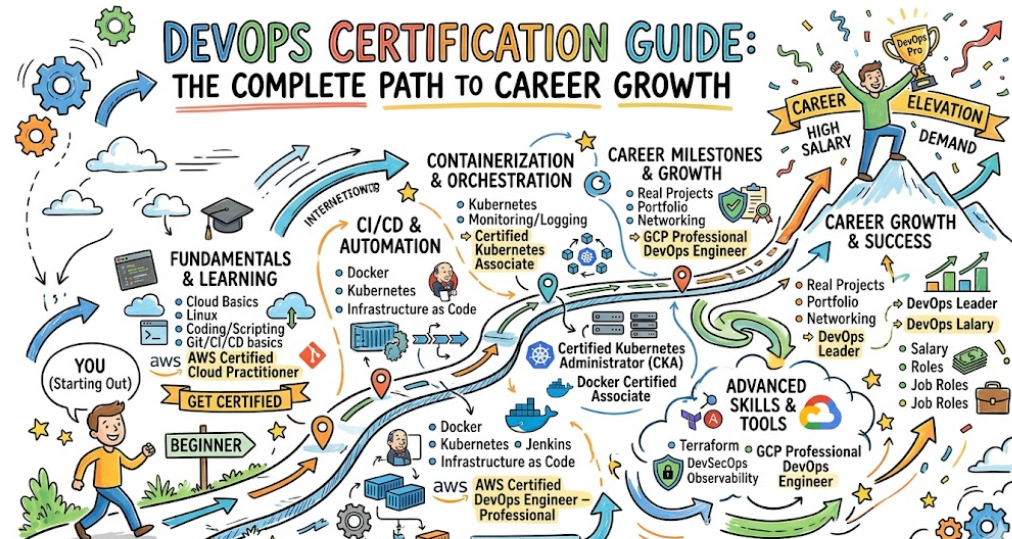
The landscape of DevOps is vast, and for many, it feels like an overwhelming maze of acronyms, tools, and methodologies. When you first step into this domain, it is easy to get caught up in the hype of “collecting” certificates. However, the most successful professionals treat certifications not as mere trophies, but as structured roadmaps for skill acquisition.
Many learners inadvertently choose the wrong certification because they focus on the brand name rather than the practical utility of the knowledge. A certification is only as valuable as the hands-on experience it enables you to apply in a production environment.
This guide is designed to cut through the noise. We will help you identify which certification aligns with your specific career goals, whether you are aiming to master cloud-native infrastructure, secure your delivery pipelines, or manage complex site reliability systems. By understanding the “why” and “how” behind these certifications, you can build a roadmap that emphasizes sustainable career growth over fleeting trends.
Why DevOps Certifications Matter
Certifications provide more than just a credential on a resume; they offer a structured path to mastery in a field that is constantly evolving.
- Skill Validation: They provide an objective standard to prove your competency to employers.
- Structured Learning: They force you to follow a logical progression, ensuring you don’t skip foundational concepts.
- Career Confidence: Passing a rigorous certification builds the internal assurance needed to tackle complex real-world problems.
- Industry Demand: Employers rely on certifications to filter candidates who have demonstrated a commitment to standard operational practices.
- Hands-on Focus: Good certifications integrate real-world tools, moving you from theory to practical application.
Who Should Read This Guide
This guide is for anyone looking to professionalize their IT journey:
- Freshers entering the IT sector.
- Developers transitioning into operational roles.
- Linux Administrators modernizing their skill sets.
- Cloud and Kubernetes Engineers managing scalable architecture.
- SRE Engineers focusing on system reliability.
- DevSecOps Professionals aiming to secure the delivery pipeline.
- Platform Engineers building robust internal developer platforms.
DevOps Certification Categories
To make informed choices, we divide these certifications into manageable categories:
- Foundation Certifications: Build your basic understanding of DevOps culture and processes.
- Tool-Based Certifications: Master specific, high-demand technologies like Docker or Terraform.
- Cloud DevOps Certifications: Focus on managing infrastructure within major cloud providers like AWS or Azure.
- DevSecOps Certifications: Shift focus to security integration within the CI/CD pipeline.
- SRE and Platform Engineering: Advanced tracks for high-scale system reliability and automation.
- Specialized Certifications: Niche expertise in fields like Machine Learning (MLOps) or Data Science.
Best DevOps Certifications at a Glance
| Certification Name | Best For | Level | Main Skills | Career Scope |
| DevOps Certified Professional (DCP) | Beginners | Foundation | CI/CD, Pipeline, Culture | DevOps Engineer |
| DevSecOps Certified Professional (DSOCP) | Security Focus | Advanced | Security Automation | DevSecOps Engineer |
| Site Reliability Engineering (SRE) | Reliability Ops | Advanced | Metrics, SLO/SLI | SRE Engineer |
| Master in DevOps Engineering (MDE) | Intermediate | Intermediate | CI/CD, Automation | DevOps Architect |
| Master in Azure DevOps | Cloud Ops | Intermediate | Azure, Pipelines | Azure Engineer |
| AWS Certified DevOps Professional | Cloud Ops | Advanced | AWS, Infrastructure | AWS DevOps Lead |
| Master in Python Programming | Automation | Foundation | Scripting, Coding | Automation Engineer |
| Hashicorp Certified Terraform Associate | IaC Focus | Intermediate | Infrastructure as Code | Cloud Engineer |
| Certified Kubernetes Administrator (CKA) | Orchestration | Advanced | K8s Cluster Admin | Kubernetes Engineer |
| Docker Certified Associate (DCA) | Containers | Foundation | Containers, Runtime | DevOps/System Admin |
| Envoy ISTIO Certification Training | Networking | Advanced | Service Mesh, Proxy | Platform Engineer |
| MLOps Certification Training Course | AI Operations | Advanced | ML Pipelines | MLOps Engineer |
| Google Cloud Professional Cloud DevOps Engineer | Cloud Ops | Advanced | GCP, SRE | Cloud Architect |
| Master in Machine Learning | Data/AI | Intermediate | ML Models, Data | Data Scientist |
| Master in Artificial Intelligence | AI Ops | Intermediate | AI Logic, Models | AI Engineer |
| Master in AppDynamics | Monitoring | Intermediate | Observability | Support Engineer |
| Master in Data Science | Analytics | Intermediate | Data Analysis | Data Analyst |
| Master in Deep Learning | AI Ops | Advanced | Neural Networks | AI Researcher |
| Prometheus with Grafana | Monitoring | Foundation | Observability, Metrics | SRE/DevOps |
| GitOps Certified Professional (GOCP) | Modern Ops | Intermediate | GitOps, Automation | Platform Engineer |
Certification Deep Dive
DevOps Certified Professional (DCP)
- What It Is: An entry-point certification focusing on the core principles of DevOps, including CI/CD and cultural shifts between development and operations teams.
- Best Career Fit: DevOps Engineer.
- Difficulty: Foundation.
- Tools: Jenkins, Git, CI/CD platforms.
Certified Kubernetes Administrator (CKA)
- What It Is: A performance-based certification that validates your ability to manage a Kubernetes cluster, covering installation, networking, and security.
- Best Career Fit: Kubernetes Administrator/Platform Engineer.
- Difficulty: Advanced.
- Tools: Kubernetes, etcd, kubectl.
DevSecOps Certified Professional (DSOCP)
- What It Is: Validates your ability to integrate security measures into the CI/CD pipeline, ensuring security is “baked in” rather than added on.
- Best Career Fit: DevSecOps Engineer.
- Difficulty: Advanced.
- Tools: Ansible, Docker, Terraform, Security Scanners.
Certification Comparison Table
| Certification | Difficulty | Main Focus | Career Scope |
| DCP | Foundation | Core Concepts | DevOps Engineer |
| DSOCP | Advanced | Security Integration | DevSecOps Engineer |
| SRE | Advanced | Reliability & Metrics | SRE Engineer |
| CKA | Advanced | Container Orchestration | K8s Engineer |
| Terraform Associate | Intermediate | Infrastructure as Code | Cloud Engineer |
DevOps Certification Roadmap
Beginner Roadmap
Focus on the fundamentals of the IT landscape.
- Linux Fundamentals: The base of everything.
- Git: Version control is non-negotiable.
- Docker: Learn how to containerize applications.
- CI/CD Basics: Understanding the flow of code to production.
- DevOps Basics: Grasping the philosophy of collaboration.
Intermediate Roadmap
Expand into automation and cloud services.
- Jenkins: Mastering automation servers.
- Terraform: Learning infrastructure as code.
- Kubernetes Basics: Getting comfortable with container orchestration.
- Cloud Fundamentals: Understanding the basics of AWS, Azure, or GCP.
Advanced Roadmap
Focus on scale, reliability, and security.
- Kubernetes Certification: Deep diving into cluster management.
- Cloud DevOps Certification: Architecting robust cloud applications.
- DevSecOps: Hardening the pipeline.
- SRE: Mastering service level objectives and error budgets.
Recommended Certification Path by Role
- DevOps Beginner: Start with DevOps Certified Professional (DCP).
- Cloud Engineer: Focus on Master in Azure DevOps or AWS Certified DevOps Professional.
- Kubernetes Engineer: Pursue Certified Kubernetes Administrator (CKA).
- SRE Engineer: Aim for Site Reliability Engineering (SRE) Certified Professional.
- DevSecOps Engineer: Specialize in DevSecOps Certified Professional (DSOCP).
- Platform Engineer: Gain expertise with GitOps Certified Professional (GOCP).
Real-World Career Scenarios
- Fresher Starting DevOps: Build your foundation with a general certification like the DevOps Certified Professional (DCP). Use this to understand the “why” before moving to specific tools.
- Cloud Engineer Moving into DevOps: If you already manage cloud infrastructure, level up by mastering automation. Pair your cloud knowledge with Hashicorp Certified Terraform Associate to start managing infrastructure as code.
- Operations Engineer Moving into SRE: Shift your focus from “keeping the lights on” to “optimizing reliability.” The Site Reliability Engineering (SRE) Certified Professional course will help you align your operational tasks with modern metrics like SLOs and SLIs.
Common Mistakes to Avoid
- Skipping Fundamentals: Do not dive into Kubernetes if you don’t understand basic Linux and networking.
- Starting Too Complex: Don’t chase advanced SRE certifications before understanding basic CI/CD.
- Focusing Only on Certificates: A certificate without a portfolio of projects is just paper. Always build as you learn.
- Ignoring the Culture: DevOps is 50% culture and collaboration, not just tools. Understand the philosophy.
Hands-On Projects to Build
To truly learn, you must do. Try these:
- Build a CI/CD Pipeline: Create a Jenkins or GitHub Actions pipeline that builds, tests, and deploys a simple application.
- Deploy using Docker: Containerize a Python or Node.js application and run it locally.
- Kubernetes Deployment: Deploy a multi-container application on a local Kubernetes cluster (like Minikube).
- Terraform Automation: Write Terraform code to provision an AWS EC2 instance.
- Monitoring: Set up Prometheus and Grafana to monitor the health of your local server.
Tools and Free Resources
While certifications provide the structure, complement them with these resource types:
- Documentation: Always read the official product docs (e.g., Kubernetes docs, Terraform registry).
- Practice Labs: Use cloud free-tiers to build your own infrastructure.
- Technical Blogs: Follow industry-standard engineering blogs to understand how large companies solve scale problems.
- GitHub Repositories: Explore open-source projects to see how production-ready code is structured.
How to Choose the Right DevOps Certification
Selecting the right certification is a personal process. Ask yourself:
- What is my current skill set? Are you a developer (learn Ops) or an admin (learn Dev)?
- What is my goal? Do you want to work on cloud architecture, security, or reliability?
- Which cloud provider is dominant in my target industry? If your target company uses Azure, get Azure certified.
- Do I want to specialize? If you love data, look at MLOps Certification.
FAQs
- Which certification is best for a beginner? The DevOps Certified Professional (DCP) is the standard starting point.
- Is Docker certification worth it? Yes, it is foundational for understanding modern containerization.
- Does DevOps require coding skills? While you don’t need to be a software developer, learning basic scripting with Python is essential.
- Can I become a DevOps engineer without a certification? You can, but certifications provide a structured path that is often missing in self-taught routes.
- Which cloud certification should I pick? Choose the one that matches the cloud provider (AWS, Azure, or GCP) used by your company.
- How long does it take to get certified? It depends on your dedication, but a focused roadmap usually takes a few months per certification.
- Is SRE part of DevOps? SRE is a specific implementation of DevOps principles.
- What is the difference between DevOps and Platform Engineering? Platform Engineering focuses on building internal tools for developers, while DevOps is a broader culture.
- Should I focus on tools or concepts? Always concepts first, tools second. Tools change; concepts remain.
- How do I maintain my certification? Most require continuous learning and potentially re-certification as the tools evolve.
- Are online certification courses enough? They are a great start, but they must be paired with hands-on practice.
Final Recommendation
Certifications are a bridge between where you are and where you want to be. The best approach is to choose one foundation certification, master it, and then build layer upon layer of knowledge through hands-on practice. Do not rush to collect certifications; instead, aim to collect skills. Build projects, break things in your lab environment, and use the certification study material as a guide to ensure you aren’t missing critical concepts. Your career in DevOps is a marathon, not a sprint—start with the fundamentals, stay consistent, and focus on applying what you learn to real-world scenarios.
