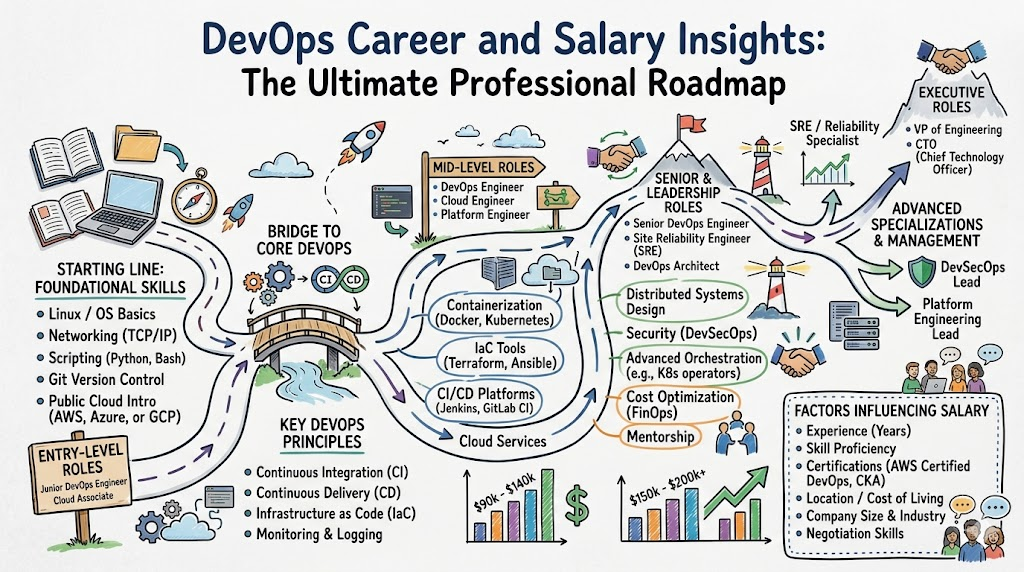
The landscape of modern IT has shifted significantly, placing DevOps salary growth at the forefront of career discussions. As businesses increasingly rely on continuous delivery, cloud infrastructure, and reliable systems, the demand for professionals who can bridge the gap between development and operations has never been higher. This transition is not merely a trend; it is a fundamental change in how software is built, secured, and scaled.
Global demand for DevOps engineers is driven by the necessity for speed, reliability, and security. Companies are moving away from manual, error-prone processes toward automated pipelines and resilient cloud architectures. This shift means that those who master these modern disciplines—from CI/CD automation to infrastructure as code—are positioned to command premium compensation packages.
In this guide, we explore the reality of the DevOps career path, salary expectations, and the factors that influence long-term growth. We focus on real-world market patterns, moving beyond superficial tool knowledge to discuss what actually drives compensation: business impact, reliability, and architectural design.
Why DevOps Salaries Are High
The high compensation associated with DevOps roles is rooted in the direct link between engineering output and business success. Key drivers include:
- Cloud Adoption: Massive shifts toward multi-cloud environments require deep expertise in landing zones and infrastructure delivery.
- Automation Demand: Companies are prioritizing toil reduction. Professionals who can automate manual tasks and create “paved roads” for developers are in high demand.
- Resilience and Reliability: As systems become more complex, the ability to maintain uptime and implement observability is a business-critical skill.
- Security Integration: The rise of DevSecOps means security is no longer a bolt-on phase but a core component of the pipeline.
- The Skill Gap: There is a persistent shortage of professionals who can manage distributed systems, handle incident response, and reduce operational costs.
Who Should Read This Guide
This guide is for any IT professional aiming to align their skills with current market demands. It is designed for:
- Freshers entering the DevOps field.
- Developers transitioning into infrastructure and automation.
- Linux and Systems administrators modernizing their skill sets.
- Cloud engineers seeking to specialize.
- Automation engineers aiming for higher-level roles.
- SRE and Platform engineers focusing on long-term career growth.
- DevSecOps professionals looking to maximize their earning potential.
DevOps Salary Overview
Salary trends in 2026 reflect a fragmented market. Compensation is often determined by the type of organization: high-scale product companies (equity-heavy), enterprise/regulated environments (bonus-heavy), and service-based firms (rate-card driven). While technical skills are the baseline, senior-level compensation is increasingly tied to operational outcomes, such as site reliability engineering (SRE) maturity and platform adoption metrics.
DevOps Salary by Experience Level
Salary growth is rarely linear; it accelerates as you move from execution-focused roles to architectural and strategic responsibilities.
| Experience Level | Typical Roles | Skills Expected | Salary Growth Potential |
| Junior | DevOps Engineer | CI/CD basics, Linux, Scripting | Moderate (Baseline) |
| Mid-Level | DevOps / Cloud Engineer | Cloud platforms, Terraform, Pipeline design | High |
| Senior | Senior Engineer | Architecture, Incident response, Mentoring | Very High |
| Staff/Lead | Staff Engineer | Cross-team architecture, Reliability strategy | Premium |
| Principal | Principal Engineer | Org-wide direction, Standards, Governance | Maximum |
Highest Paying DevOps Roles
Different specializations offer varying salary premiums. The highest potential often lies in roles that directly impact security or platform scalability.
| Role | Main Skills | Salary Potential | Career Demand |
| DevOps Engineer | CI/CD, Infrastructure Automation | Baseline | High |
| SRE Engineer | SLOs, Incident Response, Toil Reduction | Baseline + 0-15% | Very High |
| Platform Engineer | Internal Developer Platforms, Paved Roads | Baseline + 5-20% | High |
| DevSecOps Engineer | Policy-as-Code, Security SDLC, Secrets | Baseline + 10-30% | Very High |
| Cloud Engineer | Cloud Landing Zones, IAM, Infrastructure | -5% to +10% | High |
DevOps Salary by Skills
Skills that reduce business risk and improve operational efficiency offer the highest salary impact. Technical mastery alone is often treated as a baseline; the premium comes from applying these skills to solve complex problems:
- Security & Policy-as-Code: Highly rewarded, as it integrates security directly into the pipeline.
- Reliability & SLOs: Moving from “alerts responder” to “reliability engineer” is a major salary lever.
- FinOps (Cost Engineering): Ability to manage cloud costs and governance.
- Architecture & Design: Senior roles prioritize decision-making over task execution.
DevOps Salary by Certification
While certifications can validate knowledge, salary growth is primarily driven by project impact. The market values certifications that demonstrate professional competence in core infrastructure and cloud architecture.
| Certification Focus | Career Level | Skills Covered | Salary Impact |
| Cloud Platform Expert | Mid to Senior | Cloud Landing Zones, IAM, Networking | High |
| Infrastructure Specialist | Junior to Mid | Terraform, Automation, CI/CD | Moderate |
| Security Architecture | Senior | DevSecOps, Policy-as-Code | Premium |
| Reliability/SRE | Mid to Senior | SLOs, Observability, Incident Management | Premium |
DevOps Salary by Country or Region
Global salary bands vary based on local economic factors, regulatory environments, and the maturity of the local IT industry.
- USA: Generally higher base salaries, often supplemented by equity, particularly in high-scale product companies.
- Europe: Varies by country; markets like Switzerland or the Netherlands offer different cost-of-living adjustments compared to other regions.
- India & Emerging Markets: Growing demand for DevOps and SRE talent is driving competitive salaries within the local ecosystem, often aligned with international service standards.
DevOps Salary by Company Type
Where you work impacts how you are compensated and how quickly you grow:
- Startups: High learning exposure, often equity-heavy, fast-paced environments.
- Product Companies: Focus on scale and reliability; salaries are often highly competitive to retain top talent.
- MNCs/Enterprise: Often offer stable, bonus-heavy compensation structures with structured career ladders.
- Service-based Companies: Compensation is frequently tied to specific rate-cards and client contracts.
Factors That Affect DevOps Salary
To maximize compensation, focus on these critical levers:
- Scope of Influence: Moving from individual task completion to cross-team architecture.
- Reliability Ownership: The ability to implement SLOs and error budgets.
- Security Integration: Mastering secure SDLC and secrets management.
- Cost Governance: Demonstrating the ability to manage cloud capacity and economics (FinOps).
- Leadership: Mentoring and incident leadership.
Best Skills for High DevOps Salary
Build your roadmap by focusing on the right progression:
- Beginner: Linux, Git, Networking, Shell Scripting.
- Intermediate: Docker, Jenkins, Terraform, Cloud fundamentals.
- Advanced: Kubernetes, Cloud architecture, GitOps, Observability, DevSecOps, Platform engineering.
Real-World Career Scenarios
- Fresher: Start by mastering basic automation and CI/CD pipelines. Focus on learning incident basics to build a foundation.
- Developer: Transitioning into DevOps is a natural progression. Focus on infrastructure automation and cloud platforms to complement existing coding skills.
- System Administrator: Leverage your deep knowledge of Linux and infrastructure. Transitioning into Cloud DevOps or Platform Engineering allows you to modernize your operations experience.
- SRE/Platform Engineering: Focus on the “product” side of platform engineering. When an organization treats its platform as an internal product, compensation often aligns with software engineering tiers.
Common Mistakes That Reduce Salary Growth
- Focusing on tools over outcomes: Knowing a tool is baseline; solving a business problem is advanced.
- Ignoring the business side: Failing to understand how your work impacts revenue, reliability, or costs.
- Avoiding difficult areas: Shying away from security, cost engineering, or incident command.
- Static skill set: Relying on old patterns when the market is moving toward automation and platform product thinking.
Hands-On Projects to Increase Salary Opportunities
- Build CI/CD Pipelines: Create end-to-end delivery flows.
- Kubernetes Deployment: Manage and scale containerized applications.
- Infrastructure Automation: Write reusable code for environment provisioning.
- Cloud Deployment: Design and secure cloud landing zones.
- Observability: Set up metrics, logging, and tracing to improve system visibility.
- DevSecOps: Implement security scanning and secrets management in your pipelines.
Career Roadmap for Better Salary Growth
- Beginner Path: Linux → Git → Docker → CI/CD pipelines.
- Intermediate Path: Terraform → Jenkins → Cloud fundamentals.
- Advanced Path: Kubernetes → Cloud architecture → DevSecOps → Platform engineering.
FAQs
Is DevOps a high-paying career?
Yes. Because DevOps directly influences system reliability, security, and development speed, professionals who can deliver these outcomes are highly valued.
Which DevOps skill gives the highest salary?
Skills that combine security (DevSecOps) with platform engineering and architectural design generally command the highest premiums.
Does certification increase salary?
Certifications serve as a baseline to validate skills, but in the long term, real-world project impact and architectural experience are the primary drivers of salary growth.
How long does it take to become a DevOps engineer?
It depends on your starting point, but focus on building a strong foundation in Linux, networking, and CI/CD first, then progress through cloud and automation.
Is DevOps better than software development?
It is not about which is “better,” but rather different paths. DevOps is ideal for those who enjoy the intersection of infrastructure, automation, and system reliability.
Final Recommendation
To achieve long-term career growth, focus on depth. Do not just collect certificates or learn tool-specific commands; understand the architectural patterns that drive business value. Prioritize learning cloud platforms, Kubernetes, and security practices, and always look for ways to tie your work to reliability and cost efficiency. Building a career in DevOps is a marathon of continuous learning—stay curious, build real-world projects, and focus on the problems that impact the business bottom line.
