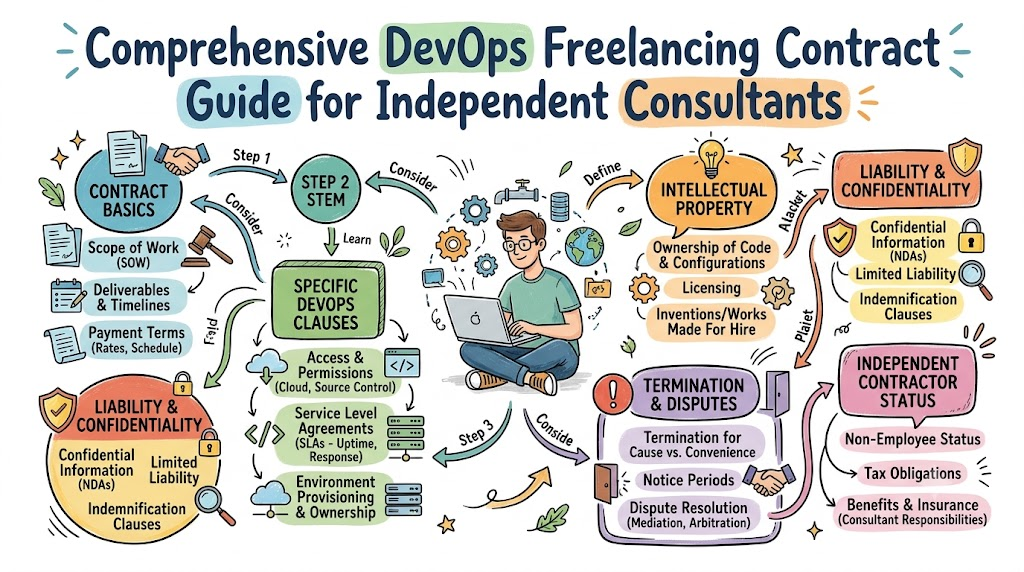
Introduction
The global IT landscape has transformed rapidly over the last few years. More companies than ever are shifting away from traditional in-house employment models to scale their operations. Organizations now prefer agile, on-demand specialized talent to build, secure, and optimize their infrastructure pipelines.
This shift has created an unprecedented demand for independent cloud specialists and infrastructure engineers. However, transitioning from a full-time employee to an independent specialist requires a major shift in how you manage your day-to-day business operations. You are no longer just writing configuration code; you are running a business entity.
When an enterprise hires you to automate their deployment systems, configure automated container architectures, or manage complex cloud environments, they are giving you the keys to their entire digital infrastructure. A single misconfigured script or an undefined expectation can lead to catastrophic downtime, security breaches, or prolonged project delays.
Without a clear, well-structured agreement, projects frequently derail due to communication gaps, unfulfilled expectations, and uncompensated workload expansions. This is exactly where a comprehensive DevOps freelancing contract becomes your most critical asset. Programs offered by platforms like DevOpsSchool help engineers build the deep technical expertise required to manage these advanced deployments confidently.
A professional contract does not just protect your income; it sets explicit boundaries for your work, establishes clear liabilities, and defines how you interact with a client’s engineering ecosystem. It turns vague discussions into a structured, transparent, and manageable roadmap that ensures both parties remain perfectly aligned throughout the project life cycle.
Consider a common freelance scenario where an independent engineer agrees to optimize a client’s deployment velocity. If the client suddenly demands around-the-clock live system troubleshooting without prior agreement, the engineer faces extreme burnout and financial losses. A formalized consulting document eliminates this risk entirely by clearly defining where your project responsibilities begin and end.
What Is a DevOps Freelancing Contract?
A DevOps freelancing contract is a legally binding document signed between an independent infrastructure specialist and a client organization. This document outlines the technical, operational, financial, and legal terms of their professional engagement.
Unlike a standard software development contract that focuses primarily on application features and user interfaces, this specific agreement centers on system availability, deployment automation, cloud architecture, security compliance, and infrastructure management.
To understand its role clearly, it helps to think of a freelance DevOps agreement as a comprehensive technical project blueprint. Before engineers pour concrete or assemble steel beams for a major corporate facility, they rely on architectural blueprints that explicitly define load boundaries, raw material specifications, utility routing, and structural safety margins.
If a builder tries to construct an advanced facility without these verified technical specifications, the entire structure risks sudden failure. The exact same risk applies to complex cloud systems and automated delivery frameworks.
In the freelance landscape, your contract serves as that vital engineering blueprint. It removes all ambiguity by detailing exactly what systems you will build, which cloud platforms you will configure, how much you will be paid, and who assumes operational risk if an automated deployment encounters an error. It translates vague verbal agreements into a clear, structured framework that governs how code moves from a developer’s workstation out to production servers.
Why DevOps Freelancers Need Proper Contracts
Operating as an independent consultant without a formal DevOps consulting contract leaves your business entirely exposed to operational disruptions and severe financial losses. The primary purpose of a formal agreement is to establish absolute scope clarity from the first day of work.
In infrastructure roles, clients often assume that hiring a DevOps specialist means they have secured an all-purpose IT troubleshooter who will fix legacy databases, patch old application code, and manage local office networks. A documented scope eliminates this confusion completely.
Another critical benefit is reliable payment protection. Infrastructure projects frequently span several months, requiring significant hours of deep technical planning, architecture design, and system configuration.
A structured contract guarantees that you receive regular payments as you achieve verified technical goals, rather than waiting for an entire multi-stage system implementation to conclude. It gives you the legal leverage necessary to pause your consulting services immediately if a client misses a payment deadline.
Furthermore, a professional contract acts as an essential tool for managing client expectations and reducing overall business risk. It defines your exact working hours, sets realistic response times for production emergencies, and outlines boundaries for system support.
By outlining these parameters before you access a client’s live production environments, you build a stable professional relationship based on mutual trust, objective performance metrics, and clear operational boundaries.
Risks of Working Without a Contract
The decision to start working on infrastructure architecture based only on a casual verbal agreement exposes your independent business to major operational hazards. The table below highlights the most frequent risks freelancers encounter when working without a formal agreement, along with their direct operational impacts.
| Risk Category | Direct Operational Impact |
| Severe Scope Creep | The client continually adds new cloud systems, legacy migrations, and application fixes without offering any additional financial compensation. |
| Extended Payment Delays | Invoice payments are delayed for months because there are no clear due dates, late payment penalties, or milestones defined. |
| System Miscommunication | The client expects constant live production support, while you assume your role is strictly limited to building automated deployment pipelines. |
| Complex Project Disputes | Disagreements arise over who is responsible for cloud service costs incurred during high-volume performance and load testing phases. |
| Security and Access Liability | You face blame or legal exposure for an unrelated system breach simply because there was no documentation outlining access limits. |
Essential Elements of a DevOps Freelancing Contract
To provide complete professional safety, a comprehensive DevOps freelancer agreement terms document must be built on a collection of core structural clauses. The table below outlines the foundational sections that must be included in every professional agreement, along with the specific purpose of each section.
| Essential Contract Section | Specific Purpose and Function |
| Detailed Scope of Work (SOW) | Defines the exact cloud platforms, tools, networks, and automated systems you will build, configure, or manage. |
| Verifiable Project Deliverables | Lists the concrete items you will pass to the client, such as automation scripts, architecture plans, and runbooks. |
| Project Timeline and Milestones | Establishes realistic target dates for finishing specific phases of the infrastructure configuration and deployment. |
| Structured Payment Terms | Outlines total consulting fees, billing cycles, milestone payouts, deposit amounts, and clear payment deadlines. |
| Strict Confidentiality and NDA | Protects the client’s internal source code, proprietary algorithms, access tokens, credentials, and business data. |
| Intellectual Property Rights | Clarifies who owns the custom automation code, configuration files, and reusable infrastructure templates. |
Scope of Work (SOW) in DevOps Projects
The Scope of Work (SOW) is the foundational element of any reliable DevOps project contract checklist. It requires meticulous technical detail and absolute clarity.
You must avoid vague statements like “Consultant will manage the client’s AWS cloud infrastructure.” A loose phrase like that allows a client to demand endless uncompensated tasks, such as manual server patching, database optimization, or individual developer troubleshooting.
A professional, highly secure SOW explicitly lists every platform, tool, and environment you are responsible for configuring. For instance, if you are hired to construct an automated delivery system, your contract should explicitly detail your ownership of the continuous integration and delivery pipelines.
You must specify the exact source control platforms, automated testing integrations, container build tools, and target staging and production environments you will configure.
SCOPE OF WORK EXCERPT (EXAMPLE ONLY)
1. CI/CD Pipeline Automation:
   - Configure a multi-stage Jenkins pipeline integrated with GitHub webhooks.
   - Automate linting, unit testing, and Docker container creation for three core microservices.
   - Implement automated staging deployments upon successful main-branch merges.

2. Cloud Infrastructure Architecture:
   - Provision AWS resources (VPC, three public subnets, three private subnets) using Terraform.
   - Configure an Amazon Elastic Kubernetes Service (EKS) cluster with a maximum scaling limit of ten worker nodes.
   - Establish IAM roles using the principle of least privilege for the engineering team.
By framing your technical responsibilities with this level of detail, you create a firm boundary around your workload. If the client later requests that you migrate an entirely separate legacy database over to a managed cloud database service, you can easily point to the signed SOW. This allows you to position that request as an explicit project expansion that requires a separate, paid contract amendment.
Deliverables in DevOps Freelance Projects
While the Scope of Work explains the day-to-day actions you will perform, the deliverables section defines the tangible, verifiable assets you must pass to the client before a project phase is marked complete. In infrastructure engineering, deliverables are rarely simple standalone software files. They typically consist of modular infrastructure-as-code files, complex pipeline templates, system architecture documentation, and performance monitoring dashboards.
To prevent any end-of-project arguments regarding whether you fulfilled your professional obligations, every single deliverable must be clearly defined alongside explicit, objective acceptance criteria.
For example, instead of listing “Terraform scripts” as a vague deliverable, you should explicitly state that the deliverable consists of modular, linted Terraform configurations that successfully provision a highly available cloud network. This configuration must pass automated verification checks and be stored securely in the client’s internal code repository.
Consider this clear structure for defining your project deliverables:
- Automated Jenkins Pipeline Configuration: A fully functional, declarative pipeline file stored in the main application code repository that automates building, testing, and containerizing code changes.
- Infrastructure-as-Code (Terraform) Modules: Documented, reusable configuration files that successfully deploy a secure virtual private cloud network, complete with isolated public and private subnets across multiple availability zones.
- Production Kubernetes Deployment Manifests: Fully validated deployment and service files that configure rolling update strategies, explicit container resource boundaries, and liveness and readiness probes.
- Comprehensive Operational Runbooks: A clear technical markdown document saved within the project repository that outlines the complete architecture design, system restoration workflows, and backup validation procedures.
- Centralized Monitoring Dashboards: Configured monitoring and alerting systems that track host processor usage, memory consumption, persistent storage limits, and live network traffic metrics.
Payment Terms and Milestone Structure
Securing consistent financial cash flow depends entirely on how well you structure your payment clauses. Independent consultants should generally avoid agreements where the entire compensation package is held back until a massive multi-month project concludes.
Infrastructure projects face frequent delays due to internal client application errors, changing business priorities, or shifting management goals. If you tie your compensation solely to the final deployment date, you might wait months for payment due to factors entirely outside your control.
To protect your business, break the project cost down into structured, milestone-based payments or adopt a predictable monthly retainer model. The table below outlines the primary compensation frameworks used within the industry, along with clear guidance on when to use each approach.
| Payment Model | Optimal When to Use |
| Upfront Initial Deposit | Always collect a 20% to 30% upfront deposit before starting any infrastructure analysis, access configuration, or initial code drafting. |
| Milestone-Based Payments | Best for clearly defined, multi-stage projects like migrating a legacy network architecture over to a secure public cloud environment. |
| Predictive Monthly Retainer | Ideal for long-term engagements focused on ongoing pipeline tuning, system health monitoring, and general infrastructure support. |
| Hourly Consulting Model | Best suited for short-term discovery phases, complex system troubleshooting, or initial architecture design sessions. |
Every milestone must be tied to an objective, easily verifiable technical event rather than a subjective opinion. For instance, structure a milestone payment to trigger immediately when the infrastructure-as-code configuration successfully provisions the staging environment, or when the automated delivery pipeline successfully runs an integration test suite without errors.
Additionally, explicitly state your net payment terms (such as Net-7 or Net-14 days) and outline a clear late fee policy for overdue payments. This encourages the client’s accounting department to process your invoices promptly.
SLA (Service Level Agreement) in DevOps Contracts
Including a Service Level Agreement (SLA) section within your DevOps SLA contract is essential if your project responsibilities involve maintaining live systems or providing operational support. Without explicit SLA boundaries, a client might call you at midnight on a weekend to fix a minor non-critical internal server issue, expecting immediate resolution without offering extra compensation.
A professional SLA protects your personal time by clearly categorizing system incidents by their true operational severity. It establishes realistic response time expectations for each tier.
For example, a total production system outage that prevents users from accessing the client’s core platform should be classified as a Severity 1 emergency. This justifies a fast response time, such as two to four hours during defined business operational windows.
INCIDENT SEVERITY MATRIX (EXAMPLE ONLY)
- Severity 1 (Critical Outage): Core production system is entirely inaccessible to users.
  * Target Response Time: Within 2 hours during defined business hours.
- Severity 2 (Degraded Performance): System is operational but experiencing slow response times.
  * Target Response Time: Within 6 hours during defined business hours.
- Severity 3 (Minor Issue): Non-production environment bug or minor configuration adjustment.
  * Target Response Time: Within 24 to 48 hours.
Crucially, you must explicitly define your precise hours of availability. If you operate as a solo consultant, state clearly that your technical support availability is restricted to specific hours, such as 9:00 AM to 5:00 PM on Monday through Friday in your local time zone.
Explicitly list any out-of-hours or emergency intervention surcharges. If the client requires you to respond to a system emergency over a weekend, they must agree to pay a premium hourly rate defined clearly in the contract terms.
Security and Access Control Clauses
Because infrastructure engineering requires high-level administrative credentials across cloud accounts, code repositories, and production servers, including a comprehensive security and access clause is non-negotiable. This section protects both parties by detailing exactly how confidential system access tokens, private SSH keys, and administrative user accounts are created, used, and revoked.
Your contract must state that the client will provide you with isolated, trackable, and individual user credentials that follow the strict principle of least privilege. You must explicitly refuse to share root corporate accounts or use shared team credentials.
This ensures that every administrative action you perform leaves a clear, auditable log entry within the client’s cloud logging systems. This step protects your professional reputation if an unrelated security incident occurs elsewhere within the client’s organization.
SECURITY ACCESS PROTOCOL (EXAMPLE ONLY)
1. Identity Verification: The Client shall provision an isolated, non-root IAM account for the Consultant.
2. Shared Access Prohibition: The Consultant shall never accept or utilize shared, team-wide login credentials.
3. Secrets Protection: API keys, database passwords, and access tokens must reside inside secure secrets managers.
4. Access Revocation: Within 5 business days of project termination, the Client must revoke all issued credentials.
Furthermore, include a clear clause requiring the client to formally revoke all your infrastructure access privileges within five business days of project completion or contract termination.
Once your contract ends, you do not want the liability of holding active administrative keys to a company’s production environment. Documenting this handoff process ensures a clean, professional separation and prevents any future security compliance misunderstandings.
Intellectual Property (IP) Rights
Intellectual Property (IP) rights clauses require a balanced approach within any DevOps engagement terms document. Clients naturally expect to own the custom application code, configuration files, and deployment architecture scripts that they pay you to develop.
However, as an experienced infrastructure specialist, you likely utilize a personal library of pre-built, reusable automation templates, shell helper scripts, and boilerplate Terraform modules that you have refined across multiple client projects over several years.
If your contract contains a sweeping, poorly drafted IP clause stating that “all code drafted by the consultant belongs exclusively to the client,” you could legally forfeit the rights to your own reusable toolsets.
To prevent this severe restriction, your contract must draw a sharp line between custom, client-specific configurations and your pre-existing engineering tools. This distinction is typically managed through a clear “Pre-Existing Works” or “Background IP” clause.
INTELLECTUAL PROPERTY CLAUSE (EXAMPLE ONLY)
- Client Ownership: All custom configuration files and architecture designs created exclusively for the Client shall transfer to the Client upon final payment completion.
- Consultant Background IP: Reusable boilerplate modules, shell scripts, and generic automation templates authored by the Consultant prior to or independently of this agreement remain the exclusive property of the Consultant.
- Usage License: The Consultant grants the Client a non-exclusive, perpetual, royalty-free license to use any embedded Background IP solely within the deliverables provided under this project.
This balanced approach provides complete safety for both businesses. The client gains full ownership of the specific cloud environment you built for them, while you retain the legal right to use your foundational automation code library to accelerate future client deployments.
Change Management Clause
In independent engineering consulting, a change management clause serves as your primary defense against sudden, unexpected scope expansions. During a project, a client’s internal software development team might alter their core framework or shift their cloud provider strategy entirely.
Without a formal change management system written directly into the agreement, you may find yourself forced to redo weeks of infrastructure design work without receiving any extra pay.
A professional change management clause establishes a clear, step-by-step process for handling any requests that fall outside the originally signed Scope of Work. It states that if either party wants to modify the project deliverables, the request must be submitted in writing.
You then evaluate the technical request and provide an impact assessment detailing how the change affects the overall project timeline and budget.
CHANGE MANAGEMENT WORKFLOW (EXAMPLE ONLY)
1. Written Request: The party proposing a project change must submit a detailed written description to the other party.
2. Impact Assessment: The Consultant will evaluate the request and provide a summary of adjustments needed for fees and timelines.
3. Signed Amendment: No proposed scope adjustment will take effect until both parties sign a formal Addendum document.
This simple workflow completely changes how project adjustments are negotiated. Instead of a casual conversation turning into uncompensated work, every change is handled as a professional business transaction.
This allows you to accommodate your client’s evolving technical needs while ensuring your business is fairly compensated for the additional engineering hours and expertise required.
Real-World Example: Poor DevOps Freelancing Contract
To understand the practical importance of these clauses, consider the real-world case of an independent engineer who accepted a vague, one-page agreement to “Automate a client’s software deployment process.” The contract contained no explicit SOW, no defined milestone stages, and no security boundaries. The total project fee was fixed at a flat rate, payable only upon final completion of the entire system.
Within two weeks, serious problems began to emerge:
- Constant Scope Creep: The client’s internal development team repeatedly changed their underlying application architecture, forcing the freelancer to completely rewrite the automated Docker files and Kubernetes deployment manifests three separate times without additional pay.
- Uncompensated Support Demands: Because the contract lacked an explicit SLA clause, the client expected the freelancer to join emergency engineering troubleshooting calls late at night whenever an internal application developer broke a staging environment build.
- Severe Payment Withholding: A minor bug inside the client’s own application code caused intermittent deployment failures on production servers. The client used this issue as an excuse to withhold the entire project payment for months, claiming the deployment automation was not fully finished.
The freelancer had no contract language to reference to halt the expanding workload or demand partial payments. They eventually had to walk away from the project entirely, losing weeks of intensive engineering labor and damaging a professional relationship.
Real-World Example: Strong DevOps Contract
In contrast, look at a professional consultant who managed an identical infrastructure deployment project using a highly detailed, comprehensive contract structure. Before writing any code, they ensured both parties signed an agreement featuring an explicit SOW, clear milestone schedules, and a well-defined SLA.
The project progressed smoothly due to clear contract boundaries:
- Clear Milestones: The project was broken down into four distinct, objective milestones. The consultant collected an initial 25% deposit before reviewing any code, and received additional milestone payments immediately upon completing the cloud network architecture and staging pipeline setups.
- Smooth Deliveries: When the client’s software engineering team requested a sudden migration of a separate legacy database system, the consultant pointed directly to the signed contract SOW. This clear boundary allowed them to smoothly negotiate a paid contract addendum that covered the extra engineering work.
- Proper Financial Flow: When an internal application bug delayed the final production launch by several weeks, the consultant still received their earlier milestone payments. The contract clearly stated that payments were tied to infrastructure delivery rather than application launch dates, ensuring stable business revenue.
The clear, professional contract turned a complex engineering project into a predictable, stress-free engagement. Both parties understood their exact responsibilities, payments were processed on time, and the project concluded with a highly successful infrastructure deployment.
Common Mistakes DevOps Freelancers Make
Even highly experienced infrastructure engineers often make critical business errors when setting up independent consulting agreements. The checklist below highlights the most common contractual mistakes freelancers make, allowing you to audit your own agreements before sending them to clients.
- [ ] Working Based on Verbal Promises: Commencing high-level cloud architecture adjustments based only on a casual phone call, Slack message, or email chain without a signed contract.
- [ ] Allowing Vague Scope Language: Writing broad descriptions like “Consultant will help optimize development velocity,” which opens the door to unlimited uncompensated work.
- [ ] Omitted Initial Deposit Clauses: Starting complex infrastructure analysis or configuration work without collecting a secure upfront deposit to confirm the client’s commitment.
- [ ] Failing to Define Availability Boundaries: Forgetting to write explicit support hours and response times into the agreement, leading to constant out-of-hours disruption.
- [ ] Ignoring Pre-Existing Work Rights: Signing away the rights to your own reusable automation scripts, helper configurations, and boilerplate Terraform modules.
- [ ] Neglecting a Clear Termination Clause: Omitting a structured process for ending the project early if the client relationship breaks down or project goals change unpredictably.
Best Practices for DevOps Freelancing Contracts
Drafting an effective independent agreement requires balancing technical precision with realistic business practices. First, always make sure your Scope of Work is highly detailed and specific. Clearly define every single tool, cloud provider region, and pipeline stage you will touch, and explicitly list any related tasks that are out of scope.
Second, break your project down into small, manageable milestones. This approach reduces your financial risk and gives the client clear visibility into your technical progress.
Third, document every single project modification and technical agreement in writing. If a client asks for a quick change during a video call, follow up immediately with a clear email summary detailing how that change impacts the timeline and budget.
Fourth, set realistic delivery deadlines that include a comfortable time cushion. Infrastructure engineering frequently uncovers hidden technical debt, legacy configuration errors, and API bugs that can delay your work. Building extra time into your schedule ensures you consistently deliver projects on time.
Finally, always establish firm boundaries around your technical support and availability. Make it clear that your standard project fee covers specific architecture delivery goals, not open-ended, around-the-clock live system monitoring.
If the client requires continuous monitoring and operational support, structure that requirement as a separate, recurring monthly support agreement with a clearly defined SLA and separate pricing.
Role of DevOpsSchool in Freelancing Skill Development
Building a successful independent consulting business requires more than just knowing how to write basic automation scripts. It demands deep, enterprise-grade technical expertise, a systematic understanding of cloud systems, and the confidence to guide client organizations through complex digital transformations.
Educational platforms like DevOpsSchool play a key role in helping engineers develop these advanced professional capabilities.
Through rigorous, project-driven training tracks, engineers gain hands-on experience handling the exact types of complex deployment scenarios they will encounter in the freelance market.
You learn how to architect production-ready continuous integration networks, manage high-volume container systems, and deploy highly resilient infrastructure using industry-standard tools like Jenkins, Terraform, AWS, Docker, and Kubernetes.
FREELANCE SKILL ROADMAP
- Deep Technical Mastery: Building automated, multi-stage delivery networks.
- Production Simulation: Designing resilient, highly available cloud systems.
- Architecture Documentation: Learning to draft clear runbooks and technical plans.
- Consulting Confidence: Gaining the expertise to define project scope and contract boundaries.
Furthermore, this comprehensive educational focus helps engineers shift away from a standard employee mindset toward a strategic consulting approach. When you thoroughly understand how infrastructure architecture directly impacts a client’s business revenue and operational velocity, you can draft highly precise Scope of Work documents.
This deep technical confidence allows you to negotiate clear, professional contracts, set accurate project milestones, and protect your independent engineering business from common operational risks.
Industries Hiring DevOps Freelancers
The requirement for specialized independent infrastructure talent spans almost every major global industry sector. Companies of all sizes actively seek external experts to optimize their delivery networks and secure their cloud systems.
- High-Growth SaaS Companies: Fast-scaling software platforms constantly hire independent consultants to optimize their deployment pipelines, minimize infrastructure overhead costs, and manage complex auto-scaling systems.
- Agile Technology Startups: Early-stage companies require expert consultants to architect their initial production cloud environments correctly from day one, helping them avoid building up massive technical debt.
- Global E-Commerce Platforms: High-traffic online retail operations bring in specialized consultants to prepare their infrastructure networks for major seasonal shopping spikes and build highly resilient checkout systems.
- Banking and Financial Institutions: Highly regulated financial firms hire external specialists to automate strict security compliance rules, audit access logs, and secure cloud networking environments.
- Healthcare Organizations: Medical technology platforms bring in independent experts to build secure data pipelines that comply with strict global privacy regulations while maintaining continuous system uptime.
- Enterprise IT Corporations: Large legacy businesses hire senior consultants to guide their internal development teams through multi-year migrations from on-premise hardware over to modern cloud architectures.
Future of DevOps Freelancing
The global market for independent infrastructure consulting is on a clear long-term growth path. Organizations worldwide continue to embrace distributed, remote-first engineering structures, allowing them to source specialized technical talent globally rather than relying only on local hiring pools.
This structural shift opens up incredible opportunities for independent cloud engineers who can deliver high-value automation skills without requiring full-time corporate onboarding overhead.
At the same time, cloud-native environments are becoming increasingly complex. As modern organizations move toward advanced multi-cloud setups, distributed microservice networks, and automated security integrations, the demand for highly specialized consultants will continue to outpace general software engineering support.
Independent specialists who focus on advanced automation delivery, cloud optimization, and infrastructure security are exceptionally well-positioned to thrive in this evolving landscape.
Ultimately, the future belongs to the professional engineer who pairs deep technical mastery with clear, organized business practices. By combining advanced infrastructure skills with reliable, structured contracts, you can build a stable, secure, and highly profitable independent consulting business.
FAQs (15 Questions)
What is a DevOps freelancing contract?
A DevOps freelancing contract is a formal, legally binding document signed between an independent infrastructure consultant and a client organization. It clearly outlines the exact scope of work, project deliverables, payment structures, timeline milestones, security access protocols, and legal liabilities that govern their professional engagement.
Why do freelancers need contracts?
Contracts are essential to protect your business from scope creep, ensure reliable and timely payments, manage client expectations, and limit your legal liability when working inside sensitive production cloud environments. It turns vague verbal agreements into a clear, enforceable operational roadmap.
What should be included in SOW?
The Scope of Work (SOW) must explicitly list every cloud platform, infrastructure tool, code repository, and environment you are responsible for configuring. It should clearly define your exact boundaries regarding continuous integration setups, infrastructure-as-code scripts, container management, and monitoring systems.
How should payment be structured?
Payment should be structured using a secure upfront deposit (typically 20% to 30%) followed by clear, milestone-based payouts tied to objective technical achievements. Alternatively, long-term infrastructure support roles can be managed using a predictable monthly retainer model with firm billing terms.
What is SLA in DevOps?
A Service Level Agreement (SLA) defines your precise hours of technical availability, outlines a clear matrix for classifying system incident severity, and sets realistic response time targets for addressing production issues. It protects your personal time by ensuring you are not treated as an uncompensated, 24/7 on-call troubleshooter.
Who owns the code?
Custom configuration files, deployment scripts, and architecture designs built specifically for a client generally transfer to the client upon receipt of final project payment. However, your contract should state that you retain exclusive ownership of your pre-existing boilerplate code templates and helper scripts.
Can contracts be changed later?
Yes, contracts can be modified using a formal change management clause. This clause requires any adjustments to the project scope, timeline, or pricing to be submitted in writing and formally signed by both parties as an official contract amendment before any new work begins.
What happens without a contract?
Working without a contract leaves your business completely exposed to severe scope creep, extended payment delays, uncompensated support demands, and complicated legal disputes regarding cloud costs or system downtime liability. It leaves you with no formal leverage to resolve client misunderstandings.
How do I handle cloud costs?
Your contract should explicitly state that the client is solely responsible for all direct cloud infrastructure costs, hosting platform fees, and third-party software licensing charges. You should never pay for a client’s cloud resources using your personal credit cards or business accounts.
What is a non-disclosure clause?
A non-disclosure agreement (NDA) or confidentiality clause is a binding commitment that protects the client’s internal source code, access tokens, database contents, business strategies, and proprietary systems from being shared or disclosed to any external third parties.
How do I limit my liability?
You should include a clear limitation of liability clause stating that you are not financially responsible for any indirect business losses, lost revenue, or system downtime caused by an infrastructure issue. This clause caps your maximum potential liability at the total amount paid to you under the contract.
What is a termination clause?
A termination clause defines the exact process for ending the project relationship early. It typically requires the party ending the contract to provide a set written notice period (such as 14 or 30 days) and guarantees that you are paid for all engineering work completed up to the termination date.
How do I handle access security?
Your contract must require the client to issue you isolated, trackable user credentials that follow the principle of least privilege. It should explicitly state that you will not share team accounts or root credentials, and require the client to revoke all your access privileges once the project concludes.
Is an email agreement valid?
While a clear email confirmation can provide basic evidence of a mutual agreement, it lacks the comprehensive legal protections, liability limits, and structured clauses found in a formal contract document. You should always use a dedicated, signed contract for substantial infrastructure projects.
What tools are covered?
A professional contract should explicitly name the primary tools and platforms you will utilize throughout the project engagement. This includes naming specific cloud vendors like AWS or Azure, configuration managers like Ansible, infrastructure-as-code engines like Terraform, and orchestration suites like Kubernetes.
Final Thoughts
Building a highly successful independent DevOps consulting practice requires balancing technical excellence with disciplined, professional business operations. Cloud automation and infrastructure engineering carry high operational stakes. Giving an external specialist administrative keys to a company’s primary production network requires absolute clarity and institutional trust.
A comprehensive, properly structured contract provides the essential foundation for that professional trust. It ensures you are never forced into uncompensated late-night support sprints or left exposed to open-ended scope creep.
Instead, it transforms your engineering engagement into a well-organized, mutually beneficial business partnership where deliverables are explicit, timelines are realistic, and payments are entirely predictable.
As you continue to scale your freelance business, treat your contract documentation with the exact same level of care and precision that you apply to writing critical infrastructure code. Protecting your time, your intellectual property, and your financial cash flow is what allows you to run a sustainable, highly respected, and profitable independent consulting business over the long term.
