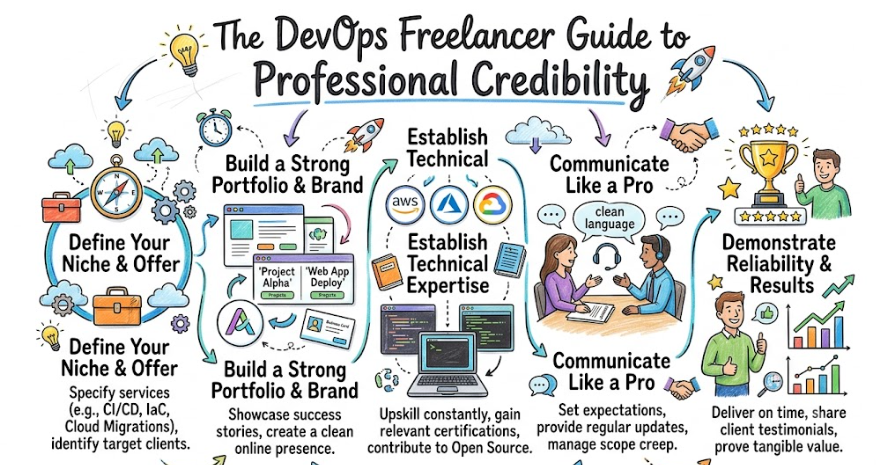
Introduction
In the world of freelance DevOps, your technical skills—knowing how to configure Kubernetes, manage CI/CD pipelines, or optimize cloud costs—are simply the entry ticket. They are the baseline. When a client hires you to manage their infrastructure, they are not just looking for a script or a configuration file; they are handing you the keys to their business continuity. If your infrastructure goes down, their revenue stops. If you misconfigure security, their data is at risk.
Because you are being granted access to high-stakes, production-level systems, the most critical currency you possess is not your coding speed—it is trust. Building trust with clients as a DevOps freelancer is a deliberate, daily practice. It is about proving that you are a steward of their business assets, not just a contractor executing tasks.
Whether you are just starting your journey or looking to scale your consulting practice, understanding how to position yourself as a reliable partner is essential. If you are looking to bridge the gap between technical proficiency and professional maturity, platforms like DevOpsSchool offer the practical insights and structural knowledge necessary to handle complex infrastructure projects. Mastering the art of client trust is the difference between constant contract hunting and a stable, referral-based career.
Why Trust Is the Foundation of DevOps Freelancing
DevOps is inherently intrusive. You are working in the nervous system of an organization. You have the potential to delete production databases, expose API keys, or inadvertently cause downtime. When a client hires you, they feel a natural anxiety.
Trust is the foundation because it lowers the client’s stress level. When a client trusts you, they stop micro-managing your code commits and start asking for your strategic advice. They move from treating you as a laborer to treating you as a consultant. This shift is where the real value—and the better pay—resides.
What Makes Clients Trust a DevOps Freelancer?
Trust is composed of several moving parts. It is rarely built by one “big win,” but rather by thousands of small, consistent actions.
| Trust Factor | Why It Matters |
| Communication | Keeps the client informed and reduces anxiety during complex changes. |
| Reliability | Proves that you do what you say, when you say you will do it. |
| Technical Honesty | Acknowledging what you do not know prevents critical system failures. |
| Transparency | Admitting to mistakes early prevents them from becoming disasters. |
| Professionalism | Shows that you value their business time and resources as much as they do. |
First Impressions Matter More Than You Think
The “trust clock” starts ticking during the very first interaction—often the discovery call or the initial email exchange. If you are disorganized, late to the meeting, or unable to explain a technical concept in a way that respects the client’s business goals, you have already lost points.
When you start a new project, focus on a structured onboarding process. Ask for documentation, clarify the scope, and identify the “definition of done.” Clients are looking for confidence. If you seem overwhelmed by their infrastructure during the first week, they will assume you are overwhelmed by the project as a whole. Present yourself as the calm, capable expert who has seen these challenges before.
Communicating Clearly With Technical and Non-Technical Clients
One of the biggest pitfalls for DevOps freelancers is speaking only in “tech-speak.” If you are talking to a CEO or a Product Manager, they do not care about the specifics of your Terraform provider version; they care about stability, costs, and time-to-market.
- Avoid Jargon: Explain infrastructure changes in terms of business impact. Instead of “I am updating the Kubernetes ingress controller,” say “I am optimizing the system so your application handles more traffic without slowing down.”
- Status Reporting: Send a brief, consistent update at the same time each week. It should include: What was accomplished, what is in progress, and any potential blockers.
- Managing Expectations: Always under-promise and over-deliver. If a task takes two days, tell the client it will take three. This gives you a buffer for unexpected technical debt—which, in DevOps, is almost guaranteed.
Why Transparency Builds Long-Term Trust
Transparency is the ultimate form of professional insurance. If you encounter a problem, report it immediately.
Do not try to “fix it in silence” for hours on end if the system is at risk. If you are working on a production migration and hit a snag that delays the timeline by four hours, communicate it the moment you realize the delay. Clients are far more forgiving of a delay they know about in advance than a missed deadline that comes as a surprise. By being transparent about risks, you position yourself as an ally who is protecting the business, not just a worker hiding mistakes.
Deliver Consistency, Not Overpromises
The quickest way to lose a client is to commit to a deadline you cannot meet. In DevOps, infrastructure is rarely predictable. Legacy code, undocumented configurations, and cloud provider limitations often cause unexpected friction.
When scoping a project, build in a “research and discovery” phase. Never promise an immediate fix for a complex issue. Use the phrase, “I need to analyze the existing logs and infrastructure state before I can provide a firm timeline.” This shows the client that you are disciplined and process-oriented, which builds immense trust.
Handling Incidents Without Losing Client Confidence
Every DevOps freelancer will eventually break something. It is part of the job. The difference between a professional and an amateur is how you handle the recovery.
If an incident occurs:
- Stop and Communicate: Do not panic or go silent. Inform the stakeholder immediately: “We are currently experiencing downtime. I have identified the issue and am working on the rollback.”
- Focus on Recovery: Prioritize getting the service back to a stable state over finding the root cause.
- Provide a Post-Mortem: After the dust settles, provide a brief, professional summary of what happened, how it was fixed, and—most importantly—what steps you are taking to ensure it does not happen again.
Taking responsibility without making excuses is the hallmark of a senior consultant.
Managing Expectations in DevOps Projects
DevOps projects are rarely linear. You might be asked to set up a CI/CD pipeline, only to find that the application code is not compatible with modern containerization.
You must manage these expectations early. Clearly define what is in scope and what is out of scope. If a client asks for a feature that is outside the original agreement, treat it as a new request. Say, “That is a great feature, and it is technically possible. However, it will require adding ‘X’ hours to our timeline. Shall we proceed with that, or should we stick to the original plan?” This keeps the project on track and maintains the business relationship.
Real-World Example: Trust Lost Due to Poor Communication
Imagine a freelancer, “Alex,” is working on a cloud migration. A critical database migration fails. Instead of telling the client, Alex spends 12 hours trying to fix it silently. The client finds out the next day because the application is still down.
The client feels blindsided, anxious, and distrustful. Even if Alex fixes it the next hour, the damage to the relationship is done. The client now wonders what else Alex is hiding. Trust has been replaced by suspicion.
Real-World Example: Trust Built Through Reliability
Contrast that with “Jamie.” During the same database migration, Jamie hits an error. At the one-hour mark, Jamie calls the client: “We hit an unexpected error with the legacy database schema. I am working on a manual workaround. It will take an extra four hours, but the data will be safe.”
The client is disappointed about the delay, but they appreciate the heads-up. When the migration finishes successfully, the client thanks Jamie for the proactive communication. Jamie has built trust by being the person who brings solutions, not just problems.
Best Practices for Building Trust as a DevOps Freelancer
- Communicate Regularly: Set a rhythm for updates.
- Be Transparent About Risks: If you see a vulnerability or a potential failure point, flag it early.
- Document Work Properly: Leave the system better than you found it. Documentation is a love letter to the person who comes after you.
- Protect Client Security: Never store credentials in insecure locations. Treat their environment as if it were your own bank account.
- Stay Accountable: If you make a mistake, own it immediately and offer a plan for remediation.
Common Freelancing Mistakes That Damage Trust
- Overpromising: Saying “yes” to deadlines you cannot meet.
- Ignoring Updates: Going “dark” when you encounter a difficult technical problem.
- Taking Too Many Projects: Becoming the bottleneck for all your clients simultaneously.
- Poor Documentation: Leaving the client with a “black box” infrastructure that only you understand (this is often perceived as holding their system hostage).
- Acting Like a Ghost: Failing to be accessible during critical deployment windows.
Role of DevOpsSchool in Freelance DevOps Readiness
The transition from a full-time employee to a freelancer requires a shift in mindset. You stop being a “task taker” and become a “service provider.” DevOpsSchool provides the practical, hands-on exposure to real-world infrastructure scenarios that helps you bridge this gap. By focusing on professional workflows, CI/CD mastery, and cloud architecture, they help you gain the confidence to handle high-pressure environments. When you have the technical foundation solid, you can focus your mental energy on building that all-important client trust.
Career Benefits of Client Trust
When you master the art of trust, your business changes:
- Higher-Paying Contracts: Clients are willing to pay a premium for a freelancer they do not have to worry about.
- Repeat Clients: Once you have “internalized” the trust, you will rarely need to hunt for work. The same clients will call you for every new project.
- Better Referrals: Trust leads to word-of-mouth recommendations, which is the highest form of marketing.
- Long-Term Stability: You move away from the “feast or famine” cycle of freelancing.
Industries Hiring DevOps Freelancers
Trust is a universal requirement, but it is magnified in certain high-compliance sectors:
- SaaS Companies: High demand for reliability and uptime.
- Healthcare: Strict requirements for data security and compliance.
- Banking & Finance: Extreme focus on security and auditability.
- E-Commerce: Massive scale and zero tolerance for downtime during sales.
- Startups: Need for agile, quick-thinking consultants who can build infrastructure from scratch.
Future of DevOps Freelancing
The future of DevOps freelancing is moving toward security-focused, multi-cloud consulting. As organizations struggle with complex cloud costs and security threats, they are increasingly looking for external experts who can provide unbiased, high-level advice. As a trusted freelancer, you are perfectly positioned to act as this strategic partner.
FAQs
1. Why is trust important in DevOps freelancing?
Because clients give you access to critical business systems. If they cannot trust you, they cannot sleep at night, and they will eventually replace you.
2. How do I gain trust quickly?
Be proactive. Report progress before they ask. Admit mistakes before they find them.
3. What if I make a mistake?
Own it. Explain what happened, how you are fixing it, and how you will prevent it from happening again.
4. Should I report delays immediately?
Yes. Always. A delay is a problem; a surprise delay is a catastrophe.
5. How often should I update clients?
Once a week at a minimum, or immediately if a critical issue arises.
6. Do certifications help build trust?
They help get the door open, but they do not replace reliability. Experience builds trust.
7. Can beginners win long-term clients?
Yes, if they act with high professionalism. Reliability and honesty often matter more to clients than 20 years of experience.
8. What destroys trust fastest?
Hiding problems, missing deadlines without notice, and failing to secure sensitive data.
9. How do I handle clients who micromanage?
Show them you have a process. Provide clear, documented status reports. When they see you are in control, they will relax.
10. Should I share my technical difficulties?
Yes, if they impact the project timeline. Do not dump technical frustration on them, but do inform them of reality.
11. Is “under-promising” dishonest?
No, it is managing risk. Providing a buffer for the unexpected is responsible engineering.
12. How do I handle a disagreement with a client?
Listen first. State your technical reasoning calmly and objectively. If you are wrong, concede gracefully.
13. Does documentation really build trust?
Yes. It proves you are not trying to create “vendor lock-in” by making yourself the only person who understands the system.
14. What if I am truly stuck?
Ask for help. Consult with peers or seek guidance. Do not let the project sit idle out of pride.
15. How do I ask for a referral?
After delivering a successful project, simply say: “I enjoyed working on this. If you know anyone else who needs help with their infrastructure, I would appreciate the introduction.”
Final Thoughts
Building trust as a DevOps freelancer is not about being perfect. You will encounter outages, broken pipelines, and difficult migrations. Trust is about how you navigate those moments. It is about consistency, transparency, and the integrity to put the client’s business interests above your own convenience. When you become the engineer that clients can rely on regardless of the technical challenge, you stop being a freelancer and start being a partner.
