Introduction
In the world of DevOps, we often fall into the trap of believing that the quality of our Terraform scripts, the robustness of our CI/CD pipelines, and the depth of our Kubernetes knowledge are the only metrics that determine our success. While technical prowess is certainly the baseline requirement, I have seen many exceptionally talented engineers struggle to sustain a freelance career. The truth is that code does not pay the invoices—clients do. And clients do not just pay for infrastructure; they pay for peace of mind, reliability, and clear communication. When you transition into freelancing, you are no longer just an engineer; you are a business owner. Your ability to manage expectations, navigate office politics, and build trust is often what differentiates a freelancer who struggles from one who enjoys a consistent stream of high-value referrals. If you are just starting, you may find that the gap between technical execution and professional client management is wide. This is where professional guidance becomes invaluable. Organizations like DevOpsSchool play a vital role here, offering resources that help professionals bridge the divide between raw technical skill and the professional awareness required to excel.
In this guide, we will explore why soft skills are the secret weapon of the most successful DevOps freelancers. We will break down the essential habits, communication frameworks, and mindsets that transform a project-based contract into a long-term, lucrative consulting partnership.
Why Soft Skills Matter in DevOps Freelancing
When you work as a full-time employee, the internal culture often acts as a safety net. You have managers to handle client politics and HR departments to facilitate team friction. As a freelancer, that safety net disappears. You are the frontline for everything.
Client-Facing Responsibilities
Clients hire freelancers to solve problems they cannot solve themselves. They are often stressed, under pressure from stakeholders, and looking for a partner who can take the weight off their shoulders. If you are technically brilliant but unresponsive or vague in your updates, the client will perceive your silence as a lack of progress or, worse, a lack of competence.
Independent Work Expectations
In a freelance capacity, you are expected to operate with autonomy. This does not mean working in a vacuum. It means managing your own workflow and proactively updating the client before they have to ask, “Where are we on this task?” Reliability is a soft skill, and it is the single biggest predictor of repeat business.
Building Professional Credibility
Think of soft skills as your professional branding. You could be the best engineer in the world, but if you consistently miss meetings, fail to document your work, or handle feedback defensively, your reputation will suffer. Building credibility is about showing up, being prepared, and communicating clearly.
Top Soft Skills Every DevOps Freelancer Should Develop
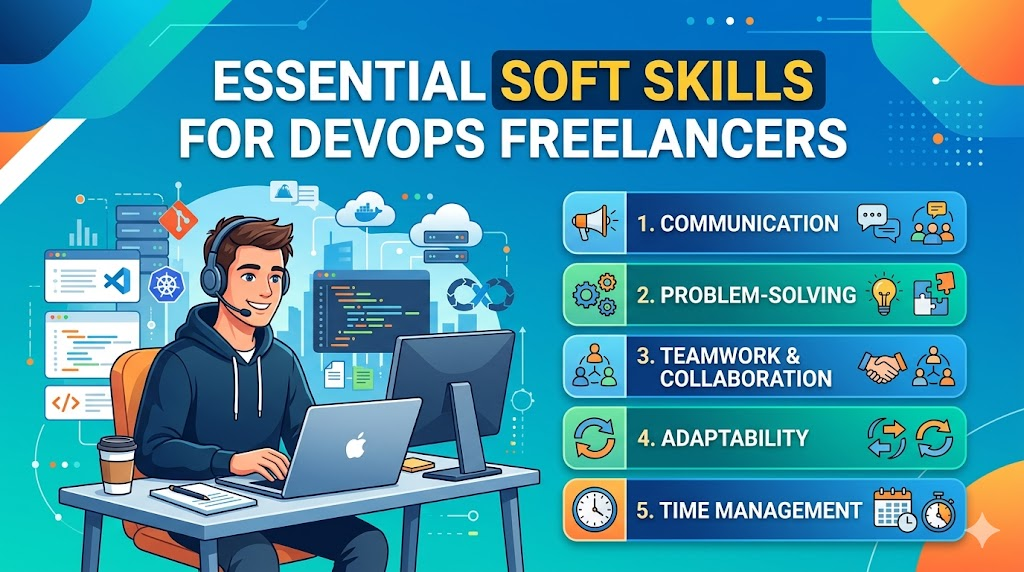
Success in DevOps freelancing is not accidental. It is a calculated combination of technical execution and human interaction. Here are the core soft skills you need to prioritize.
Communication Skills
This is the bedrock of your success. DevOps is complex, and your job is to demystify it for non-technical stakeholders. If you cannot explain why a Kubernetes cluster upgrade is necessary in plain, business-friendly language, you lose the ability to influence decisions.
- Practical Scenario: You need to convince a CTO to migrate from a legacy on-premise setup to AWS. Do not start by explaining VPCs or subnets. Start by explaining the cost-saving potential and the increased uptime.
Active Listening
Most engineers listen with the intent to reply. Great consultants listen with the intent to understand. When a client explains a requirement, they might not be describing the real problem. By asking clarifying questions and paraphrasing what you heard, you avoid building the wrong solution.
- Practical Scenario: A client says, “I want to move everything to serverless.” Instead of saying “Okay,” ask, “What are the specific pain points you are experiencing with your current infrastructure that makes you feel serverless is the answer?”
Time Management
Freelancing involves juggling multiple projects, administrative tasks, and personal development. If you overpromise on delivery dates, you destroy trust. Learn to buffer your estimates and provide realistic timelines, not optimistic ones.
Accountability
Mistakes will happen. You might accidentally delete a production bucket or misconfigure an IAM role. The difference between a junior freelancer and a seasoned professional is how they handle these moments. Own the mistake immediately, explain the fix, and outline the preventative measures you are taking to ensure it never happens again.
Problem-Solving Mindset
Clients love engineers who bring solutions, not problems. If you identify a bottleneck, do not just report it. Report the bottleneck along with two potential solutions, a cost-benefit analysis of each, and your professional recommendation.
Adaptability
DevOps is a landscape of constant change. Requirements shift, priorities change, and new tools emerge. Your ability to pivot without frustration is a significant asset. Clients value freelancers who remain calm and composed when the goalposts move.
Collaboration Skills
Even as a freelancer, you are part of a team. You will interact with developers, security analysts, and product managers. Understanding their language and their unique pressures will make you a more effective collaborator.
Emotional Intelligence
You will receive feedback that feels personal, even if it isn’t. You will work with difficult personalities. Emotional intelligence allows you to de-escalate tension, process feedback objectively, and maintain professional relationships even when project dynamics are strained.
Communication Framework for DevOps Freelancers
Use this table as a quick reference when navigating common consulting scenarios.
| Situation | Recommended Communication Approach |
| Missed Deadlines | Proactively communicate before the deadline. Explain the blocker, provide a new ETA, and offer a path forward. Never wait for the client to ask. |
| Production Issues | Be direct and transparent. Focus on incident response, not blame. Provide clear, chronological updates until the resolution is verified. |
| Requirement Changes | Acknowledge the change. Assess the impact on scope and timeline. Provide an updated quote or schedule before committing to the new work. |
| Delayed Client Responses | Send a polite, professional nudge. Keep a record of the request. Do not halt your work on other parts of the project unless the delay makes further progress impossible. |
| Additional Work Requests | Document the request. Clearly state that this is out-of-scope. Provide a brief estimate of the time/cost to add it to the current project or a future phase. |
Real-World Example: Highly Skilled Freelancer Who Lost Clients
Let’s call him “Alex.” Alex was a brilliant engineer. He could configure a multi-region disaster recovery plan in his sleep. However, Alex suffered from the “genius syndrome.” He believed his code spoke for itself. He rarely provided status updates because he felt he was “getting the work done.” When clients asked for an ETA, he gave short, impatient answers. He viewed documentation as a waste of time.
Eventually, the client felt disconnected from the project. They didn’t know if the money they were paying was yielding results because Alex didn’t communicate the value. When a minor production issue occurred, the client felt they couldn’t trust Alex to handle the communication with the rest of the business. Alex was let go, despite his technical brilliance, because he was not a “partner.”
Real-World Example: Average Technical Freelancer With Strong Client Retention
Let’s look at “Sarah.” Sarah was a good engineer, but perhaps not as naturally gifted at deep architecture as Alex. However, Sarah understood the business of freelancing. Every Monday, she sent a bulleted email outlining what she planned to achieve that week. Every Friday, she sent a recap of what was accomplished and any blockers she faced. When she hit a snag, she explained it clearly and offered alternatives.
Sarah documented every decision she made in a shared repository. If she was unavailable, another engineer could step in. Her clients felt safe with her. She wasn’t just a resource; she was a partner. Sarah’s client retention rate was exceptionally high, and her clients frequently recommended her to others.
Common Soft Skill Mistakes DevOps Freelancers Make
- Overpromising: Saying “yes” to every request to keep the client happy, then burning out or failing to deliver.
- Avoiding difficult conversations: Ignoring a bad requirement or a looming deadline hoping it will go away. It never does.
- Technical jargon overload: Using complex terminology to sound smart. It actually makes the client feel confused and excluded.
- Ignoring documentation: Failing to leave a paper trail. If you don’t document, the project dies when you leave.
- Delayed communication: Waiting 24 hours to reply to a simple question. Timeliness builds trust.
Best Practices for Improving Soft Skills
- Practice Concise Communication: Before sending an email or Slack message, edit it down. Remove the fluff. Get to the point.
- Document Decisions: Use a standard format for architectural decision records. It shows you think through problems systematically.
- Seek Feedback Regularly: Every month, ask your client: “Is there anything about our communication or workflow that I could improve?”
- Improve Presentation Skills: Learn to explain your work visually. A simple architecture diagram is worth a thousand lines of configuration code.
- Build Consulting Habits: Treat your emails like professional letters. Maintain a professional tone, even when you have been working with a client for a long time.
Role of DevOpsSchool in Building Professional Readiness
Transitioning from a traditional job to a freelance career is a significant step. It requires more than just technical certification; it requires a shift in mindset. Platforms like DevOpsSchool are designed to help bridge this gap. By providing exposure to real-world workflows and emphasizing practical collaboration, such ecosystems allow you to develop the professional readiness that defines a successful consultant. It is not just about learning a tool; it is about learning how that tool solves business problems in a collaborative environment.
Career Benefits of Strong Soft Skills
The impact of your interpersonal abilities extends throughout your entire career trajectory:
- Freelance DevOps Engineer: You gain the ability to charge premium rates because clients view you as low-risk and high-value.
- DevOps Consultant: You move from being a “task-doer” to a “strategic advisor.” Clients start asking for your opinion on business decisions, not just technical ones.
- Cloud Consultant: You become the bridge between the boardroom and the server room, a rare and highly compensated position.
- Platform Engineer: You learn to build internal platforms that teams actually want to use because you have cultivated empathy for the user.
- Technical Advisor: You become the go-to person for leadership, allowing you to influence the technical direction of entire organizations.
Industries Hiring DevOps Freelancers
The demand for communicative, reliable DevOps experts is universal.
- SaaS: Fast-paced environments where uptime is revenue. They need reliable partners.
- FinTech: High security and compliance requirements. Accountability and documentation are non-negotiable here.
- Healthcare: Strict regulatory environments. Proactive communication regarding security risks is highly valued.
- E-Commerce: Scalability is key. They need freelancers who can communicate the impact of infrastructure changes on user experience.
- Startups: They need “full-stack” personality types—people who are adaptable and can solve problems across multiple domains.
- Enterprise IT: They need consultants who can navigate complex office politics and integrate seamlessly with existing teams.
Future of DevOps Freelancing
The future of DevOps freelancing is moving toward outcome-based engagements. As AI takes over some of the repetitive tasks in automation, the human value proposition is shifting toward strategic advisory.
- AI-assisted engineering: You will be expected to leverage AI to move faster, which means your value will come from curating and validating output, not just writing it.
- Remote consulting growth: As teams become more distributed, the ability to document clearly and communicate asynchronously will become the most important skill in your toolkit.
- Strategic advisory: Clients will increasingly look for “fractional” experts who can guide their technical strategy rather than just implement tools.
FAQs
1. Why are soft skills important in DevOps freelancing?
Soft skills build the trust necessary for clients to hire you repeatedly. They allow you to manage expectations and ensure that your technical work aligns with business goals.
2. Which soft skill matters most?
Communication. If you can explain what you are doing and why, you can solve almost any other interpersonal problem.
3. How can I improve communication with clients?
Start by setting clear expectations early. Over-communicate on progress during the first few weeks of a contract until you understand their preferred communication style.
4. Is technical expertise enough to succeed?
No. Technical expertise wins the first project. Soft skills win the second, third, and fourth projects.
5. How do I handle difficult clients?
Stay objective. Focus on the project goals. If a client is unreasonable, rely on documentation and agreed-upon scopes to guide the conversation back to reality.
6. How important is documentation?
It is vital. It is the legacy you leave behind. A well-documented project makes you indispensable because the client can always understand what you built.
7. Can introverts succeed in freelancing?
Absolutely. Many great consultants are introverts. Freelancing allows you to control your communication channels, which can actually be easier for many people than constant office interaction.
8. How do soft skills increase repeat business?
Clients prefer working with people who are pleasant, reliable, and clear. They will often choose a “good” engineer who communicates well over a “great” engineer who is difficult to work with.
9. What if I don’t know the answer to a question?
Be honest. Say, “I do not know the answer to that right now, but I will research it and get back to you by [Time/Date].” Reliability is better than faking expertise.
10. How do I manage time across multiple clients?
Use a shared calendar and clear project management tools. Always communicate your availability and stick to it.
11. Is it okay to say “no” to a client?
Yes. If a request is outside the scope or technically inadvisable, explain why. Framing it as “protecting the project’s health” makes it a collaborative suggestion, not a rejection.
12. How do I ask for a raise as a freelancer?
Base it on value provided. Document your achievements, how you saved them money, or how you improved their system’s reliability.
13. Do I need to be a manager to have soft skills?
No. Soft skills are about personal professional maturity, regardless of your role.
14. What if the client is slow to respond?
Send a friendly follow-up. Do not be passive-aggressive. Assume they are busy, not ignoring you.
15. How do I handle feedback?
Listen, thank the client for their input, and ask for specific examples of how you can improve. Do not take it personally.
Final Thoughts
Technical expertise opens the door to freelancing, but your soft skills are what keep that door open. Clients are not just looking for code; they are looking for a partner who can translate their business needs into scalable infrastructure.The most successful DevOps freelancers I have mentored over the years are not necessarily the ones with the deepest knowledge of every single cloud service. They are the ones who show up on time, admit when they make mistakes, communicate clearly about risks, and treat the client’s business as if it were their own.If you are looking to take your freelance career to the next level, start by auditing your own professional habits. Are you communicating proactively? Are you documenting your work? Are you solving problems before they become crises?Technical depth is the foundation, but soft skills are the structure that holds your career together. Invest in these interpersonal habits, and you will find that your freelance career becomes much more rewarding, sustainable, and profitable. Explore the professional learning ecosystem at DevOpsSchool to continue refining your consulting mindset and technical readiness.
