Introduction
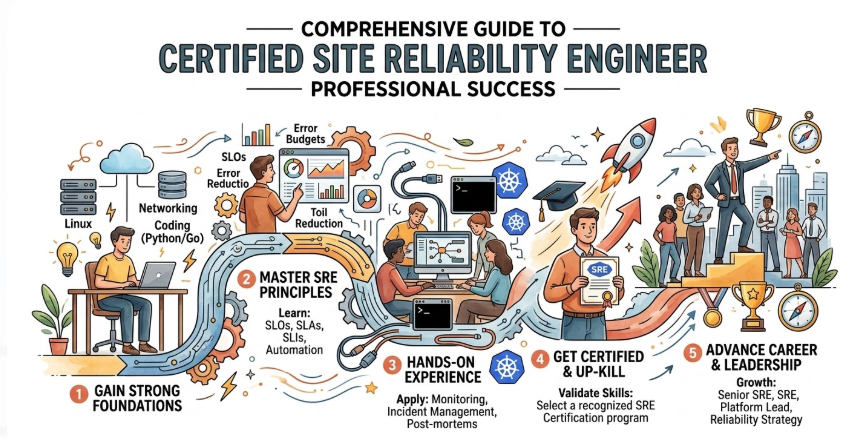
Modern software delivery has shifted from simple code deployment to managing complex, distributed systems at scale. The Certified Site Reliability Engineer program is designed for professionals who want to bridge the gap between software engineering and operations through a data-driven, automated approach. This guide is for engineers, architects, and managers who need to understand how to build resilient systems that remain stable under high demand. By exploring this certification, you will learn how to transition from traditional reactive operations to a proactive, engineering-led reliability model that is essential in today’s cloud-native landscape. Making an informed career decision requires understanding how these skills map to current industry needs, and this deep dive provides that clarity.
What is the Certified Site Reliability Engineer?
The Certified Site Reliability Engineer designation represents a commitment to the principles of reliability, scalability, and efficiency in production environments. It is not merely a theoretical exercise but a validation of an engineer’s ability to apply software engineering practices to solve infrastructure and operations problems. The curriculum focuses on real-world scenarios, such as managing service level objectives, handling large-scale incidents, and automating manual “toil” out of the system. In modern enterprise practices, this certification ensures that an engineer can navigate the complexities of microservices and hybrid cloud environments while maintaining a focus on the end-user experience.
Who Should Pursue Certified Site Reliability Engineer?
This certification is highly beneficial for DevOps engineers, systems administrators, and software developers who are moving into reliability-focused roles. Cloud architects and platform engineers will find the curriculum essential for designing systems that are inherently stable and observable. Even engineering managers and technical leaders should pursue this knowledge to better understand how to structure their teams and set realistic performance targets for their products. Whether you are a beginner looking to enter the field or an experienced professional in India or the global market, this certification provides a standardized framework for excellence in system operations.
Why Certified Site Reliability Engineer is Valuable and Beyond
The demand for reliability expertise continues to grow as organizations move more of their core business logic to the cloud. This certification offers long-term value because it focuses on core principles—like observability and error budgets—that remain relevant even as specific tools and platforms change. For a professional, it represents a significant return on time investment by providing a competitive edge in a crowded job market where “reliability” is a top-tier requirement. Enterprises are increasingly adopting these practices to reduce downtime and improve customer trust, making SRE skills a prerequisite for high-impact technical roles.
Certified Site Reliability Engineer Certification Overview
The program is delivered through a structured curriculum designed to test both conceptual understanding and practical application. It is hosted on a dedicated platform that provides comprehensive learning materials, including labs and case studies that mirror actual production issues. The assessment approach is rigorous, focusing on the ability to diagnose problems and implement long-term fixes rather than quick patches. Ownership of the certification resides with a body of experts who ensure the content remains aligned with the latest industry shifts in automation and site reliability.
Certified Site Reliability Engineer Certification Tracks & Levels
The certification is organized into levels that cater to different stages of a professional’s career, starting from foundational concepts and moving toward advanced architectural mastery. The foundation level introduces the SRE mindset, while professional and advanced levels dive deep into specialized areas like automation, incident response, and performance tuning. These tracks allow engineers to specialize in areas like SRE for FinOps or SRE for AI-driven systems, ensuring a clear path for career progression. By following these levels, a practitioner can evolve from a contributor to a strategic leader who influences how the entire organization approaches uptime and performance.
Complete Certified Site Reliability Engineer Certification Table
| Track | Level | Who it’s for | Prerequisites | Skills Covered | Recommended Order |
| SRE Core | Foundation | Aspiring SREs & Developers | Basic Linux & Networking | SLOs, SLIs, Toil Reduction | First |
| SRE Ops | Professional | Experienced Cloud Engineers | 2+ Years Ops Experience | Incident Management, On-call | Second |
| SRE Arch | Advanced | Principal Engineers & Architects | Professional Level SRE | Distributed Systems Design | Third |
| SRE Automation | Specialist | Automation & DevOps Engineers | Python/Go Scripting | CI/CD for SRE, IaC | Optional |
Detailed Guide for Each Certified Site Reliability Engineer Certification
What it is
This certification validates a candidate’s understanding of the fundamental SRE principles and the cultural shift required to implement them. It ensures the professional speaks the language of reliability and understands the core metrics used to measure service health.
Who should take it
It is ideal for junior engineers, developers transitioning to operations, and managers who need to oversee SRE teams. No deep prior SRE experience is required, but a general understanding of IT lifecycles is helpful.
Skills you’ll gain
- Defining Service Level Indicators (SLIs) and Service Level Objectives (SLOs).
- Calculating and managing Error Budgets.
- Identifying and eliminating operational Toil through automation.
- Understanding the SRE approach to incident management and post-mortems.
Real-world projects you should be able to do
- Create a reliability dashboard for a web application using standard monitoring tools.
- Conduct a blameless post-mortem for a simulated service outage.
- Develop a basic automation script to replace a repetitive manual task.
Preparation plan
- 7–14 days: Focus on reading the core SRE handbook and understanding the terminology.
- 30 days: Engage with practice exams and start mapping SRE concepts to your current work projects.
- 60 days: Deep dive into specific case studies and participate in community forums to discuss real-world applications.
Common mistakes
- Confusing SRE with traditional DevOps or just “automated Ops.”
- Focusing too much on specific tools rather than the underlying principles.
- Neglecting the cultural and “blameless” aspects of the methodology.
Best next certification after this
- Same-track option: Certified Site Reliability Engineer – Professional.
- Cross-track option: Certified DevOps Professional.
- Leadership option: Technical Lead / SRE Manager track.
Choose Your Learning Path
DevOps Path
This path focuses on integrating reliability into the continuous integration and delivery pipeline. It is designed for engineers who want to ensure that code is not only delivered fast but is also stable once it hits production. You will learn how to build automated gates that prevent unreliable code from reaching users. This path bridges the gap between the speed of development and the stability of operations.
DevSecOps Path
In this track, the focus is on making reliability and security inseparable components of the system lifecycle. It involves automating security checks and ensuring that the infrastructure is resilient against both performance spikes and security threats. Professionals here learn to treat “security as a feature” that contributes to the overall uptime of the service. It is essential for those working in regulated industries where downtime or breaches have severe consequences.
SRE Path
This is the “pure” path for those dedicated to the craft of site reliability engineering as a primary role. It dives deep into the architecture of distributed systems, focusing on how to maintain high availability across multiple regions and cloud providers. You will master the art of observability, ensuring that every part of the system is transparent and measurable. This path is for the engineer who wants to be the ultimate guardian of the production environment.
AIOps Path
This specialized path explores how machine learning and artificial intelligence can be used to predict and resolve system issues before they impact users. It involves working with large datasets generated by monitoring tools to identify patterns and anomalies. Engineers in this track learn to build “self-healing” systems that can adjust resources or fix common errors without human intervention. It represents the cutting edge of modern infrastructure management.
MLOps Path
Focused on the reliability of machine learning models in production, this path ensures that AI services are as stable as traditional software. You will learn how to monitor model drift, automate the retraining of models, and ensure the infrastructure supporting AI can scale effectively. This is a critical role as more enterprises integrate complex data science projects into their core product offerings.
DataOps Path
This path addresses the reliability of data pipelines and large-scale data processing systems. It ensures that data is delivered accurately and on time to the applications that depend on it. Professionals learn to apply SRE principles to databases and data lakes, focusing on data integrity and availability. As businesses become more data-driven, the reliability of the underlying data infrastructure becomes a top priority.
FinOps Path
The FinOps path merges reliability engineering with cloud financial management to ensure that systems are not just stable, but also cost-effective. You will learn to monitor cloud spending alongside performance metrics to find the “sweet spot” of efficiency. This role is vital for organizations looking to scale in the cloud without seeing their operational costs spiral out of control.
Role → Recommended Certified Site Reliability Engineer Certifications
| Role | Recommended Certifications |
| DevOps Engineer | SRE Foundation, SRE Automation Specialist |
| SRE | SRE Foundation, SRE Professional, SRE Advanced |
| Platform Engineer | SRE Foundation, SRE Architecture |
| Cloud Engineer | SRE Foundation, Cloud Specialist SRE |
| Security Engineer | SRE Foundation, DevSecOps Specialist |
| Data Engineer | SRE Foundation, DataOps Specialist |
| FinOps Practitioner | SRE Foundation, FinOps SRE Specialist |
| Engineering Manager | SRE Foundation, SRE Leadership Track |
Next Certifications to Take After Certified Site Reliability Engineer
Same Track Progression
After mastering the foundation, the logical step is to move toward the professional and advanced levels of the SRE track. This involves taking on more complex architectural challenges, such as multi-cloud orchestration and global traffic management. Deep specialization allows you to become a Subject Matter Expert (SME) within your organization, capable of solving the most difficult scaling issues.
Cross-Track Expansion
If you want to broaden your impact, consider moving into adjacent areas like DevSecOps or MLOps. Understanding how reliability interacts with security or data science makes you a versatile asset in any cross-functional team. This expansion helps you understand the full lifecycle of a digital product, from initial code to secure, data-driven production environments.
Leadership & Management Track
For those looking to move away from day-to-day coding, the leadership track focuses on building and scaling SRE organizations. You will learn how to set organizational reliability goals, manage budgets for engineering tools, and lead a culture of continuous improvement. This is a vital transition for those who want to influence the engineering strategy at a company-wide level.
Training & Certification Support Providers for Certified Site Reliability Engineer
DevOpsSchool
This provider offers extensive resources for professionals looking to master SRE and DevOps methodologies. They provide hands-on training that focuses on the practical application of tools and culture in a real-world setting. Their curriculum is updated frequently to reflect the latest changes in the cloud-native ecosystem.
Cotocus
Cotocus specializes in high-end technical training for enterprise teams and individual engineers. Their approach is heavily focused on labs and practical scenarios, ensuring that students can actually implement what they learn. They are known for their deep expertise in automation and infrastructure as code.
Scmgalaxy
As a community-driven platform, Scmgalaxy provides a wealth of knowledge on configuration management and SRE practices. They offer a mix of free resources and structured training programs that cater to engineers at all levels. It is a great place to find niche technical information and peer support.
BestDevOps
This organization focuses on providing clear and concise training paths for modern engineering roles. They prioritize the most impactful skills, helping engineers get certified and job-ready in a shorter timeframe. Their training is designed to be highly accessible and career-oriented.
devsecopsschool.com
This platform is the primary destination for engineers who want to integrate security into their SRE and DevOps workflows. They provide specialized courses that cover automated security testing, compliance as code, and secure cloud architecture. It is an essential resource for modern security professionals.
Dedicated specifically to the site reliability engineering discipline, this site offers deep-dive courses into every aspect of SRE. From SLO design to incident response, the content is curated by experts with years of experience in high-traffic production environments. It is a one-stop-shop for SRE mastery.
aiopsschool.com
This provider focuses on the intersection of artificial intelligence and operations. They teach engineers how to use machine learning to automate infrastructure management and improve observability. As systems grow more complex, the skills taught here are becoming increasingly valuable.
dataopsschool.com
For those focused on the reliability of data systems, this platform offers specialized training in managing large-scale data pipelines. They cover the application of SRE principles to data engineering, ensuring that data flows are robust and high-performing.
finopsschool.com
This organization helps engineers and financial professionals align their cloud spending with business value. Their training provides the tools and frameworks needed to optimize cloud costs without sacrificing the reliability or performance of the system.
Frequently Asked Questions (General)
- How difficult is the Certified Site Reliability Engineer exam?
The exam is moderately difficult and requires a solid understanding of both SRE theory and practical troubleshooting. It is designed to test your ability to apply concepts to real-world scenarios. - How long does it take to prepare for the foundation level?
Most professionals find that 30 to 60 days of consistent study is sufficient to grasp the core concepts and pass the initial certification. - Are there any prerequisites for the foundation certification?
There are no formal prerequisites, but a basic understanding of software development and IT operations is highly recommended. - What is the return on investment (ROI) for this certification?
Professionals often see immediate benefits in terms of job opportunities and salary increases, as SRE remains one of the highest-paying roles in tech. - Is this certification recognized globally?
Yes, the principles taught in this program are universal and are used by major tech companies across the globe, from Silicon Valley to Bangalore. - Should I take DevOps or SRE certification first?
While they overlap, the SRE certification is better if you are specifically focused on the health and stability of production systems. - How often does the certification need to be renewed?
Generally, these certifications are valid for two to three years, after which you may need to pass an updated exam or demonstrate continued learning. - Can a manager benefit from this certification?
Absolutely, as it provides managers with the framework needed to set realistic performance goals and build more resilient engineering teams. - Does the program cover specific tools like Kubernetes or Terraform?
While it focuses on principles, it often uses these industry-standard tools in its labs and practical examples to illustrate the concepts. - Is there a community or forum for students?
Yes, most providers offer access to a community of peers and experts where you can ask questions and share experiences during your preparation. - How is the exam administered?
The exam is typically conducted online through a proctored platform, allowing you to take it from anywhere in the world. - Will this certification help me move into a remote role?
Yes, because SRE skills are in high demand for distributed teams that manage global infrastructure, making it a great fit for remote work.
FAQs on Certified Site Reliability Engineer
- What makes the Certified Site Reliability Engineer unique compared to others?
It focuses specifically on the “Engineering” part of operations, emphasizing code-based solutions for infrastructure stability and the use of data to drive all operational decisions. - How does this certification address the concept of “Toil”?
It provides a specific framework for identifying manual, repetitive tasks and teaches strategies for automating them so engineers can focus on high-value project work. - Does the curriculum include incident management?
Yes, it covers the entire lifecycle of an incident, from detection and mitigation to the final blameless post-mortem and the implementation of long-term fixes. - What are SLIs and SLOs in the context of this exam?
These are the core metrics (Indicators) and targets (Objectives) used to define what a “reliable” service looks like from the perspective of the user. - Is there a focus on on-call culture?
The program teaches how to structure on-call rotations that are sustainable and don’t lead to engineer burnout, which is a critical aspect of SRE culture. - How does it handle error budgets?
It explains how to use error budgets to balance the need for fast feature delivery with the absolute requirement for system stability. - Is automation a major part of the assessment?
Yes, a significant portion of the advanced levels focuses on using scripts and tools to manage infrastructure and deploy software reliably at scale. - Can I specialize in a specific cloud provider during this certification?
While the principles are cloud-agnostic, the practical labs often allow you to apply the concepts to major providers like AWS, Azure, or Google Cloud.
Final Thoughts: Is Certified Site Reliability Engineer Worth It?
From a senior mentoring perspective, the Certified Site Reliability Engineer is one of the most practical investments an engineer can make. We have moved past the era where “it works on my machine” is acceptable; today, if it doesn’t work in production, it doesn’t work at all. This certification provides you with a disciplined, engineering-centric approach to making sure systems stay up and performant under pressure. It is not a magic bullet, but it gives you the vocabulary, the framework, and the technical confidence to lead reliability efforts in any organization. If you are serious about a career in modern infrastructure, this is a path worth taking. There is no substitute for the peace of mind that comes from knowing your systems are built to be observable, scalable, and resilient.
