Introduction
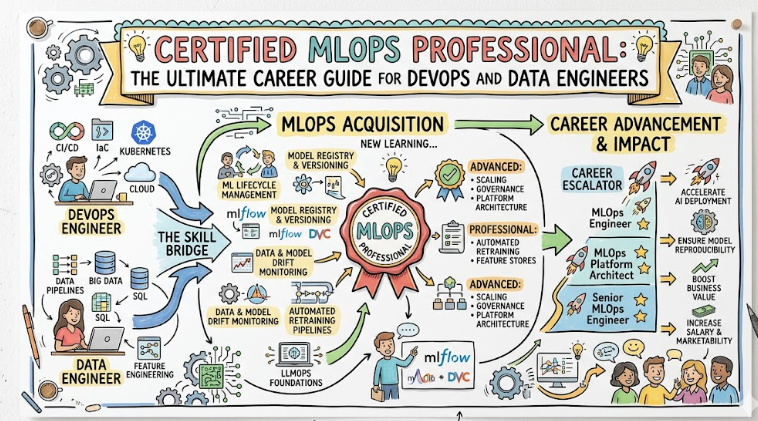
The Certified MLOps Professional is a specialized credential designed to bridge the gap between machine learning development and large-scale production operations. This guide is crafted for engineers who realize that building a model is only a small fraction of the journey toward delivering actual business value. In today’s landscape, the ability to automate, monitor, and scale machine learning pipelines is what separates a successful project from a stalled experiment.
As the industry moves toward automated intelligence, professionals in DevOps, cloud-native, and platform engineering must evolve to handle the unique lifecycle of machine learning data. This guide provides a clear roadmap for navigating the complexities of model deployment and lifecycle management. By the end of this article, you will understand how this certification helps you make informed career decisions and positions you as a leader in the next generation of operations.
What is the Certified MLOps Professional?
The Certified MLOps Professional represents a rigorous validation of an engineer’s ability to manage the intersection of data science, DevOps, and data engineering. It exists because traditional software deployment practices are often insufficient for the non-deterministic nature of machine learning models. While standard CI/CD focuses on code, MLOps requires the orchestration of code, data, and the models themselves.
This program emphasizes real-world, production-focused learning, moving far beyond theoretical concepts of neural networks or algorithms. It aligns with modern engineering workflows by focusing on “Model-as-Code” and “Data-as-Code” paradigms. For the enterprise, having professionals who understand these practices ensures that AI initiatives are reliable, repeatable, and capable of operating under strict performance and security requirements.
Who Should Pursue Certified MLOps Professional?
This certification is highly beneficial for DevOps engineers and Site Reliability Engineers (SREs) who are increasingly being asked to support data science teams and productionize complex models. Cloud professionals and platform engineers will find it valuable as they build the underlying infrastructure that hosts high-concurrency ML applications. Security and data roles also benefit, as MLOps introduces specific governance and data lineage challenges that require specialized knowledge.
The program is structured to accommodate a wide range of experience levels, from beginners looking for a solid foundation to seasoned managers who need to oversee MLOps departments. In the global market, particularly within India’s growing tech hubs, there is a massive demand for engineers who can bridge the “last mile” of machine learning. Managers can use this framework to build cohesive teams that speak a common language across data and operations silos.
Why Certified MLOps Professional is Valuable Today and Beyond
The demand for MLOps expertise is skyrocketing as enterprises move from pilot projects to full-scale AI adoption. While specific tools and frameworks may change over time, the core principles of MLOps—such as versioning, testing, and monitoring—provide longevity to a professional’s career. Obtaining this certification ensures that you remain relevant in an era where automated decision-making is becoming a standard feature of every enterprise software stack.
Longevity in the IT sector comes from mastering processes rather than just individual tools, and this certification delivers exactly that. It helps professionals stay resilient despite the rapid evolution of the technology landscape. The return on career investment is high because organizations are willing to pay a premium for experts who can prevent “model drift” and ensure the continuous delivery of accurate machine learning results in production environments.
Certified MLOps Professional Certification Overview
The program is delivered via the official training portal and is hosted on aiopsschool.com. It is structured to provide a comprehensive look at the machine learning lifecycle, starting from data ingestion and ending with real-time model monitoring. The certification approach is practical, involving hands-on labs and assessments that mimic the challenges faced by engineering teams in real production environments.
Ownership of the learning process is placed on the candidate, with structured modules that cover everything from containerization of models to advanced monitoring strategies. The program structure is designed to be logical and incremental, ensuring that even those with limited data science experience can grasp the operational requirements. It provides a standardized framework that allows companies to measure the competency of their technical staff accurately.
Certified MLOps Professional Certification Tracks & Levels
The certification is divided into three primary levels to ensure a smooth transition from basic concepts to complex architecture. The Foundation level introduces the core vocabulary and concepts of the ML lifecycle, making it ideal for those new to the field. The Professional level dives into the implementation of CI/CD pipelines for machine learning and the automation of training processes.
Advanced levels focus on specialization, such as MLOps for large-scale distributed systems or specialized security requirements. These levels align with career progression, allowing a junior engineer to eventually grow into a Lead MLOps Architect or an Engineering Manager. By following these tracks, professionals can build a specialized portfolio that demonstrates their ability to handle various operational challenges in a data-centric world.
Complete Certified MLOps Professional Certification Table
| Track | Level | Who it’s for | Prerequisites | Skills Covered | Recommended Order |
| Core MLOps | Foundation | Newcomers, Managers | Basic DevOps Knowledge | ML Lifecycle, Tooling | First |
| Engineering | Professional | SREs, DevOps | Foundation Level | CI/CD for ML, Monitoring | Second |
| Architecture | Advanced | Lead Engineers | Professional Level | Scaling, Governance, Cost | Third |
| Security | Specialist | Security Engineers | Professional Level | Model Privacy, Data Security | Optional |
Detailed Guide for Each Certified MLOps Professional Certification
Certified MLOps Professional – Foundation
What it is
This certification validates a foundational understanding of how machine learning models move from a local notebook to a production server. It covers the basic terminology and the general workflow of an MLOps pipeline.
Who should take it
It is suitable for software developers, junior DevOps engineers, and technical managers who need to understand the high-level components of a machine learning operation without getting bogged down in deep mathematical theory.
Skills you’ll gain
- Understanding of the machine learning development lifecycle.
- Knowledge of standard MLOps terminology and core concepts.
- Ability to identify the components of a production ML stack.
- Understanding the role of data versioning in model reproducibility.
Real-world projects you should be able to do
- Map out a basic MLOps workflow for a standard classification model.
- Identify bottlenecks in a manual machine learning deployment process.
- Explain the differences between traditional DevOps and MLOps to stakeholders.
Preparation plan
- 14 Days: Review official documentation and foundational videos on the ML lifecycle.
- 30 Days: Complete introductory labs on model versioning and container basics.
- 60 Days: Deep dive into case studies of successful MLOps implementations in the industry.
Common mistakes
- Focusing too much on the math of the models rather than the operational workflow.
- Underestimating the importance of data lineage and versioning systems.
Best next certification after this
- Same-track option: Certified MLOps Professional – Professional Level.
- Cross-track option: DataOps Foundation.
- Leadership option: AIOps Management Foundation.
Certified MLOps Professional – Professional
What it is
This level focuses on the hands-on implementation of automated pipelines and monitoring systems. It validates the ability to build and maintain the infrastructure required for continuous training and model deployment.
Who should take it
Experienced DevOps engineers, SREs, and Data Engineers who are responsible for building and maintaining production-grade machine learning environments should pursue this level.
Skills you’ll gain
- Building CI/CD pipelines specifically for machine learning models.
- Implementing automated model testing and validation strategies.
- Setting up monitoring for model performance and data drift.
- Managing containerized ML workloads using Kubernetes.
Real-world projects you should be able to do
- Create an automated pipeline that triggers model retraining when data drift is detected.
- Deploy a machine learning model as a scalable microservice with integrated logging.
- Implement a feature store to manage and reuse data features across different models.
Preparation plan
- 14 Days: Intensive focus on Kubernetes and container orchestration for ML workloads.
- 30 Days: Building and testing automated CI/CD pipelines for sample models.
- 60 Days: Implementing full-stack monitoring and alerting for a production ML model.
Common mistakes
- Overcomplicating the pipeline with too many tools before mastering the core process.
- Neglecting the security aspects of model endpoints and data access.
Best next certification after this
- Same-track option: Certified MLOps Professional – Advanced Level.
- Cross-track option: DevSecOps Professional.
- Leadership option: MLOps Strategy and Leadership.
Choose Your Learning Path
DevOps Path
Engineers following this path should focus on how machine learning changes their existing CI/CD habits. The goal is to integrate model training and validation into standard software delivery pipelines seamlessly. You will learn to treat models as another artifact in your repository, ensuring that every deployment is traceable and reversible. This path bridges the gap between software development and data science operations.
DevSecOps Path
This path prioritizes the security of the machine learning pipeline, including data privacy and model integrity. You will focus on identifying vulnerabilities in third-party ML libraries and ensuring that training data is handled according to compliance standards. Protecting model endpoints from adversarial attacks and ensuring that the data used for training is sanitized are critical components of this learning journey.
SRE Path
The Site Reliability Engineering path focuses on the availability and performance of machine learning services. You will learn to define Service Level Objectives (SLOs) specifically for ML models, such as latency for real-time predictions. The focus is on building resilient infrastructure that can handle the heavy compute requirements of model inference while maintaining high uptime and efficient resource utilization.
AIOps Path
This path explores the use of artificial intelligence to improve general IT operations and infrastructure management. It is about applying machine learning to solve operational problems like log analysis and predictive maintenance of servers. By following this path, you become an expert in using AI tools to make the overall IT environment more self-healing and proactive in identifying potential system failures.
MLOps Path
The MLOps path is a deep dive into the specific lifecycle of machine learning models, from data ingestion to decommissioning. It is distinct from AIOps because it focuses on the operational health of the models themselves rather than the infrastructure they run on. You will master the nuances of model drift, retraining triggers, and the orchestration of complex data pipelines that feed the machine learning process.
DataOps Path
Professionals on this path focus on the health and delivery of the data that fuels machine learning models. DataOps emphasizes the automation of data quality checks, data integration, and the speed of data delivery to the science teams. By mastering DataOps, you ensure that the machine learning models are always trained on high-quality, relevant data, which is the foundation of any successful MLOps strategy.
FinOps Path
The FinOps path is essential for managing the often-staggering costs associated with training and running large-scale machine learning models. You will learn how to optimize cloud spend for GPU and TPU resources and how to attribute ML costs to specific business units. This path ensures that the machine learning initiatives remain economically viable and do not exceed the organization’s cloud budget.
Role → Recommended Certified MLOps Professional Certifications
| Role | Recommended Certifications |
| DevOps Engineer | Certified MLOps Professional (Professional), CI/CD Specialist |
| SRE | Certified MLOps Professional (Professional), SRE Foundation |
| Platform Engineer | Certified MLOps Professional (Advanced), Cloud Architect |
| Cloud Engineer | Certified MLOps Professional (Foundation), Cloud Specialist |
| Security Engineer | Certified MLOps Professional (Professional), DevSecOps Expert |
| Data Engineer | Certified MLOps Professional (Professional), DataOps Specialist |
| FinOps Practitioner | Certified MLOps Professional (Foundation), FinOps Core |
| Engineering Manager | Certified MLOps Professional (Foundation), Leadership Track |
Next Certifications to Take After Certified MLOps Professional
Same Track Progression
Once you have mastered the professional level, you should look toward advanced architectural certifications. Deepening your knowledge in specific areas like distributed model training or specialized edge computing for ML can make you a top-tier expert. The goal is to move from implementing pipelines to designing the entire organizational framework for machine learning maturity across different departments.
Cross-Track Expansion
After securing your MLOps credentials, expanding into DataOps or DevSecOps provides a more holistic view of the enterprise. Understanding how data quality affects model output, or how security vulnerabilities can compromise a model, makes you a more versatile engineer. This cross-pollination of skills is highly valued in senior roles where complex, multi-layered problem-solving is required daily.
Leadership & Management Track
For those looking to move away from hands-on engineering, leadership certifications in AI strategy and project management are the next logical step. These programs focus on the business impact of MLOps, including ROI calculation, team building, and long-term technology roadmapping. Transitioning to leadership requires a shift from managing tools to managing people, budgets, and high-level organizational goals.
Training & Certification Support Providers for Certified MLOps Professional
DevOpsSchool
This provider is a major leader in the technical training space, offering a wide array of programs focused on automation and modern software delivery. They specialize in helping professionals transition from legacy systems to cloud-native environments through hands-on labs and expert-led sessions. With a vast library of resources and a strong community presence, they support engineers at every stage of their career journey, focusing on practical implementation and industry standards. Their curriculum is updated frequently to reflect the shifting landscape of global technology trends and enterprise requirements.
Cotocus
Cotocus is known for its specialized consulting and training services that focus on high-end technology stacks and niche engineering disciplines. They provide tailored learning experiences that are designed to solve specific organizational challenges, making them a preferred partner for corporate training. Their approach combines theoretical knowledge with deep practical application, ensuring that candidates can immediately apply what they learn to their production environments. They have a strong reputation for producing high-quality technical content and maintaining a network of experienced instructors who are active in the industry.
Scmgalaxy
As a community-driven platform, Scmgalaxy has been a staple in the software configuration management and DevOps world for many years. They offer a wealth of tutorials, blog posts, and training modules that cater to both beginners and advanced practitioners. Their focus on the broader ecosystem of software delivery makes them an excellent resource for anyone looking to understand the history and future of operations. They provide a space for professionals to share knowledge, solve problems, and stay updated on the latest tools and methodologies in the field.
BestDevOps
This provider focuses on delivering high-quality, curated training paths for engineers who want to excel in the DevOps and MLOps domains. They emphasize a streamlined learning experience that cuts through the noise of the crowded technical education market. By focusing on the most critical skills and tools required by modern enterprises, they help professionals achieve their certification goals efficiently. Their training programs are designed with a clear focus on career advancement and the practical needs of the global engineering workforce.
devsecopsschool.com
This organization is dedicated to the integration of security into the DevOps lifecycle, providing specialized training for security-conscious engineers. They offer detailed tracks that cover everything from static analysis to secure container orchestration. Their mission is to ensure that security is not an afterthought in the development process but a core component of the operational pipeline. By providing in-depth training on modern security tools and practices, they help organizations build resilient and secure software delivery systems.
sreschool.com
Focused specifically on the principles of Site Reliability Engineering, this provider helps engineers master the art of maintaining reliable and scalable systems. Their curriculum covers critical SRE topics like error budgets, monitoring, and incident response. They provide a structured approach to learning how to balance the need for rapid feature delivery with the necessity of system stability. Their programs are ideal for those looking to move into high-level operations roles in large-scale cloud environments.
aiopsschool.com
This platform is at the forefront of the AIOps and MLOps movement, offering specialized certifications that focus on the intersection of AI and IT operations. They provide the core training for the Certified MLOps Professional and other related credentials. Their mission is to educate the next generation of engineers who will manage AI-driven infrastructure. With a focus on real-world application and production-grade scenarios, they are a primary destination for professionals looking to specialize in automated intelligence and machine learning operations.
dataopsschool.com
DataOps School addresses the growing need for specialized data management practices within the DevOps framework. They offer training that focuses on the automation of data pipelines, data quality, and the collaborative aspects of data engineering. Their programs are designed to help professionals manage the flow of data across the organization with speed and reliability. By emphasizing the “Data-as-Code” philosophy, they help engineers build robust foundations for any machine learning or analytics initiative.
finopsschool.com
As cloud costs continue to rise, FinOps School provides the essential training needed to manage and optimize cloud spending. They teach engineers and finance professionals how to collaborate to achieve maximum business value from their cloud investments. Their curriculum covers cost allocation, optimization strategies, and the cultural shifts required to implement successful FinOps practices. They are a critical resource for organizations looking to scale their cloud and AI operations without losing control of their budgets.
Frequently Asked Questions (General)
- How difficult is the certification exam for a beginner?
The exam is challenging but fair. It focuses on practical logic and understanding the workflow rather than memorizing obscure commands. - How long does it typically take to complete the training?
Most professionals complete the core modules and labs within 30 to 60 days, depending on their existing background in DevOps. - Are there any specific prerequisites before starting the course?
A basic understanding of Linux commands, containerization, and general software development lifecycles is highly recommended. - Does this certification expire after a certain period?
Standard certifications typically require renewal or continuing education every two to three years to ensure your skills remain current. - Is there a heavy focus on coding and programming?
While you don’t need to be a senior developer, a working knowledge of Python and scripting is essential for the labs. - How does this certification help in a job search?
It provides verifiable proof of your specialized skills, making it easier to pass initial HR screenings for high-level MLOps roles. - Can this training be done entirely online?
Yes, the program is designed to be accessible globally through an online portal with virtual lab environments. - Is there a community or forum for students to discuss topics?
Most providers offer access to a dedicated community where you can interact with instructors and other candidates. - What is the return on investment for this program?
Given the high demand and salary premium for MLOps skills, most find the investment pays for itself within the first year of a new role. - Does the certification cover specific cloud providers like AWS or Azure?
The principles are cloud-agnostic, but the labs often use common cloud environments to demonstrate implementation. - Are there hands-on labs included in the certification package?
Yes, hands-on practice is a core part of the learning experience and is required to pass the assessments. - Is this certification recognized by major tech companies?
The curriculum is built around industry-standard practices that are widely recognized by global enterprises and tech hubs.
FAQs on Certified MLOps Professional
- What is the primary goal of the Certified MLOps Professional program?
The goal is to teach engineers how to build and manage automated systems that ensure machine learning models are reliable and scalable in production. - Does this certification cover data science and model building?
It focuses on the operations side. While you will learn how models function, the emphasis is on deployment, monitoring, and lifecycle management. - How does MLOps differ from traditional DevOps in this course?
The course highlights the unique challenges of machine learning, such as data versioning, model retraining, and managing non-deterministic code behavior. - Is Kubernetes knowledge required for this certification?
Kubernetes is a major component of modern MLOps, so the program includes significant training on how to orchestrate ML workloads using it. - What is model drift, and is it covered in the exam?
Model drift is when a model’s accuracy declines over time. Understanding and monitoring drift is a critical part of the certification. - Will I learn about feature stores in this program?
Yes, the program covers the role of feature stores in maintaining data consistency across different stages of the ML lifecycle. - How does the certification address the cost of ML operations?
It includes modules on resource optimization and managing the high compute costs associated with machine learning pipelines. - What tools are commonly used during the hands-on labs?
You will typically work with tools like Git, Docker, Kubernetes, and various open-source MLOps frameworks to build complete pipelines.
Final Thoughts: Is Certified MLOps Professional Worth It?
From the perspective of a mentor who has watched the industry shift through multiple eras of computing, I can tell you that MLOps is not a passing trend. It is the logical evolution of software engineering in a world driven by data. If you are an engineer who enjoys solving complex problems at the intersection of different disciplines, this certification is a strategic move for your career.
It provides a structured way to gain skills that are in extremely high demand and short supply. Instead of just learning how to use a tool, you are learning how to build a production system that delivers value. While it requires a significant commitment of time and effort, the career stability and the opportunity to work on cutting-edge AI projects make it one of the most valuable investments you can make in your professional development today.
