Introduction
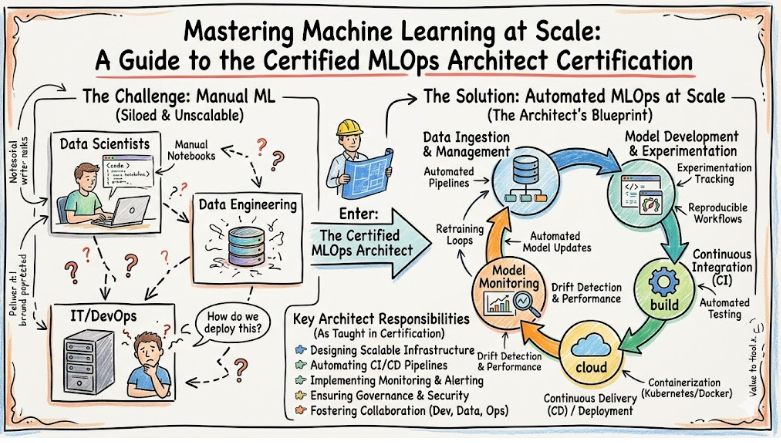
The transition from experimental machine learning to production-scale operations has created a significant gap in the technology industry. The Certified MLOps Architect program is designed to bridge this divide by equipping professionals with the architectural framework required to deploy, monitor, and scale models reliably. This guide is written for software engineers, platform architects, and technical managers who recognize that building a model is only the first step in a much larger lifecycle. As organizations move away from manual handoffs toward automated pipelines, understanding the intersection of DevOps and machine learning becomes a mandatory skill set for career progression. By following this roadmap, professionals can transition from traditional infrastructure roles into high-impact positions within the AIOps School ecosystem, ensuring they stay relevant in an increasingly automated landscape.
What is the Certified MLOps Architect?
The Certified MLOps Architect designation represents a professional standard for individuals who design and implement end-to-end machine learning lifecycles. It is not merely a theoretical exercise but a production-focused validation of an engineer’s ability to handle data versioning, model orchestration, and automated deployment. In the modern enterprise, this certification exists to prove that a professional can move beyond writing Python scripts to building resilient systems that handle drift, retraining, and governance. It aligns perfectly with the shift toward cloud-native architectures where machine learning models are treated as first-class citizens alongside traditional microservices.
Who Should Pursue Certified MLOps Architect?
This certification is ideally suited for DevOps engineers, Site Reliability Engineers (SREs), and Cloud Architects who are increasingly tasked with supporting data science teams. Data engineers who want to understand the deployment side of the pipeline, as well as security and compliance professionals focused on AI governance, will find immense value in this curriculum. Even technical managers and leads who oversee cross-functional teams benefit by gaining a common language to bridge the gap between data scientists and infrastructure specialists. Whether you are based in India’s growing tech hubs or working within a global distributed team, this path offers a clear trajectory for anyone aiming to master the operational side of artificial intelligence.
Why Certified MLOps Architect is Valuable Today and Beyond
The demand for MLOps expertise is skyrocketing as enterprises realize that most machine learning projects fail during the transition from a notebook to a production environment. Holding this certification ensures longevity in your career because it focuses on architectural principles that remain constant even as specific tools and frameworks evolve. It provides a significant return on investment by positioning you as a specialist who can reduce technical debt and improve the speed of model delivery. As businesses continue to adopt automated decision-making systems, the need for architects who can ensure the reliability and ethical compliance of these systems will only intensify.
Certified MLOps Architect Certification Overview
The program is delivered via the official training portal and is hosted on the AIOps School platform, providing a structured approach to professional development. The certification is divided into various levels that cater to different stages of a professional’s career, moving from foundational concepts to advanced architectural design. Unlike traditional academic courses, this program emphasizes practical assessments where candidates must demonstrate their proficiency in real-world scenarios. By maintaining a rigorous ownership and assessment structure, the certification ensures that every credential holder possesses the hands-on skills required by the modern technology industry.
Certified MLOps Architect Certification Tracks & Levels
The certification is structured into three primary tiers: Foundation, Professional, and Advanced. The Foundation level introduces the core vocabulary of MLOps, focusing on the integration of CI/CD with machine learning pipelines. The Professional level dives deeper into specific tracks such as SRE-driven MLOps or FinOps for machine learning, teaching engineers how to optimize for both performance and cost. Finally, the Advanced level is designed for those aiming for leadership or principal architect roles, focusing on enterprise-wide governance, multi-cloud strategies, and complex system design. This tiered approach allows professionals to progress at their own pace while aligning their learning with their current job responsibilities.
Complete Certified MLOps Architect Certification Table
| Track | Level | Who it’s for | Prerequisites | Skills Covered | Recommended Order |
| Core MLOps | Foundation | Beginners, Junior DevOps | Basic Linux, Python | CI/CD, Versioning, Pipelines | 1st |
| Architecture | Professional | SREs, Senior Engineers | Foundation Level | Orchestration, Monitoring, Drift | 2nd |
| Governance | Advanced | Managers, Architects | Professional Level | Compliance, Scaling, Security | 3rd |
| Optimization | Specialization | FinOps Practitioners | Basic Cloud Knowledge | Cost Modeling, Resource Scaling | Optional |
| Reliability | Specialization | Platform Engineers | SRE Knowledge | Observability, Incident Response | Optional |
Detailed Guide for Each Certified MLOps Architect Certification
Certified MLOps Architect – Foundation Level
What it is
This certification validates a candidate’s understanding of the basic lifecycle of machine learning models and the essential DevOps principles applied to data science. It confirms that the individual can navigate the core components of an MLOps pipeline.
Who should take it
It is designed for junior engineers, data analysts, or traditional DevOps professionals who are new to the world of machine learning operations and want to build a solid baseline.
Skills you’ll gain
- Understanding the ML Lifecycle (Data, Model, Code).
- Basic CI/CD integration for ML projects.
- Version control for datasets and models.
- Basics of containerization for ML environments.
Real-world projects you should be able to do
- Setting up a Git-based workflow for a simple ML model.
- Automating a basic retraining pipeline using standard CI tools.
- Deploying a model as a simple REST API within a container.
Preparation plan
- 7-14 Days: Focus on vocabulary, the difference between ML and traditional software, and basic pipeline concepts.
- 30 Days: Practice setting up automated triggers for model builds and exploring data versioning tools.
- 60 Days: Complete full-length practice exams and build three sample pipelines from scratch to production.
Common mistakes
- Focusing too much on the math of the models rather than the infrastructure.
- Ignoring the importance of data quality checks in the early stages of the pipeline.
Best next certification after this
- Same-track option: Certified MLOps Architect – Professional Level.
- Cross-track option: Certified DataOps Professional.
- Leadership option: Technical Team Lead Foundation.
Certified MLOps Architect – Professional Level
What it is
This level focuses on the operational excellence required to maintain models in production over the long term. It validates skills in monitoring, scalability, and handling the unique challenges of machine learning drift.
Who should take it
Intermediate to senior engineers who are actively managing production environments and need to implement sophisticated monitoring and automation strategies.
Skills you’ll gain
- Advanced orchestration using tools like Kubeflow or MLflow.
- Implementing automated model monitoring and alerting.
- Managing feature stores and data drift detection.
- Scalable model serving architectures.
Real-world projects you should be able to do
- Building a full-scale automated monitoring system for model performance.
- Implementing an A/B testing framework for model deployment.
- Designing a scalable feature store for cross-team data sharing.
Preparation plan
- 7-14 Days: Deep dive into orchestration frameworks and cloud-native ML services.
- 30 Days: Work on hands-on labs involving model drift and automated rollback strategies.
- 60 Days: Focus on high-availability designs and multi-environment deployment strategies.
Common mistakes
- Over-engineering the solution before understanding the business requirements.
- Failing to account for the latency requirements of real-time model serving.
Best next certification after this
- Same-track option: Certified MLOps Architect – Advanced Level.
- Cross-track option: Certified SRE Professional.
- Leadership option: Engineering Manager Certification.
Certified MLOps Architect – Advanced Level
What it is
The Advanced level is the pinnacle of the certification program, focusing on the strategic and governance aspects of MLOps at an enterprise scale. It validates the ability to design organization-wide standards and secure AI platforms.
Who should take it
Principal engineers, chief architects, and technical directors responsible for the overall technology strategy and compliance of machine learning initiatives.
Skills you’ll gain
- Designing multi-cloud and hybrid MLOps architectures.
- Implementing AI security, privacy, and ethics frameworks.
- Enterprise-wide governance and auditability of ML models.
- Cost optimization and ROI analysis for large-scale ML operations.
Real-world projects you should be able to do
- Creating a corporate governance policy for model transparency and bias detection.
- Designing a global-scale ML infrastructure spanning multiple cloud regions.
- Leading a migration from legacy ML systems to a modern, automated platform.
Preparation plan
- 7-14 Days: Review legal and compliance standards (GDPR, AI Act) and their technical implementations.
- 30 Days: Case study analysis of large-scale failures and successes in the MLOps industry.
- 60 Days: Design and document a comprehensive enterprise MLOps strategy for a hypothetical Fortune 500 company.
Common mistakes
- Neglecting the cultural shift required for successful MLOps adoption.
- Underestimating the complexity of data privacy in a distributed ML environment.
Best next certification after this
- Same-track option: Specialist Research Fellow in AI Operations.
- Cross-track option: Certified FinOps Cloud Architect.
- Leadership option: CTO Leadership Program.
Choose Your Learning Path
DevOps Path
This path focuses on integrating machine learning into existing DevOps workflows. It teaches you how to treat model code, data, and configuration as part of a unified CI/CD pipeline. Professionals here will learn to bridge the gap between software release cycles and machine learning experiments, ensuring that model updates are as seamless as application updates. It emphasizes automation, testing, and consistent delivery.
DevSecOps Path
The DevSecOps path layers security into every stage of the machine learning lifecycle. You will learn about protecting data pipelines, securing model endpoints from adversarial attacks, and ensuring that training data remains private. This path is critical for industries like finance and healthcare where data sensitivity is paramount. It ensures that the speed of MLOps does not come at the expense of corporate or user security.
SRE Path
Focusing on reliability and observability, the SRE path applies Site Reliability Engineering principles to machine learning models. You will study service level indicators (SLIs) and service level objectives (SLOs) specifically for ML performance. This path covers how to handle incidents when models fail, how to automate recovery, and how to maintain the health of large-scale inference clusters.
AIOps Path
The AIOps path is distinct from MLOps as it focuses on using artificial intelligence to improve traditional IT operations. You will learn how to build systems that automatically detect anomalies in infrastructure, predict outages, and automate root cause analysis. This is about applying machine learning to solve DevOps and infrastructure problems rather than deploying business models.
MLOps Path
The MLOps path is the core journey of deploying and managing machine learning models for business use cases. It covers the entire spectrum from data ingestion to model serving and retraining loops. This path is for those who want to be the primary architects of the machine learning factory, ensuring that models move from the data scientist’s desk to the customer’s hands efficiently.
DataOps Path
DataOps focuses on the health and flow of data that feeds the machine learning models. Without high-quality, timely data, MLOps cannot succeed. This path teaches you how to build robust data pipelines, manage data quality at scale, and ensure that the data engineering side of the house is perfectly synchronized with the model training phase.
FinOps Path
The FinOps path is dedicated to managing the high costs associated with machine learning. Cloud resources for GPUs and data processing can be expensive, and this path teaches you how to monitor, forecast, and optimize these costs. You will learn how to balance the need for high-performance computing with the budgetary constraints of the organization.
Role → Recommended Certified MLOps Architect Certifications
| Role | Recommended Certifications |
| DevOps Engineer | Certified MLOps Architect – Foundation & Professional |
| SRE | Certified MLOps Architect – Professional & SRE Specialist |
| Platform Engineer | Certified MLOps Architect – Professional & DataOps Foundation |
| Cloud Engineer | Certified MLOps Architect – Foundation & FinOps Specialist |
| Security Engineer | Certified MLOps Architect – Professional & DevSecOps Specialist |
| Data Engineer | Certified MLOps Architect – Foundation & DataOps Professional |
| FinOps Practitioner | Certified MLOps Architect – Foundation & FinOps Specialist |
| Engineering Manager | Certified MLOps Architect – Foundation & Advanced Level |
Next Certifications to Take After Certified MLOps Architect
Same Track Progression
After completing the architect levels, professionals should seek specialized deep dives into specific tooling or platform-specific certifications. This might include mastery of specific orchestration engines or advanced automated machine learning (AutoML) operations. Deepening your expertise in the same track ensures you remain the go-to authority for end-to-end model lifecycle management.
Cross-Track Expansion
To become a more versatile leader, consider expanding into DataOps or FinOps. Understanding the financial implications of your architecture or the complexities of data ingestion makes you a more effective architect. Cross-training allows you to see the bigger picture and communicate more effectively with different departments within the organization.
Leadership & Management Track
For those looking to move into management, the logical next step is a focus on technical leadership or engineering management certifications. These programs help you transition from hands-on implementation to strategic planning and team building. You will learn how to justify MLOps investments to executives and how to build high-performing cross-functional teams.
Training & Certification Support Providers for Certified MLOps Architect
DevOpsSchool
DevOpsSchool provides a comprehensive range of training modules that focus on the practical application of MLOps tools within a DevOps framework. They offer instructor-led sessions that are highly interactive and designed to help professionals master the complexities of modern software delivery. Their curriculum is tailored to meet the needs of both individuals and corporate teams looking to upskill quickly.
Cotocus
Cotocus is known for its hands-on approach to technical training, emphasizing real-world scenarios and industry best practices. They provide specialized coaching for various cloud and automation certifications, ensuring that students gain the confidence needed to pass exams and excel in their roles. Their trainers are experienced industry veterans who bring a wealth of practical knowledge to the classroom.
Scmgalaxy
Scmgalaxy is a premier community and training hub for software configuration management and DevOps professionals. They offer extensive resources, including tutorials, forums, and specialized courses that cover the entire software development lifecycle. Their focus on community-driven learning makes them an excellent choice for those who want to stay connected with industry trends.
BestDevOps
BestDevOps focuses on delivering high-quality training content that is both accessible and technically rigorous. They offer a variety of certification paths designed to help engineers advance their careers in cloud-native technologies and automated operations. Their structured learning paths are ideal for professionals who prefer a clear, step-by-step approach to mastering new skills.
devsecopsschool.com
This provider specializes in the intersection of security and operations, offering deep dives into how to secure the modern software supply chain. Their training programs are essential for any engineer looking to integrate security into their MLOps or DevOps pipelines. They focus on the tools and cultural changes necessary to build a successful DevSecOps practice.
sreschool.com
Sreschool.com is dedicated to the principles of Site Reliability Engineering, providing training on how to build and maintain highly available systems. Their courses cover observability, incident management, and automation, making them a perfect fit for professionals looking to apply SRE concepts to machine learning. They help engineers move from reactive troubleshooting to proactive system design.
aiopsschool.com
As the primary host for the Certified MLOps Architect program, aiopsschool.com offers the most direct and comprehensive path to achieving this certification. Their curriculum is specifically designed to address the unique challenges of artificial intelligence operations. They provide the necessary tools, labs, and assessments to ensure that every candidate is production-ready.
dataopsschool.com
Dataopsschool.com focuses on the data-centric side of modern operations, teaching engineers how to manage the lifecycle of data with the same rigor as code. Their training is crucial for MLOps professionals who need to ensure that their models are fed by high-quality, reliable data streams. They emphasize the automation of data pipelines and the improvement of data quality.
finopsschool.com
Finopsschool.com addresses the financial management of cloud and machine learning resources, helping organizations control their spending while maximizing performance. Their courses teach the frameworks and practices needed to bring financial accountability to the cloud-native world. This is an essential resource for architects who need to balance technical excellence with business profitability.
Frequently Asked Questions (General)
- How difficult is the certification exam for architects?
The exam is designed to be challenging and requires a deep understanding of both architectural theory and hands-on implementation. It is not a multiple-choice test that can be passed by memorization alone; it requires practical application of knowledge. - What is the typical time commitment for preparation?
For the Foundation level, most professionals spend about 30 days preparing, while the Professional and Advanced levels can require 60 to 90 days of focused study and lab work. - Are there any mandatory prerequisites?
While anyone can start with the Foundation level, the higher tiers typically require you to have passed the previous level or demonstrate equivalent industry experience in a professional setting. - What is the return on investment for this certification?
Professionals often see immediate benefits in terms of job opportunities and salary increases, as MLOps architects are currently among the most sought-after roles in the technology sector. - How long does the certification remain valid?
The certification is typically valid for two to three years, after which you may need to complete a renewal process or pass an updated exam to ensure your skills remain current with industry changes. - Can I skip the Foundation level if I have experience?
It is generally recommended to follow the levels sequentially to ensure no gaps in foundational knowledge, but experienced professionals can often move through the early stages very quickly. - Does this certification focus on specific tools like AWS or Azure?
While the principles are applicable across all clouds, the program focuses on cloud-agnostic architectural patterns and open-source tools that can be implemented in any environment. - Is the exam conducted online or at a testing center?
The certification assessments are typically conducted online through a secure, proctored platform, allowing you to take the exam from anywhere in the world. - What happens if I fail the exam on my first attempt?
Most programs allow for a retake after a specific waiting period, during which you are encouraged to review the feedback from your previous attempt and focus on areas of weakness. - Are there community groups for certified professionals?
Yes, holders of the certification often gain access to exclusive alumni groups and forums where they can network, share best practices, and find job opportunities. - How does this differ from a standard Data Science certification?
Standard certifications focus on model building and statistics, whereas this certification focuses on the infrastructure, automation, and reliability required to run those models in production. - Is this certification recognized globally?
Yes, the program is designed to meet international standards and is recognized by major technology firms and enterprises across the globe as a valid measure of MLOps expertise.
FAQs on Certified MLOps Architect
- What specific MLOps tools are covered in the curriculum?
The curriculum covers a wide range of industry-standard tools including MLflow, Kubeflow, DVC, and various CI/CD platforms. The focus is on how these tools fit into an overall architecture rather than just the syntax of a single tool. - Does the program cover the ethical aspects of AI?
Yes, the Advanced level specifically addresses AI ethics, bias detection, and transparency, ensuring that architects can build systems that are not only efficient but also responsible and compliant. - Is there a focus on real-time vs. batch processing?
The certification covers both real-time inference and batch processing strategies, teaching you how to choose the right architecture based on the specific latency and throughput needs of your business. - How much coding is required for the exam?
A solid understanding of Python and shell scripting is essential, as you will be required to write automation scripts and configure pipelines as part of the practical assessment. - Are feature stores covered in the Professional level?
Yes, feature stores are a critical component of the Professional level, where you will learn how to manage and serve features consistently across training and inference. - Does the certification address multi-cloud strategies?
The Advanced level specifically focuses on how to design MLOps pipelines that can span multiple cloud providers or operate in hybrid cloud environments to avoid vendor lock-in. - Is there training available for the FinOps side of MLOps?
Yes, there is a specialized specialization track that focuses on cost optimization for ML, teaching you how to manage the expenses of training and serving large models. - What is the focus of the SRE specialization within MLOps?
The SRE specialization focuses on the reliability of ML systems, covering topics such as automated rollbacks, monitoring for drift, and maintaining the uptime of inference endpoints.
Final Thoughts: Is Certified MLOps Architect Worth It?
From a mentor’s perspective, the transition to MLOps is not a trend but a fundamental shift in how software is built and maintained. Investing your time in becoming a Certified MLOps Architect is a pragmatic decision for any engineer who wants to stay at the forefront of the industry. It moves you away from being a generalist and positions you as a specialist in one of the most critical bottlenecks in the modern enterprise. While the journey requires a significant commitment to learning complex infrastructure and data patterns, the long-term career stability and the ability to work on cutting-edge projects make it one of the most valuable paths available today. Focus on the fundamentals, master the automation, and you will find yourself in high demand for years to come.
