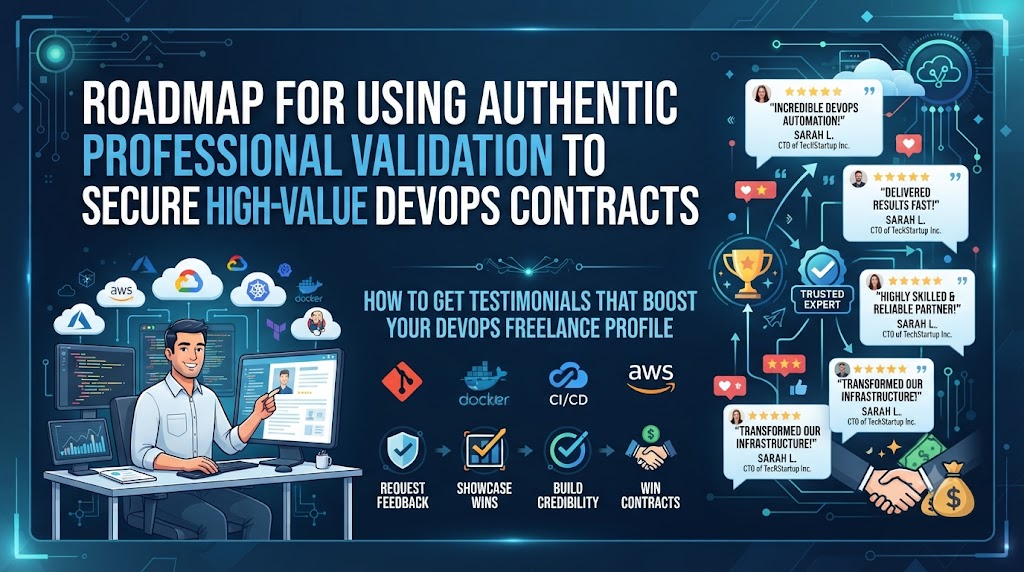
Introduction
Securing high-value contracts as an independent consultant requires more than an impressive list of technical proficiencies. Because critical infrastructure migrations and cloud optimizations carry high financial and operational risks, prospective clients prioritize risk mitigation. They seek verifiable assurance that a practitioner can operate seamlessly within complex production environments and solve real-world problems reliably.
While a resume dense with toolsets is valuable, technical claims alone rarely convince a decision-maker to extend an offer. Authentic client feedback serves as an indispensable validator, bridging the gap between theoretical knowledge and practical execution. It transforms abstract technical skills into concrete examples of operational success, establishing the foundational trust required to win premium freelance engagements.
For independent professionals seeking to establish an authoritative digital presence, leveraging structured educational resources can significantly accelerate career progression. Platforms such as DevOpsSchool provide the comprehensive training and technical foundations required to execute complex enterprise projects successfully. Documenting the business value you create thereafter ensures your profile stands out, turning technical expertise into a sustainable consulting career.
Why Testimonials Matter for DevOps Freelancers
Accelerating Trust in High-Stakes Environments
Infrastructure and platform engineering initiatives involve direct interaction with an organization’s core digital assets. Clients are naturally hesitant to hand over administrative access to their cloud environments, deployment pipelines, and Kubernetes clusters to an unverified contractor. Written validation from past clients acts as an immediate trust accelerator, reducing the perceived risk associated with onboarding an external consultant.
Differentiating Capabilities in a Crowded Market
The global freelance marketplace contains numerous profiles claiming expertise in modern containerization, infrastructure as code, and cloud architecture. Most of these professionals list identical keywords on their resumes. Genuine feedback shifts the focus from generic technical lists to demonstrated professional value. It highlights your unique problem-solving methodology, communication style, and engineering standards, making your profile stand out among competing bids.
Validating Communication and Collaborative Aptitude
Technical excellence is only one component of a successful engineering engagement. Freelancers must also demonstrate strong communication skills, an ability to mentor internal teams, and a collaborative mindset during high-pressure incidents. When a past client documents your ability to systematically root-cause systemic issues while keeping stakeholders informed, they validate the essential soft skills that cannot be effectively demonstrated through a list of technologies alone.
Justifying Premium Consulting Rates
Securing premium billing rates requires shifting the conversation from hours worked to business value delivered. When your professional profile features detailed accounts of how you reduced infrastructure expenditure, accelerated deployment cycles, or eliminated deployment failures, you justify your pricing structure. Prospective clients view you as a strategic partner capable of driving measurable operational improvements rather than a temporary resource.
What Makes a Strong Testimonial?
A vague, overly generalized endorsement such as “Great engineer, highly recommended” offers minimal value to a prospective client. A high-impact testimonial must provide specific context, highlight clear operational challenges, and quantify the resulting business improvements.
| Element | Why It Matters | Example Outcome |
| Contextual Specificity | Demonstrates the exact environment and scope of the engagement. | “During our migration from a legacy monolithic architecture to AWS…” |
| Quantifiable Business Impact | Proves the financial or operational value of the technical intervention. | “…reduced deployment cycle times by 45% and lowered cloud spend by 20%.” |
| Soft Skill Validation | Confirms communication clarity, leadership, and team integration. | “…coordinated seamlessly with our internal QA and development teams under tight deadlines.” |
| Problem-to-Solution Narrative | Showcases systematic problem-solving capabilities under pressure. | “…resolved a persistent database bottleneck that had caused intermittent production outages for months.” |
| Authenticity and Credibility | Establishes absolute trust through verifiable professional identities. | Verified LinkedIn profile link featuring a Director of Engineering title. |
To maximize the impact of your client feedback, ensure that each quote addresses a specific business challenge. A well-structured endorsement should guide the reader through the initial problem, your technical strategy, and the measurable operational outcomes of your work.
When to Request Testimonials
Timing your request is critical to capturing enthusiastic, detailed, and highly impactful feedback. Initiating the conversation at the wrong moment can result in generic responses or unreturned messages.
[Project Kickoff & Goal Alignment]
               │
               ▼
[Successful Major Milestone Achievement]  ──► (Soft Request / Pulse Check)
               │
               ▼
[Production Deployment & Optimization]
               │
               ▼
[Project Completion & Offboarding]       ──► (Formal Testimonial Request)
               │
               ▼
[30-Day Post-Launch Follow-Up]          ──► (Secondary Request / Impact Review)
1. Successful Production Deployments
The ideal window to request feedback is immediately following a major successful release or infrastructure migration. At this moment, the benefits of your work are fresh in the client’s mind. The system is stable, the deployment pipelines are functioning smoothly, and the operational strain on the internal team has decreased. Capturing their input during this period ensures the feedback remains detailed and enthusiastic.
2. Achievement of Major Project Milestones
For long-term consulting engagements spanning several months or years, do not wait until the final contract conclusion. Request feedback upon the successful completion of significant phases, such as migrating a primary database cluster, implementing comprehensive monitoring infrastructure, or automating a manual onboarding process. This strategy allows you to collect highly targeted social proof for distinct technical milestones.
3. During Formal Offboarding and Technical Handovers
Incorporate the feedback process directly into your standard project offboarding workflow. As you deliver final documentation, conduct knowledge transfer sessions, and transition systems back to the internal engineering team, naturally introduce a structured feedback request. Clients expect administrative wrap-up activities during this phase and are generally highly receptive to participating.
4. Post-Project Performance Evaluations
Schedule a follow-up interaction roughly 30 to 60 days after contract conclusion to evaluate long-term system stability. This timeframe allows the client to gather concrete data regarding reduced infrastructure costs, improved system uptime, or increased deployment velocity. Requesting a testimonial at this stage enables the client to include precise, long-term metric improvements in their written endorsement.
How to Ask Clients Professionally
Respecting Client Constraints and Priorities
When requesting feedback, maintain a professional, structured approach that respects the client’s time. Enterprise stakeholders, engineering managers, and technical executives manage demanding schedules. To secure their participation, make the process as simple and frictionless as possible by providing clear guidance and concise communication channels.
Reducing Friction with Guided Prompts
Avoid sending open-ended requests such as “Could you write a few words about our time working together?” This puts the burden of structuring the narrative entirely on the client, which often leads to delays or generic responses. Instead, offer a structured set of light prompts to guide their thoughts:
- What specific operational bottleneck led you to bring me onto the project?
- How did the technical solutions implemented impact your deployment speed, reliability, or infrastructure costs?
- What stood out to you regarding our technical communication and collaboration throughout the engagement?
Follow-Up Etiquette and Professional Boundaries
If a client does not respond to your initial request, maintain professional patience. Wait at least seven to ten business days before sending a single, polite follow-up note. Frame the follow-up around ensuring they have successfully transitioned into post-project operations, rather than focusing solely on your request. If they remain unresponsive after the second message, leave the matter open and revisit it during a future check-in.
Testimonial Request Framework
To build a consistent collection of professional validation, you need a repeatable framework. This systematic process ensures every testimonial you receive is detailed, structured, and compliant with client confidentiality requirements.
Phase 1: Successful Project Delivery
Ensure all deliverables meet or exceed the agreed-upon statement of work. Complete all documentation, clean up infrastructure code repositories, and verify that automated alerting frameworks are functioning correctly.
Phase 2: Client Satisfaction Confirmation
Conduct a brief technical wrap-up call to confirm that the client’s internal engineering stakeholders are satisfied with the performance, stability, and structure of the delivered architecture.
Phase 3: The Structured Request
Send a personalized communication requesting feedback. Detail the value of their perspective to your independent practice and provide targeted questions to guide their response.
Phase 4: Structuring and Guidance
Offer to draft a preliminary outline based on your project notes and shared milestones if the client prefers a quick review over writing from scratch. This allows busy executives to approve or refine a well-structured draft in seconds.
Phase 5: Verification and Client Sign-Off
Present the finalized text to the client to secure explicit approval. Ensure they are comfortable with the technical details shared and the format in which their name, title, and corporate logo will appear.
Phase 6: Strategic Publication
Deploy the verified testimonial across your professional marketing assets, ensuring alignment with search engine optimization best practices and target profile positioning.
LinkedIn Recommendations and Professional Profiles
The Power of Third-Party Verification
LinkedIn recommendations serve as highly trusted endorsements in the professional landscape. Because these recommendations are directly linked to a living, verifiable professional profile, they carry immense credibility. Prospective clients can easily click through to inspect the reviewer’s professional history, corporate tenure, and industry stature, confirming the authenticity of the feedback.
Enhancing Profile Search Visibility
The algorithmic architecture of professional networking platforms prioritizes complete, active profiles that display deep community engagement. Receiving regular, keyword-rich recommendations that mention terms like platform engineering, CI/CD automation, or cloud modernization signals profile authority to recruiters and hiring managers.
Leveraging B2B Networking Opportunities
A well-constructed LinkedIn recommendation often highlights your ability to interface effectively with executive leadership, manage project risk, and deliver measurable return on investment. This focus elevates your visibility among high-level enterprise decision-makers who utilize the platform to source niche independent talent for critical technical initiatives.
Portfolio Testimonials
Integrating social proof directly into your technical portfolio transforms a basic project summary into a persuasive case study. Strive to present these endorsements alongside technical architectural diagrams and code snippets to validate your engineering capabilities completely.
┌────────────────────────────────────────────────────────────────────────┐
│  PROJECT: Global Microservices Platform Modernization                  │
├────────────────────────────────────────────────────────────────────────┤
│                                                                        │
│  [Technical Architectural Diagram]       [Core Engineering Metrics]    │
│  ┌───────────────────────────────┐       │ • System Uptime: 99.99%     │
│  │   API Gateway -> EKS Cluster  │       │ • Deployment Time: -60%     │
│  └───────────────────────────────┘       │ • Cloud Cost ROI: 35%       │
│                                                                        │
├────────────────────────────────────────────────────────────────────────┤
│  CLIENT VALIDATION                                                     │
│  "The infrastructure overhaul completely transformed our release       │
│  velocity. We shifted from stressful bi-weekly deployments to seamless │
│  daily production updates without experiencing a single minute of     │
│  downtime during the migration."                                       │
│                                                                        │
│  — Senior Director of Infrastructure Engineering                       │
└────────────────────────────────────────────────────────────────────────┘
1. Case Study Integration
Position relevant client quotes right within your detailed project summaries. If a case study outlines an infrastructure migration project, place the client’s feedback concerning the smooth execution of that migration next to the technical breakdown. This layout instantly validates your technical narrative.
2. Contextual Placement Near Technical Architecture Diagrams
Place your client testimonials directly beneath your technical system diagrams. When a prospective client evaluates your architectural decisions, seeing immediate written confirmation from the project sponsor regarding system reliability and performance reinforces the validity of your engineering choices.
3. Website Landing Page Optimization
If you maintain an independent consulting website, place high-impact, quantitative quotes prominently on your primary landing page. Ensure these highlights focus on core business metrics—such as reduced cloud expenditure, accelerated delivery cadences, and system stability improvements—to capture prospective clients’ attention right away.
Showcasing Testimonials Effectively
To extract maximum value from your gathered endorsements, you must distribute them strategically across every primary client touchpoint.
| Platform | Benefit | Best Practice |
| LinkedIn Profile | Provides instant, public, and verifiable professional credibility to recruiters and hiring managers. | Place detailed, technical testimonials at the top of your profile experience section or within the dedicated recommendations area. |
| Personal Portfolio Website | Delivers structured, brand-aligned control over your case studies and technical documentation layouts. | Embed client quotes next to system architecture diagrams, infrastructure code summaries, and performance charts. |
| Consulting Proposals & SOWs | Addresses specific client objections during the active bidding and negotiation phase. | Include a dedicated social proof section featuring past project outcomes directly relevant to the prospect’s current technical challenges. |
| Freelance Platform Profiles | Maximizes platform search visibility, improves placement rankings, and increases conversion rates. | Feature highly quantitative, results-oriented testimonials at the very beginning of your profile description text. |
Measuring Testimonial Impact
Tracking the performance of your client validation strategies helps you understand exactly how social proof influences your pipeline velocity and business growth.
Profile Discovery and Inbound Lead Volume
Monitor the volume of inbound inquiries and profile views following the strategic integration of detailed testimonials. A well-optimized profile that features strong social proof typically experiences a measurable lift in organic reach and inbound messages from enterprise talent acquisition teams.
Proposal Conversion and Close Rates
Analyze the percentage of submitted consulting proposals that successfully convert into signed contracts. Documenting and comparing your conversion rate before and after embedding targeted case study testimonials into your Statement of Work (SOW) documents will highlight the direct financial value of social proof.
Contract Velocity and Reduced Sales Cycles
Measure the average duration between an initial discovery call and formal contract execution. When prospective clients review comprehensive, verified validation from their industry peers early in the process, they spend less time debating your capabilities. This trust speeds up the onboarding timeline and reduces bureaucratic friction.
| Metric | Why It Matters | Career Benefit |
| Inbound Inquiries | Demonstrates high profile attractiveness and relevance to target buyers. | Reduces time spent on cold outreach and platform bidding. |
| Proposal Conversion Rate | Measures the persuasive impact of your case studies and documentation. | Increases revenue efficiency per submitted contract bid. |
| Contract Onboarding Velocity | Measures how quickly prospects move past trust barriers to sign contracts. | Shortens sales pipelines, keeping engineering utilization high. |
Common Challenges
Managing Client Confidentiality and Non-Disclosure Agreements
A frequent hurdle in corporate infrastructure consulting is navigating strict Non-Disclosure Agreements (NDAs). When an organization prohibits the public use of its corporate name or proprietary architecture details, you must adapt your approach. Frame the endorsement anonymously by using descriptions like “Lead DevOps Consultant for a Fortune 500 Financial Institution.” Focus the text heavily on general architectural patterns and percentage-based efficiency gains rather than exposing internal technologies or corporate identifiers.
Handling Generic or Low-Impact Feedback
If a client provides a well-meaning but vague testimonial like “Excellent work on our pipelines,” proactively follow up to gather more detail. Thank them warmly for their support and ask if they would mind expanding slightly on the specific operational improvements achieved. You might say: “I appreciate your kind words! To help future clients understand my expertise, could we mention the 40% reduction in build times we achieved?” This gentle guidance helps transform a generic phrase into a highly effective marketing asset.
| Challenge | Impact | Recommended Solution |
| Strict Corporate NDAs | Prevents the use of client names, logos, and proprietary details. | Anonymize the profile using industry classifications and focus entirely on generalized percentage gains. |
| Vague, Generic Endorsements | Fails to convince technical decision-makers looking for deep expertise. | Gently follow up with specific metrics from the project and ask permission to add them. |
| Extended Response Delays | Slows down profile updates and stalls marketing momentum. | Provide pre-structured templates or bulleted summaries based on project notes for quick approval. |
Best Practices
- Deliver Verifiable Operational Excellence: The foundation of a powerful endorsement is always the exceptional quality of your engineering work. Prioritize building robust, maintainable, and thoroughly documented infrastructure that delivers clear, long-term value to the client’s engineering organization.
- Cultivate Long-Term Professional Relationships: View every client engagement as a long-term professional partnership rather than a one-off transaction. Invest time in understanding their broader business objectives, participating actively in engineering discussions, and providing support during critical production incidents.
- Request Feedback Continuously: Establish a reliable cadence for requesting feedback across all active contracts. Normalize checking in regularly during project milestones so that gathering feedback becomes a natural extension of your engineering workflow.
- Highlight Quantifiable Business Metrics: Guide your clients to focus their reviews on objective, measurable operational improvements. Strive to showcase clear metrics, such as decreased infrastructure spend, reduced lead time to production, or fewer deployment errors.
- Maintain High Authenticity Standards: Always ensure absolute accuracy and authenticity across all featured testimonials. Avoid altering the client’s core meaning or overstating your project contribution, as maintaining true professional integrity is essential for sustainable career growth.
- Keep Professional Profiles Updated: Regularly review and refresh the testimonials displayed across your public marketing assets. Replace older, less relevant feedback with modern case studies that highlight your mastery of current cloud-native architectures and engineering methodologies.
Real-World Example
The Challenge: Overcoming a Silent Profile
An independent infrastructure engineer transitioned into full-time freelance consulting after seven years of working in internal enterprise IT roles. Despite possessing deep expertise in infrastructure automation, container orchestration, and multi-cloud architecture, their initial freelance profile struggled to attract high-value inquiries. Inbound opportunities were scarce, and prospective clients frequently questioned their ability to deliver complex projects independently due to a lack of public case studies and visible client validation.
The Strategy: Implementing a Metric-Driven Feedback System
The consultant shifted their approach during a three-month contract with a mid-sized e-commerce platform facing major deployment bottlenecks and rising infrastructure costs. Instead of simply completing the tasks and moving on, the consultant established a clear, metric-focused feedback plan:
- Aligned project goals with clear business metrics during kickoff: reducing deployment times and optimizing cloud spend.
- Maintained a detailed log of all operational improvements, including automated infrastructure code implementations and environment cleanups.
- Quantified the final results: cut deployment times by 55% and reduced monthly cloud expenditure by $14,000.
- During formal offboarding, they presented the client with a concise, pre-structured summary of these achievements and requested a formal recommendation.
The Outcome: Increased Visibility and Premium Contracts
The client happily approved the detailed, metric-rich draft, publishing it directly to the consultant’s LinkedIn profile and allowing its use on their portfolio website.
┌────────────────────────────────────────────────────────┐
│ BEFORE: Zero Testimonials                              │
├────────────────────────────────────────────────────────┤
│ • Inbound Lead Volume: ~1 message per month            │
│ • Average Contract Value: Low-tier hourly tasks        │
│ • Sales Process: Lengthy, filled with trust hurdles    │
└────────────────────────────────────────────────────────┘

                           │
                           ▼

┌────────────────────────────────────────────────────────┐
│ AFTER: Strategic, Metric-Rich Social Proof             │
├────────────────────────────────────────────────────────┤
│ • Inbound Lead Volume: 4-6 qualified inquiries / week  │
│ • Average Contract Value: Premium enterprise retainers │
│ • Sales Process: Rapid conversion based on clear proof │
└────────────────────────────────────────────────────────┘
The impact of adding this verifiable social proof was immediate. Within six weeks of publishing the detailed testimonial, the consultant’s profile saw a significant lift in organic search appearances. More importantly, inbound inquiries transformed from low-tier tasks into premium enterprise consulting opportunities. Prospective clients could now review tangible evidence of their technical value, which streamlined introductory discovery calls and eliminated common price objections.
Common Mistakes
1. Requesting Feedback Too Early in the Engagement
Avoid asking for a formal testimonial before you have delivered tangible, verified project value. Requesting endorsements during the early stages of a contract can make clients uncomfortable and create unnecessary professional friction. Let your engineering solutions prove themselves in production first.
2. Relying on Vague, Non-Specific Feedback
Generic praise like “Great communicator, hard worker” does little to convince a selective engineering manager looking for deep technical expertise. These high-level summaries fail to prove your specific problem-solving abilities or cloud-native architecture skills. Always work to steer feedback toward clear, project-specific accomplishments.
3. Modifying Client Feedback Too Extensively
While correcting minor typographical errors is perfectly fine, avoid rewriting substantial portions of a client’s testimonial to force-feed specific keywords. Altering their natural voice reduces the authenticity of the message and risks damaging your relationship with the client if they notice the unauthorized changes.
4. Overlooking Ongoing Client Relationships
Do not view clients as mere sources of professional validation. Neglecting your professional network once a contract concludes misses out on long-term value. Maintain regular, light contact with past stakeholders by sharing interesting industry insights or offering occasional operational check-ins. This long-term relationship building often yields ongoing referral opportunities.
5. Sharing Endorsements Without Context
Presenting a testimonial completely detached from its project context minimizes its educational impact. A quote isolated from the accompanying architectural challenges, system constraints, and engineering methodologies loses its persuasive power. Always anchor your social proof within a clear, well-structured project narrative.
Future of Professional Reputation
The Growing Demand for Verifiable Credibility
As global remote work and independent technical consulting continue to expand, the landscape of professional validation is becoming increasingly sophisticated. Generic, easily fabricated text reviews are losing their influence among discerning enterprise clients. The market is shifting rapidly toward highly transparent, verifiable, and deeply integrated forms of professional validation.
AI-Assisted Talent Sourcing and Profiling
Modern enterprise talent acquisition teams increasingly leverage specialized semantic search engines and machine learning algorithms to source independent technical experts. These advanced tools do not just scan profiles for generic technology keywords; they evaluate the context, depth, and sentiment of your public recommendations. Profiles featuring detailed, high-impact testimonials that describe successful system modernizations rank much higher in automated talent discovery pipelines.
The Rise of Multi-Dimensional Skill Validation
Building a strong professional reputation in the modern market requires a comprehensive approach to personal branding. The future of consulting success depends on combining direct client validation with visible contributions to the broader engineering community. True career stability belongs to independent practitioners who pair authoritative client endorsements with active open-source contributions, technical mentorship, and continuous professional development.
Certifications & Professional Development
To consistently secure enterprise-grade testimonials, you must continually sharpen both your technical skills and architectural capabilities. Engaging with comprehensive educational ecosystems, such as the training programs offered by DevOpsSchool, ensures you stay adept at managing complex infrastructure projects. Combining deep, up-to-date technical expertise with a proven track record of client satisfaction creates a powerful professional profile that naturally attracts high-value consulting contracts.
| Certification Area | Best For | Skill Level | Credibility Benefit |
| Advanced Kubernetes Engineering | Platform Engineers, Cloud Architects | Advanced | Validates ability to orchestrate, scale, and secure complex containerized workloads in enterprise production environments. |
| Infrastructure as Code (IaC) | DevOps Freelancers, Site Reliability Engineers | Intermediate to Advanced | Proves mastery over repeatable, secure, and automated cloud infrastructure deployment workflows. |
| DevSecOps Integration Frameworks | Security Consultants, Systems Engineers | Advanced | Confirms deep understanding of automated security compliance, vulnerability scanning, and secure CI/CD practices. |
| Multi-Cloud Architecture Optimization | Enterprise Consultants, Cloud Architects | Expert | Demonstrates capability to design resilient, cost-effective, high-availability systems across multiple cloud providers. |
Testimonial Collection Checklist
- Deliver Quantifiable Business Value: Confirm that all technical project deliverables are stable, fully documented, and meeting key performance indicators in production.
- Identify Key Decision-Makers: Locate the specific stakeholders, engineering managers, or product owners who directly observed your technical contributions.
- Time the Request Strategically: Initiate your feedback request immediately following a major successful milestone or during formal project offboarding.
- Provide Clear, Helpful Prompts: Supply your client with a few structured questions to make the process easy and ensure the feedback focuses on specific metrics.
- Secure Official Approval: Verify that the client is fully comfortable with the final wording and the display of their professional title or corporate logo.
- Publish Across Key Channels: Strategically add the new testimonial to your portfolio website, LinkedIn profile, and active consulting proposals.
- Maintain the Relationship: Stay in touch with the client periodically to share relevant industry insights and keep the door open for future collaborations.
FAQs
1. When should I ask for a testimonial?
The ideal time to ask is immediately after a major project milestone or a successful production deployment. Capturing feedback when your value is fresh in the client’s mind ensures the response is detailed and meaningful. For longer projects, ask at the end of key phases rather than waiting months for the entire contract to close.
2. How many testimonials do I need?
Focus on quality over sheer numbers. Having three to five highly detailed, results-oriented testimonials that highlight specific metrics is far more effective than displaying dozens of generic quotes. Aim to collect a few strong endorsements for each core technical service you offer.
3. Are LinkedIn recommendations enough?
LinkedIn recommendations are excellent because they connect directly to a real, verifiable profile. However, you shouldn’t rely on them exclusively. To maximize their value, copy those verified quotes onto your portfolio website, case studies, and project proposals so prospective clients encounter them at every touchpoint.
4. What if clients do not respond?
Busy enterprise leaders often mean to help but get sidetracked by their daily schedules. Send one polite, friendly follow-up note about a week after your initial request. If they still don’t respond, let it go for now and check in down the road during a natural networking opportunity.
5. Should I edit testimonials?
You should never alter the core meaning or overstate your impact. It is perfectly fine to fix minor typos or clean up punctuation for clarity, but always run the polished version by the client to get their official sign-off before publishing.
6. How can I showcase feedback effectively?
Place your testimonials contextually right where they make the most sense. Instead of hiding them on a generic reviews page, embed them directly within relevant case studies, next to system diagrams, or right inside your project proposals where they address specific client concerns.
7. Can beginners benefit from testimonials?
Absolutely. If you don’t have paid freelance clients yet, you can gather valuable testimonials from open-source project maintainers, pro-bono work, hackathon teammates, or instructors from advanced training programs. Technical validation is valuable regardless of the setting.
8. What makes a testimonial credible?
Real credibility comes from specific details and clear context. A strong testimonial includes the reviewer’s name, title, company, a brief description of the project challenge, and the measurable results achieved through your engineering work.
9. How do I handle strict NDAs?
When an NDA prevents you from using a client’s name or logo, describe the engagement anonymously using its industry classification—for example, “Lead DevOps Consultant for a Major Healthcare Platform.” Focus the write-up on the technical challenges solved and the percentage-based improvements achieved.
10. Should I offer discounts for testimonials?
Avoid offering financial incentives or discounts in exchange for reviews, as this can undermine the authenticity of the feedback. Let the quality of your engineering work and the value you deliver drive genuine, unprompted endorsements.
11. How long should a testimonial be?
A great testimonial is usually between three and six sentences long. This provides enough space to outline the initial problem, the technical solution, and the measurable outcome without overwhelming the reader with a wall of text.
12. Can I use video testimonials?
Video testimonials are incredibly engaging and carry high trust. If a client has the time and willingness to record a quick 60-second clip discussing your project success, feature it prominently on your website alongside a brief text summary.
13. How often should I update my portfolio reviews?
Aim to refresh your featured testimonials every year. Keeping your profile updated with recent case studies shows prospective clients that you are actively working with modern cloud-native architectures and current engineering practices.
14. What if a client leaves negative feedback?
Treat constructive criticism as a valuable learning opportunity to refine your consulting workflow. Address any underlying issues professionally, update your technical processes, and focus on delivering an exceptional experience on your next engagement.
15. How do I ask for feedback on training projects?
When wrapping up a technical training or mentorship initiative, ask the stakeholders or participants how the program directly impacted their team’s daily operational efficiency, deployment confidence, or technical capabilities.
Final Thoughts
Building a sustainable, premium freelance consulting practice requires a balanced combination of technical mastery and deliberate personal branding. As an independent professional, your long-term success depends on your ability to cultivate deep client trust and maintain an unblemished reputation within the engineering community. Technical certifications and tool proficiencies get you to the table, but verified social proof and real-world results are what close premium contracts.
Focus your energy on delivering clear, measurable business value in every engagement. Treat every infrastructure migration, automation pipeline, and architecture review as an opportunity to build a powerful, long-term professional relationship. When you prioritize clear communication, professional integrity, and operational excellence, gathering impactful client testimonials becomes a natural, seamless part of your career growth.
