Introduction
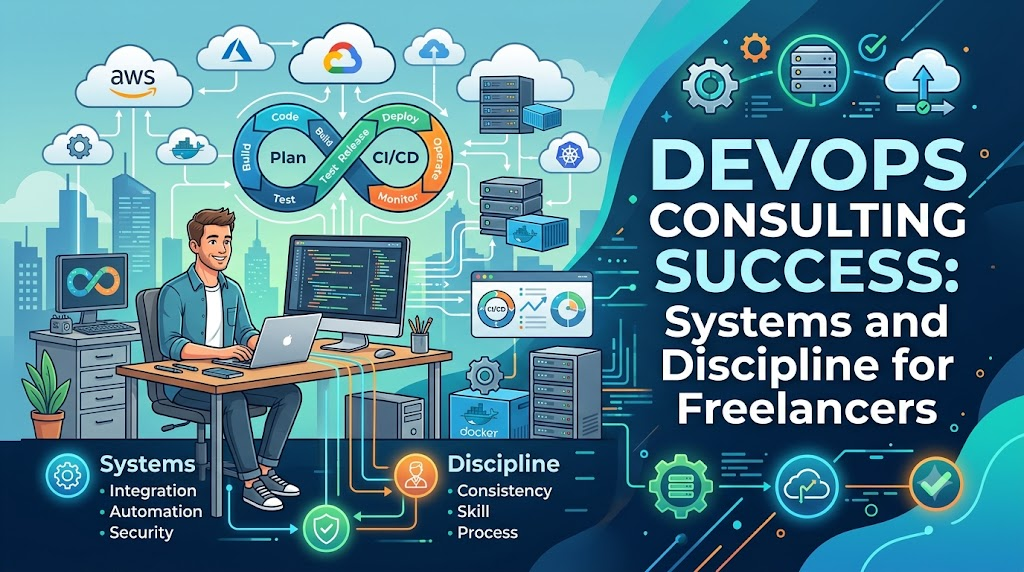
Transitioning to freelance DevOps offers professional autonomy, yet it frequently descends into a high-stakes juggling act where a single unmanaged deployment can trigger a cascade of infrastructure failures across disparate client environments. Many freelancers enter this space only to find themselves paralyzed by the complexity of maintaining disjointed CI/CD pipelines, navigating conflicting time zones, and reacting to multiple simultaneous production incidents—a state of constant firefighting that inevitably leads to burnout and compromised service quality. The reality is that successful freelancing requires more than just deep technical knowledge; it demands a structured, scalable approach to project management that transforms your workload from reactive chaos into a predictable, high-value delivery engine. By adopting the industry-proven frameworks and standardized engineering workflows taught at DevOpsSchool, you can replace that persistent “always-on” anxiety with a disciplined system that stabilizes your infrastructure, protects your productivity, and allows you to scale your business sustainably without sacrificing the quality of your output.
Why Managing Multiple DevOps Projects Is Challenging
Freelance DevOps is distinct from internal roles. As an employee, you focus on a single infrastructure ecosystem. As a freelancer, you become a multi-tenant service provider.
The primary challenges include:
- Diverse Infrastructure Environments: One client might use AWS with legacy Jenkins pipelines, while another runs on Google Cloud with modern GitHub Actions. Keeping your knowledge current across these variations while actively working on them is mentally taxing.
- Time Zone Fragmentation: You may find yourself managing a client in London, another in San Francisco, and a third in Tokyo. This creates a state of perpetual availability that is unsustainable without strict boundaries.
- Toolchain Variations: Constant context switching between different monitoring stacks (Datadog vs. Prometheus), logging solutions (Splunk vs. ELK), and cloud providers creates significant cognitive load.
- Priority Conflicts: When two clients experience a critical failure simultaneously, you cannot physically be in two places. Determining which “emergency” takes precedence is a high-pressure decision.
- Incident-Driven Interruption: DevOps is inherently reactive. Unlike a freelance web designer who can pause a project, a DevOps engineer is often on call for their clients’ infrastructure, meaning deep work sessions are frequently interrupted by alerts.
Key Skills Needed to Handle Multiple DevOps Freelance Projects
Technical brilliance is the baseline. To survive and scale, you need a specific set of operational skills.
| Skill Category | Description |
| Time Management | The ability to allocate blocks for deep work vs. client communication. |
| Communication Skills | Managing expectations via clear, written status reports rather than constant status pings. |
| Automation Skills | Using Infrastructure as Code (IaC) to create repeatable, standardized environments. |
| Prioritization Skills | Distinguishing between “urgent” and “important” in a multi-client context. |
| Technical Adaptability | The capacity to switch between cloud providers and toolchains without losing efficiency. |
How to Prioritize Multiple DevOps Projects Effectively
Prioritization is not about doing everything; it is about doing the right thing for the business survival of your clients.
1. The Eisenhower Matrix for DevOps
Apply the Eisenhower Matrix to your project backlog:
- Urgent and Important: Production outages, security breaches, deployment failures. These get immediate attention.
- Not Urgent but Important: Refactoring CI/CD pipelines, documentation, cost optimization. These require scheduled blocks of time.
- Urgent but Not Important: Most client meetings that could be emails, minor UI configuration requests. These should be delegated or time-boxed.
- Not Urgent and Not Important: Low-priority feature requests. Defer these to a later phase.
2. Incident-Based Prioritization
Establish a clear hierarchy. If Client A has a production down incident, that supersedes the sprint work for Client B. Always communicate this hierarchy to clients during the onboarding phase so they understand that service-level agreements (SLAs) are prioritized by technical criticality.
3. Client Dependency Mapping
Create a roadmap for each client. If Client A is in a stable state and Client B is in a high-growth migration phase, allocate your “peak energy” hours to the migration work. Do not let your schedule be dictated solely by who shouts the loudest.
Time Management Strategies for DevOps Freelancers
Time Blocking Technique
Divide your day into “Context Buckets.” Dedicate the first four hours of your day to deep technical work for a single client. Avoid checking emails or messages from other clients during this block.
Task Batching
Group similar tasks. If you have three clients that need Terraform updates, handle all of them in one session. This reduces the mental cost of switching from one cloud environment to another.
Fixed Daily Schedules
Communicate your availability clearly. Use a calendar tool to block off time for specific clients. For example, Client A gets 9:00 AM – 1:00 PM, and Client B gets 2:00 PM – 6:00 PM. Adhere to this as strictly as you would a full-time job.
Buffer Time Planning
Never schedule back-to-back tasks. Include a 30-minute buffer between client meetings or deep-work sessions to handle unforeseen incidents or to perform a “context reset.”
Using Automation to Handle Multiple Projects
Automation is the only way to scale. If you are doing a task manually for more than two clients, write a script.
- CI/CD Reuse Strategies: Develop a library of reusable pipeline templates. If you are using GitLab or GitHub Actions, standardize your deployment patterns. You should not be reinventing the wheel for every new client.
- Infrastructure Templates: Use Terraform modules or Ansible roles that you have battle-tested. When starting with a new client, deploy these standardized modules rather than building from scratch.
- Monitoring Automation: Create a “standard starter pack” for monitoring. If a client has no monitoring, deploy your preferred stack (e.g., Prometheus/Grafana) using an automated script immediately.
- Script Automation: Automate routine maintenance tasks like certificate renewals, log rotation, and database backups.
Real-World Example: Freelancer Struggling With Multiple Projects
The Scenario: A freelance engineer, Rahul, accepts four clients simultaneously. He manages them all by checking emails and Slack sporadically throughout the day.
The Failure:
- Context Switching: He spends 30 minutes just remembering what he was doing for Client A after being interrupted by Client C.
- Burnout: He is working 14-hour days to keep up with four distinct communication channels.
- Result: A misconfiguration on Client A’s production environment goes unnoticed because he was rushing to finish a task for Client D. The project is canceled, and his reputation suffers.
Real-World Example: Successful Multi-Project DevOps Freelancer
The Scenario: Sarah manages four clients but treats her business like an agency.
The Success:
- Structured Scheduling: She uses a dedicated slack-check time (10:00 AM and 3:00 PM) rather than constant notifications.
- Automated Pipelines: She maintains a private repository of “Golden Templates” for Terraform. When Client B needs a new cluster, she deploys a standard, secure, and monitored environment in hours, not days.
- Clear Communication: She provides a weekly “Infrastructure Health Report” to each client. This proactive communication reduces inbound queries, as clients feel informed without needing to reach out.
Tools That Help Manage Multiple DevOps Projects
| Tool Type | Recommended Usage |
| Version Control | Git (Use separate organizations/accounts for client separation). |
| Task Tracking | Jira or Trello. Keep a separate board for every client. Never mix tasks. |
| Communication | Slack or Teams. Keep client accounts distinct to avoid cross-contamination. |
| CI/CD | GitLab CI, GitHub Actions, or Jenkins (with job folders). |
| Documentation | Notion or Confluence. Crucial for offboarding/onboarding and knowledge transfer. |
Client Communication Best Practices
Communication is where most DevOps freelancers fail.
- Setting Expectations Early: Define exactly what is in scope. Does “DevOps support” include being on-call 24/7? If yes, charge accordingly. If no, be explicit.
- Weekly Status Updates: Send a summary: “What I did, what I am doing next, any blockers.” This reduces the need for constant status calls.
- Incident Transparency: If you mess up, own it immediately. Provide a root cause analysis (RCA) and a fix. This builds trust faster than hiding mistakes.
- Scope Clarity: If a request is out of scope, politely remind them of the SOW (Statement of Work) and offer a separate quote for the additional work.
Common Mistakes Freelancers Make
- Taking Too Many Projects: Overestimating capacity is the fastest way to lose clients.
- No Prioritization System: Letting the “loudest” client dictate your schedule.
- Over-automation Without Control: Automating systems so complex that the client cannot manage them once you leave.
- Poor Communication: Going silent when you are overwhelmed.
- Ignoring Documentation: Leaving clients with “tribal knowledge” instead of a documented infrastructure.
Best Practices for Sustainable Freelance DevOps Work
- Limit Active Projects: Do not take more clients than your mental bandwidth allows. 3-4 is usually the limit for high-touch roles.
- Standardize Workflows: Create a personal “DevOps playbook” that you apply to every project.
- Automate Repetitive Tasks: If a task takes more than 15 minutes, script it.
- Maintain Documentation: Update README files as you commit code.
- Focus on Quality Over Quantity: One well-managed, high-paying client is better than three low-paying, high-maintenance clients.
Role of DevOpsSchool in Freelance Skill Development
Professional growth in the freelance market requires staying ahead of the curve. DevOpsSchool serves as a vital resource for freelancers who need to sharpen their skills in real-world infrastructure practices.
By engaging with standardized learning paths, freelancers can move beyond ad-hoc knowledge and adopt professional-grade workflows. Understanding how large-scale enterprise systems are architected allows you to bring that same level of rigor to your freelance clients, positioning you as an expert rather than just an extra pair of hands. The training provided helps bridge the gap between knowing tools and knowing how to design sustainable, automated, and secure systems that clients value highly.
Industries Hiring DevOps Freelancers
- SaaS Companies: They need constant infrastructure scaling and CI/CD maintenance.
- Startups: They often cannot afford a full-time senior DevOps engineer but need high-level strategy.
- E-Commerce Platforms: Seasonal traffic spikes require expert load balancing and performance tuning.
- FinTech Firms: Security, compliance, and auditing are key here.
- Cloud Service Providers: They require specialized engineers for niche cloud migrations.
Future of DevOps Freelancing
The future lies in Platform Engineering. Freelancers who can build internal developer platforms (IDP) rather than just maintaining pipelines will be in the highest demand. With the rise of AI-assisted DevOps, the manual, repetitive tasks will vanish, leaving room for freelancers to focus on high-level architecture and governance. Distributed freelance teams will also become more common, allowing for 24/7 coverage across global time zones.
FAQs
1. How do DevOps freelancers manage multiple projects?
They use strict time blocking, prioritize tasks based on business impact, and automate as much infrastructure code as possible to minimize manual intervention.
2. How many projects should I take at once?
For most, 2 to 3 projects is the sweet spot to maintain quality and avoid burnout. Anything more requires a team or highly automated environments.
3. What tools help freelancers manage work?
Jira or Trello for task management, Notion for documentation, and robust CI/CD tools like GitHub Actions or GitLab to handle deployment repeatability.
4. How do you prioritize DevOps tasks?
Use an Eisenhower-style matrix: treat production outages as top priority, followed by planned infrastructure improvements, then low-priority feature requests.
5. How do freelancers avoid burnout?
Set clear boundaries on availability, stop taking calls during deep-work hours, and do not overcommit to more clients than you can handle during peak demand.
6. Is DevOps freelancing profitable?
Yes, but profitability depends on efficiency. If you are selling hours at a low rate, it is difficult. If you sell outcomes and automated solutions, it is highly lucrative.
7. How do you handle emergencies in multiple projects?
Maintain a clear escalation policy in your contracts and communicate which client has priority during a concurrent incident.
8. What skills are needed for DevOps freelancing?
Beyond technical skills like Terraform, Kubernetes, and AWS, you need strong project management, communication, and expectation-setting abilities.
9. How do you handle client requests outside of hours?
Unless you have a 24/7 SLA, clearly communicate your business hours and use automated responders for non-emergency inquiries.
10. Should I standardize my toolchain?
Yes. While some customization is necessary for each client, having a core set of tools you are an expert in improves speed and reduces errors.
11. How do you deal with scope creep?
Keep a strict SOW. When a new request arrives, clarify that it is out of scope and provide an estimate for the additional work.
12. Is documentation necessary for freelancers?
It is essential. Proper documentation is your safety net when you move on to new projects and prevents clients from constantly calling you for trivial issues.
13. How do you maintain security across multiple clients?
Use separate VPNs, dedicated SSH keys, and password managers for each client. Never share credentials between projects.
14. What if I fall behind on a project?
Communicate immediately. Proactive honesty builds trust; hiding delays destroys it. Re-negotiate the timeline before the deadline passes.
15. How do I start freelancing in DevOps?
Start with one reliable client, perfect your workflow, document your successes, and then gradually expand your client base while refining your automation library.
Final Thoughts
Freelancing in the DevOps space is not just about technical capability; it is about operational discipline. Success is built on the foundation of structured time management, relentless automation, and transparent communication. If you approach every project with the goal of making the infrastructure self-sustaining, you will move from being a resource-constrained freelancer to a highly sought-after consultant. Prioritize your workflows, automate the repetition, and maintain clear boundaries. Sustainable freelancing is a marathon, not a sprint.
