Introduction
The global shift toward cloud-native architectures and automated infrastructure has triggered an unprecedented surge in demand for independent technical expertise, offering an exceptional path toward financial independence for contractors who can successfully navigate the transition from simple task execution to high-level system strategy. While entering the market as a junior freelancer involves specific challenges—such as fluctuating client pipelines, scope creep, and the difficult task of securing trust for critical infrastructure—true career advancement requires moving away from simply trading hours for basic script configuration and moving toward delivering measurable business value. Navigating this transition requires access to structured education, mentorship, and production-grade validation, which is why aspiring specialists looking to accelerate their mastery of complex ecosystems can leverage structured learning pathways, such as those provided by DevOpsSchool, to bridge the gap between conceptual knowledge and enterprise application.
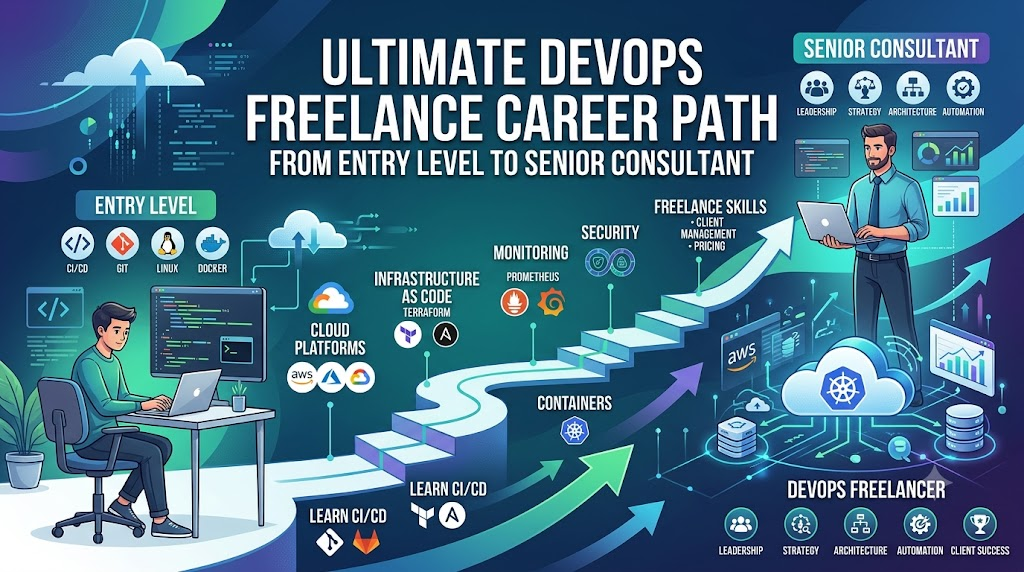
Understanding the DevOps Freelance Career Path
The journey of an independent specialist is defined by a progressive shift in responsibility, ownership, and strategic impact. Unlike traditional corporate ladders where promotion is tied to organizational tenure, freelance advancement is strictly meritocratic and driven by market validation.
Junior Level
At the entry level, independent contractors typically function as hands-on executors. Clients hire junior professionals to complete clearly defined, low-risk tasks. These often include writing simple Dockerfiles, modifying existing Jenkins files, or updating basic Terraform variables. The primary focus at this stage is operational execution and learning to work under the direct supervision of an internal team lead or architect.
Mid-Level
Mid-level professionals operate with minimal supervision and manage entire operational subsystems. At this stage, you are expected to design and implement standard CI/CD pipelines, manage multi-environment Kubernetes clusters, and orchestrate cloud migrations. Mid-level contractors write modular Infrastructure as Code (IaC) and take full ownership of technical deliverables from initial setup to deployment.
Senior Level
Senior independent specialists shift their focus from raw execution to comprehensive systems architecture and risk management. As a senior freelancer, you do not just write code; you design resilient, highly available, and cost-optimized cloud architectures. You are hired to solve complex, systemic organizational bottlenecks, such as reducing cloud spend by 40% or migrating legacy monoliths to microservices with zero downtime.
Consultant Level
The peak of the independent path is the strategic consultant. At this tier, professionals act as trusted advisors to C-level executives and engineering directors. Freelance consultants evaluate organizational structures, design platform engineering roadmaps, establish security governance frameworks, and define long-term technology strategies. The work shifts entirely from operational implementation to high-value strategic transformation.
Junior vs Senior DevOps Freelancer
| Area | Junior Freelancer | Senior Freelancer |
| Technical Skills | Focuses on single tools, basic scripting, and following pre-defined templates. | Masters multi-cloud architecture, advanced automation, and system design patterns. |
| Project Ownership | Requires detailed tickets, explicit instructions, and constant internal guidance. | Takes complete ownership from initial discovery to production delivery and post-launch support. |
| Client Communication | Focuses on highly technical updates, often struggling to articulate business value to non-technical stakeholders. | Translates complex technical challenges into clear financial outcomes, risks, and strategic advantages. |
| Architecture Knowledge | Understands component-level configuration but lacks insight into system interdependencies. | Designs highly resilient, fault-tolerant, secure, and horizontally scalable distributed systems. |
| Pricing Power | Commands lower hourly rates, competes on price on bidding platforms, and faces high competition. | Commands premium project rates, retains long-term clients, and wins work through authority and referrals. |
| Business Impact | Completes isolated tasks; optimization has minimal impact on the client’s broader business goals. | Accelerates time-to-market, lowers infrastructure overhead, and establishes reliable deployment practices. |
Technical Skills Required for Growth
True career progression requires moving past surface-level tool configuration and mastering the underlying principles of computer systems, networking, and distributed architecture.
Linux and Systems Internals
A senior specialist must possess an advanced understanding of the Linux operating system. You need to look beyond basic file operations and master kernel namespaces, cgroups, process states, system signals, and performance troubleshooting using utilities like strace, lsof, and htop. Understanding how the OS manages memory, CPU scheduling, and I/O operations is critical when debugging production bottlenecks within containerized environments.
Multi-Cloud Architecture
Relying on a single cloud vendor limits your market availability. True seniority requires deep fluency across major public cloud providers, specifically Amazon Web Services (AWS), Google Cloud Platform (GCP), and Microsoft Azure. You must understand how to architect cross-region, highly available systems, manage IAM governance at scale, optimize complex VPC network topologies, and implement effective cost-containment frameworks.
Continuous Integration & Continuous Delivery (CI/CD)
Advanced CI/CD involves more than just triggering scripts on a code commit. Senior professionals design secure, automated release pipelines that integrate automated testing, static application security testing (SAST), dynamic application security testing (DAST), and automated rollback mechanisms. You must master advanced deployment patterns like Blue-Green, Canary, and progressive delivery using tools like ArgoCD or FluxCD within a GitOps operational framework.
[Developer Commit] ➔ [Automated Build & Lint] ➔ [SAST/DAST Scanning] ➔ [Canary Deployment] ➔ [Automated Rollback on Error]
Enterprise Kubernetes Orchestration
Running production workloads in Kubernetes requires extensive operational experience. You must master cluster architecture, custom resource definitions (CRDs), ingress controllers, service meshes (such as Istio or Linkerd), network policies, and persistent storage management. Senior freelancers are frequently brought in to resolve complex container networking issues, optimize cluster autoscaling, and secure multi-tenant cluster environments.
Advanced Infrastructure as Code (IaC)
Writing basic Terraform files is a junior task. Senior specialists build highly reusable, version-controlled, and deeply secure IaC modules using tools like Terraform, OpenTofu, or Pulumi. You must understand how to manage complex state files across distributed teams, implement drift detection, enforce policy-as-code using Open Policy Agent (OPA) or Rego, and integrate compliance checks directly into infrastructure repositories.
Telemetry, Observability, and Performance Metrics
As architectures grow more complex, deep visibility becomes essential. Senior contractors design comprehensive monitoring, logging, and distributed tracing architectures using Prometheus, Grafana, ELK/PLG stacks, and OpenTelemetry. You must know how to establish meaningful Service Level Indicators (SLIs) and Service Level Objectives (SLOs) that map directly to business performance, ensuring engineering teams receive actionable alerts instead of alert fatigue.
DevSecOps and Compliance Governance
Security cannot be an afterthought left for a separate team. Senior specialists embed security into every phase of the development lifecycle. This includes implementing secret management systems (like HashiCorp Vault), configuring automated container vulnerability scanning, setting up runtime threat detection (such as Falco), and ensuring infrastructure meets rigorous compliance standards like SOC2, ISO 27001, HIPAA, or PCI-DSS.
Building Consulting and Business Skills
Technical excellence alone will not sustain a premium independent consulting practice. To command top-tier rates, you must master the commercial side of engineering engagement.
Requirement Gathering and Scope Discovery
Clients rarely understand their exact technical needs. They often approach freelancers with symptoms rather than root causes. A senior consultant conducts deep discovery sessions, interviews stakeholders, analyzes legacy architectures, and uncovers structural bottlenecks. This process ensures you diagnose the foundational issues before proposing or building a technical solution.
Stakeholder Communication and Translation
You will frequently interact with non-technical leaders, including Chief Financial Officers, Product Directors, and Founders. Senior specialists avoid technical jargon during these conversations. Instead of explaining that you are implementing a “three-node Redis cluster with Sentinel,” frame the project around business outcomes: “We are establishing a highly available data caching layer that prevents user checkout failures during peak traffic events.”
Technical Documentation and Architectural Blueprints
A senior professional leaves behind comprehensive, highly polished documentation. This includes architectural diagrams (using C4 models), runbooks, deployment guides, and post-mortem reports. Clear documentation ensures the internal engineering team can easily maintain the systems you build, solidifying your reputation as a professional who delivers clean, production-ready assets.
Precise Project Estimation and Risk Mitigation
Accurately predicting the time and resources required for complex cloud transformations is a key differentiator for senior professionals. You must learn to break large projects down into clear milestones, account for unforeseen technical debt, build in appropriate buffers, and clearly document external dependencies. This structured approach helps prevent scope creep and keeps your projects profitable.
Career Growth Framework
Transitioning to high-level independent consulting requires following a deliberate, structured developmental path.
Stage 1: Learning Fundamentals
       ↓
Stage 2: Hands-On Projects
       ↓
Stage 3: Specialization
       ↓
Stage 4: Portfolio Development
       ↓
Stage 5: Client Acquisition
       ↓
Stage 6: Consulting Skills
       ↓
Stage 7: Thought Leadership
       ↓
Stage 8: Senior Freelancer Positioning
- Stage 1: Learning Fundamentals: Master Linux administration, core networking concepts, basic scripting, and the core services of at least one public cloud vendor.
- Stage 2: Hands-On Projects: Build end-to-end automated deployment pipelines, containerize multi-tier applications, and manage small-scale production systems.
- Stage 3: Specialization: Move beyond general administration to select a high-value niche, such as Kubernetes architecture, cloud cost optimization, or DevSecOps governance.
- Stage 4: Portfolio Development: Document your technical execution through deep-dive case studies, public production-grade GitHub repositories, and clear structural architecture diagrams.
- Stage 5: Client Acquisition: Optimize your professional profiles, leverage selective freelance platforms, and tap into your existing industry networks to secure initial mid-tier contracts.
- Stage 6: Consulting Skills: Refine your discovery frameworks, master value-based scoping, and improve your ability to communicate complex technical strategies to non-technical business leaders.
- Stage 7: Thought Leadership: Publish technical deep-dives, contribute to open-source software, speak at industry events, and share practical architectural insights on platforms like LinkedIn.
- Stage 8: Senior Freelancer Positioning: Transition completely away from low-leverage bidding platforms, operating strictly through direct referrals, inbound inquiries, and premium value-driven consulting retainers.
Choosing a DevOps Specialization
Generalists face high competition and pricing pressure. Specializing allows you to stand out from the crowd and position yourself as the definitive expert for specific organizational challenges.
| Specialization | Market Demand | Career Benefit |
| Cloud DevOps Architecture | Very High | Allows you to lead enterprise cloud migrations and design resilient multi-region environments. |
| Kubernetes & Container Orchestration | High | Positions you as the go-to expert for scaling microservices and optimizing complex cloud-native compute platforms. |
| DevSecOps & Compliance | Very High | Commands premium rates from highly regulated industries (Finance, Healthcare) by integrating strict security frameworks directly into automated deployment pipelines. |
| Platform Engineering | Emerging / High | Enables you to design and build Internal Developer Platforms (IDPs) that improve developer velocity and standardize enterprise infrastructure access. |
| Site Reliability Engineering (SRE) | High | Focuses on maximizing system availability, designing advanced telemetry ecosystems, and managing large-scale incident response systems. |
| CI/CD Automation | Consistent | Helps organizations accelerate software delivery lifecycles, eliminate manual deployment risks, and optimize code-to-production workflows. |
Building a Strong Portfolio
As an independent consultant, your portfolio is your most effective sales tool. It serves as tangible proof of your ability to execute complex projects under production conditions.
Production-Grade GitHub Repositories
Avoid filling your public repositories with simple tutorial forks or basic hello-world configurations. Instead, showcase production-ready, highly modular Infrastructure as Code templates. Your code should feature strict linting, built-in security scans, comprehensive inline documentation, clear architecture diagrams, and fully automated test suites. This demonstrates to potential clients that your work meets enterprise-grade standards.
Real-World Business Case Studies
Frame your previous work around clear business problem-solving rather than just listing the tools you used. Structure your case studies using a clear, results-oriented framework:
- Context: What specific business and technical challenge was the client facing? (e.g., A high-growth e-commerce platform was experiencing frequent checkout crashes during flash sales).
- Action: What specific architecture did you design and implement? (e.g., Migrated the monolithic backend to AWS EKS, implemented HPA based on custom Prometheus metrics, and optimized database connection pooling).
- Result: What quantifiable impact did your solution deliver? (e.g., Eliminated checkout downtime completely, reduced page load latency by 35%, and cut monthly infrastructure spend by 22%).
Technical Content Production
Writing deep-dive technical articles establishes your domain expertise. Publish detailed breakdowns covering how you solved complex technical challenges, optimized messy configuration structures, or resolved difficult system out-of-memory errors. Sharing these insights online builds strong professional authority, which naturally attracts inbound client inquiries.
Client Acquisition Strategies
Relying solely on low-cost bidding platforms often leads to downward price competition. High-value consulting requires building a multi-channel inbound pipeline.
Optimizing Technical Freelance Platforms
While general marketplaces can be highly competitive, specialized technical networks like Toptal, Gun.io, or Turing connect verified experts with enterprise clients willing to pay premium rates. Ensure your profiles focus heavily on specialized engineering achievements, enterprise architectures, and clear business outcomes rather than just listing standard keywords.
Strategic Organic Networking
Engage actively with community meetups, cloud technology conferences, and open-source working groups. Do not attend these events simply looking for immediate job offers. Instead, focus on building meaningful professional relationships with engineering managers, directors, and startup founders by actively helping them brainstorm solutions to their current infrastructure challenges.
Professional LinkedIn Optimization
Transform your LinkedIn profile from a standard, passive resume into an active landing page for your consulting services. Regularly share practical technical insights, breakdowns of recent projects, and breakdowns of common industry mistakes. Clearly state the exact types of organizations you help and the specific technical transformations you deliver.
[Publish Insightful Content] ➔ [Attract Engineering Leaders] ➔ [Nurture via Comments/DM] ➔ [Inbound Discovery Call]
Building a Strong Referral Ecosystem
The most valuable consulting contracts typically come through direct client referrals. When you consistently deliver exceptional results, communicate clearly, and treat client teams with respect, your clients become active advocates for your business. Solidify this word-of-mouth growth by maintaining professional relationships with former colleagues and project stakeholders long after your initial contract ends.
Pricing Evolution From Junior to Senior
As your technical expertise and business acumen develop, your pricing model should adapt to reflect the increased value you bring to clients.
Junior: Hourly Billing (Low Leverage) ➔ Mid: Project Milestones ➔ Senior: Value-Based/Retainers (High Leverage)
Hourly Billing
Most junior freelancers begin by trading hours directly for money. While this model is straightforward, it inherently penalizes efficiency; the faster and more proficient you become at configuring a system, the less you get paid for that task. Hourly billing is best reserved for initial discovery phases or highly unpredictable maintenance work.
Fixed-Project Milestone Pricing
As you gain experience, transition toward pricing based on predefined project milestones. For example, instead of billing an hourly rate to build a deployment pipeline, charge a flat fee for the entire delivery lifecycle. This model shifts the client’s focus away from tracking your hours and onto the concrete value of the final deliverable, rewarding your speed and technical efficiency.
Monthly Consulting Retainers
Senior consultants frequently structure engagements around long-term advisory retainers. A client pays a set monthly fee to secure a dedicated portion of your strategic availability. Under this model, you might review architectural designs, mentor internal engineering teams, or participate in high-level roadmap planning, providing highly predictable income without requiring constant hands-on implementation.
Value-Based Project Pricing
Value-based pricing aligns your compensation directly with the financial impact of the solution you deliver. If your infrastructure optimization saves an enterprise client $500,000 in annual cloud spend, pricing your consulting engagement at $50,000 is an incredibly easy investment for them to approve, regardless of the physical hours it takes you to implement the solution.
Measuring Freelance Growth
Track your professional progression using clear business and operational metrics rather than just relying on gut feeling.
| KPI Metric | Strategic Importance | Professional Value Assessment |
| Client Retention Rate | Measures the percentage of contract partners who extend engagements or sign ongoing retainers. | High retention indicates you are delivering consistent, long-term value that aligns with the client’s business goals. |
| Average Contract Value | Tracks the growth of your average project size and financial scope over time. | Higher contract values prove the market recognizes your seniority and trusts you with high-risk projects. |
| Inbound Lead Generation | Measures the frequency of qualified project inquiries arriving through your content, website, or referrals. | A steady stream of inbound leads reduces your dependence on active outbound prospecting and gives you strong pricing leverage. |
| Referral Conversion Frequency | Tracks the volume of new business driven directly by recommendations from past clients. | High referral rates are the clearest sign of strong professional credibility and delivery quality. |
| Technical Stack Evolution | Monitors how quickly you phase out basic maintenance tasks in favor of cutting-edge architecture work. | Ensures you remain competitive by continually moving up the value chain into high-demand specializations. |
Common Challenges in Freelance Growth
The path to senior-level freelancing is rarely linear. Overcoming common professional roadblocks requires proactive career management.
| Foundational Challenge | Operational Impact on Business | Recommended Strategic Solution |
| Imposter Syndrome | Leads to underpricing services, accepting low-leverage execution tasks, and avoiding complex enterprise projects. | Ground your confidence in verifiable data: document your technical wins, track your system optimization metrics, and let past project successes prove your capability. |
| Rapid Technology Sprawl | Causes professional burnout and surface-level knowledge from trying to learn every new tool that enters the market. | Focus heavily on architectural fundamentals (networking, system design, security patterns) rather than chasing every new tool variation. |
| Income Volatility | Creates high financial stress, leading to a frantic cycle of rushing through delivery while constantly worrying about finding the next gig. | Build a robust financial cushion (3–6 months of operating expenses) and deliberately transition toward long-term retainer models to stabilize your cash flow. |
| Scope Creep & Boundary Blur | Erodes project profitability as clients continually add unpriced technical requirements to an existing contract. | Establish strict Statements of Work (SOW) before kicking off any project, and handle new feature requests using formal change-order pricing. |
| Global Price Competition | Forces you to compete on price against global talent on public bidding boards, driving down your earning potential. | Shift away from commoditized implementation services; position yourself as a specialized, high-value consultant who solves core business challenges. |
Best Practices for Becoming a Senior DevOps Freelancer
- Master the Architectural Fundamentals: Move beyond simply memorizing specific CLI commands. Focus on deeply understanding foundational principles like distributed systems design, network security, operating system internals, and data consistency models.
- Establish a Highly Focused Niche: Avoid marketing yourself as a generic developer who does a little bit of everything. Position yourself as the definitive expert for a specific, high-stakes operational challenge, such as securing Kubernetes clusters or building high-throughput GitOps workflows.
- Elevate Your Communication Skills: Dedicate time to improving your business writing, discovery frameworks, and presentation style. The ability to present technical strategies clearly to C-suite executives is just as critical to your growth as writing clean automation code.
- Produce High-Value Thought Leadership: Consistently share your architectural insights, production case studies, and lessons learned from system failures. Publishing this content publicly builds long-term industry authority and naturally attracts high-value inbound clients.
- Maintain Absolute Operational Reliability: Never compromise on the quality of your deliverables. Ensure every piece of infrastructure you design is thoroughly tested, secure, well-documented, and built to scale smoothly under production pressure.
Real-World Example: A Case Study in Career Evolution
The Starting Point
An independent contractor began their freelance journey offering basic Linux administration and simple Jenkins configuration on entry-level bidding platforms. While their technical execution was solid, they struggled with erratic income, unpolished client management, and low hourly rates ($35/hour), leaving them stuck in a highly stressful cycle of chasing small tasks.
Structured Professional Development
To break out of this cycle, the contractor committed to a rigorous professional development roadmap. They shifted focus toward enterprise-grade cloud architecture, cloud cost optimization, and Kubernetes orchestration. During this transition, they leveraged advanced educational ecosystems, such as the comprehensive training frameworks at DevOpsSchool, to quickly master production-level multi-tenant cluster management, advanced infrastructure as code security, and complex multi-cloud deployments.
Portfolio Transformation
The contractor completely revamped their public profile. They archived their basic tutorial repositories and published three highly detailed, real-world case studies. One notable case study documented how they helped a scaling software company migrate a fragmented legacy application to AWS EKS, reducing deployment failure rates by 70% and cut infrastructure spending by 30%.
Initial State: Manual Setup ($35/hr) ➔ Skill Upgrade + EKS Case Study ➔ Premium Advisory Retainer ($150+/hr)
Strategic Re-Positioning and Results
The engineer completely stopped using low-cost bidding boards. They optimized their LinkedIn presence to highlight their cost-optimization and container expertise, leading to a steady stream of inbound inquiries. Within eighteen months, they successfully transitioned from a junior task-executor to a senior freelance consultant, regularly securing premium project milestones and commanding over $150/hour for strategic architecture advisory work.
Common Misconceptions
- Certifications Alone Establish True Domain Expertise: While certifications are valuable for structured learning and validating foundational concepts, they cannot replace real-world experience. True consulting authority is built by successfully navigating messy, unpredictable production failures and complex enterprise migrations.
- Knowing More Tools Automatically Makes You More Senior: Mastery is not about the sheer number of tools on your resume; it is about knowing how to design resilient architectures. A senior professional focuses on selecting the right pattern for the problem, understanding that tools change but foundational systems architecture principles remain constant.
- Senior Freelancers Only Handle Technical Implementation: As you move up the freelance ladder, your responsibilities shift heavily toward human interaction, strategic planning, discovery workshops, financial optimization, and team alignment. The code you write is simply the mechanism used to deliver broader business outcomes.
- Freelancing is an Easier, More Flexible Path Than Full-Time Employment: Independent consulting offers incredible professional autonomy, but it also requires managing a fully functioning business. You are responsible for handling your own sales, client management, invoicing, tax compliance, and continuous technical training.
- Commanding Premium Rates Happens Automatically With Time: The market does not reward simple tenure; it rewards the value and risk mitigation you bring to a project. Raising your rates requires consistently demonstrating your ability to solve complex, high-stakes business challenges that directly impact a client’s bottom line.
Senior DevOps Freelancer Maturity Model
Level 1: Learning & Exploration (Basic configurations, guided tasks)
       ↓
Level 2: Independent Execution (Manages subsystems, builds standard pipelines)
       ↓
Level 3: Specialized Expertise (Owns complex clusters, optimizes cloud spend)
       ↓
Level 4: Trusted Consultant (Leads discovery workshops, aligns tech with business)
       ↓
Level 5: Strategic Advisor (Designs enterprise infrastructure governance, C-suite advisor)
Level 1 – Learning & Exploration
At this entry stage, the professional focuses on understanding core tools, learning basic scripting languages, configuring standalone servers, and executing clearly defined technical tasks under the close supervision of an internal team lead.
Level 2 – Independent Execution
Engineers at this level operate autonomously on standard infrastructure tasks. They take ownership of building out regular CI/CD automation pipelines, writing modular Infrastructure as Code components, and managing core cloud services with minimal day-to-day oversight.
Level 3 – Specialized Expertise
At this milestone, the specialist has established clear domain expertise in a high-leverage niche, such as advanced Kubernetes orchestration or DevSecOps governance. They are trusted to solve complex architectural challenges and routinely optimize large-scale infrastructure environments.
Level 4 – Trusted Consultant
The professional moves beyond purely tactical execution to lead strategic discovery workshops. They analyze complex organizational requirements, design end-to-end multi-cloud architectures, manage client expectations smoothly, and align all technical deliverables with clear business metrics.
Level 5 – Strategic Advisor
At this highest maturity tier, the specialist operates as a critical advisor to enterprise C-suite leaders and engineering executives. They define long-term platform engineering roadmaps, establish overarching corporate security governance frameworks, and guide organizations through massive, high-stakes digital transformations.
Future of DevOps Freelancing
The independent consulting landscape continues to evolve rapidly, driven by emerging technological shifts.
AI-Assisted Operations and Intelligent Automation
The integration of Large Language Models and AI coding assistants is fundamentally changing day-to-day engineering workflows. Junior tasks like generating basic YAML manifests or simple bash scripts are becoming highly commoditized. Senior freelancers leverage these AI tools to accelerate routine tasks, shifting their own focus toward high-level architectural validation, system prompts engineering, security compliance, and complex integration strategies.
The Rise of Internal Platform Engineering
Organizations are increasingly moving away from scattered, ad-hoc tool tracking in favor of building unified Internal Developer Platforms (IDPs). Freelancers who know how to build self-service infrastructure portals using tools like Backstage are seeing surge in demand. This shift allows internal development teams to safely provision resources without needing to manually configure underlying cloud networks for every deployment.
Continuous Security Integration (DevSecOps)
With security threats increasing worldwide, companies are shifting security compliance checks much earlier into the development lifecycle. Independent specialists who know how to naturally embed automated vulnerability scanning, access governance, policy-as-code checks, and secrets management directly into delivery pipelines will continue to command a significant premium in the market.
Fractional Architecture and Strategic Advisory Services
A growing number of mid-sized organizations and venture-backed startups need high-level enterprise architecture oversight but do not have the budget or need for a permanent, full-time Chief Architecture Officer. This opens up a highly profitable niche for elite freelance consultants to step in as fractional architects, overseeing cloud governance and mentoring internal teams across multiple clients simultaneously.
Certifications & Learning Paths
While hands-on project delivery is your most important asset, earning targeted, industry-recognized certifications can help reinforce your technical foundation and build early credibility with new clients.
| Certification Area | Best Focus Profile | Current Skill Level | Strategic Freelance Relevance |
| AWS Solutions Architect Professional | Enterprise Multi-Cloud Specialists | Advanced | Validates your ability to design complex, highly scalable, and cost-optimized systems across the extensive AWS ecosystem. |
| Certified Kubernetes Administrator (CKA) | Container Orchestration Experts | Intermediate to Advanced | Serves as industry-standard proof that you can confidently deploy, manage, and troubleshoot production Kubernetes clusters. |
| HashiCorp Certified: Terraform Associate | Automation and IaC Engineers | Intermediate | Demonstrates a solid understanding of modern, cloud-agnostic Infrastructure as Code best practices and state management. |
| Certified DevSecOps Professional (CDP) | Security & Compliance Consultants | Advanced | Validates your practical knowledge in embedding automated security testing and governance checks directly into enterprise CI/CD pipelines. |
When planning your educational path, leveraging an enterprise-grade learning environment like the DevOpsSchool ecosystem gives you access to comprehensive, production-mapped training courses. These programs combine deep conceptual frameworks with extensive, real-world laboratory exercises, ensuring you build the concrete skills required to successfully deliver high-stakes client projects.
Freelance Growth Readiness Checklist
- Evaluate Your Current Technical Foundation: Ensure you have a deep, practical understanding of Linux systems internals, core networking protocols, containerization mechanics, and modern infrastructure security.
- Define and Commit to a Specialized Niche: Stop marketing yourself as a generic technical freelancer. Choose a high-demand focus area, such as DevSecOps compliance, platform engineering, or cost-optimization architecture.
- Upgrade Your Public Portfolio Asset: Replace basic tutorial code with comprehensive, real-world production case studies that highlight the business problems you solved and the concrete metrics you achieved.
- Refine Your Strategic Client Discovery Process: Design a structured discovery framework that allows you to confidently uncover a client’s core organizational challenges during initial consultation calls.
- Diversify and Optimize Your Client Acquisition Pipeline: Build a sustainable mix of inbound content marketing, targeted networking, and specialized technical platforms to ensure a steady stream of incoming leads.
- Establish Clean Business Governance Practices: Set up professional systems for tracking project profitability, managing client scope changes, protecting your working boundaries, and monitoring your key performance metrics.
FAQs (Frequently Asked Questions)
1. How long does it typically take to transition from a junior to a senior DevOps freelancer?
The transition timeline depends heavily on your prior engineering experience and how deliberately you focus on upskilling. For a professional dedicating consistent time to enterprise projects, mastering advanced systems architecture, and refining their consulting skills, the transition generally takes three to five years of focused application.
2. Which specific technical skills carry the highest value in the freelance market?
The market places the highest premium on complex architectural capabilities that directly protect revenue or reduce corporate costs. Advanced Kubernetes orchestration, enterprise-grade multi-cloud migration architecture, cloud cost optimization, and automated DevSecOps compliance governance consistently command top-tier consulting rates.
3. Is it absolutely necessary for a freelance consultant to specialize?
Yes. Operating as a generalist leaves you competing on price against a massive global pool of talent on public bidding boards. Specialization allows you to stand out from the crowd, positioning you as the definitive expert for specific, high-stakes challenges and allowing you to command premium, value-driven pricing.
4. How can a junior freelancer secure initial projects without an extensive professional track record?
Focus on building highly polished, production-grade open-source tools and documenting end-to-end architectures on GitHub. Write detailed articles breaking down how you built these systems. This public execution serves as tangible proof of your technical capabilities, giving early clients the confidence to trust you with their infrastructure.
5. Do professional certifications guarantee success in the independent market?
Certifications are excellent tools for structuring your education and validating core concepts, but they do not guarantee client engagements. Real success comes down to your practical portfolio, your ability to solve messy production problems, your communication skills, and your capacity to deliver clear business value.
6. How should an independent specialist adjust their pricing structure over time?
As your expertise grows, move away from simple hourly billing, which inherently limits your earning potential. Transition toward fixed-project milestone pricing for standard implementations, and leverage high-level monthly retainers or value-based pricing models for strategic architecture advisory work.
7. What are the most common mistakes that slow down freelance career growth?
The most damaging pitfalls include failing to learn the business side of consulting, chasing every new tool that hits the market instead of mastering architectural fundamentals, allowing unpriced scope creep to erode project profitability, and failing to maintain a consistent inbound marketing pipeline.
8. How can an independent consultant accurately measure their professional growth?
Track clear, quantifiable business metrics over time. Monitor your average contract value, client retention rates, the percentage of leads coming through inbound channels, the reduction in manual execution tasks in favor of strategic advisory work, and your overall profit margins.
9. What is the most effective way to handle unexpected scope creep during a project?
Never rely on loose verbal agreements. Clearly define the exact technical boundaries of your work in a signed Statement of Work before kicking off the project. If the client requests additional features or modifications mid-project, handle them using formal, clearly priced change-order documents.
10. How should an independent consultant approach client management when production systems fail?
Maintain absolute transparency and calm under pressure. Immediately notify key stakeholders about the incident, provide clear updates on your remediation steps, resolve the issue systematically, and deliver a comprehensive post-mortem report that explains how you will prevent the issue from happening again.
11. Is it beneficial for a senior consultant to contribute to open-source software?
Absolutely. Contributing to major open-source projects or maintaining your own public tools builds exceptional industry credibility. It demonstrates to potential clients that your code is high quality, well-reviewed, and trusted by the broader engineering community.
12. How can a freelancer maintain steady income during market downturns?
Focus on building long-term advisory retainers and targeting mission-critical operational challenges, such as cloud cost containment and security compliance. Companies may pause new feature development during downturns, but they will always invest in cutting infrastructure costs and protecting their systems.
13. What role does automated testing play in modern infrastructure consulting?
Automated testing is critical for enterprise delivery. A senior specialist integrates rigorous validation checks, policy enforcement, and security linting directly into infrastructure repositories. This ensures that any configuration changes are automatically tested before they ever reach production.
14. Should senior freelance consultants offer post-project system support?
You can offer post-project support, but it should be structured carefully. Avoid making yourself available for ad-hoc troubleshooting at all hours. Instead, bundle post-launch support into formal, high-value monthly availability retainers with clearly defined SLA response windows.
15. How can an independent specialist keep their skills sharp amid rapid technology shifts?
Avoid trying to learn every new tool that appears on your timeline. Dedicate regular, structured time to deep-diving into foundational systems architecture, security standards, and operational principles, ensuring you use verified learning ecosystems to ground your technical growth.
Final Thoughts
Transitioning from a junior executor to an elite, senior DevOps freelancer is a deliberate process of building deep technical mastery, commercial acumen, and professional authority. True longevity in the independent market requires moving away from simply configuring tools on demand and moving toward operating as a strategic consultant who aligns infrastructure transformations with concrete business objectives.
Building a sustainable independent practice requires patience, continuous learning, and a relentless focus on delivery quality. By systematically sharpening your technical capabilities, establishing a clear market niche, refining your discovery processes, and consistently sharing value with the community, you naturally position yourself as a trusted advisor. Commit to long-term professional development, protect your operational standards fiercely, and let your production results drive your business growth.
