Introduction
The demand for cloud infrastructure management has turned DevOps into one of the most sought-after skills in the technology sector. As a result, many engineers are entering the market as independent contractors. However, the common trajectory for a new freelancer often begins with short-term, task-specific gigs—fixing a broken CI/CD pipeline, configuring a Kubernetes cluster, or managing a one-time migration. While these projects provide quick income, they rarely offer the stability needed for a sustainable career.
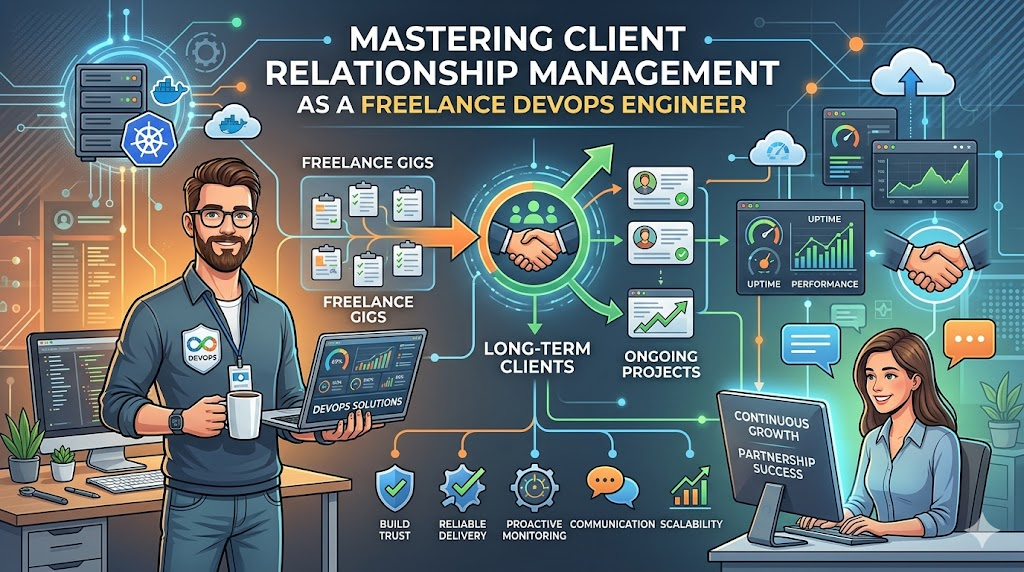
Most freelancers find themselves constantly hunting for the next project because they treat their work as a commodity rather than a partnership. The real shift occurs when you move from being a “fixer” to being a “consultant.” By focusing on client retention strategies and building deep trust, you can transform these isolated engagements into long-term, high-value consulting contracts. Whether you are sharpening your technical skills at DevOpsSchool or refining your business approach, the transition requires a deliberate pivot in mindset. This guide explores how to stop chasing gigs and start building a resilient consulting business.
Why Most DevOps Freelance Gigs Are Short-Term
The prevalence of short-term contracts in the DevOps space usually stems from how businesses perceive external talent. When a client hires a freelancer to solve a specific, immediate problem, they often view the engagement as a “plug-and-play” transaction.
The Task-Based Trap: Clients often have a specific pain point—like a deployment failure—that they need resolved immediately. If you complete the task and leave, the client has no incentive to keep you on retainer.
Lack of Visibility: Many freelancers focus entirely on the technical ticket without engaging with the broader business objectives. When a client doesn’t see you as someone who understands their long-term infrastructure roadmap, they view you as a temporary resource, not a strategic partner.
What Clients Really Expect From DevOps Freelancers
Beyond technical proficiency, clients are looking for a reliable partner who can reduce their operational anxiety.
- Reliability: Doing exactly what you said you would do, within the agreed timeframe, is the baseline.
- Ownership Mindset: Clients value engineers who treat their systems with as much care as if they were internal employees.
- Proactive Problem Solving: Don’t just fix the alert; explain why it happened and how to prevent it from ever recurring.
- Clear Documentation: If you leave a system better than you found it, but fail to document the changes, the client is left with technical debt, which kills the possibility of a long-term relationship.
Difference Between Freelancers and DevOps Consultants
| Feature | Freelancer | DevOps Consultant |
| Engagement | Transactional/Short-term | Relationship-based/Long-term |
| Focus | Specific tasks/tickets | Business goals and infrastructure health |
| Approach | Reactive (fixing problems) | Proactive (preventing problems) |
| Value | Execution speed | Strategy, architecture, and advice |
| Retention | Low | High |
How to Build Trust With DevOps Clients
Trust is the currency of the consulting world. You build it by being transparent about your progress and honest about your limitations.
Scenario: You are tasked with migrating a database. During the process, you identify an outdated security configuration that isn’t part of your project scope. A simple freelancer ignores it. A consultant documents the risk, presents a plan to fix it, and explains how it aligns with the company’s long-term security goals. By showing this level of care, you position yourself as an essential guardian of their infrastructure.
Delivering Value Beyond the Assigned Task
To secure a long-term contract, you must become “sticky”—meaning your absence would create a noticeable gap in their operations.
Identify Hidden Needs: While automating a build pipeline, suggest optimizations for their monitoring stack. If you notice they are wasting money on cloud resources, suggest a cost-optimization plan. When you bring solutions to problems they didn’t even know they had, you transition from a cost center to a revenue-enabling consultant.
Communication Strategies That Retain Clients
Poor communication is the fastest way to lose a client. Even if your code is perfect, a lack of visibility will make the client nervous.
- Weekly Reports: Send a brief summary of what was accomplished, what is planned for next week, and any blockers.
- Clear Reporting: Use project management tools to keep the client updated in real-time.
- Proactive Alerts: If you anticipate a potential infrastructure issue, inform the client before it happens. This demonstrates that you are watching out for their business interests 24/7.
How to Convert a One-Time Gig Into Long-Term Work
- Deliver Excellence Early: Knock the initial task out of the park.
- Conduct a Mini-Audit: Once you have access, review the rest of their stack.
- Present a Roadmap: Show them what needs to be improved over the next 3–6 months.
- Propose a Retainer: Suggest a monthly consulting engagement to help implement the improvements you identified.
Building a DevOps Freelance Reputation
Your reputation is your best marketing tool. Maintain a clean, professional GitHub presence where you document your methodologies. Develop case studies that focus on the business impact of your work (e.g., “Reduced deployment time by 40%”) rather than just the tools used.
Real-World Scenarios
The Freelancer Who Lost Clients
An engineer was hired to fix a CI/CD pipeline. He fixed the bugs and moved on to the next client. When the pipeline broke again two weeks later, the company had to hire someone else because the original freelancer had made no effort to build a relationship or explain the system’s ongoing maintenance needs.
The Freelancer Who Built Long-Term Clients
An engineer was hired for a containerization project. While working, she noticed the team was struggling with manual environment setup. She introduced infrastructure-as-code (IaC) templates, documented the new workflow, and offered a monthly retainer to manage the ongoing evolution of their cloud environment. The client was happy to pay for the peace of mind.
Common Mistakes Freelance DevOps Engineers Make
- Overpromising: Agreeing to impossible deadlines leads to burnout and poor quality.
- Ignoring Documentation: If you don’t document, the client will eventually have to replace you to regain control.
- No Follow-up: Failing to check in after a project ends misses out on future work.
- Poor Communication: Keeping the client in the dark creates distrust.
Best Practices for Client Retention: A Checklist
- Deliver consistent results on time.
- Maintain transparent and proactive communication.
- Deeply understand the business goals behind the technical requirements.
- Regularly suggest architecture and performance improvements.
- Document every change thoroughly.
Role of DevOpsSchool in Building DevOps Freelance Skills
Building a sustainable business requires deep knowledge of the DevOps ecosystem. DevOpsSchool provides the practical, hands-on exposure to CI/CD, cloud architecture, and automation workflows that are necessary to gain the confidence of high-level clients. By mastering modern tools and industry-standard practices, you ensure that your advice is always grounded in reality, which is the cornerstone of professional consulting.
Career Growth From Freelancer to DevOps Consultant
As you build your portfolio, your role will evolve:
- Freelance DevOps Engineer: Focused on execution and technical tasks.
- DevOps Consultant: Focused on advising, auditing, and high-level architectural planning.
- Cloud Consultant / SRE Contractor: Specializing in complex cloud migrations or high-availability system design.
Industries Hiring Freelance DevOps Experts
- SaaS Companies: Need constant pipeline optimization and scaling.
- Startups: Often lack internal DevOps teams and need external expertise to set up foundations.
- E-Commerce: Require high availability and performance during peak traffic.
- FinTech & Healthcare: Prioritize compliance, security, and robust infrastructure.
Future of DevOps Freelancing
The market is moving toward remote-first, expert consulting. As AI begins to assist with basic scripting, the value of a DevOps professional will lie in their ability to design systems, ensure security, and bridge the gap between development and operations.
FAQs
1. How do I get long-term DevOps clients?
Focus on providing value beyond the initial task and demonstrating that you understand their long-term business goals.
2. Why do freelance gigs end quickly?
Often, it is because the freelancer treats the engagement as a one-off transaction rather than a relationship.
3. How can I build trust with clients?
By being transparent, documenting your work, and communicating proactively about risks and opportunities.
4. Should I specialize in one tool?
It is better to be a generalist with a strong understanding of principles, but having deep expertise in at least one cloud provider (AWS/Azure/GCP) is vital.
5. How important is communication?
It is just as important as your technical skill. Clients will forgive a minor technical hiccup, but they will not forgive a lack of communication.
6. Can freelancers become consultants?
Yes, by shifting your focus from executing tasks to solving business-level infrastructure problems.
7. What mistakes should I avoid?
Avoid under-communicating and over-promising. Always document your work.
8. How do I price long-term contracts?
Move from an hourly rate to a value-based or retainer model that covers ongoing maintenance and strategic advisory.
9. Do I need a big portfolio?
Quality over quantity. A few well-documented case studies are better than a long list of minor, uncredited tasks.
10. How do I handle a client who only wants one-off tasks?
Gently propose a “maintenance” or “optimization” phase once the initial task is done.
11. Is remote consulting viable?
Yes, it is currently the industry standard for DevOps professionals.
12. How does documentation help retention?
It makes you replaceable only if they choose to, but it makes you indispensable because you are the one who understands the system best.
13. What is the biggest challenge in freelancing?
The “feast or famine” cycle, which is solved by securing long-term recurring clients.
14. Should I learn new tools?
Yes, constant learning is necessary, and platforms like DevOpsSchool are essential for staying updated.
15. Is it worth moving from a job to freelancing?
It depends on your appetite for business development, but it offers higher potential for income and personal growth.
Final Thoughts
Transitioning from a task-based freelancer to a long-term DevOps consultant is not about technical wizardry alone; it is about mindset. If you want to build a sustainable career, you must stop being a vendor and start being a partner. Focus on delivering consistent value, maintaining clear communication, and proactively solving the problems your clients have not yet noticed. By positioning yourself as a strategic consultant, you move from fighting for every project to being the person your clients call first when they face a challenge.
