Introduction
The rise of remote work and cloud-native computing has created an unprecedented demand for freelance DevOps engineers. Companies of all sizes are moving away from monolithic legacy systems to agile, automated environments. They need experts who can configure CI/CD pipelines, manage Kubernetes clusters, and automate infrastructure on demand. However, there is a significant gap between knowing the tools and getting hired.
In the freelancing world, a standard resume often falls short. Clients are not interested in a list of buzzwords; they want to see proof of work. They want to see how you solved a scaling issue, how you reduced deployment time, or how you secured a cloud environment. This is where a DevOps freelancing portfolio becomes your most valuable asset. It is the bridge between being an anonymous applicant and a trusted consultant.
Building credibility is the hardest part of starting a freelance career. When you present a robust portfolio, you are not asking for a chance; you are demonstrating your value. If you are ready to structure your technical expertise into a business-winning asset, explore the comprehensive training pathways at DevOpsSchool. This article will guide you through the exact steps to create a portfolio that converts technical skill into freelance income.
What Is a DevOps Freelancing Portfolio?
A DevOps freelancing portfolio is a curated collection of your technical work, documentation, and architecture diagrams. Unlike a resume, which acts as a historical record of your employment, a portfolio is a living demonstration of your technical capabilities. It provides evidence that you can translate business requirements into working, scalable, and secure technical solutions.
It is not just a link to your GitHub repository. A raw repository without context is often confusing to non-technical stakeholders. A portfolio adds the narrative layer, explaining the why and how behind your code. It shows a potential client exactly what you are capable of delivering.
Why a Strong DevOps Freelancing Portfolio Matters
In freelancing, trust is the primary currency. Clients are often skeptical of hiring remote, independent contractors because they fear project failure or poor communication. A strong portfolio mitigates this risk.
- Client Trust: When a client sees a well-documented case study of an infrastructure migration you performed, they stop viewing you as a risk and start seeing you as a solution.
- Skill Validation: You can claim you know Terraform, but a portfolio shows a repository where you have written, tested, and deployed modular infrastructure code that handles production-grade environments.
- Faster Project Acquisition: Clients rarely ask technical questions when they have already seen your work in action. Your portfolio does the heavy lifting of the interview process before you even speak to them.
- Better Rates: Specialists with proven track records command higher hourly or project-based rates. A portfolio demonstrates that you are a specialist, not a generalist trying to learn on the client’s time.
Resume vs DevOps Freelancing Portfolio
Understanding the difference is critical to your strategy.
| Feature | Resume | DevOps Freelancing Portfolio |
| Primary Goal | To get an interview | To win the project |
| Content | Chronological work history | Case studies and projects |
| Proof | Claims of expertise | Demonstrated code and architecture |
| Target Audience | Recruiters and HR | Technical Managers and Founders |
| Format | Static PDF | Interactive website or repository |
| Depth | Broad overview | Deep technical insight |
Essential Elements of a Strong DevOps Freelancing Portfolio
Your portfolio must be balanced. It should be technical enough for a CTO to verify, yet clear enough for a business owner to understand the value.
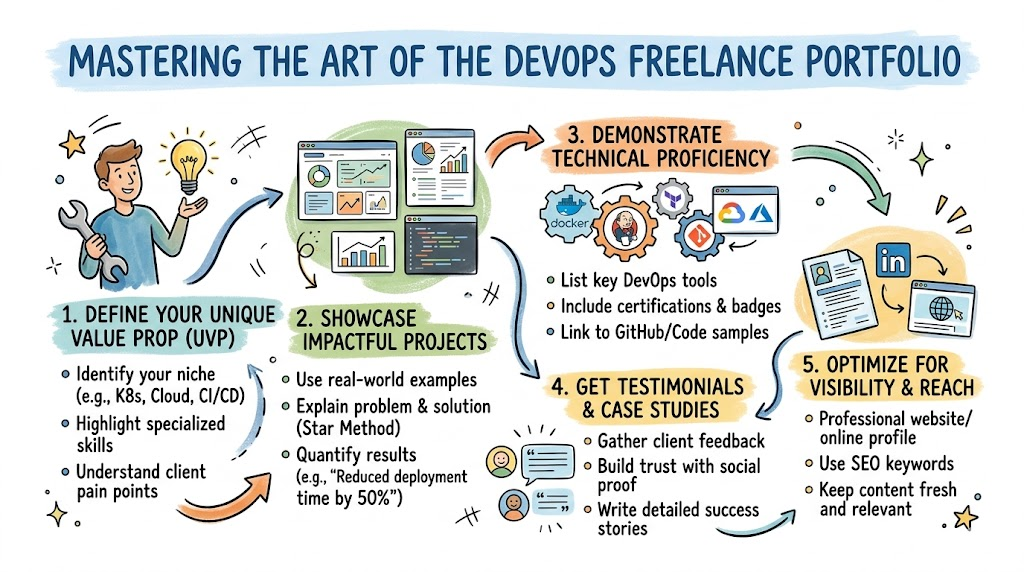
- Professional Introduction: A brief bio highlighting your niche (e.g., Kubernetes consulting, CI/CD automation).
- Technical Skills Overview: A categorized list of your toolchain (e.g., AWS, Azure, Jenkins, Docker, Terraform).
- Real DevOps Projects: Detailed case studies for each major project you have completed.
- Architecture Diagrams: Visual representations of your solutions.
- Documentation: High-quality README files that explain the setup and usage of your code.
- Certifications and Learning: Displaying professional credentials to show a commitment to continuous growth.
Top Projects Every DevOps Freelancer Should Include
Your projects are the core of your portfolio. Do not include basic tutorials you followed from a blog. Customize them to solve specific, realistic problems.
CI/CD Pipeline Project
Showcase an end-to-end automation pipeline.
- Tools: GitHub Actions or Jenkins.
- Implementation: Demonstrate a pipeline that triggers on code commit, runs linting/unit tests, builds a Docker image, and deploys it to a staging environment.
- The Hook: Explain how this setup reduces deployment time by 40%.
Kubernetes Deployment Project
Demonstrate cluster management skills.
- Tools: Helm, ArgoCD, Kubernetes.
- Implementation: Deploy a microservices-based application. Show how you managed secrets, utilized ConfigMaps, and configured horizontal pod autoscaling.
- The Hook: Explain how you handled rolling updates with zero downtime.
Infrastructure as Code (IaC) Project
Showcase your ability to build repeatable environments.
- Tools: Terraform, AWS/Azure.
- Implementation: Write modules for VPCs, subnets, and RDS instances. Include a module for auto-scaling groups.
- The Hook: Discuss how this code makes environment recreation a five-minute task instead of a day-long manual process.
Monitoring & Logging Setup
Show how you ensure system reliability.
- Tools: Prometheus, Grafana, ELK Stack.
- Implementation: Build a dashboard that visualizes system health and triggers alerts for high CPU or memory usage.
- The Hook: Explain how this monitoring prevented a production outage.
Cloud Migration Project
Showcase high-level architectural thinking.
- Tools: Migration tools, Cloud CLI, Networking basics.
- Implementation: Create a scenario where you move a traditional application to a containerized cloud environment.
- The Hook: Focus on the security improvements and cost optimizations you achieved.
How to Showcase DevOps Projects Properly
The biggest mistake freelancers make is just dumping code into a repository. Use the following template for each project:
- Problem Statement: What was the challenge? (e.g., “The client was manually deploying updates, causing frequent downtime.”)
- Architecture Explanation: Briefly describe the design choice and why it fits.
- Tools Used: A concise list of the tech stack.
- Challenges Solved: Mention a specific technical hurdle (e.g., “Configuring IAM roles for cross-account access”).
- Results Achieved: Quantifiable metrics (e.g., “Reduced deployment time from 2 hours to 5 minutes”).
Best Platforms to Showcase Your Portfolio
- GitHub: Your primary source of truth. Your repositories must be clean, with professional README.md files.
- Personal Website: A static site (hosted on AWS S3/CloudFront) allows you to present your bio and case studies professionally.
- LinkedIn: Use your Featured section to link to your best case studies or blog posts about technical challenges you have solved.
- Freelance Platforms: Use your profile description to link to your portfolio website.
How to Build Trust Through Your Portfolio
Clients do not just buy code; they buy confidence.
- Clear Documentation: If a client cannot understand your code, they cannot hire you to maintain it.
- Visuals: Architecture diagrams prove you understand the big picture, not just the command line.
- Transparent Problem-Solving: Write about the mistakes you made during a project and how you fixed them. This shows maturity.
Common Portfolio Mistakes DevOps Freelancers Make
- Only Listing Tools: Listing “I know AWS, Kubernetes, and Docker” is not a portfolio.
- No Hands-On Proof: If you don’t have public repositories that demonstrate your code, the client will assume you are a theorist.
- Weak Documentation: A project without a README is useless.
- Fake Experience: Never claim a project is professional work if it is a tutorial clone. Be honest about your experience level.
- Poor Project Explanation: Never assume the client knows the technical jargon. Explain the business value.
Beginner Portfolio Roadmap
| Phase | Focus Area | Goal |
| Month 1-2 | Linux, Git, Scripting | Master the command line and version control. |
| Month 3-4 | CI/CD Pipelines | Automate a simple app deployment. |
| Month 5-6 | Containers & Kubernetes | Manage container orchestration. |
| Month 7-8 | Terraform & Cloud | Provision infrastructure as code. |
| Month 9+ | Monitoring & Security | Build a production-ready dashboard. |
How Certifications Help Freelance Credibility
Certifications act as a stamp of approval from recognized entities. They are particularly useful when you are starting out and lack a deep history of client projects.
| Certification | Best For | Skill Level | Freelance Value |
| AWS Solutions Architect | Cloud Specialists | Mid | High |
| CKA (Kubernetes) | K8s Specialists | Advanced | Very High |
| Terraform Associate | IaC Specialists | Intermediate | High |
| DevOps Foundation | Beginners | Beginner | Moderate |
Hands-on skills always outweigh certifications in the end, but the learning ecosystem at DevOpsSchool helps bridge the gap between passing an exam and applying the knowledge in a real-world project.
Real-World Portfolio Examples
Beginner Freelancer Example
- Strategy: Focus on simplicity and automation.
- Demonstrated Skills: Basic AWS EC2 setup, shell scripting for backups, simple Git workflow.
- Outcome: Proves you can manage small, stable infrastructure.
Mid-Level DevOps Freelancer Example
- Strategy: Focus on containerization and pipelines.
- Demonstrated Skills: Docker, Kubernetes cluster setup, Jenkins pipeline, monitoring with Prometheus.
- Outcome: Proves you can handle modern, application-focused infrastructure.
Cloud-Native Consultant Example
- Strategy: Focus on complex migrations and high availability.
- Demonstrated Skills: Multi-account AWS architecture, Terraform modules, security compliance automation.
- Outcome: Proves you can handle enterprise-scale, sensitive, and high-traffic systems.
Freelancing Platforms for DevOps Engineers
- Upwork: High volume of small to medium projects. Great for building your reputation.
- Fiverr: Useful for specific, smaller tasks like “Fixing a Jenkins pipeline” or “Dockerizing an app.”
- Toptal: Highly selective, but offers access to elite clients and high rates.
- Direct Consulting: Reaching out to small agencies or startups. This is where your portfolio website becomes crucial.
Pricing and Positioning Yourself as a DevOps Freelancer
- Beginner Pricing: Focus on gaining experience and positive reviews. Keep rates competitive.
- Mid-Level Consulting: Shift from hourly rates to project-based pricing. Charge for the value of the solution, not just the time spent.
- Specialized Kubernetes/Cloud Pricing: This is premium territory. Companies pay a premium for niche expertise that solves complex problems quickly.
Building a Personal Brand as a DevOps Freelancer
- Blogging: Write technical deep dives about problems you solved.
- LinkedIn Content: Share tips on automation, cloud cost optimization, and DevOps culture.
- Open-Source Contributions: Contributing to popular tools signals that you have high-level engineering skills.
- Networking: Engage in community forums and technical groups.
Career Opportunities in DevOps Freelancing
- DevOps Consultant: Auditing existing infrastructure and suggesting improvements.
- Kubernetes Freelancer: Helping companies transition to container orchestration.
- CI/CD Specialist: Building custom automation pipelines for dev teams.
- Cloud Infrastructure Engineer: Designing secure and scalable cloud environments from scratch.
- SRE Consultant: Focusing on system reliability and incident response.
Common Beginner Mistakes
- Learning Too Many Tools: Don’t try to learn every cloud provider at once. Master one (e.g., AWS) before moving to others.
- Ignoring Linux Basics: You cannot be a good DevOps engineer without deep Linux knowledge.
- Avoiding Cloud Platforms: Use the free tiers provided by major clouds to practice.
- No Hands-On Practice: Reading documentation is not enough. You must build, break, and fix things.
- Weak Communication: Technical skills are vital, but you must be able to communicate effectively with clients.
Future of DevOps Freelancing
- Cloud-Native Consulting: The shift to cloud-native is accelerating.
- AI-Assisted Automation: Leveraging AI to write and audit infrastructure code.
- Platform Engineering: A growing trend where DevOps engineers build internal platforms for developers.
- Security-First DevOps: Security is no longer an afterthought; it is integrated into every step of the pipeline.
- Multi-Cloud Demand: Companies are increasingly looking for engineers who can manage infrastructure across multiple providers.
Frequently Asked Questions
- What is a DevOps freelancing portfolio?It is a collection of your work, projects, and case studies that demonstrates your technical skills to potential clients.
- Why is a portfolio important?It provides proof of competence, builds trust, and helps you command higher rates than just a resume.
- What projects should I include?Include projects that solve real-world problems: CI/CD pipelines, Kubernetes deployments, IaC modules, and monitoring setups.
- Is GitHub enough for freelancing?GitHub is essential for your code, but a personal website with documentation is necessary to provide context for non-technical clients.
- Do certifications matter?They act as a good baseline, but real-world projects in your portfolio are significantly more important to clients.
- Can beginners start freelancing?Yes, if you have a strong, portfolio-backed demonstration of your skills, even if you lack corporate experience.
- What skills do freelance DevOps engineers need?Linux, Git, CI/CD, Cloud (AWS/Azure/GCP), Containers, Kubernetes, and IaC (Terraform).
- How do I get my first client?Start by fixing small, specific problems on freelance platforms and use those results to build your portfolio.
- Do I need a website?A simple, professional portfolio website significantly increases your credibility over just a GitHub profile.
- How long does it take to build a portfolio?It is an ongoing process. Expect to spend at least 6 months building your first set of solid, professional-grade projects.
- Should I specialize?Yes. Specialization (e.g., Kubernetes) allows you to charge more and attract better clients.
- How do I document my work?Use the STAR method: Situation, Task, Action, Result, ensuring you highlight the business value of your technical work.
- Are architecture diagrams necessary?Yes. They bridge the gap between technical implementation and business understanding.
- How do I handle client confidentiality?Create anonymized “proof of concept” versions of your projects that demonstrate the same skills without revealing sensitive client data.
- What if I don’t have clients yet?Build personal projects that solve problems you encounter while learning. These demonstrate your ability to execute tasks independently.
Final Thoughts
A DevOps freelancing portfolio is not a one-time project; it is a long-term commitment to quality. Clients are not looking for someone who has memorized a manual; they are looking for someone who has solved problems. Your portfolio is the only way to demonstrate that you can step into an unfamiliar environment and start delivering value immediately.
Do not worry about being perfect. Focus on being practical. Document what you learn, build projects that solve real challenges, and keep your repositories clean. Continuous learning is the hallmark of a successful DevOps engineer. As you advance, your portfolio will evolve, attracting higher-tier projects and clients. Keep building, keep documenting, and let your work speak for itself.
