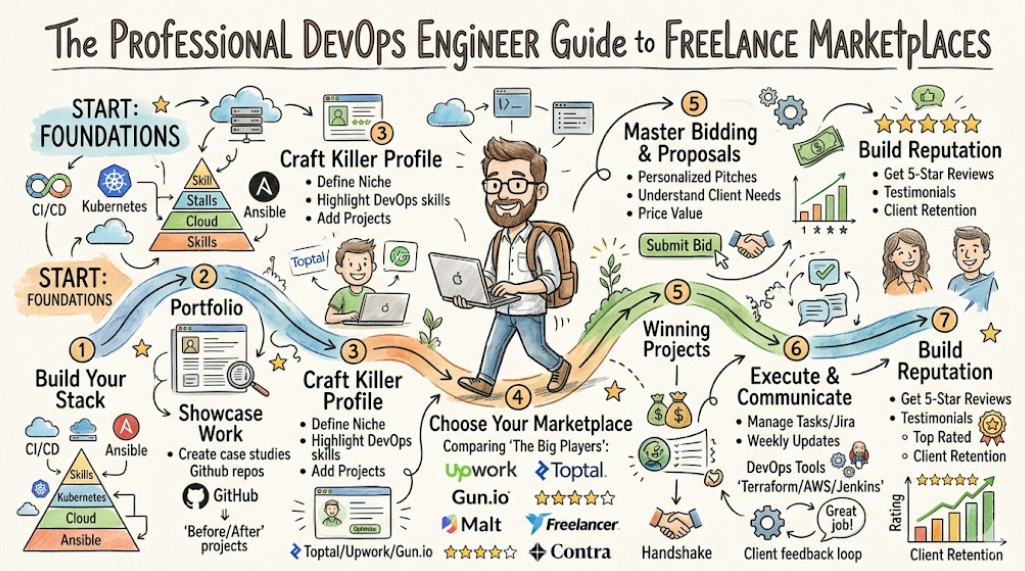
Introduction
The landscape of software engineering has shifted dramatically. The demand for cloud-native infrastructure, automated CI/CD pipelines, and robust security practices has outpaced the internal hiring capacity of many organizations. This gap has created a significant opportunity for independent contractors. Companies are no longer strictly searching for full-time employees; they are actively seeking skilled DevOps engineers to solve specific, complex infrastructure problems on a freelance or consultative basis.
DevOps freelancing is not merely about picking up odd jobs; it is about providing specialized engineering solutions to businesses that cannot justify a full-time, in-house DevOps team or that require rapid scaling. As a professional, this path offers autonomy, the ability to work with diverse tech stacks, and the potential to earn significantly more than a standard salary. However, success in this space requires more than just technical proficiency; it requires knowing how to navigate the market.
To find these clients, you must understand where the demand lives. Choosing the right DevOps freelancing platforms is the most critical step in your journey. Whether you are looking for short-term fixes or long-term consulting engagements, your choice of platform dictates the type of client you attract and the rates you can command.
For those looking to bridge the gap between theoretical knowledge and practical, market-ready skills, platforms like DevOpsSchool provide the training and real-world exposure necessary to stand out in a competitive freelance market. Transitioning into this field is a strategic career move, and with the right approach to profile building and client acquisition, you can build a sustainable and lucrative freelance business.
What Is DevOps Freelancing?
DevOps freelancing is the practice of offering DevOps, Cloud, and SRE expertise to multiple clients on a contract basis, rather than being employed by a single organization. A freelance DevOps engineer operates as an independent consultant or a business entity, selling specific outcomes—such as a migrated Kubernetes cluster, an automated deployment pipeline, or a security audit—rather than just selling time.
Unlike a full-time employee who focuses on the internal roadmap of one company, a freelancer frequently switches contexts between different infrastructures, cloud providers, and organizational cultures. This makes the role highly dynamic and intellectually demanding.
Common scenarios include:
- Startup rescue: Setting up infrastructure for a seed-stage startup that has grown too fast.
- Legacy migration: Helping an enterprise move from on-premise servers to AWS, Azure, or GCP.
- Security hardening: Implementing DevSecOps practices for a company facing compliance audits.
Freelancing is attractive because it removes the limitations of a single salary. You control your pricing, your schedule, and your tech stack. If you prefer working with Terraform and AWS over Azure, you can choose to specialize in those services.
Why DevOps Freelancing Is Growing Rapidly
The surge in DevOps freelancing is driven by several macroeconomic and technical shifts:
- Cloud Adoption: Every company is now a software company. As businesses migrate to the cloud, they realize that cloud infrastructure requires a level of specialized maintenance that standard IT support cannot handle.
- The Skill Shortage: True DevOps expertise—combining systems administration, development, and security—is rare. Companies often cannot find or afford senior talent in their local geography, making remote freelance talent the logical solution.
- Remote Work Culture: Post-2020, organizations are far more comfortable with engineers working asynchronously from different time zones. The location of the engineer matters far less than the reliability of their code.
- Cost Efficiency for Clients: Hiring a freelancer for a six-month cloud migration project is often more cost-effective for a business than hiring a full-time employee with benefits and overhead.
What Services Do DevOps Freelancers Offer?
Understanding the service landscape is essential for positioning your profile correctly.
| Service | Description | Client Type |
| CI/CD Automation | Designing pipelines (Jenkins, GitLab CI, GitHub Actions) | SaaS Startups, SMBs |
| Cloud Migration | Moving workloads from on-premise or legacy to Cloud | Enterprise, Scaling Startups |
| Kubernetes Consulting | Cluster setup, optimization, and management | Tech-heavy companies |
| Infrastructure as Code | Using Terraform, CloudFormation, or Pulumi | All sizes |
| Monitoring & Logging | Setting up Prometheus, Grafana, ELK stack | DevOps-mature teams |
| Security Automation | DevSecOps, secret management, compliance | FinTech, Healthcare |
| Cost Optimization | Reducing cloud spend via architecture audits | Enterprises |
How to Choose the Right DevOps Freelancing Platform
When selecting a platform, consider these four variables:
- Client Quality: Are the companies looking for cheap labor, or are they looking for engineering partners? High-ticket consulting usually happens on vetted platforms.
- Competition Level: Generalist platforms have high competition. Niche or vetted platforms have lower volume but higher conversion rates for skilled professionals.
- Payment Security: Never work without a platform’s escrow system if you are new to the client.
- Fee Structure: Understand the platform’s cut. Some take a percentage, while others charge a flat subscription fee.
Top DevOps Freelancing Platforms to Find Clients
Upwork
- What it is: The largest generalist freelance marketplace.
- Best for: Finding your first few clients and building a rating.
- Advantages: Huge volume of jobs; diverse range of projects from small scripts to large infrastructure contracts.
- Limitations: Highly competitive; can become a “race to the bottom” on pricing if you don’t differentiate.
- Strategy: Create a highly specialized profile. Do not list “DevOps” as your only skill; list “AWS Migration Specialist” or “Kubernetes/Helm Expert.”
Toptal
- What it is: A platform that vets the top 3% of freelancers.
- Best for: Experienced senior DevOps engineers.
- Advantages: High pay; high-quality, pre-vetted clients; professional reputation.
- Limitations: Extremely rigorous screening process.
- Strategy: Ensure your technical resume is impeccable. Prepare for live coding and deep-dive technical interviews before applying.
Fiverr Pro
- What it is: A curated section of the Fiverr platform for professional freelancers.
- Best for: Productized services (e.g., “I will set up your AWS environment in 48 hours”).
- Advantages: You define the scope and price upfront; no bidding wars.
- Limitations: Requires a strong portfolio to get approved for the “Pro” status.
- Strategy: Create packages based on specific outcomes, such as “Dockerizing your Node.js application.”
Freelancer.com
- What it is: One of the oldest freelancing platforms.
- Best for: Small to mid-sized script writing or quick debugging tasks.
- Advantages: Global reach.
- Limitations: Extremely price-sensitive; high spam rate.
- Strategy: Use this for quick wins to build your profile, but move to more premium platforms as your experience grows.
PeoplePerHour
- What it is: A UK-based platform popular for remote work.
- Best for: European and UK-based clients.
- Advantages: Good balance of project quality; allows for “Hourlies” (fixed-price quick services).
- Strategy: Optimize your profile for time zones that match your availability.
Guru
- What it is: A platform that emphasizes long-term relationships.
- Best for: Ongoing maintenance contracts.
- Advantages: Allows for “WorkRooms” to manage communication and file sharing effectively.
- Strategy: Focus on landing a retainer client rather than one-off tasks.
LinkedIn Services
- What it is: A native feature on LinkedIn to showcase your consulting services.
- Best for: Inbound leads from your existing professional network.
- Advantages: Your clients are already in your network or referred by it; highest conversion rate.
- Strategy: Post about the specific problems you have solved. When people see you as a problem-solver, they contact you directly.
Wellfound (formerly AngelList)
- What it is: A platform specifically for startups.
- Best for: Freelance-to-hire roles or early-stage startup contracts.
- Advantages: You get to work with the founders directly.
- Strategy: Highlight your ability to work with limited resources and high ambiguity.
Arc.dev
- What it is: A platform that focuses on remote-first engineering roles.
- Best for: Long-term remote freelance contracts.
- Advantages: Vetted process; focuses on long-term engagement rather than gig work.
- Strategy: Focus on your communication skills as much as your technical depth.
Contra
- What it is: A modern, commission-free freelance platform.
- Best for: High-end creative and technical freelancers.
- Advantages: Beautiful portfolios; no fees for freelancers.
- Strategy: Use it as your primary landing page/portfolio.
Platform Comparison Table
| Platform | Best For | Competition | Fees | Client Quality | Beginner Friendly |
| Upwork | Variety of jobs | High | Variable | Medium-High | Yes |
| Toptal | High-ticket / Senior | Very High | High (Client-side) | Very High | No |
| Fiverr Pro | Productized services | Medium | Medium | High | Moderate |
| Freelancer.com | Quick tasks | Very High | Low | Low | Yes |
| Arc.dev | Long-term contracts | Medium | Low | High | No |
Best Platforms for Beginners
If you are just starting, do not aim for Toptal immediately. Your goal is to build a reputation.
- Upwork: The volume of work allows for trial and error.
- PeoplePerHour: Good for getting your first testimonials.
- Contra: Excellent for building a professional, modern portfolio that you can share outside of the platform.
Focus on smaller, low-risk jobs (e.g., “Fix a failed Jenkins build” or “Write a Dockerfile for a Python app”) to earn 5-star reviews. Once you have five to ten reviews, you can raise your rates and apply to more exclusive platforms.
Best Platforms for Experienced DevOps Freelancers
Once you have 3+ years of experience and a portfolio of completed projects:
- Toptal: The vetting process is a badge of honor. It opens doors to enterprise clients.
- Arc.dev: Ideal if you want stable, long-term freelance engagements.
- LinkedIn: Direct outreach to potential clients is the most profitable channel for senior engineers.
How to Create a Winning DevOps Freelancer Profile
Your profile is your landing page. Treat it like a product page.
- Professional Headline: Avoid “DevOps Engineer.” Use “Cloud Infrastructure Specialist | AWS & Kubernetes Expert | CI/CD Automation.”
- Technical Skills: Do not just list tools. List outcomes. Instead of “I know Terraform,” write “I design and manage scalable infrastructure using Terraform.”
- Certifications: Include AWS Certified Solutions Architect, CKA (Certified Kubernetes Administrator), etc.
- Case Studies: Write a short paragraph for your top 3 projects: The Problem, The Technical Solution, and The Business Impact (e.g., “Reduced deployment time by 40%”).
How to Build a Strong DevOps Portfolio
A portfolio for a DevOps engineer is not a gallery of images; it is a repository of solutions.
- GitHub/GitLab: Have a public repository with clean code, proper documentation (READMEs), and CI/CD pipelines for your own personal projects.
- Case Studies: Write blog posts about the hardest technical issue you solved. Explain your troubleshooting process.
- Documentation: Create templates for common tasks (e.g., “Standardized Ansible Playbook for Nginx Setup”) that you can share as proof of expertise.
How to Price Your DevOps Freelance Services
- Hourly Pricing: Best for ad-hoc support or debugging tasks. ($40 – $150+ per hour depending on seniority).
- Fixed-Price Contracts: Best for projects with clear scopes (e.g., “Migrate legacy server to Docker”). Always add a 20% buffer for scope creep.
- Retainer Models: The “Gold Standard.” Offer a monthly package for support, monitoring, and maintenance. This provides steady income.
How to Get Your First DevOps Client
- Start Small: Bid on tasks that take 1–3 hours. The goal is to get a review, not to retire on one project.
- Write Personalized Proposals: Never use a template. Mention something specific from the client’s job description.
- The “Audition” Strategy: Offer to do a 30-minute paid consultation to discuss their infrastructure. It builds trust faster than any resume.
Common Mistakes DevOps Freelancers Make
- [ ] No Specialization: Trying to be an expert in every tool makes you look like an amateur in all. Pick a niche (e.g., Kubernetes in AWS).
- [ ] Ignoring Communication: Clients pay for peace of mind. Update them before they ask.
- [ ] Underpricing: If you are too cheap, clients assume you aren’t skilled.
- [ ] Missing Deadlines: In DevOps, downtime costs money. Reliability is your #1 currency.
- [ ] Poor Documentation: If you leave a client with code they can’t understand, they won’t hire you again.
Best Practices for Long-Term Freelancing Success
- Continuous Learning: The tools change every year. Dedicate 5 hours a week to learning new tech (e.g., moving from Docker to Podman, or exploring AI-driven observability).
- Build Relationships: Your best clients will come from referrals. Treat every contract as a long-term partnership.
- Personal Branding: Write on LinkedIn or a personal blog. When you are known as an expert, you stop competing on price.
Real-World Example of a Successful DevOps Freelancer Journey
- Learning: Rahul, an IT administrator, spends 6 months learning AWS and Terraform through structured courses.
- Portfolio: He builds a mock-production environment on AWS using Terraform and documents the architecture on GitHub.
- The First Client: He joins Upwork and searches for “Terraform troubleshooting.” He lands a $100 job fixing a broken script for a small web agency.
- Growth: He completes the job early and documents the fix. The agency is impressed and hires him for a monthly maintenance retainer.
- Scaling: Rahul uses the steady retainer income to pursue a CKA certification and upgrades his profile to apply for larger contracts on Toptal.
Role of DevOpsSchool in Building Freelancing Skills
Transitioning to freelancing requires more than just knowing a tool; it requires knowing how to implement it in a production environment. DevOpsSchool provides the hands-on learning ecosystem where engineers can master CI/CD automation, cloud-native deployments, and container orchestration. By working on real-world projects during your training, you build the experience necessary to present yourself as a confident consultant, ensuring you are not just “learning,” but “executing.”
Industries Hiring DevOps Freelancers
- SaaS Platforms: Need constant updates; high demand for CI/CD experts.
- E-Commerce: Need extreme uptime; high demand for load balancing and scaling experts.
- FinTech: Need high security; demand for DevSecOps professionals.
- Healthcare: Compliance-heavy; demand for infrastructure security and auditing.
- Startups: Need “all-rounder” DevOps engineers to set up the foundation.
Career Growth in DevOps Freelancing
The hierarchy of a DevOps freelancer typically looks like this:
- Freelance Engineer: Solving tactical tasks.
- Cloud Consultant: Auditing architectures and suggesting improvements.
- Specialist Consultant (e.g., Kubernetes Architect): High-ticket, expert-level consulting for complex enterprise clusters.
Income potential scales with the value of the problem you solve. Fixing a login bug is cheap; designing an auto-scaling, fault-tolerant, cost-optimized AWS architecture is highly lucrative.
Certifications & Learning Paths
| Certification | Best For | Skill Level | Focus Area |
| AWS Certified Solutions Architect | All freelancers | Intermediate | Cloud Architecture |
| CKA (Certified Kubernetes Admin) | Kubernetes Specialists | Advanced | Orchestration |
| Terraform Associate | IaC Specialists | Intermediate | Infrastructure as Code |
| Google Professional Cloud DevOps | Multi-cloud engineers | Advanced | SRE / DevOps |
Future of DevOps Freelancing
The future belongs to the Platform Engineer. Companies are moving toward internal developer platforms (IDPs). The demand for freelancers who can build these internal platforms, automate security, and implement AI-assisted monitoring will skyrocket. The “manual” parts of DevOps (server patching) will continue to automate away; the “strategic” parts (platform architecture) will grow in value.
FAQs
- What are the best DevOps freelancing platforms?For beginners, Upwork and PeoplePerHour are ideal. For senior engineers, Toptal and Arc.dev are the industry leaders.
- Can beginners start DevOps freelancing?Yes, but you must have a “proof of work” portfolio. Build 3–5 solid projects before seeking your first client.
- How much do DevOps freelancers earn?Rates vary widely. Beginners might start at $30-$50/hr, while experienced consultants with a niche specialty (like Kubernetes security) can charge $150-$300+/hr.
- Is Upwork good for DevOps engineers?It is excellent for building a client base and gaining initial reviews, but you should aim to move off-platform or to premium networks once you have a reputation.
- Is Kubernetes important for freelancing?It is one of the highest-demand skills. If you are a proficient Kubernetes freelancer, you will rarely be out of work.
- How do I find my first client?Focus on small, specific technical problems. Search for jobs that involve debugging or simple automation, and provide a clear, concise proposal.
- Should I specialize in one area?Absolutely. “DevOps” is broad. Being a “Kubernetes Migrations Specialist” or “AWS Security Auditor” allows you to charge more.
- Is DevOps freelancing a good career?It is a high-reward career for those who enjoy constant learning and problem-solving, but it requires the self-discipline to manage your own business.
- Do I need to be a Linux expert?Yes. Most cloud and container infrastructure runs on Linux. Deep Linux knowledge is a prerequisite for any professional DevOps role.
- How do I deal with client feedback?Always ask for feedback. If it is negative, treat it as a learning opportunity to improve your process. If positive, use it to bolster your profile.
- How do I handle time zones?Clearly state your availability in your profile. Remote work is global, but your client needs to know when they can reach you.
- What if I don’t know the answer to a client’s problem?Be honest. Tell them you need to research the solution. Professionalism and the ability to find answers are often more important than immediate knowledge.
- Is freelancing more stable than a job?It depends on your client portfolio. If you have 3–4 steady retainer clients, it can be more stable than a single employer.
- How do I handle contracts?Always use the platform’s terms initially. Once you move to direct clients, use a standard consulting agreement that covers scope, payment terms, and liability.
- What is the most important skill for a freelancer?Communication. If you can explain complex technical concepts to non-technical stakeholders, you will be highly valued.
Final Thoughts
Freelance DevOps engineering is a challenging yet rewarding path. It demands a high level of technical rigor, a professional mindset, and the ability to self-manage. You are moving from a role where you are told what to do, to a role where you are the expert providing the guidance.
The platforms listed here are merely tools. Your success ultimately depends on the quality of your work, your reliability, and your ability to deliver tangible business value to your clients. Focus on building real-world projects, keep your skills sharp through dedicated learning platforms, and treat every client interaction as a step toward building a long-term reputation.
