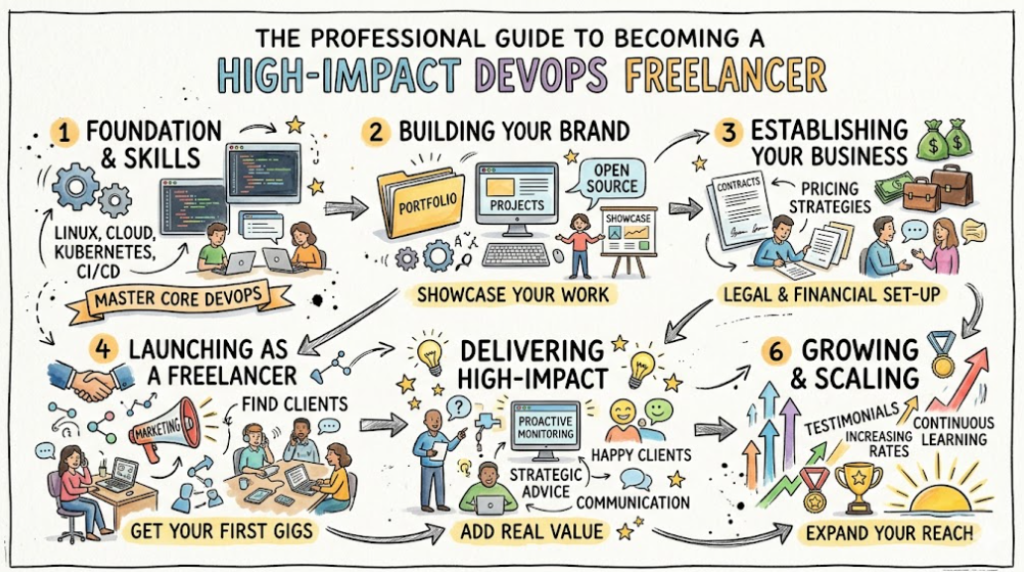
Introduction
The landscape of modern IT has shifted dramatically toward cloud-native architectures, fueling a massive demand for specialized engineering talent. As organizations transition to microservices and automated infrastructure, the role of the DevOps freelancer has evolved from a niche position into a cornerstone of agile business operations. Companies are increasingly seeking the high-level expertise of independent consultants to bridge skill gaps, manage complex Kubernetes environments, and implement robust CI/CD pipelines without the overhead of long-term staffing.
For many engineers, this shift represents a unique opportunity to achieve professional autonomy. However, success in this field requires more than just technical prowess; it demands a structured approach to remote work, clear communication, and a commitment to continuous skill refinement. Whether you are looking to transition from a full-time role or are starting your journey in cloud automation, understanding the practical realities is essential. For those seeking structured guidance, resources provided by DevOpsSchool offer comprehensive pathways to master these complex environments. This article explores the day-to-day operations, challenges, and strategic requirements of a professional DevOps freelancer.
What Does a DevOps Freelancer Do?
A DevOps freelancer serves as a bridge between development and operations, ensuring that software delivery is fast, reliable, and secure. Unlike a traditional system administrator, a freelancer focuses on creating repeatable, automated workflows.
- CI/CD Automation: Building and maintaining pipelines that automatically test and deploy code changes to production.
- Cloud Infrastructure Management: Provisioning and managing resources on platforms like AWS, Azure, or GCP using code rather than manual clicks.
- Kubernetes Deployments: Orchestrating containerized applications to ensure high availability, scalability, and performance.
- Monitoring and Troubleshooting: Setting up observability stacks to detect issues before they impact end-users and responding to incidents when they occur.
- Client Consulting: Translating business requirements into technical roadmaps, advising on cloud cost optimization, and ensuring security best practices are baked into the architecture.
Why DevOps Freelancing Is Growing
The rise of the “everything-as-a-service” model has made DevOps expertise a mandatory requirement for businesses of all sizes.
- Cloud-Native Adoption: Businesses are moving away from monolithic data centers to distributed cloud systems, which require constant maintenance and optimization.
- Remote Engineering Culture: Global teams now prioritize talent over location, making it easier for freelancers to work with clients across different time zones.
- Startup Demand: Early-stage startups often need a high level of expertise to set up their infrastructure but may not have the budget or immediate need for a full-time, senior-level DevOps architect.
- Flexible Hiring Models: Organizations can scale their DevOps capacity up or down based on specific project needs, such as a major cloud migration or a security audit.
Typical Daily Schedule of a DevOps Freelancer
| Time | Activity | Purpose | Tools Used |
| 08:00 | Infrastructure Health Check | Review production logs and system alerts. | Grafana, Prometheus |
| 09:30 | Client Sync / Standup | Align on project goals and troubleshoot blockers. | Slack, Zoom, Jira |
| 10:30 | CI/CD Pipeline Maintenance | Fix failing builds and optimize deployment speed. | Jenkins, GitHub Actions |
| 13:00 | Deep Work: K8s/IaC | Develop new infrastructure modules or scale clusters. | Terraform, Kubernetes |
| 15:30 | Documentation & Reporting | Update runbooks and draft project status reports. | Notion, Confluence |
| 16:30 | Skill Development | Research new cloud-native features and tools. | Documentation, Labs |
Morning Routine: Reviewing Infrastructure and Alerts
The day often begins with a “health check.” For a DevOps freelancer, this means verifying that the environments under their care are operating within expected parameters.
Using dashboards in Grafana or Prometheus, you look for anomalies. Are the API response times creeping up? Is a node in the Kubernetes cluster showing memory pressure? If an alert triggers, you prioritize it based on impact. This phase is critical because it builds trust with clients; identifying and fixing a bottleneck before the client’s team notices demonstrates significant professional value.
Managing CI/CD Pipelines During the Day
Pipeline management is where the “DevOps” philosophy is put into practice. You are essentially building the factory that produces the client’s software.
Throughout the day, you may find yourself debugging a Jenkins pipeline that is failing because of a dependency issue, or updating a GitHub Actions workflow to include a new security scanning step. The goal is to move code from a developer’s laptop to production with minimal human intervention. Success here is measured by the frequency and stability of deployments.
Kubernetes and Cloud Infrastructure Tasks
Managing Kubernetes and cloud infrastructure requires a mindset shift toward Infrastructure as Code (IaC). You don’t just manually patch a server; you update a Terraform script.
When a client needs to scale an application, you aren’t just adding a server; you are adjusting a HPA (Horizontal Pod Autoscaler) policy in the cluster. This allows you to manage massive infrastructures for multiple clients simultaneously because the work is standardized and repeatable.
Client Meetings and Communication
Communication is arguably as important as technical skill. In meetings, you aren’t just a technician; you are an advisor. You will often need to explain why a certain migration strategy is safer or why cost-optimization measures (like moving to spot instances) are beneficial. Clear reporting and proactive updates prevent the “black box” syndrome, where clients feel disconnected from the work you are doing.
Common DevOps Freelance Projects
- CI/CD Pipeline Setup: Transforming manual build processes into fully automated, gated pipelines.
- Kubernetes Migration: Moving legacy applications from virtual machines into orchestrated container environments.
- Cloud Infrastructure Automation: Using Terraform or Ansible to replace manual server configurations with version-controlled code.
- Monitoring & Observability: Implementing full-stack monitoring so teams can “see” their infrastructure health in real-time.
- DevSecOps Integration: Adding security checks, such as vulnerability scanning and secret management, directly into the deployment workflow.
- Infrastructure Cost Optimization: Analyzing cloud bills and rightsizing resources to save clients significant monthly overhead.
Tools Commonly Used by DevOps Freelancers
| Tool Category | Popular Tools | Purpose |
| CI/CD | Jenkins, GitLab CI, GitHub Actions | Automating code testing and deployment. |
| Container Platforms | Docker, Kubernetes | Packaging and orchestrating applications. |
| Cloud Platforms | AWS, Azure, GCP | Hosting and managing cloud services. |
| Monitoring Tools | Datadog, Grafana, Prometheus | Tracking system health and performance. |
| Infrastructure as Code | Terraform, Ansible, Pulumi | Automating server provisioning and configuration. |
| Collaboration | Slack, Jira, Notion | Managing projects and client communication. |
Time Management as a DevOps Freelancer
Managing multiple clients requires strict boundaries. Use time-blocking to dedicate specific hours to specific clients. If you have a high-priority “production down” incident for one client, ensure you have a professional way to communicate delays to others. The secret to avoiding burnout is to build “buffer time” into your schedule for deep learning and administrative tasks.
Challenges Faced by DevOps Freelancers
- Unpredictable Workloads: Some weeks are quiet; others involve back-to-back incidents.
- Production Incidents: You are often the “last line of defense” for critical systems.
- Time Zone Differences: Syncing with a global client base requires flexibility in your daily routine.
- Continuous Learning Pressure: The cloud ecosystem changes monthly; keeping skills sharp is a full-time commitment.
Skills Every DevOps Freelancer Needs
To thrive, you need a T-shaped skill set: broad knowledge across the entire stack and deep expertise in a few areas.
- Linux Administration: The foundation of almost all cloud environments.
- CI/CD Automation: The core of the DevOps value proposition.
- Kubernetes Operations: The industry standard for modern container management.
- Networking: Understanding DNS, VPCs, load balancing, and firewalling.
- Cloud Computing: Proficiency in at least one major provider (AWS/Azure/GCP).
- Soft Skills: Clear reporting, expectation management, and technical writing.
Importance of Cloud-Native Skills in Freelancing
The market for generic IT support is shrinking, while the demand for cloud-native specialists is skyrocketing. Projects involving microservices, serverless functions, and service meshes are where the highest-paying freelance opportunities exist. Mastering these allows you to offer premium consulting services that solve complex architectural problems.
Real-World Freelance DevOps Workflow Example
- Assessment: Audit the client’s current environment.
- Planning: Map out the desired state (e.g., automated deployment).
- Proof of Concept: Implement the pipeline for a single microservice.
- Automation: Write the Terraform and CI/CD code.
- Validation: Perform load testing and security checks.
- Handover: Document the process and train the client’s internal team.
DevOps Freelancing vs Full-Time DevOps Jobs
| Feature | Freelancing | Full-Time Job |
| Flexibility | High; you set your schedule. | Low; fixed office hours. |
| Income Stability | Variable; project-based. | Stable; fixed salary. |
| Variety | High; work with many tech stacks. | Moderate; deep dive into one stack. |
| Career Growth | Self-driven; continuous. | Structured; corporate ladders. |
| Client Exposure | High; direct relationship. | Limited; internal focus. |
How DevOps Freelancers Find Clients
- Freelancing Platforms: Start with niche IT-focused job boards.
- LinkedIn Networking: Share technical insights and “build in public” to attract recruiters.
- Technical Blogging: Writing tutorials on complex topics builds authority.
- Open-Source Contributions: Helping fix bugs in popular tools showcases your skill.
- Referrals: The most consistent source of high-quality work is satisfied previous clients.
Building a Strong DevOps Freelancer Portfolio
Your portfolio is not a resume; it is evidence of your capability. Maintain a public GitHub profile filled with:
- Reusable Terraform modules.
- Complete CI/CD pipeline examples.
- Kubernetes manifests for sample applications.
- Documentation of “how I solved X problem.”
Income Potential for DevOps Freelancers
Income is directly tied to the complexity of the problems you can solve. A freelancer who can merely deploy a server earns significantly less than one who can architect a self-healing, cost-optimized, and secure Kubernetes cluster for a global FinTech company. Specialized expertise in areas like DevSecOps or AI-infrastructure deployment commands top-tier rates.
Best Practices for Successful DevOps Freelancing
- Document Everything: Clear documentation prevents clients from needing you for trivial tasks, freeing you for higher-value work.
- Communication is Key: Never leave a client guessing. Over-communicate during incidents.
- Standardize Your Stack: Develop your own “base” set of tools and scripts that you can deploy rapidly for new clients.
- Prioritize Security: Make security a foundational element of every project, not an afterthought.
Popular Technologies Every DevOps Freelancer Should Learn
| Technology | Importance | Industry Demand | Beginner Difficulty |
| Linux | Essential | High | Moderate |
| Git | Essential | High | Easy |
| Docker | Essential | Very High | Moderate |
| Kubernetes | High | Very High | Hard |
| Terraform | High | High | Moderate |
| AWS | High | Very High | Moderate |
Industries Hiring DevOps Freelancers
- SaaS Platforms: Constant need for uptime and scalability.
- E-Commerce: Seasonal spikes require elastic infrastructure.
- FinTech: High security and compliance needs drive consultant demand.
- Healthcare: Strict data protection requires specialized architecture.
- Startups: Need to move fast without the burden of long-term headcount.
Certifications & Learning Paths
While hands-on experience is king, certifications provide a roadmap for learning. Focus on vendor-neutral certs (like CKA/CKAD for Kubernetes) and provider-specific professional certifications. The DevOpsSchool ecosystem is designed to help engineers bridge the gap between theoretical knowledge and real-world project execution.
| Certification | Best For | Skill Level | Focus Area |
| CKA | Kubernetes Experts | Advanced | Cluster Ops |
| AWS Solutions Arch. | Cloud Specialists | Intermediate | Infrastructure |
| Terraform Associate | IaC Specialists | Intermediate | Automation |
Common Beginner Mistakes in DevOps Freelancing
- Skipping Basics: Trying to master Kubernetes without understanding Linux networking.
- Over-Engineering: Implementing complex tools when a simple script would suffice.
- Ignoring Monitoring: Building systems that you cannot actually “see.”
- Poor Communication: Not setting clear expectations on project scope or timeline.
- Stagnation: Getting comfortable with one tool and refusing to learn new ones.
Future of DevOps Freelancing
The future is in Platform Engineering. Companies are looking for freelancers who can build “Internal Developer Platforms” (IDPs). As AI-assisted operations become more prevalent, the DevOps freelancer of tomorrow will spend less time doing manual tasks and more time architecting systems that allow developers to self-serve their infrastructure needs in a secure and automated way.
FAQs
- What does a DevOps freelancer do daily? They manage infrastructure, fix CI/CD pipelines, monitor health, and advise clients on architecture.
- Is DevOps freelancing a good career? Yes, it offers high autonomy and income potential for those who stay ahead of technical trends.
- What skills are required? Linux, CI/CD, Kubernetes, Cloud (AWS/Azure/GCP), and IaC (Terraform).
- Is Kubernetes important? It is the standard for modern scaling; it is essential for high-paying roles.
- How do freelancers find clients? Through professional networking, technical blogging, and specialized platforms.
- What tools should I learn first? Linux, Git, Docker, and a basic CI/CD tool.
- Can beginners start freelancing? It is better to have 2-3 years of core experience to ensure you can handle production incidents.
- Is cloud computing necessary? Yes, the vast majority of DevOps work is now cloud-based.
- How do you handle multiple clients? Through strict time-blocking and documentation.
- Do you need a degree? No, portfolio and certifications are more important.
- How do I manage burnout? Set boundaries and dedicate time for non-technical rest.
- Is DevOps dying? No, it is evolving into Platform Engineering and DevSecOps.
- How do you price services? Usually by project complexity or hourly rates for consulting.
- Is it hard to learn? It is challenging, but rewarding for those who enjoy constant learning.
- Where should I start learning? Use structured resources like DevOpsSchool.
Final Thoughts
DevOps freelancing is not a shortcut; it is a serious career path for engineers who are passionate about automation and cloud-native architecture. It offers the freedom to choose your projects and the chance to work with cutting-edge technologies. However, it requires a foundation of strong technical fundamentals, an obsession with reliability, and the soft skills to communicate value to your clients. If you are willing to embrace the pace of change, the world of DevOps freelancing provides an exceptional opportunity to build a high-impact, long-term career.
