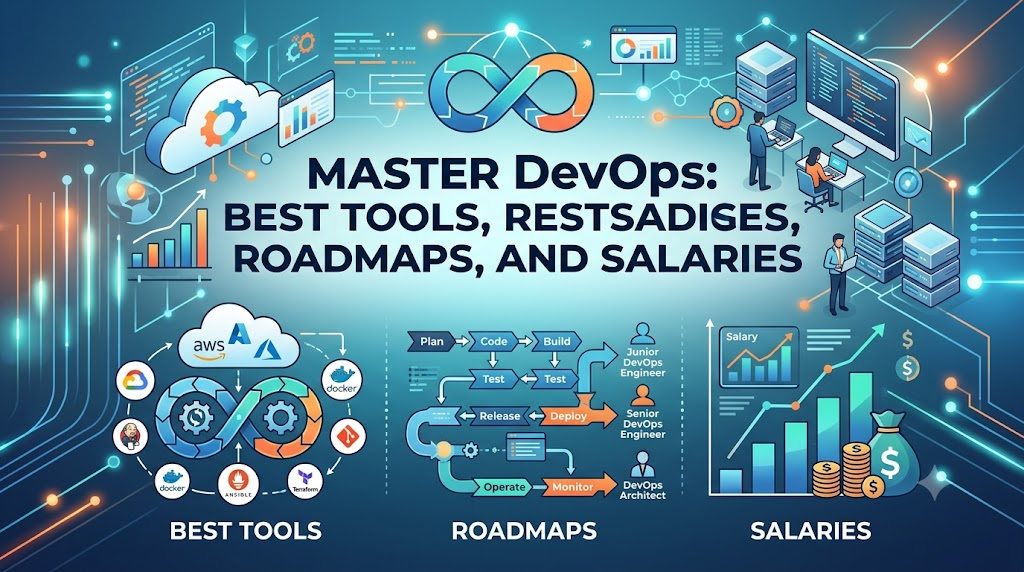
The tech landscape shifts rapidly, but if there is one methodology that remains the backbone of modern software engineering, it is DevOps. Organizations no longer view fast deployments as a luxury—it is a core business requirement. Achieving this level of agility requires the right mix of cultural alignment, automated workflows, and a deep understanding of the best DevOps tools available today. For anyone looking to break into this field or level up their engineering skills, navigating the sheer volume of technologies can feel overwhelming.
Whether you are seeking a comprehensive DevOps tutorial for beginners, trying to map out your learning journey, or preparing to ace technical interviews, having a structured approach is essential. This comprehensive guide breaks down the essential skills, tools, and career paths you need to succeed in contemporary platform engineering and ecosystem automation.
Why DevOps Matters in the Modern Tech Landscape
In the traditional software development model, developers wrote code and handed it off to an operations team for deployment. This siloed approach inevitably created friction. Developers wanted to push new features quickly, while operations focused on maintaining system stability, often leading to delayed releases and finger-pointing when deployments failed.
DevOps bridges this gap by unifying development and operations into a continuous lifecycle. By automating testing, integration, and deployment, engineering teams can release updates faster, minimize human error, and diagnose system failures within minutes instead of days.
The Shift to Platform Engineering and SRE
The industry has matured beyond basic automation. Today, DevOps practices closely integrate with Site Reliability Engineering (SRE) to maximize system uptime and Platform Engineering to build internal developer platforms (IDPs). Understanding these shifts is crucial for any modern engineering team aiming to reduce cognitive load on developers while maintaining strict compliance and security boundaries.
The Evolution of the DevOps Lifecycle
To implement a successful deployment pipeline, you need to understand the core phases of the continuous integration and continuous delivery (CI/CD) lifecycle. Each phase relies on specific automated processes to move code cleanly from a developer’s local machine to a production environment.
[ Plan ] ➔ [ Code ] ➔ [ Build ] ➔ [ Test ] ➔ [ Release ] ➔ [ Deploy ] ➔ [ Operate ] ➔ [ Monitor ]
   ▲                                                                                     │
   └─────────────────────────────────── Feedback Loop ───────────────────────────────────┘
- Continuous Integration (CI): Developers frequently merge their code changes into a central repository. Every merge triggers an automated build and test sequence to catch integration bugs early.
- Continuous Delivery / Deployment (CD): Once the code passes all tests, it is automatically bundled and prepared for release. In a continuous deployment setup, validated changes go live directly to production without manual intervention.
- Continuous Monitoring and Observability: After deployment, production systems are continuously tracked to gather performance metrics, logs, and trace data. This ensures immediate visibility into application health and user experience.
The Ultimate DevOps Roadmap
Building a successful career in this field requires a structured learning path. Navigating an absolute sea of technologies becomes much simpler when you follow a proven DevOps roadmap focused on core foundational concepts before moving to specialized tooling.
Phase 1: Foundations of Systems & Scripting
Before touching cloud providers or orchestrators, you must master the environments where applications actually run.
- Linux Fundamentals: Learn shell navigation, file permissions, SSH key management, and process management. Most enterprise containers and cloud workloads run on Linux flavors.
- Scripting and Programming: Master Python or Bash to automate repetitive tasks, parse logs, and interact with cloud APIs.
Phase 2: Source Control & Networking
- Git and Version Control: Learn branching strategies (Gitflow, trunk-based development), merging, rebasing, and resolving conflicts.
- Networking Protocols: Solidify your understanding of HTTP/S, DNS, TCP/IP, load balancing, subnets, and firewalls.
Phase 3: Infrastructure as Code (IaC) & Cloud
- Cloud Computing Platforms: Gain proficiency in at least one major cloud provider—AWS, Microsoft Azure, or Google Cloud Platform (GCP).
- Declarative Provisioning: Shift away from manual cloud console clicks. Learn how to write reusable, version-controlled infrastructure definitions using tools like Terraform or OpenTofu.
Phase 4: Containers & Orchestration
- Containerization: Packages applications with all dependencies. Learn how to write optimized Dockerfiles, manage image layers, and handle local environments via Docker Compose.
- Container Orchestration: For production environments running hundreds of containers, Kubernetes (K8s) is the industry standard for managing scaling, healing, and service discovery.
Crucial Technical Skills to Master
To command a competitive DevOps engineer salary, you must build practical competency across several interconnected technical disciplines. Relying on generic concepts is not enough; you must understand how these components interact in production environments.
1. Infrastructure as Code (IaC)
IaC treats infrastructure configurations exactly like application source code. It ensures that environments are reproducible, version-controlled, and audited. Instead of manually configuring servers, you define the desired end-state in configuration files, and the tool handles the provisioning and alignment.
2. Configuration Management
While IaC builds the underlying hardware or cloud resources, configuration management tools configure the software inside those resources. They ensure that your packages, user accounts, security patches, and application dependencies remain consistent across thousands of virtual machines.
3. Containerization and Microservices
Breaking large monolithic applications into microservices makes them easier to scale and update. Containers provide a lightweight, isolated runtime environment that guarantees an application will run exactly the same way on a QA engineer’s laptop as it does on a massive production cluster.
4. Continuous Integration and Continuous Delivery (CI/CD)
CI/CD forms the central engine of automated delivery pipelines. By orchestrating everything from static code analysis and security scans to artifact building and zero-downtime deployments, CI/CD pipelines eliminate manual deployment errors and ensure a predictable release cadence.
Categorized Overview of the Best DevOps Tools
Choosing the right toolkit depends on your specific infrastructure architecture, team size, and application requirements. The table below outlines the industry-standard software suites used across major enterprise delivery pipelines:
| Lifecycle Phase | Industry Standard Tools | Core Use Case |
|---|---|---|
| Version Control & GitOps | Git, GitHub, GitLab, Bitbucket | Source control, pull requests, code reviews, and GitOps automation. |
| CI/CD Orchestration | Jenkins, GitHub Actions, GitLab CI, ArgoCD | Automation of build, test, and deployment pipelines. |
| Infrastructure as Code | Terraform, OpenTofu, AWS CloudFormation | Declarative cloud resource provisioning and lifecycle management. |
| Configuration Management | Ansible, Chef, Puppet | Automated server configuration, patching, and application setup. |
| Container Ecosystem | Docker, Podman, Kubernetes, Helm | Container runtimes, cluster orchestration, and package management. |
| Cloud Computing | AWS, Microsoft Azure, Google Cloud (GCP) | Scalable compute, storage, databases, and managed services. |
| Monitoring & Observability | Prometheus, Grafana, ELK Stack, Datadog | Metric collection, visualization, centralized logging, and tracing. |
| Security & Secret Management | HashiCorp Vault, SonarQube, Snyk | Secure credential storage and automated code vulnerability scanning. |
Understanding and Optimizing DORA Metrics
High-performing engineering teams do not deploy blindly; they rely heavily on quantitative data to track speed and stability. The DevOps Research and Assessment (DORA) group identified four key metrics that indicate an engineering team’s operational health.
┌─────────────────────────────────────────────────────────────────────────┐
│                              DORA METRICS                               │
├────────────────────────────────────┬────────────────────────────────────┤
│           DELIVERY SPEED           │        STABILITY & QUALITY         │
├────────────────────────────────────┼────────────────────────────────────┤
│  Deployment Frequency              │  Change Failure Rate               │
│  (How often code is deployed)      │  (% of deployments causing errors) │
├────────────────────────────────────┼────────────────────────────────────┤
│  Lead Time for Changes             │  Failed Component Recovery Time    │
│  (Commit to production speed)      │  (Time to restore service / MTTR)  │
└────────────────────────────────────┴────────────────────────────────────┘
Modern DORA metrics tools integrate directly into your version control systems and production infrastructure to track these numbers automatically. By constantly monitoring deployment frequency and mean time to recovery (MTTR), leaders can easily pinpoint bottlenecks in their testing environments or deployment gates.
Common Implementation Challenges & Solutions
Transitioning to automated infrastructure is rarely completely smooth. Teams frequently encounter systemic hurdles that can stall progress if not handled proactively.
- The “Culture Clash” Resistance: DevOps requires cultural transformation. Developers must take ownership of post-deployment behavior, and operations teams must adopt engineering mindsets like writing code for automation.
- Secret Sprawl and Security Leaks: As automation grows, scripts require access keys and API credentials. Hardcoding passwords into Git repositories is a critical mistake. Teams should use secure, dynamic credential providers like HashiCorp Vault to inject secrets at runtime.
- Tool Fatigue and Over-Engineering: Trying to implement complex orchestrators like Kubernetes for a small, static website introduces massive unnecessary complexity. Always pick tools that match the scope and real-world scale of your application.
Step-by-Step Practical Example: A Minimal CI/CD Pipeline
To understand how these concepts function in practice, consider this example of a basic automated deployment pipeline for a containerized Node.js application running on GitHub Actions.
YAML
# .github/workflows/deploy.yml
name: Production CI/CD Pipeline

on:
  push:
    branches: [ main ]

jobs:
  build-and-test:
    runs-on: ubuntu-latest
    steps:
    - name: Checkout Source Code
      uses: actions/checkout@v4

    - name: Initialize Node.js Environment
      uses: actions/setup-node@v4
      with:
        node-version: '20'

    - name: Run Test Suite
      run: |
        npm ci
        npm test

  build-and-push-container:
    needs: build-and-test
    runs-on: ubuntu-latest
    steps:
    - name: Checkout Source Code
      uses: actions/checkout@v4

    - name: Authenticate with DockerHub
      run: echo "${{ secrets.DOCKER_PASSWORD }}" | docker login -u "${{ secrets.DOCKER_USERNAME }}" --password-stdin

    - name: Build and Push Docker Image
      run: |
        docker build -t myregistry/app:latest .
        docker push myregistry/app:latest
This simple configuration guarantees that bad code never hits registry storage, because the container building job will not run unless the test suite completes with a successful return code.
Career Insights and Professional Value
Because companies across all industries continue to prioritize digital transformation, the demand for professionals with strong DevOps engineer skills remains exceptionally strong.
Salary Horizons
While pay rates vary based on location, experience, and specific cloud specialties, a typical DevOps engineer salary reflects the high technical value brought to an organization:
- Junior DevOps Engineer: $85,000 – $115,000 / year
- Mid-Level Cloud/DevOps Engineer: $120,000 – $155,000 / year
- Senior Infrastructure / Platform Engineer: $160,000 – $210,000+ / year
Professional Certification Paths
Earning specialized certifications validates your theoretical knowledge and demonstrates dedication to future employers. Some of the best DevOps certifications to target include:
- AWS Certified DevOps Engineer – Professional: Validates advanced cloud orchestration, provisioning, and monitoring on AWS.
- Certified Kubernetes Administrator (CKA): Proves real-world capability in managing, troubleshooting, and configuring production Kubernetes clusters.
- HashiCorp Certified: Terraform Associate: Confirms basic operational competency with declarative multi-cloud infrastructure deployment.
Frequently Asked Questions
What is the absolute best DevOps course for beginners?
The ideal course blends architectural theory with hands-on practice. Look for programs that require you to write real code, configure Linux environments, and build complete CI/CD pipelines rather than just watching lecture videos.
What are the core skills a DevOps engineer must have?
You need a balanced mix of system administration (Linux), coding/scripting (Python, Go, or Bash), a strong grasp of CI/CD concepts, knowledge of Infrastructure as Code (Terraform), and a clear understanding of containerization (Docker, Kubernetes).
How do I prepare for technical interviews?
Review core architectural designs and browse structured lists of DevOps interview questions. Be ready to explain your real-world troubleshooting experiences, how you design robust CI/CD pipelines, and how you manage infrastructure failures under pressure.
What is the difference between DevOps and Agile?
Agile is a software development philosophy focused on iterative delivery, collaboration, and adapting to changing requirements. DevOps extends that philosophy to the entire deployment lifecycle, focusing on automation, tools, and infrastructure stability.
Do I need to be an expert programmer to work in DevOps?
No, you do not need to write complex application logic like a full-stack engineer. However, you must be comfortable writing clean, readable automation scripts, configuring YAML files, and debugging code architectures to optimize runtime performance.
Why are DORA metrics tools so valuable to leadership teams?
DORA metrics provide concrete data on software delivery velocity and stability. This allows engineering leadership to make data-driven decisions, clear technical debt, and measure the ROI of automation investments.
What are some good DevOps projects to add to my portfolio?
Build a complete end-to-end pipeline: take a simple web application, containerize it using Docker, orchestrate its deployment using GitHub Actions or Jenkins, provision the underlying cloud infrastructure with Terraform, and set up live alerts using Prometheus and Grafana.
Is Kubernetes always necessary for container management?
No. For simpler apps or smaller teams, managed container runtimes like AWS ECS, Google Cloud Run, or Docker Compose on a single instance are often much easier to manage and completely sufficient.
Key Takeaways
- Focus on Fundamentals: Master Linux, git version control, and networking fundamentals before jumping into complex orchestrators.
- Treat Infrastructure as Code: Avoid manual environment updates. Use version-controlled declarative tools to ensure your infrastructure is reproducible.
- Automate Responsibly: Ensure every step in your CI/CD pipeline adds value without introducing unnecessary complexity.
- Measure What Matters: Track deployment velocity and system stability using DORA metrics to find and eliminate production bottlenecks.
Next Steps to Advance Your Journey
Mastering DevOps requires continuous hands-on practice and regular exposure to real-world deployment challenges. If you want to dive deeper, expand your technical skill set, and stay ahead of industry trends, explore the comprehensive learning ecosystem at BestDevOps.com.
The platform offers curated DevOps projects, hands-on tutorials, deep dives into the best DevOps tools, and targeted preparation guides featuring common DevOps interview questions to help you land your next engineering role. Turn your theoretical knowledge into practical expertise and start building more reliable software delivery systems today.
