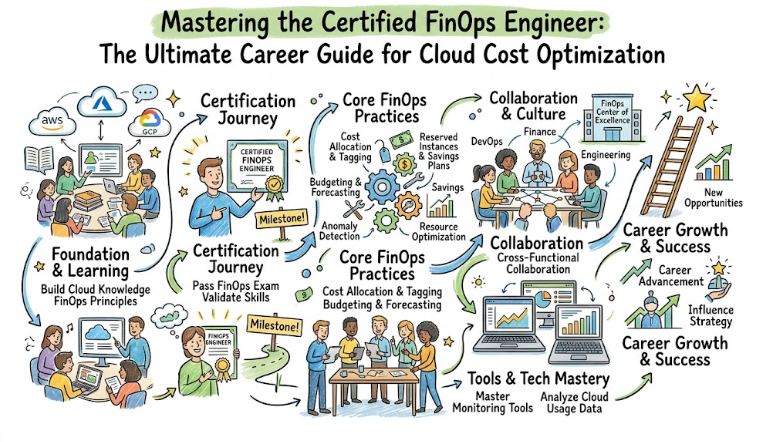
Cloud computing has shifted from a simple infrastructure play to a complex financial ecosystem. As organizations scale their cloud footprint, the “bill shock” phenomenon has made financial accountability as critical as system uptime. This guide focuses on the Certified FinOps Engineer, a credential designed to bridge the gap between engineering execution and fiscal responsibility. Whether you are a DevOps professional, an SRE, or a cloud architect, understanding how to architect for cost is no longer optional. This roadmap, supported by finopsschool, provides a clear, experience-driven path to mastering the intersection of cloud, finance, and technology.
What is the Certified FinOps Engineer?
The Certified FinOps Engineer represents a shift in how engineering teams interact with cloud resources. Unlike traditional finance certifications, this is a technical track that focuses on the “Inform, Optimize, and Operate” phases of the FinOps lifecycle. It exists because cloud spending is decentralized; engineers make spending decisions every time they provision a resource. This certification ensures that those decisions are backed by data, tagging strategies, and rightsizing logic. It emphasizes production-focused learning, teaching engineers how to automate cost savings without compromising performance or reliability.
Who Should Pursue Certified FinOps Engineer?
This certification is tailor-made for SREs, DevOps engineers, and Platform engineers who are tired of being questioned about rising cloud costs during quarterly reviews. It is equally valuable for Cloud Architects who must design scalable systems that remain economically viable at the enterprise level. In India and global markets, managers are increasingly looking for leaders who can speak both “Python” and “Profitability.” Beginners looking to enter the cloud space will find this a powerful differentiator, while seasoned veterans can use it to pivot into high-level FinOps Practitioner or Head of Cloud Infrastructure roles.
Why Certified FinOps Engineer is Valuable in the Future and Beyond
As enterprise adoption of multi-cloud environments grows, the complexity of billing and resource management increases exponentially. The demand for FinOps-literate engineers is high because they provide a direct return on investment by reducing waste and identifying architectural inefficiencies. This career path offers longevity because while specific cloud tools may change, the fundamental need to manage margins and cloud unit economics remains constant. Investing time in this certification helps professionals stay relevant as organizations move from cloud migration to cloud maturity and optimization.
Certified FinOps Engineer Certification Overview
The program is delivered via the official portal and is hosted on the finopsschool.com platform. The assessment approach is designed to be practical, moving away from rote memorization toward scenario-based problem-solving. It covers the ownership of cloud spend, the structure of modern billing data, and the cultural shift required to make FinOps work within an agile team. The certification ensures that an engineer can not only identify a high bill but can also trace it back to a specific microservice, team, or deployment pipeline using advanced metadata strategies.
Certified FinOps Engineer Certification Tracks & Levels
The certification path is broken down into Foundation, Professional, and Advanced levels to accommodate different stages of a career. The Foundation level introduces the core vocabulary and concepts of cloud finance. The Professional level dives deep into the engineering aspects, such as automated rightsizing, reserved instance planning, and spot instance orchestration. The Advanced level is aimed at those moving into leadership or specialized roles, focusing on governance, policy-as-code for cost, and organizational transformation. These levels allow for a natural progression as an engineer takes on more responsibility.
Complete Certified FinOps Engineer Certification Table
| Track | Level | Who it’s for | Prerequisites | Skills Covered | Recommended Order |
| Core FinOps | Foundation | Beginners, Managers | Basic Cloud Knowledge | Vocabulary, Lifecycle, Principles | First |
| Engineering | Professional | SREs, DevOps | Foundation Level | Automation, Rightsizing, Tagging | Second |
| Architecture | Advanced | Senior Architects | Professional Level | Policy-as-Code, Multi-cloud Governance | Third |
| Specialized | Expert | Heads of Cloud | 10+ Years Experience | Unit Economics, KPI Design | Final |
Detailed Guide for Each Certified FinOps Engineer Certification
Certified FinOps Engineer – Foundation
What it is
This entry-level certification validates a basic understanding of the FinOps framework and its three primary phases. It ensures the candidate understands the difference between CapEx and OpEx in a cloud context.
Who should take it
This is ideal for junior developers, non-technical managers, and finance professionals who need to collaborate effectively with engineering teams on cloud spending.
Skills you’ll gain
- Understanding the FinOps Lifecycle (Inform, Optimize, Operate).
- Knowledge of cloud billing terminology across AWS, Azure, and GCP.
- Ability to interpret basic cost and usage reports.
Real-world projects you should be able to do
- Create a basic cloud cost visibility dashboard for a small team.
- Identify orphaned resources and unattached storage volumes in a dev environment.
Preparation plan
- 7–14 days: Review official documentation and learn the core principles of the FinOps Foundation.
- 30 days: Practical exploration of cloud billing dashboards and mock exam practice.
- 60 days: Not recommended for this level; the focus should be on rapid acquisition and moving to Professional.
Common mistakes
- Treating FinOps as a one-time accounting task rather than a continuous engineering culture.
- Ignoring the cultural aspect of team accountability.
Best next certification after this
- Same-track option: Certified FinOps Engineer Professional.
- Cross-track option: Cloud Digital Leader (GCP) or AWS Cloud Practitioner.
- Leadership option: Engineering Management Fundamentals.
Certified FinOps Engineer – Professional
What it is
The Professional level validates the technical ability to implement automation and architectural changes that drive cost efficiency. It focuses on the “Optimize” and “Operate” phases deeply.
Who should take it
Working DevOps engineers and SREs who have at least one year of experience managing cloud infrastructure and want to specialize in efficiency.
Skills you’ll gain
- Advanced tagging and labeling strategies for granular cost allocation.
- Implementation of automated scaling policies based on cost-performance metrics.
- Mastery of commitment-based discounts (RIs, Savings Plans).
Real-world projects you should be able to do
- Develop a Lambda or Cloud Function to automatically shut down non-production environments after hours.
- Implement a cross-account dashboard that aggregates multi-cloud spending into a single pane of glass.
Preparation plan
- 7–14 days: Deep dive into specific cloud provider billing APIs and cost explorer tools.
- 30 days: Hands-on labs focusing on automated rightsizing and spot instance integration.
- 60 days: Extensive case study review and simulation of large-scale enterprise cost migrations.
Common mistakes
- Optimizing for cost at the expense of system performance or user experience.
- Failing to automate the optimization process, leading to “manual toil.”
Best next certification after this
- Same-track option: Certified FinOps Engineer Advanced.
- Cross-track option: CKA (Certified Kubernetes Administrator).
- Leadership option: Technical Program Management for Cloud.
Choose Your Learning Path
DevOps Path
The DevOps path focuses on integrating cost feedback loops directly into the CI/CD pipeline. Engineers on this path learn to treat “cost” as a test case, ensuring that a code change doesn’t trigger an unintentional spike in resource consumption. It emphasizes the “Shift Left” approach where cost awareness starts at the development stage rather than the billing cycle.
DevSecOps Path
In this track, the focus is on the intersection of security and cost. For example, a security breach often manifests as a sudden spike in compute usage for crypto-mining. DevSecOps professionals learn to use FinOps monitoring as a security signal, ensuring that governance policies satisfy both compliance and budget constraints simultaneously.
SRE Path
Site Reliability Engineers use FinOps to balance the “Error Budget” with the “Financial Budget.” This path focuses on building resilient systems that are “frugal by design.” SREs learn to use advanced observability tools to correlate latency with cost, ensuring that the system is meeting its SLAs at the lowest possible price point.
AIOps Path
The AIOps path explores how machine learning can predict future cloud spending patterns. Engineers learn to use AI models to identify anomalies in usage and automate the procurement of reserved capacity. This involves high-level data analysis and the implementation of self-healing infrastructures that adjust their size based on predicted demand.
MLOps Path
MLOps professionals face unique challenges with high GPU and specialized hardware costs. This path focuses on the lifecycle of machine learning models, from training to inference, and how to optimize the underlying infrastructure. It covers data transfer costs and the economic impact of different model architectures on production budgets.
DataOps Path
DataOps focuses on the massive costs associated with big data storage and egress. This path teaches engineers how to manage data lifecycles, choose between hot and cold storage effectively, and optimize SQL queries to reduce compute consumption in serverless data warehouses. It is essential for managing large-scale data lakes economically.
FinOps Path
This is the pure-play path for those wanting to become FinOps Practitioners. It focuses on the bridge between finance, procurement, and engineering. It covers the organizational change management required to build a FinOps center of excellence and how to communicate technical cost data to executive stakeholders effectively.
Role → Recommended Certified FinOps Engineer Certifications
| Role | Recommended Certifications |
| DevOps Engineer | Certified FinOps Engineer (Professional) |
| SRE | Certified FinOps Engineer (Professional + Advanced) |
| Platform Engineer | Certified FinOps Engineer (Advanced) |
| Cloud Engineer | Certified FinOps Engineer (Foundation + Professional) |
| Security Engineer | Certified FinOps Engineer (Foundation) |
| Data Engineer | Certified FinOps Engineer (Professional) |
| FinOps Practitioner | All Levels (Foundation through Advanced) |
| Engineering Manager | Certified FinOps Engineer (Foundation) |
Next Certifications to Take After Certified FinOps Engineer
Same Track Progression
Once you have mastered the engineering side, moving into the Advanced Architectural track is the logical next step. This involves looking at multi-cloud strategies and how to maintain a consistent FinOps posture across different providers like AWS and Azure. It moves from “fixing things” to “designing things that don’t break the bank.”
Cross-Track Expansion
The most powerful combination for a modern engineer is FinOps plus Containerization. Pursuing a CKA (Certified Kubernetes Administrator) after your FinOps certification allows you to manage the specific cost complexities of Kubernetes, such as pod-level cost allocation and cluster autoscaling efficiency.
Leadership & Management Track
For those looking to move into management, combining FinOps with a leadership certification prepares you for a Director of Infrastructure or VP of Engineering role. Understanding the financial impact of technical decisions makes you a much more effective leader who can justify budgets and prove the department’s value to the CFO.
Training & Certification Support Providers for Certified FinOps Engineer
DevOpsSchool
This provider offers extensive community support and structured bootcamps that cover the entire DevOps spectrum. They are known for their deep technical dives and have a strong presence in the training industry, helping thousands of engineers transition into automated workflows. Their curriculum is often updated to reflect the latest changes in the cloud-native ecosystem, making them a reliable choice for those looking for comprehensive career support.
Cotocus
Cotocus specializes in providing hands-on lab environments that simulate real-world production scenarios. Their focus is on high-end technical training for enterprises, ensuring that teams can apply what they learn immediately. They emphasize the practical application of tools and methodologies, which is critical for engineers who need to manage complex, distributed systems in a high-pressure environment.
Scmgalaxy
As a knowledge-sharing platform, Scmgalaxy provides a wealth of tutorials, blogs, and community forums. They are a go-to resource for troubleshooting and staying updated on the latest trends in software configuration management and cloud operations. Their content is driven by industry experts who share practical insights from their daily professional lives.
BestDevOps
This portal focuses on curated learning paths and certification guidance for individuals looking to climb the professional ladder. They provide clear comparisons of different training programs and help candidates choose the path that best fits their current skill level and career goals. Their approach is straightforward and focused on results, helping professionals avoid unnecessary filler content.
devsecopsschool.com
This platform is the primary destination for engineers looking to integrate security into their automation pipelines. They provide specialized courses that cover everything from threat modeling to automated compliance. Their curriculum is essential for anyone working in highly regulated industries where security is just as important as speed and cost.
sreschool.com
Focused entirely on the discipline of Site Reliability Engineering, this site provides deep insights into observability, incident management, and system resilience. It is an excellent resource for those who want to understand the technical nuances of maintaining high availability in the cloud and how to correlate those efforts with business value.
aiopsschool.com
This is the leading provider for content related to the application of artificial intelligence in IT operations. They help engineers understand how to leverage data and machine learning to automate complex tasks and predict system behavior. Their training is vital for those looking to stay at the cutting edge of the “Ops” evolution.
dataopsschool.com
For professionals dealing with the complexities of data pipelines and storage at scale, this site offers targeted training. They cover the operational aspects of managing data as a product, ensuring that data flows are reliable, secure, and cost-effective. It is a niche but critical area for modern data-driven organizations.
finopsschool.com
As the primary host and provider for FinOps engineering content, this platform offers the most direct path to mastering cloud financial management. They focus exclusively on the intersection of cloud technology and finance, providing the specialized tools and knowledge needed to drive economic efficiency in the cloud.
Frequently Asked Questions (General)
- How difficult is the exam?
The exam is moderately difficult and requires a solid understanding of both cloud architecture and financial principles. It is not just about theory; you must know how to apply concepts to real scenarios. - How long does it take to prepare?
Most working professionals spend about 30 to 45 days preparing, depending on their existing familiarity with cloud billing and automation. - Are there any prerequisites?
While there are no hard prerequisites for the Foundation level, the Professional level strongly recommends at least one year of cloud engineering experience. - What is the ROI of this certification?
Professionals often see immediate career benefits, as FinOps is currently one of the highest-paying specializations in the cloud market due to the high demand for cost-saving skills. - Do I need to be a finance expert?
No, you do not need a finance degree. You only need to understand basic financial concepts as they relate to cloud spending and resource allocation. - Is the certification recognized globally?
Yes, the standards taught are based on global industry practices used by major enterprises and cloud providers worldwide. - How does this differ from a Cloud Architect certification?
A Cloud Architect focuses on how to build a system that works; a FinOps Engineer focuses on how to build a system that is economically sustainable. - Is there a lab component to the exam?
The Professional and Advanced levels often involve scenario-based questions that simulate real-world infrastructure problems you must solve. - Can I take the exam online?
Yes, the certification exams are typically proctored online, allowing you to take them from anywhere in the world. - How long is the certification valid?
Like most technical certifications, it is usually valid for two to three years, after which you must recertify to stay current with new cloud features. - Does this cover AWS, Azure, and Google Cloud?
Yes, the principles are cloud-agnostic, though you will learn how to apply them specifically to the major providers. - Will this help me move into management?
Absolutely. Managers are responsible for budgets, and being able to technically manage those budgets is a massive advantage for any aspiring leader.
FAQs on Certified FinOps Engineer
- What is the primary focus of the Certified FinOps Engineer?
The focus is on creating a culture of financial accountability within engineering teams and automating the “Optimize” phase of cloud management. - How does it help with Kubernetes?
It teaches you how to allocate costs to specific pods and namespaces, which is traditionally a very difficult task in shared clusters. - Does it cover automation tools?
Yes, it emphasizes using tools like Terraform, CloudFormation, and custom scripts to enforce cost-saving policies automatically. - What is “Unit Economics” in this context?
It refers to measuring the cloud cost per business metric, such as cost per customer acquisition or cost per transaction. - Is it useful for small startups?
Yes, even at a small scale, avoiding waste can extend a startup’s runway significantly. - How do I start a FinOps team?
The certification provides a roadmap for building a “Cloud Center of Excellence” that includes engineering, finance, and leadership. - What are “Shadow IT” costs?
These are unmanaged cloud costs incurred by teams outside of the central IT oversight, which FinOps helps to identify and bring under control. - Does it help with multi-cloud governance?
Yes, it provides strategies for maintaining a single source of truth for costs across multiple different cloud providers.
Final Thoughts: Is Certified FinOps Engineer Worth It?
In my two decades of experience, I have seen many trends come and go. However, the need for efficiency never goes out of style. The Certified FinOps Engineer is not just another badge; it is a fundamental shift in the engineering mindset. If you want to be the person who not only builds the future but also ensures it is sustainable and profitable, this is the right path. It bridges the gap between the “what” of technology and the “why” of business. For any serious professional in the cloud space, this certification is a practical, high-value investment in your long-term career resilience.
