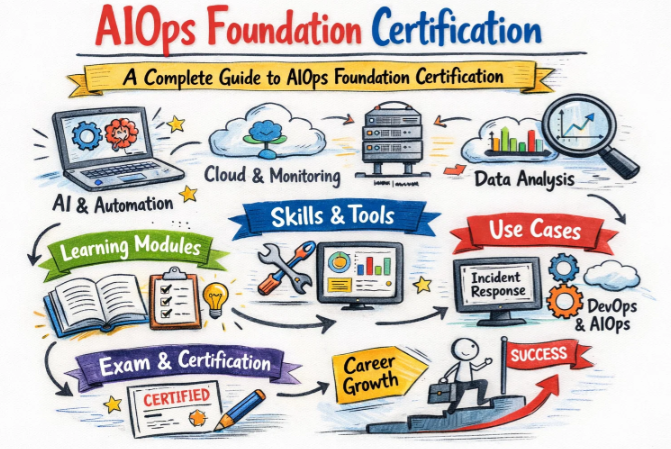
Introduction
The IT landscape is moving toward a state of complexity that human intervention alone can no longer manage. As systems become more distributed through microservices and ephemeral cloud-native architectures, the volume of telemetry data has exploded. This guide focuses on the AIOps Foundation Certification, a program designed to bridge the gap between traditional IT operations and machine learning.
Whether you are an SRE managing large-scale clusters or a DevOps engineer looking to automate incident response, understanding how to apply artificial intelligence to operations is no longer optional. This roadmap is crafted for professionals who want to move beyond basic monitoring and into the world of predictive maintenance and automated root cause analysis. By following the curriculum provided by AIOps School, engineers can transition from reactive troubleshooting to proactive system management.
This guide helps technical professionals and managers evaluate the practical utility of becoming certified in this domain. We will explore how this certification impacts your daily workflow, its relevance in the global market, and how it fits into a long-term career in platform engineering. Our goal is to provide a clear, unbiased perspective on how to leverage these skills to build more resilient and self-healing infrastructure.
What is the AIOps Foundation Certification?
The AIOps Foundation Certification is a professional credential that validates an engineer’s ability to integrate machine learning and big data analytics into IT operations. It represents a shift from manual threshold-based alerting to algorithmic-driven insights that can identify patterns in massive datasets. This certification exists because modern enterprises require a more sophisticated way to handle the “noise” generated by modern observability stacks.
The program focuses heavily on production-grade applications rather than abstract data science theories. It teaches engineers how to collect, aggregate, and analyze logs, metrics, and traces using AI models to improve the Mean Time to Detect (MTTD) and Mean Time to Resolve (MTTR). This aligns perfectly with modern engineering workflows where speed and reliability must coexist in a continuous delivery environment.
By obtaining this certification, a professional demonstrates they understand the lifecycle of an AIOps project, from data ingestion to model deployment and feedback loops. It emphasizes the practical use of historical data to predict future outages, which is a core requirement for any enterprise operating at scale. The curriculum is built to reflect the realities of managing complex hybrid-cloud environments where traditional monitoring tools often fall short.
Who Should Pursue AIOps Foundation Certification?
This certification is designed primarily for DevOps engineers, Site Reliability Engineers (SREs), and Cloud Architects who are responsible for maintaining system uptime. It is also highly beneficial for Security Operations Center (SOC) analysts who need to differentiate between normal traffic patterns and sophisticated cyber threats. Managers who oversee technical teams will find value in learning how AI can optimize their operational budget and team efficiency.
For beginners, it provides a structured entry point into the intersection of data science and systems engineering. For experienced professionals, it offers a way to modernize their toolkit and stay ahead of the automation curve. Even data professionals, such as DataOps or MLOps engineers, can benefit by learning how their models can be applied specifically to the health and performance of the infrastructure itself.
From a global perspective, the demand for AIOps skills is surging in major tech hubs, including the thriving engineering ecosystem in India. As Indian enterprises and global service providers move toward “Zero-Ops” or “No-Ops” models, having a foundational understanding of AI-driven operations becomes a significant competitive advantage. This certification ensures that your skills remain relevant regardless of the specific tools or cloud providers your organization chooses.
Why AIOps Foundation Certification is Valuable
The value of the AIOps Foundation Certification lies in its focus on longevity and enterprise-level adoption of smart automation. As organizations move away from simple automation scripts and toward intelligent decision-making systems, professionals who understand the underlying mechanics of AIOps will be the most sought after. It protects your career against the commoditization of basic administrative tasks by moving you into a high-value architectural role.
Enterprises are increasingly adopting AIOps to handle the sheer volume of data produced by Kubernetes clusters and serverless functions. By mastering these concepts, you enable your organization to reduce operational costs and avoid the catastrophic financial impact of unplanned downtime. The return on investment for this certification is high, as it directly addresses the most painful aspects of modern IT management: alert fatigue and slow incident response.
Furthermore, this certification helps engineers stay relevant even as specific tools change. While software like Prometheus, Grafana, or ELK stacks may evolve, the fundamental principles of data-driven operations remain the same. Investing time in this certification is an investment in your ability to lead digital transformation projects that rely on high-availability systems and data-backed performance optimization.
AIOps Foundation Certification Overview
The AIOps Foundation Certification program is delivered through a structured digital curriculum and assessment process. The program is designed to be accessible yet rigorous, ensuring that only those with a genuine understanding of the concepts receive the credential. It covers the essential pillars of AIOps, including data collection, pattern recognition, and the automation of remedial actions.
Participants are evaluated on their ability to apply AI concepts to real-world IT scenarios rather than just memorizing definitions. The assessment approach typically involves a mix of theoretical questions and scenario-based problems that mimic the challenges faced in a production environment. This ensures that the certification holds weight with hiring managers and technical leaders who value practical expertise over paper qualifications.
The ownership and structure of the program are designed to be vendor-neutral, meaning the skills you learn are applicable whether you work with AWS, Azure, Google Cloud, or on-premises data centers. It provides a holistic view of the operational lifecycle, emphasizing the need for a unified data strategy to feed AI models effectively. This structured approach helps professionals build a solid base before moving on to more specialized or advanced AIOps tracks.
AIOps Foundation Certification Tracks & Levels
The certification ecosystem is structured to support professionals at every stage of their career, starting with the Foundation level. The Foundation track introduces the core vocabulary, the AIOps lifecycle, and the basic mathematical concepts behind anomaly detection. It serves as the essential gateway for anyone looking to specialize in more advanced operational disciplines.
After mastering the foundation, engineers can progress to the Professional level, where the focus shifts to designing and deploying AIOps pipelines. At this stage, the curriculum becomes more technical, involving hands-on work with data streaming platforms and machine learning frameworks. Advanced levels are intended for architects and principal engineers who are responsible for the entire operational strategy of an organization.
Specialization tracks also allow professionals to align their AIOps learning with their specific job roles. For instance, an SRE might focus on tracks that emphasize predictive scaling and automated failover, while a FinOps practitioner might focus on AI-driven cost optimization. This alignment ensures that the certification path directly supports your day-to-day responsibilities and long-term career goals.
Complete AIOps Foundation Certification Table
| Track | Level | Who it’s for | Prerequisites | Skills Covered | Recommended Order |
| Core Operations | Foundation | Aspiring AIOps Engineers, DevOps engineers, Managers | Basic IT Ops knowledge | AIOps lifecycle, Data types, Anomaly detection basics | 1st |
| Site Reliability | Professional | SREs, System Administrators, Cloud Architects | Foundation Cert, Python/R knowledge | Predictive analytics, Root cause analysis automation | 2nd |
| Platform Engineering | Advanced | Principal Engineers, Technical Leads, Architects | Professional Cert, Experience in ML | Architecting AIOps platforms, Model governance | 3rd |
| Financial Ops | Specialist | FinOps Practitioners, Cloud Economists | Foundation Cert, Cloud billing knowledge | AI-driven cost forecasting, Anomaly-based spend detection | 2nd (Optional) |
| Security Ops | Specialist | Security Analysts, DevSecOps Engineers | Foundation Cert, Security basics | Behavioral analysis, Automated threat response | 2nd (Optional) |
Detailed Guide for Each AIOps Foundation Certification
AIOps Foundation Certification – Foundation Level
What it is
The Foundation level is the entry point that validates a candidate’s understanding of how artificial intelligence and machine learning transform standard IT operations. It confirms that the individual can speak the language of AIOps and understands the fundamental workflow of an AI-driven monitoring system.
Who should take it
This is ideal for DevOps engineers, SREs, and IT managers who are new to machine learning but have a solid background in infrastructure management. It is also suitable for technical recruiters or sales professionals who need to understand the technical nuances of the AIOps market.
Skills you’ll gain
- Understanding the difference between traditional monitoring and AIOps-driven observability.
- Identifying various data sources including logs, metrics, traces, and events for AI ingestion.
- Grasping the basics of pattern discovery and how AI reduces event noise.
- Knowledge of how to calculate the ROI of an AIOps implementation within an enterprise.
- Familiarity with the ethical and practical challenges of automating operational decisions.
Real-world projects you should be able to do
- Designing a high-level architecture for an AIOps data pipeline.
- Identifying “noisy” alerts in a legacy monitoring system and proposing an AI-based filtering strategy.
- Creating a roadmap for transitioning a traditional NOC to a modern, AI-enhanced SOC/NOC.
Preparation plan
- 7–14 days: Focus on core definitions, the AIOps lifecycle, and reading industry whitepapers on AI in operations.
- 30 days: Engage with online labs, study case studies of successful AIOps deployments, and take practice exams.
- 60 days: Deep dive into the mathematical concepts of anomaly detection and experiment with open-source AIOps tools in a sandbox.
Common mistakes
- Focusing too much on specific coding languages and not enough on the operational workflow and logic.
- Assuming that AIOps is a “magic bullet” that requires no data cleaning or human oversight.
- Underestimating the importance of data quality; “garbage in, garbage out” applies heavily to AIOps models.
Best next certification after this
- Same-track option: AIOps Professional Certification.
- Cross-track option: Certified SRE Professional.
- Leadership option: ITIL Leader: Digital and IT Strategy.
Choose Your Learning Path
DevOps Path
The DevOps path focuses on integrating AI into the Continuous Integration and Continuous Deployment (CI/CD) pipeline. Engineers learn how to use AI to predict the success of a build or a deployment based on historical data patterns. This reduces the risk of deploying faulty code and automates the rollback process when anomalies are detected. It bridges the gap between development speed and operational stability.
DevSecOps Path
In this path, the focus shifts to using AI for proactive security monitoring and automated vulnerability assessment. Professionals learn how to identify abnormal user behavior or network traffic that might indicate a zero-day exploit or an insider threat. By applying AIOps principles to security, teams can respond to breaches in milliseconds rather than hours. This path is essential for organizations operating in highly regulated industries.
SRE Path
The Site Reliability Engineering path leverages AIOps to maintain strict Service Level Objectives (SLOs) and Error Budgets. SREs use machine learning to automate incident management, from initial detection to the execution of self-healing scripts. This path emphasizes the reduction of “toil” by letting AI handle repetitive operational tasks. It is the most technically demanding path, requiring a deep understanding of distributed systems and data science.
AIOps Path
This specialized track is for those who want to become pure AIOps architects, focusing on the infrastructure of AI itself. You will learn how to build and maintain the platforms that ingest petabytes of operational data and run complex models in real-time. This includes mastering data lakes, stream processing, and model lifecycle management specifically for IT operations data. It is the core path for those leading an organization’s AI transformation.
MLOps Path
The MLOps path focuses on the operationalization of machine learning models across the entire business, not just IT ops. It applies DevOps principles to the ML lifecycle, ensuring that models are trained, tested, and deployed reliably. While it shares tools with AIOps, the goal here is to manage the health of the machine learning models themselves. This path is crucial for organizations where AI is a core product
DataOps Path
DataOps focuses on the automated, policy-based management of data used by AI models. This path ensures that the data being fed into AIOps systems is clean, relevant, and delivered with low latency. Professionals learn how to build robust data pipelines that can handle the massive variety and volume of IT telemetry. Without strong DataOps, any AIOps initiative is likely to fail due to poor data quality.
FinOps Path
The FinOps path uses AI to manage and optimize cloud spending in real-time. Professionals learn how to identify cost anomalies, such as a developer accidentally leaving a high-performance instance running. AI models are used to forecast future spending and suggest the most cost-effective resource allocations. This path is highly valued by management as it directly impacts the organization’s bottom line and operational efficiency.
Role → Recommended Certifications Table
| Role | Recommended Certifications |
| DevOps Engineer | AIOps Foundation, Certified Kubernetes Administrator (CKA) |
| SRE | AIOps Foundation, SRE Professional, Chaos Engineering Practitioner |
| Platform Engineer | AIOps Foundation, HashiCorp Certified: Terraform Associate |
| Cloud Engineer | AIOps Foundation, AWS/Azure Solutions Architect |
| Security Engineer | AIOps Foundation, DevSecOps Professional, CISSP |
| Data Engineer | AIOps Foundation, Google Professional Data Engineer |
| FinOps Practitioner | AIOps Foundation, FinOps Certified Practitioner |
| Engineering Manager | AIOps Foundation, ITIL 4 Foundation, PMP |
Next Certifications to Take After AIOps Foundation Certification
Same Track Progression
Once the Foundation level is secured, the logical next step is to move into the Professional and Advanced tiers of AIOps. These certifications allow you to move from understanding concepts to actually architecting complex, self-healing systems. You will likely dive deeper into specific AI frameworks and big data technologies like Apache Spark or Flink. This progression cements your status as a subject matter expert in AI-driven operations.
Cross-Track Expansion
For those who want to be more versatile, expanding into SRE or DevSecOps certifications is highly recommended. Understanding AIOps gives you a “superpower” in these other fields, as you can approach security or reliability problems with a data-driven mindset. Broadening your skills this way makes you a prime candidate for “T-shaped” roles where you have deep expertise in one area and broad knowledge in others.
Leadership & Management Track
If your goal is to move into technical leadership, combining AIOps knowledge with management certifications like ITIL or PMP is a powerful move. It allows you to lead digital transformation efforts with a clear understanding of the technical possibilities and limitations of AI. You will be able to speak both the language of the business (ROI, budgets) and the language of the engineers (anomaly detection, latency).
Training & Certification Support Providers for AIOps Foundation Certification
DevOpsSchool
DevOpsSchool is a prominent training provider that focuses on providing hands-on experience in the DevOps and AIOps domains. They offer a variety of courses designed to take engineers from a basic level to an advanced professional stage. Their curriculum often includes real-world projects and lab environments that simulate actual production issues. This practical approach is highly beneficial for those who want to apply their knowledge immediately in their workplace. They are known for their community support and extensive library of learning resources that help candidates stay updated on the latest industry trends and toolsets.
Cotocus
Cotocus specializes in delivering high-quality corporate training and consulting services in the areas of cloud-native technologies and AIOps. They pride themselves on having a faculty of industry experts who bring years of practical experience into the virtual or physical classroom. Their training modules are structured to be intensive and outcome-oriented, making them a popular choice for organizations looking to upskill their entire engineering teams. Cotocus also provides specialized guidance on certification paths, helping professionals choose the right track based on their career aspirations and current skill levels. Their focus on emerging technologies ensures that learners are always at the cutting edge.
Scmgalaxy
Scmgalaxy is a community-driven platform that has been a staple in the software configuration management and DevOps community for over a decade. They offer a wealth of free resources, tutorials, and specialized training programs focused on automation and AIOps. The platform is excellent for self-starters who want to learn through a mix of community interaction and structured course content. Scmgalaxy often hosts webinars and workshops featuring industry leaders, providing learners with a broader perspective on how AIOps is being implemented across different sectors globally. Their extensive experience in the field makes their certification support highly reliable and practical.
BestDevOps
BestDevOps focuses on providing streamlined, efficient training paths for professionals who want to master modern operational practices. Their AIOps Foundation training is designed to be concise yet comprehensive, covering all the essential topics required to pass the certification exam. They prioritize clarity and ease of learning, making complex AI concepts accessible to engineers who may not have a background in data science. BestDevOps is an ideal choice for busy professionals who need to gain high-value skills in a relatively short amount of time without sacrificing depth of understanding or practical application.
devsecopsschool.com
DevSecOpsSchool is a specialized training portal that emphasizes the critical intersection of development, security, and operations. Their AIOps curriculum is uniquely tailored to highlight how artificial intelligence can enhance security protocols and automate threat detection. They provide in-depth training on using ML models to identify vulnerabilities in the CI/CD pipeline and in production environments. For professionals who are focused on the security aspect of IT operations, this provider offers a highly specialized and relevant perspective that is not often found in more general AIOps courses. Their labs are specifically designed to simulate security incidents and AI-driven responses.
sreschool.com
SRESchool is dedicated to the principles of Site Reliability Engineering and how they can be scaled using modern technology. Their support for the AIOps Foundation Certification is centered around the concept of “error budgets” and “toil reduction.” They teach students how AI can be the primary tool for an SRE to manage massive scales without a proportional increase in headcount. The training provided here is deeply technical and focuses on the metrics that matter most to system reliability. For anyone pursuing an SRE career path, this school provides the necessary context to make AIOps skills truly effective in a production-heavy environment.
aiopsschool.com
AIOpsSchool is the primary hub for professionals seeking specialized credentials in Artificial Intelligence for IT Operations. They host the official AIOps Foundation Certification and provide the most direct and relevant training materials for the program. Their curriculum is developed by experts who are actively working on AIOps implementations in major enterprises. By focusing solely on this niche, they offer a depth of knowledge and a range of specialized tracks that are hard to find elsewhere. Learners at AIOpsSchool benefit from a curriculum that is constantly updated to reflect the latest advancements in machine learning and observability technologies.
dataopsschool.com
DataOpsSchool addresses the foundational layer of any AI initiative: the data itself. Their training programs are essential for AIOps candidates who want to understand how to build the high-performance data pipelines required for real-time monitoring. They focus on data quality, governance, and the automated movement of telemetry data across the enterprise. By learning the principles of DataOps, engineers can ensure that their AIOps models are always working with the most accurate and timely information. This provider is crucial for those who want to specialize in the “Big Data” side of IT operations and infrastructure management.
finopsschool.com
FinOpsSchool provides specialized training on how to use AIOps principles for cloud financial management. Their courses explain how AI can be used to predict cloud spending patterns and identify opportunities for cost savings that are invisible to the human eye. In an era where cloud costs are a major concern for every enterprise, the skills taught here are in extremely high demand. They bridge the gap between technical operations and financial accountability, helping professionals become “cloud economists.” Their AIOps support focuses heavily on regression models and forecasting techniques applied to billing data and resource utilization metrics.
Frequently Asked Questions (General)
- How difficult is the AIOps Foundation Certification?
The certification is moderately challenging. It requires a solid understanding of IT operations and a willingness to learn basic machine learning concepts. It is designed to be achievable for working professionals with some effort. - How long does it take to prepare for the exam?
Most candidates with an engineering background spend 30 to 60 days preparing. This allows for a mix of reading, watching videos, and hands-on practice. - Are there any mandatory prerequisites?
While there are no strict formal prerequisites for the Foundation level, a basic understanding of Linux, networking, and standard monitoring tools is highly recommended. - What is the return on investment (ROI) for this certification?
Professionals often see a significant increase in salary and job opportunities. Enterprises are willing to pay a premium for engineers who can reduce downtime using AI. - In what order should I take the certifications?
Start with the Foundation level, move to Professional, and then specialize in a track like SRE, Security, or FinOps based on your career goals. - Is this certification recognized globally?
Yes, AIOps is a global trend, and this certification is recognized by major tech companies and service providers across the world, including India, Europe, and North America. - Does the certification expire?
Most professional certifications require renewal or continuing education every two to three years to ensure your skills remain current with technology changes. - Can I pass the exam with just self-study?
Yes, self-study is possible using the recommended resources, but many find that structured training from a provider significantly increases their chances of passing. - How much coding is required for the Foundation level?
The Foundation level focuses more on concepts and logic than deep coding. However, knowing basic Python or Shell scripting is helpful for the practical parts. - Is AIOps only for large enterprises?
While large enterprises have the most data, small and medium businesses are increasingly using AIOps tools to manage their cloud infrastructure more efficiently. - How does AIOps differ from standard automation?
Standard automation follows fixed rules (“if this, then that”). AIOps uses machine learning to find patterns and make decisions that haven’t been explicitly programmed. - Will AI replace DevOps engineers?
No, AI is a tool that augments the capabilities of DevOps engineers. It handles the repetitive data analysis, allowing engineers to focus on higher-level architectural tasks.
FAQs on AIOps Foundation Certification
- What specific AI models are covered in the Foundation curriculum?
The curriculum focuses on anomaly detection, clustering for alert grouping, and regression for forecasting. It explains the “why” behind these models in an operational context. - Does the exam involve hands-on lab exercises?
The Foundation exam is primarily multiple-choice and scenario-based, but advanced levels usually include hands-on labs where you must configure an AIOps pipeline. - Can I take the exam online?
Yes, the certification exam is typically offered through an online proctored platform, allowing you to take it from the comfort of your home or office. - What is the passing score for the AIOps Foundation exam?
The passing score is generally around 70%, though this can vary slightly depending on the specific version of the exam and the hosting platform. - Are there any study groups or communities I can join?
Platforms like Scmgalaxy and AIOpsSchool have active communities where you can ask questions and share study tips with other candidates. - What kind of documentation should I study for the exam?
Focus on official course materials, industry whitepapers on observability, and the documentation for major AIOps tools like Moogsoft, BigPanda, or Dynatrace. - Does this certification cover open-source AIOps tools?
Yes, the certification is vendor-neutral and covers the application of open-source tools like ELK stack, Prometheus, and various ML libraries in an operational setting. - How does this certification help with career progression?
It validates your expertise in a niche, high-growth area, making you a strong candidate for Senior SRE, Platform Lead, or AIOps Architect roles.
Final Thoughts: Is AIOps Foundation Certification Worth It?
From a mentor’s perspective, the AIOps Foundation Certification is a strategic move for any engineer who wants to stay relevant in the coming decade. We are past the point where manual monitoring can keep up with the scale of modern systems. Learning how to leverage AI is not about chasing a buzzword; it is about adopting the only viable method for managing the future of IT infrastructure.
The certification provides a structured way to learn a complex subject that can otherwise feel overwhelming. It forces you to understand the data lifecycle, which is a skill that translates to almost every other technical domain. While the certificate itself is a great addition to your resume, the real value is the shift in mindset from being a “firefighter” to being a “system architect” who builds resilient, intelligent platforms.
My advice is to approach this not just as a test to pass, but as a framework for your professional development. Use the concepts you learn to improve your current projects. If you can show your employer how you used AI to reduce alert noise or predict a failure, the certification will have paid for itself many times over. It is a solid, practical investment in a world where data-driven operations are the new standard.
