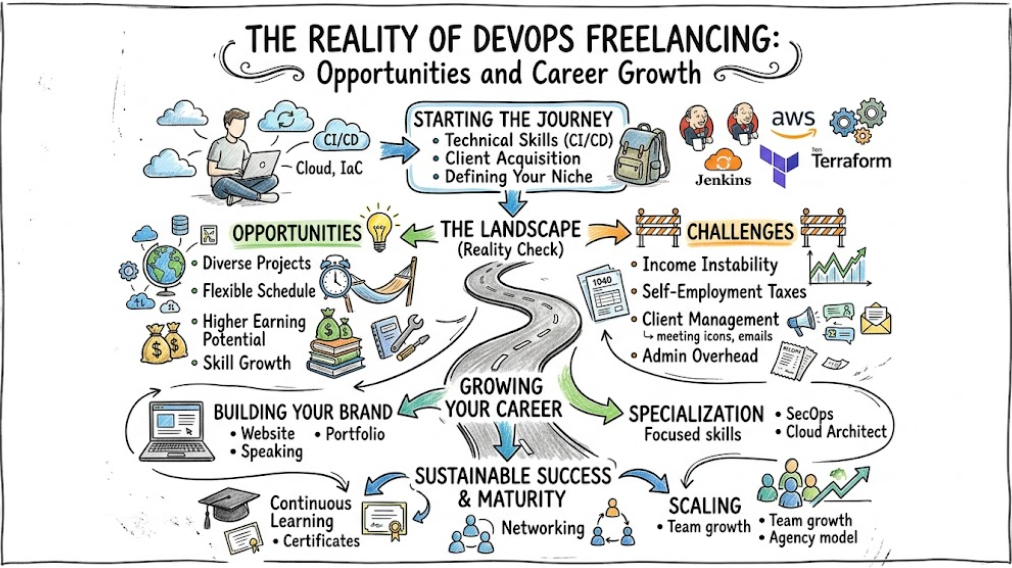
Introduction
The landscape of software development and IT infrastructure has shifted dramatically toward cloud-native architectures and rapid automation. As organizations across the globe race to implement efficient CI/CD pipelines and scalable infrastructure, the demand for specialized talent has outpaced the supply of full-time employees.
Freelancing in the DevOps space is no longer just a trend; it is a strategic career choice for those who thrive on variety, continuous learning, and technical autonomy. Whether it is helping a startup migrate their legacy infrastructure to the cloud or assisting an enterprise in adopting GitOps practices, the opportunities are vast. For professionals looking to gain a foothold in this sector, resources like DevOpsSchool offer the foundational knowledge and practical training necessary to navigate this transition effectively. In this guide, we will explore the practical realities of building a sustainable career as a remote DevOps engineer.
What Does a DevOps Freelancer Do?
A DevOps freelancer serves as an external consultant who bridges the gap between software development and IT operations. Unlike a full-time employee embedded in one team, a freelancer is often brought in to solve specific, high-impact problems.
- CI/CD Automation: Designing and maintaining pipelines that allow teams to deploy code faster and more reliably.
- Cloud Infrastructure Management: Provisioning and managing resources on platforms like AWS, Azure, or GCP.
- Kubernetes Consulting: Helping companies containerize their applications and manage clusters efficiently.
- Infrastructure as Code (IaC): Writing scripts to automate the setup of environments, ensuring consistency across development, staging, and production.
- Monitoring and Observability: Implementing systems to track performance and alert teams to potential issues before they impact users.
Real-World Example: A client might hire a freelancer for a three-month project to migrate their monolithic application to a microservices architecture on AWS, requiring the setup of EKS (Elastic Kubernetes Service) and automated deployment pipelines using Terraform and GitHub Actions.
Why DevOps Freelancing Is Growing
The growth of this career path is driven by the global shift toward digital transformation.
- Cloud Adoption: As more businesses move away from on-premise hardware, the need for cloud-fluent engineers has skyrocketed.
- Startup Ecosystem: Startups often need senior-level DevOps expertise but cannot afford a full-time, high-salaried senior engineer, making them ideal clients for freelancers.
- Remote Engineering Culture: Modern tools have made it possible to manage global infrastructure from anywhere, breaking down geographical barriers for talent.
- Cost Efficiency for Business: Engaging a freelancer for a specific project allows companies to get expert help without the long-term overhead costs of a full-time hire.
Skills Required to Become a DevOps Freelancer
To be successful, you must move beyond basic tool knowledge and focus on architectural problem-solving.
- Linux Administration: The backbone of most infrastructure. You must be comfortable with the command line, permissions, and service management.
- Networking Fundamentals: Understanding DNS, VPCs, subnets, and load balancing is non-negotiable when designing cloud environments.
- Cloud Platforms: Proficiency in at least one major provider (AWS, Azure, or GCP).
- Docker & Kubernetes: The current industry standards for application deployment and orchestration.
- CI/CD Pipelines: Experience with tools that automate the software delivery lifecycle.
- Infrastructure as Code: Ability to define infrastructure through code (Terraform, Pulumi).
- Scripting & Automation: Proficiency in Bash, Python, or Go to glue different parts of the pipeline together.
- Security Basics (DevSecOps): Implementing security guardrails within the automation process.
- Communication Skills: The ability to explain complex technical concepts to non-technical stakeholders.
Best Cloud Platforms for Freelance DevOps Engineers
| Platform | Best For | Difficulty Level | Enterprise Demand |
| AWS | Overall versatility and market share | Moderate | Very High |
| Azure | Integration with Microsoft ecosystems | Moderate | High |
| Google Cloud | Data, ML, and Kubernetes (GKE) focus | Higher | Growing |
Popular DevOps Tools Freelancers Should Learn
| Tool | Purpose | Enterprise Usage | Learning Difficulty |
| Terraform | IaC provisioning | Very High | Moderate |
| Kubernetes | Orchestration | High | High |
| Jenkins | CI/CD Automation | High | Moderate |
| GitHub Actions | Pipeline automation | Growing | Low |
| Prometheus | Monitoring | High | Moderate |
Step-by-Step Roadmap to Become a DevOps Freelancer
- Foundation Phase: Spend 3–6 months mastering Linux and networking. These are the skills that never go out of style.
- Cloud & Containerization: Pick one cloud provider and learn Docker and Kubernetes deeply.
- Automation Mastery: Learn IaC and CI/CD tools by building end-to-end projects.
- Portfolio Building: Document your projects in GitHub and create a simple website showcasing your work.
- Entry to Market: Start by contributing to open-source projects or offering low-cost consulting to build your reputation.
- Scale: Once you have testimonials, start charging for your value based on project complexity rather than just hours worked.
How to Build a Strong DevOps Portfolio
A strong portfolio proves your competence before a client even speaks to you.
- GitHub Repositories: Keep your code clean, well-documented, and modular.
- CI/CD Demos: Show a repository that automatically tests and deploys a sample application to a cloud environment.
- Kubernetes Deployments: Host a multi-container application on a small cluster and demonstrate how you handle scaling.
- Monitoring Dashboards: Include screenshots or links to Grafana dashboards that visualize metrics.
Best Freelance Services DevOps Engineers Can Offer
- CI/CD Pipeline Setup: Creating robust, automated deployment processes for growing teams.
- Kubernetes Migration: Moving applications from VMs to containers.
- Cloud Migration Consulting: Auditing and executing the move of legacy apps to the cloud.
- Infrastructure as Code Audit: Refactoring manual configurations into clean, reusable Terraform scripts.
- SRE Support: Providing off-hours or overflow support for incident response.
Where to Find DevOps Freelance Clients
- Freelance Marketplaces: Platforms like Upwork or Toptal are starting points for beginners.
- LinkedIn Networking: Share your technical learnings consistently to attract recruiters and business owners.
- Startup Communities: Engage in niche forums or Slack groups where tech startups hang out.
- Referrals: Your best source of work will eventually be word-of-mouth from satisfied clients.
Freelance Pricing & Project Models
| Pricing Model | Best For | Advantages | Challenges |
| Hourly | Support/Ad-hoc tasks | Simple to track | No incentive for speed |
| Fixed-Price | Defined projects | Clear client expectations | Risk of scope creep |
| Retainer | Long-term maintenance | Predictable income | Requires high trust |
Challenges in DevOps Freelancing
- Scope Creep: Clients often add features mid-project. Always have a written agreement.
- On-call Burden: Clarify if you are responsible for 24/7 support.
- Time Management: As a freelancer, you are your own salesperson, accountant, and engineer.
- Continuous Learning: You must invest time in learning new tools even when you are busy with projects.
Soft Skills Needed for DevOps Freelancers
- Communication: Being able to say “no” or “this is not possible” respectfully is essential.
- Documentation: Always leave your client with clear, readable documentation for the infrastructure you built.
- Client Handling: Manage expectations early and communicate proactively about delays.
DevOps Freelancer vs Full-Time DevOps Engineer
| Feature | DevOps Freelancer | Full-Time DevOps Engineer |
| Flexibility | High | Low |
| Income Stability | Variable | Steady |
| Variety | High (multiple clients) | Low (one stack) |
| Benefits | You manage your own | Provided by employer |
Certifications That Help DevOps Freelancers
While experience is king, certifications act as a signal of competence to potential clients.
| Certification | Best For | Skill Level | Focus Area |
| AWS Solutions Architect | Cloud Strategy | Intermediate | Architecture |
| CKA (Kubernetes) | Container Management | Advanced | Kubernetes |
| Terraform Associate | Automation | Beginner/Int. | IaC |
You can explore various training paths for these through the learning ecosystems provided by organizations like DevOpsSchool.
Real-World Freelance DevOps Scenarios
- The “Legacy Rescue”: A small firm has a server that keeps crashing. You are hired to audit the logs, implement monitoring, and move them to a stable auto-scaling cloud environment.
- The “Pipeline Overhaul”: A development team is deploying code manually via FTP. You build a GitHub Actions pipeline that automates testing, building, and deploying their code to production.
Common Mistakes Beginners Make
- Ignoring Fundamentals: Trying to learn Kubernetes before understanding basic Linux commands.
- Broad Focus: Trying to learn every tool at once instead of mastering one cloud and one CI/CD tool.
- Underpricing: Charging too little devalues your expertise and attracts clients who are difficult to work with.
Future of DevOps Freelancing
The future is bright for those who embrace Platform Engineering and AI-assisted operations. As automation becomes standard, the value of a DevOps freelancer will shift toward designing high-level, self-service platforms that allow developers to deploy their own infrastructure safely.
FAQs
- Can beginners become DevOps freelancers? It is difficult. Usually, 1–2 years of hands-on experience is recommended before freelancing.
- How long does it take to start? Depending on your prior IT experience, it can take 6–12 months of focused learning.
- Which cloud platform is best? AWS currently has the highest market share and demand for freelancers.
- Is Kubernetes necessary? It is highly recommended if you want to work with medium-to-large scale clients.
- How do I find clients? Focus on LinkedIn and building a public portfolio of your projects.
- Do I need certifications? They help with credibility, but a strong GitHub portfolio is often more persuasive.
- Can this be a full-time career? Absolutely. Many freelancers earn as much or more than full-time employees.
- What if I don’t know a specific tool? The best skill is the ability to learn a new tool quickly based on your solid fundamentals.
- Do I need a degree? Not strictly. Skills and proven results are what clients pay for.
- How do I handle taxes? Consult a local accountant, as freelance tax requirements vary by region.
- Is the market saturated? While there are many freelancers, there is always a shortage of truly skilled ones.
- How do I price my first project? Research industry standards and start with a competitive rate for your level of experience.
- Do I need my own hardware? A reliable laptop and a stable internet connection are sufficient for 99% of tasks.
- How do I deal with client stress? Clear contracts and frequent communication prevent most misunderstandings.
- Where to learn? Use resources like DevOpsSchool to structure your learning path.
Final Thoughts
Becoming a DevOps freelancer is a journey of continuous improvement. It requires a balance of deep technical skill, professional reliability, and a business mindset. Do not be intimidated by the breadth of tools in the DevOps ecosystem. Start by mastering the fundamentals, build projects that solve real problems, and be patient with your growth. The best freelance DevOps engineers are those who view every project as an opportunity to build trust and deliver lasting value.
