Introduction
The landscape of software delivery has shifted dramatically. Where once large teams managed monolithic environments, the modern era is defined by cloud-native startups and agile enterprises that rely on distributed, remote engineering talent. This transition has sparked an immense demand for experts who can bridge the gap between development and operations without the constraints of a traditional full-time role.
As a professional in this field, you likely see the pattern: businesses need agility, scalability, and robust automation, but they do not always need a permanent, full-time headcount to achieve it. This is where the role of the freelance engineer becomes critical. However, success in this space is not just about writing scripts; it is about mastering the specific DevOps freelancer skills that solve real business pain points.
Whether you are looking to refine your technical edge or transition from a permanent role into independent consulting, understanding the intersection of automation, cloud architecture, and communication is vital. For those serious about formalizing their journey, platforms like DevOpsSchool provide the structured learning paths necessary to navigate these high-demand technologies effectively. This guide breaks down exactly what clients are looking for and how you can position yourself as a go-to consultant in the cloud-native ecosystem.
What Does a DevOps Freelancer Do?
At its core, a freelance DevOps engineer acts as a bridge, a problem solver, and a builder of efficient delivery systems. Unlike a standard employee who might focus on a single product’s long-term maintenance, a freelancer is often hired to solve specific, high-impact challenges.
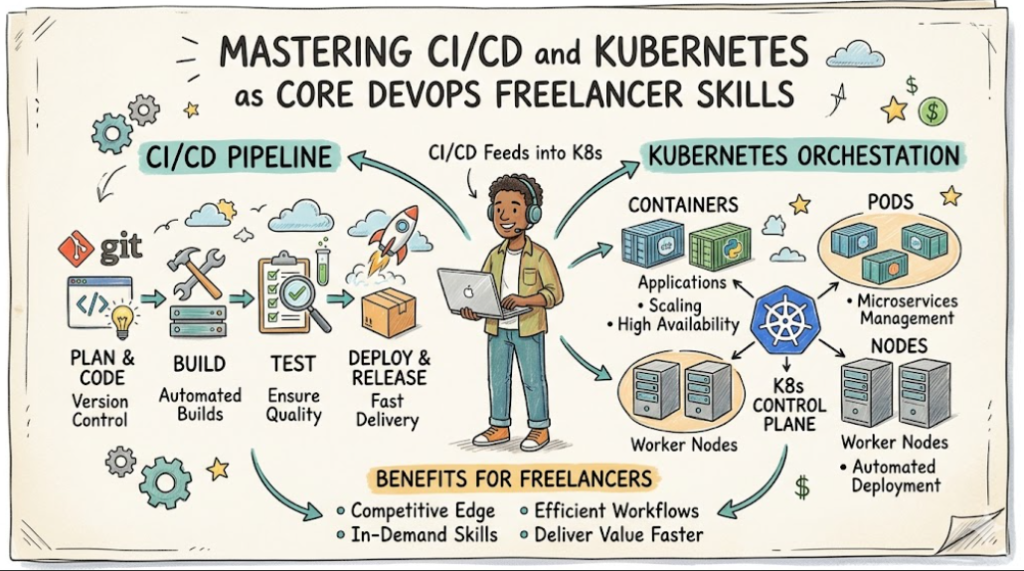
- CI/CD Implementation: Designing and maintaining automated pipelines that allow developers to push code to production safely and frequently.
- Cloud Infrastructure Management: Provisioning and managing resources on platforms like AWS, Azure, or GCP to ensure cost-efficiency and performance.
- Kubernetes Operations: Managing container orchestration, scaling workloads, and ensuring high availability for microservices.
- Monitoring and Automation: Setting up observability stacks to detect issues before they impact users and automating manual, repetitive tasks to save the client time.
Essentially, you are hired to make the client’s software delivery process faster, cheaper, and more reliable.
Why Companies Hire DevOps Freelancers
Companies—ranging from early-stage startups to established enterprises—turn to freelancers for very specific strategic reasons.
- Cost-Effective Expertise: Small companies often need enterprise-level DevOps practices but cannot justify the salary of a full-time senior architect. They hire freelancers for specific projects.
- Faster Project Delivery: When a company needs to migrate to the cloud or set up a new Kubernetes cluster, they need an expert who can hit the ground running, not someone who needs months of onboarding.
- Specialized Knowledge: A full-time team might lack experience with a specific tool (e.g., migrating to Terraform or setting up Prometheus). Freelancers bring this specialized “niche” expertise.
- Temporary Scaling: During a major product launch or infrastructure overhaul, a company may need extra hands to manage the load and ensure stability.
Evolution of DevOps Freelancing
DevOps freelancing has evolved alongside the shift to cloud-native technologies.
- The Early Days: Consulting was often focused on manual server administration and basic script automation.
- The Cloud Era: As AWS, Azure, and GCP gained dominance, the focus shifted to managing remote infrastructure, leading to the “Cloud Architect” freelance model.
- The Current Landscape: Today, the focus is on Kubernetes, GitOps, and platform engineering. Clients are no longer just asking for servers; they are asking for fully automated, self-healing platforms. This evolution has made the role of a freelance consultant more complex but significantly more valuable.
Core DevOps Freelancer Skills Every Client Loves
To thrive as a freelancer, you must possess a T-shaped skill set: broad knowledge across the entire software delivery lifecycle, with deep expertise in a few critical areas.
Skill 1: Linux Administration
Linux is the backbone of the internet. You cannot be an effective DevOps consultant if you cannot navigate a terminal, manage file systems, troubleshoot process bottlenecks, or configure firewalls. Most cloud instances run on Linux, and mastery of Bash scripting for task automation is a foundational requirement.
Skill 2: CI/CD Pipeline Automation
Clients want to ship code fast. Your job is to make that happen. You should be proficient in building pipelines using tools like Jenkins, GitHub Actions, or GitLab CI/CD. The goal is to create a seamless journey from a developer’s local commit to a production environment.
Skill 3: Kubernetes Expertise
Kubernetes is the standard for container orchestration. Clients expect you to know how to deploy applications using Helm charts, manage namespaces, configure ingress controllers, and scale deployments based on resource usage.
Skill 4: Docker & Containerization
Before you orchestrate containers, you must build them. This involves writing efficient Dockerfiles, optimizing image sizes to reduce deployment times, and understanding multi-stage builds to maintain security and performance.
Skill 5: Cloud Computing Knowledge
Whether it is AWS, Azure, or Google Cloud, you must understand how to provision Virtual Private Clouds (VPCs), manage Identity and Access Management (IAM), and optimize resource costs. A client loves a consultant who knows how to save them money on their monthly cloud bill.
Skill 6: Infrastructure as Code (IaC)
Manual configuration is a “no-go” in modern DevOps. Tools like Terraform and Ansible allow you to define infrastructure in code, making it version-controlled and reproducible. This is perhaps the most requested skill for any freelance cloud project.
Skill 7: Monitoring & Observability
If you cannot measure it, you cannot manage it. Clients need to know if their system is healthy. You must be skilled in setting up dashboards in Grafana, collecting metrics with Prometheus, and centralizing logs with the ELK stack or Datadog.
Skill 8: Networking Fundamentals
Cloud-native applications depend heavily on networking. You must understand DNS, load balancing, reverse proxies (like Nginx), and how to secure communication between microservices within a Kubernetes cluster.
Skill 9: Security & DevSecOps Awareness
Security can no longer be an afterthought. You should know how to scan containers for vulnerabilities, manage secrets using tools like HashiCorp Vault, and ensure that your CI/CD pipelines are not exposing sensitive credentials.
Skill 10: Automation Mindset
This is not a tool; it is a philosophy. An automation-first mindset means that every time you perform a task twice, you ask yourself: “How can I script this?” Clients highly value freelancers who proactively identify and eliminate manual toil.
Soft Skills Every DevOps Freelancer Needs
Technical skills get you the interview, but soft skills get you the repeat contract.
- Communication Skills: You are often working with developers who may not have a DevOps background. You must be able to explain complex infrastructure changes in simple terms.
- Problem-Solving Ability: Systems fail. The ability to remain calm during a production incident and methodically debug the issue is what separates a good freelancer from a great one.
- Documentation Skills: When you leave a project, the client needs to understand what you built. Quality documentation is the hallmark of a professional.
- Time Management: As a freelancer, you are your own boss. You must manage your deadlines and balance the needs of multiple clients without burning out.
DevOps Freelancer vs Full-Time DevOps Engineer
| Feature | DevOps Freelancer | Full-Time DevOps Engineer |
| Flexibility | High (Choose your projects) | Low (Fixed schedule) |
| Project Variety | High (Exposure to many stacks) | Low (Deep dive into one stack) |
| Income Potential | High (Scalable per project) | Fixed (Steady salary) |
| Stability | Variable (Project-based) | High (Long-term) |
| Learning Speed | Very Fast | Moderate |
DevOps Freelancer Workflow Example
- Requirement Gathering: A meeting to understand the client’s current pain points (e.g., slow deployments or high cloud costs).
- Assessment: Audit the existing infrastructure and code repositories.
- Strategy: Propose an automation roadmap (e.g., “We will migrate to Terraform and build a CI/CD pipeline in GitHub Actions”).
- Implementation: Execute the setup in a staging environment.
- Validation: Test the pipelines, monitoring, and security protocols.
- Handover: Provide thorough documentation and conduct a training session for the client’s internal team.
- Maintenance: Offer periodic check-ins or retainer-based support.
Popular Tools DevOps Freelancers Must Know
| Tool | Purpose | Client Demand | Difficulty Level |
| Terraform | IaC | Very High | Medium |
| Kubernetes | Orchestration | High | Hard |
| Docker | Containerization | Very High | Easy |
| Jenkins | CI/CD | High | Medium |
| Prometheus | Monitoring | High | Medium |
| Ansible | Config Mgmt | Medium | Easy |
Industries Hiring DevOps Freelancers
- SaaS Startups: Need rapid deployment cycles and scalable infrastructure.
- E-Commerce: Require high availability and robust load balancing for seasonal traffic spikes.
- FinTech: Demand extreme security, auditability, and compliance-driven infrastructure.
- Healthcare: Focus on data privacy, secure cloud storage, and automated patching.
- Gaming: Need massive, low-latency scaling and efficient resource management.
Best Practices for Becoming a Successful DevOps Freelancer
- Master the Fundamentals: Never skip Linux and networking. Tools change, but these basics remain constant.
- Build a Portfolio: Create a “DevOps Lab” on GitHub. Show off your Terraform scripts, Kubernetes manifests, and CI/CD pipelines.
- Specialize: It is better to be a “Kubernetes Expert” than a “Generalist.”
- Networking: Join online communities and participate in open-source projects.
- Always Document: Every project should end with a clean README or a Wiki page.
Building a Strong DevOps Freelancer Portfolio
Clients need proof of competence. Your portfolio should include:
- Real-World CI/CD: A demo project that deploys a simple app to AWS or GCP automatically on every commit.
- Kubernetes Labs: A repository showcasing a multi-service deployment with Helm charts and ingress configurations.
- IaC Examples: Terraform code that provisions a secure, multi-tier VPC environment.
Certifications & Learning Paths
Hands-on experience is paramount, but certifications provide credibility to clients who may not be technical enough to evaluate your code directly.
| Certification | Best For | Skill Level | Focus Area |
| CKA | Kubernetes | Advanced | Cluster Ops |
| AWS Solutions Architect | Cloud | Intermediate | Architecture |
| Terraform Associate | IaC | Intermediate | Automation |
Note: Explore the DevOpsSchool learning ecosystem to find structured courses tailored for these certifications.
Future of DevOps Freelancing
The future is shifting toward Platform Engineering. Instead of just building pipelines, DevOps engineers are now expected to build internal developer platforms (IDP) that allow developers to self-service their infrastructure. AI-assisted operations (AIOps) are also emerging, where freelancers will be expected to integrate AI tools to predict system failures and optimize costs autonomously.
Career Growth Opportunities for DevOps Freelancers
- Freelance DevOps Consultant: High-level strategic advice for enterprise migrations.
- Kubernetes Specialist: Focused technical implementation for complex, containerized environments.
- Platform Engineering Consultant: Designing self-service infrastructure for large development teams.
- DevSecOps Freelancer: High-demand role focusing specifically on secure CI/CD and compliance.
FAQs
- What skills are required for DevOps freelancing? You need a mix of Linux, CI/CD, Kubernetes, Cloud (AWS/Azure/GCP), and IaC (Terraform).
- Is Kubernetes important for freelancers? Yes, it is currently the most requested technology in the cloud-native space.
- How do DevOps freelancers find clients? Through professional networking, maintaining an active portfolio on GitHub, and platforms like LinkedIn.
- Is Linux knowledge mandatory? Absolutely. It is the foundation of every cloud service you will manage.
- Which cloud platform should freelancers learn first? AWS is the most widely used, but focus on the one most popular in your target market.
- Are certifications important for freelancers? They are great for building trust with non-technical clients.
- Can beginners start DevOps freelancing? It is better to have at least 1-2 years of solid production experience before going fully freelance.
- How much can DevOps freelancers earn? Income varies by expertise and region, but it is generally significantly higher than full-time roles due to the project-based nature.
- What is the best way to handle production incidents? Have a clear monitoring and alerting strategy, and always maintain backups and rollback procedures.
- How do I manage multiple clients? Use project management tools and maintain strict time-tracking and communication schedules.
- Do I need to know programming? Basic knowledge of Python or Go is highly beneficial for automation tasks.
- What is GitOps? It is a modern approach to continuous delivery that uses Git as the single source of truth for infrastructure and application code.
- How do I stay updated? Follow industry blogs, newsletters, and the DevOpsSchool updates.
- Is networking really that important? Yes, cloud-native apps are distributed, and understanding how they talk to each other is vital.
- How do I price my services? Start with an hourly rate that reflects your experience, then transition to project-based pricing as you get faster.
Final Thoughts
The path of a DevOps freelancer is challenging, rewarding, and constantly evolving. Success requires more than just technical proficiency; it requires a mindset of continuous improvement, a commitment to automation, and the ability to communicate value to your clients.
Start by mastering the core fundamentals of Linux and networking, then build your way up to complex Kubernetes and IaC implementations. Always remember that clients are hiring you to solve problems, not just to write code. Stay curious, keep building, and treat every project as a chance to improve your craft.
