Canada has long been a top-tier destination for professionals and families seeking a stable, high-quality life. With its thriving economy, world-class healthcare, free public education, and a culture that celebrates diversity, it is no wonder millions dream of calling the Great White North their home.
However, moving to Canada requires navigating a robust immigration framework. The most critical step in this journey is understanding your eligibility through the Canada PR CRS Calculator. Whether you are an IT specialist, a nurse, or a fresh graduate, knowing your standing is the first step toward securing your future.
What Is a Canada PR CRS Calculator?
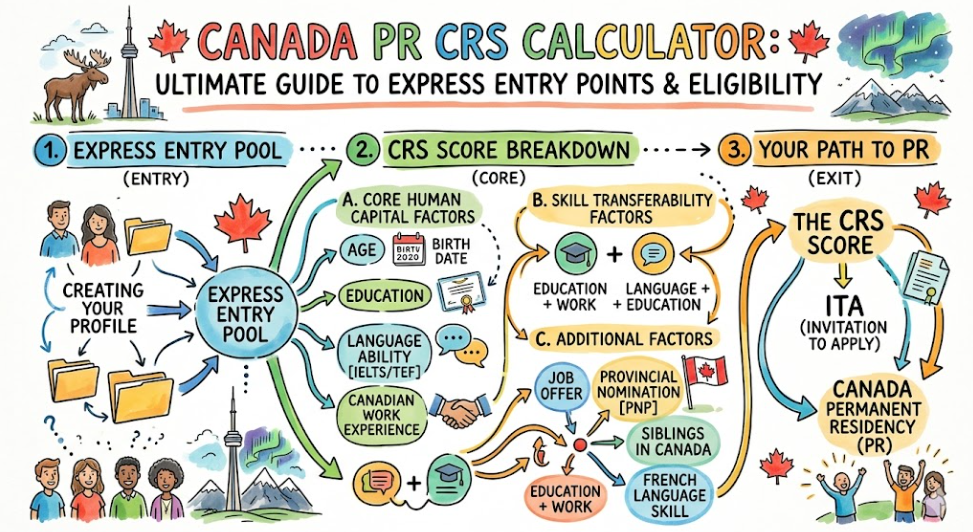
The Canada PR CRS Calculator is a tool used to estimate your Comprehensive Ranking System (CRS) score. The CRS is a points-based system that the Canadian government uses to rank candidates in the Express Entry pool.
Why Eligibility Checking Matters
- Strategic Planning: Knowing your score helps you identify which immigration programs you qualify for.
- Competitive Edge: It tells you exactly how you rank against other candidates.
- Gap Identification: It highlights exactly which areas—such as language skills or education—you need to improve to increase your chances.
How the System Works
Canada uses the Express Entry system to manage skilled worker applications. It is not a first-come, first-served process; it is a merit-based system. High-scoring candidates are invited to apply for permanent residency during regular draws.
Note: The “eligibility” score is different from your “ranking” score. You must first meet the minimum requirements for a program (like the Federal Skilled Worker Program) before your CRS score determines your position in the pool.
How Canada CRS Points System Works
Your CRS score is calculated based on four major pillars:
- Core Human Capital: Factors like age, education, and language.
- Spouse/Partner Factors: If you are applying with a partner, their credentials also contribute points.
- Skill Transferability: How well your education and experience translate into success in the Canadian labor market.
- Additional Points: Bonuses for provincial nominations, Canadian education, or having a sibling in Canada.
CRS Points Breakdown (Overview)
| Factor | Max Points (Approx.) |
| Age | 110 |
| Education | 150 |
| Language Skills | 160 |
| Canadian Work Experience | 80 |
| Provincial Nomination | 600 |
Canada Express Entry System Explained
Express Entry is the digital pipeline for Canada’s economic immigration. It manages three main federal programs:
- Federal Skilled Worker Program (FSWP): For professionals with foreign work experience.
- Canadian Experience Class (CEC): For those who have already worked in Canada.
- Federal Skilled Trades Program (FSTP): For qualified tradespeople.
Step-by-Step Example of Canada CRS Score Calculation
Example 1: The Software Engineer
- Age: 29 (Prime age for maximum points)
- Education: Master’s Degree (High points)
- Work Experience: 3 years foreign experience
- Language: IELTS CLB 9 (High proficiency)
- Result: A strong score, likely placing them well in the pool.
Example 2: The Healthcare Professional
- Age: 34
- Education: Bachelor’s Degree
- Work Experience: 5 years in a clinical setting
- Language: IELTS CLB 7
- Result: Highly competitive, especially if they qualify for category-based draws targeting healthcare workers.
How to Increase Canada CRS Score
If your score is below the current cut-off, don’t worry. You can boost it while in the pool:
- Retake Language Tests: Moving from CLB 8 to CLB 9 can jump your score by dozens of points.
- Gain Canadian Work Experience: Even one year of local experience significantly boosts your ranking.
- Educational Credential Assessment (ECA): Ensure all your degrees are assessed to maximize education points.
- Provincial Nomination (PNP): This is the “gold standard” boost, adding 600 points to your profile.
- Learn French: Achieving proficiency in both English and French provides bonus points.
Common Mistakes to Avoid
- Incorrect Information: Always double-check your NOC codes.
- Ignoring Language Requirements: A small dip in your test score can disqualify you from certain programs.
- Expired Documents: Ensure your ECA and police certificates are current.
- Overestimating CRS: Do not assume you have points for work experience that doesn’t meet the “skilled” criteria.
FAQs
1. What is a good CRS score?
Scores fluctuate, but generally, a score above 450–480 is considered strong in the current Express Entry environment.
2. Is IELTS mandatory?
Yes, unless you have specific exemptions, you need to prove your language proficiency through approved tests like IELTS or CELPIP.
3. Does age affect my score?
Yes, points for age begin to decrease after age 29.
4. Can I move to Canada without a job offer?
Yes, you can enter the Express Entry pool and receive an Invitation to Apply (ITA) based on your CRS score alone.
5. How long does the PR process take?
Most Express Entry applications are processed within six months once an ITA is issued.
6. Can students settle in Canada?
Yes, international students who graduate from a Canadian institution can often transition to PR through the CEC pathway.
7. How accurate are online calculators?
They are great for estimates, but always cross-verify your findings with the official IRCC website.
8. Are there jobs in demand?
Canada frequently issues category-based invitations for sectors like Healthcare, STEM, and Trades.
9. Can my family join me?
Yes, you can include your spouse and dependent children in your Express Entry application.
10. What if my CRS is too low?
Focus on improving language scores or obtaining a Provincial Nomination.
11. Is Express Entry the only way?
No, there are many provincial and employer-specific pathways, but it remains the most popular.
12. Does a job offer give me points?
While job offers don’t grant raw CRS points as they once did, they are vital for eligibility in certain streams.
Conclusion
The Canada PR CRS Calculator is your roadmap to Canadian permanent residency. By understanding where you stand, you can take proactive steps to strengthen your profile. Don’t wait for the “perfect” moment—start preparing your documents, improving your language skills, and exploring provincial pathways today. Your Canadian journey starts with a single step.
