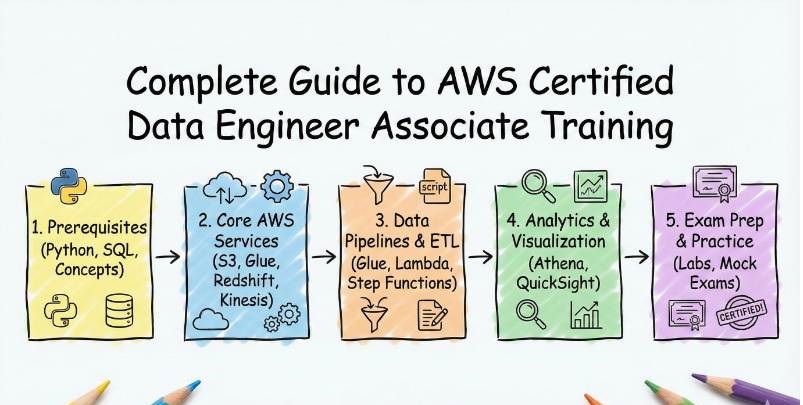
The modern engineering landscape has moved beyond the simple act of storing data. We are now in an era where the ability to move, clean, and protect that data at scale is what separates successful companies from the rest. Having spent a long career building and breaking systems, I have seen the focus shift from managing hardware to managing the flow of information. It is no longer enough to just write code; you must understand how that code interacts with massive data pipelines and cloud infrastructure.
For software engineers, managers, and cloud practitioners across India and the global market, specialization is the only way to remain competitive. The AWS Certified Data Engineer – Associate is the essential credential for those who want to prove they can handle the heavy lifting of data in the cloud. This guide is built to show you the way forward.
AWS Data Engineer Associate Training: The Big Picture
If you are trying to understand where this fits into your professional growth, this table provides the essential details.
| Track | Level | Who it’s for | Prerequisites | Skills Covered | Recommended Order |
| Data Engineering | Associate | Software Engs, Data Leads, Managers | 1-2 years cloud data work | Ingestion, ETL, Security, Data Lakes | After Solutions Architect Assoc. |
AWS Certified Data Engineer – Associate
What it is
The AWS Certified Data Engineer – Associate (DEA-C01) is a technical certification designed to validate your expertise in building and maintaining robust data pipelines. It isn’t just a broad cloud exam; it is a deep dive into the “plumbing” of AWS. It proves you can select the right services—like AWS Glue for batch work or Amazon Kinesis for live streams—to ensure data is delivered accurately and safely.
Who should take it
This is the ideal path for Software Engineers who want to pivot into data-centric roles, ETL Developers looking to move away from legacy tools, and Engineering Managers who need to vet the technical designs of their teams. If you are responsible for how data moves from point A to point B in the cloud, this is your certification.
Skills you’ll gain
Working through this training helps you adopt a “reliability-first” mindset. You will learn that data is a dynamic flow, not a static file.
- Pipeline Construction: Mastering the tools to pull data from scattered sources and move it into a central warehouse or data lake.
- Storage Logic: Learning how to organize S3, Redshift, and DynamoDB so that queries are fast but storage costs stay low.
- Operational Automation: Using AWS Step Functions and Managed Airflow to make sure your data tasks run on time, every time, without manual intervention.
- Security & Governance: Deepening your knowledge of AWS Lake Formation and KMS to ensure that data is encrypted and access is strictly controlled.
- Troubleshooting: Setting up CloudWatch logs and metrics to catch errors in the pipeline before they impact the business.
Real-world projects you should be able to do
After finishing this training, you will have the technical confidence to build production-grade systems.
- Live Analytics Engine: Create a system that captures user activity from an app, processes it instantly, and updates a business dashboard in real-time.
- Serverless Data Lake Architecture: Design a multi-stage S3 data lake that automatically categorizes and cleans raw data using AWS Glue.
- Secure Governance Layer: Set up a central control point where you can manage data permissions across different departments or global regions from one console.
- On-Premise to Cloud Migration: Lead the effort to move large, old databases from local servers into a modern Amazon Redshift environment with minimal downtime.
Preparation Plan
| Timeline | Action Strategy |
| 7–14 Days (The Sprint) | Perfect for those already working in AWS. Focus on “gap-filling” in areas like Glue and Redshift. Take 4-5 mock exams to get used to the question style. |
| 30 Days (The Standard) | Week 1-2: Ingestion and Storage (Kinesis, S3, Redshift). Week 3: Transformation and Workflow (Glue, Step Functions). Week 4: Security and Mock Exams. |
| 60 Days (The Deep Dive) | Recommended for software engineers new to data. Spend the first 30 days on hands-on labs. Use the second month to master the theory and complex exam scenarios. |
Common Mistakes
I have seen many experienced engineers fail this exam by overlooking the basics.
- Ignoring the Bill: AWS expects you to know how to save money. Choosing a high-performance service when a cost-effective one would do is a common wrong answer.
- Security as an Afterthought: Many focus only on the data movement. If you don’t understand IAM roles, bucket policies, and encryption keys, you will likely fail the security portion.
- Lack of CLI Knowledge: The exam often tests your understanding of the commands behind the buttons. Don’t just rely on the visual console; learn the underlying APIs.
- Poor Partitioning: Building an S3 data lake without a clear folder structure leads to slow performance and high costs. You must understand how to organize data logically.
Choose Your Path: 6 Career Directions
Data engineering is the foundation for many specialized tracks. This certification is a major asset in any of these paths:
- DevOps: Focus on building the automated infrastructure that supports data-heavy applications and ensures fast deployments.
- DevSecOps: Make data protection a priority by integrating security scans and encryption directly into the automated pipeline.
- SRE (Site Reliability Engineering): Ensure that massive data platforms stay online, perform well, and can handle traffic spikes without breaking.
- AIOps/MLOps: Build the high-quality data pipelines that are required to feed and train modern artificial intelligence models.
- DataOps: This is the core domain, focusing on the speed, quality, and collaborative nature of data delivery across the business.
- FinOps: Become the expert who manages cloud spending, ensuring that the company’s data architecture remains profitable and efficient.
Role → Recommended Certifications Mapping
| Role | Primary Certification | Secondary/Support Certs |
| Data Engineer | AWS Data Engineer Assoc. | AWS Solutions Architect Assoc. |
| DevOps Engineer | AWS DevOps Engineer Prof. | AWS Developer Assoc. |
| SRE | AWS SysOps Admin Assoc. | AWS DevOps Engineer Prof. |
| Platform Engineer | AWS Solutions Architect Prof. | CKA (Kubernetes) |
| Security Engineer | AWS Security Specialty | AWS Solutions Architect Assoc. |
| Cloud Engineer | AWS Solutions Architect Assoc. | AWS SysOps Admin Assoc. |
| FinOps Practitioner | AWS Cloud Practitioner | FinOps Certified Practitioner |
| Engineering Manager | AWS Cloud Practitioner | AWS Solutions Architect Assoc. |
Next Certifications to Take (Top 3 Options)
Based on industry research and trends for software engineers, consider these next steps:
- Option 1 (Same Track): AWS Certified Machine Learning – Associate. This allows you to bridge the gap between preparing data and actually building the models that use it.
- Option 2 (Cross-Track): AWS Certified Solutions Architect – Associate. This gives you a broader view of how data services interact with networking and general design.
- Option 3 (Leadership): PMP (Project Management Professional). For those moving into senior management, this bridges the gap between technical execution and business strategy.
Top Institutions for AWS Data Engineer Training
If you are looking for professional help to pass your certification, these institutions are highly recommended:
- DevOpsSchool: A premier institution that provides detailed, instructor-led bootcamps. They focus heavily on real-world projects and provide the hands-on labs you need to truly understand the AWS data ecosystem.
- Cotocus: Known for their deep technical training, Cotocus helps corporate teams and individuals bridge the gap between classroom theory and actual industry work in the cloud data space.
- Scmgalaxy: This institution offers training that covers the entire software lifecycle, helping data engineers understand how their work fits into the bigger picture of DevOps and supply chain management.
- BestDevOps: A great choice for those who want focused, fast-paced modules that help them upskill quickly in specific areas like AWS data services and automation.
- devsecopsschool: If your interest lies in protecting data, this school specializes in the intersection of security and engineering, teaching you how to build secure-by-default pipelines.
- sreschool: Their curriculum is designed around reliability and scalability, helping you build data systems that can handle massive traffic without failing.
- aiopsschool: This school focuses on the future of operations, teaching data engineers how their pipelines support modern AI and machine learning workflows.
- dataopsschool: A specialized institution dedicated to the DataOps domain, providing training on every aspect of the data lifecycle from ingestion to final delivery.
- finopsschool: This school teaches the essential skill of cloud financial management, ensuring you can build powerful data systems that remain profitable and cost-effective.
FAQs: Career, Difficulty, and Strategy
1. How difficult is this exam compared to others?
It is more technically narrow but significantly deeper than the Solutions Architect Associate. You need a very clear understanding of specific tools like Glue and Redshift rather than a general knowledge of everything in AWS.
2. How much time should I set aside for studying?
Most working professionals find that 40 to 60 hours of study is the “sweet spot” for passing, provided they have some hands-on experience.
3. Are there any prerequisites I must complete first?
No. AWS has removed the mandatory requirements, so you can jump straight into the Associate level. However, a basic understanding of cloud concepts is very helpful.
4. What is the recommended order for AWS certifications?
I suggest: Cloud Practitioner -> Solutions Architect Associate -> Data Engineer Associate. This builds a strong foundation before you get into the technical details of data.
5. Is this certification useful for people in management roles?
Yes. It gives managers the technical vocabulary they need to lead their teams effectively, plan project timelines accurately, and make better budget choices.
6. What kind of salary or career boost can I expect?
Specialized data roles often pay significantly more than general cloud roles. It opens doors to titles like Senior Data Engineer or Analytics Architect in global markets.
7. How long will my certification remain valid?
It is valid for three years. To keep it active, you can either retake the exam or move up to a Professional-level certification.
8. Is this better than the old Data Analytics specialty?
This is a more modern certification. It focuses on the engineering—the actual building of systems—which is currently in much higher demand than just data analysis.
9. Can a standard Software Engineer switch to Data Engineering with this?
Absolutely. The certification is designed to teach developers how to apply their coding skills to manage data at a cloud scale.
10. How does this help with global job opportunities?
AWS certifications are a global standard. Having this on your resume makes it much easier to pass the initial screening for roles in the US, Europe, or the Middle East.
11. What is the minimum passing score?
You need a score of 720 out of 1,000. The questions are weighted based on difficulty.
12. Does the exam include a live lab portion?
Currently, the exam is multiple-choice and multiple-response. However, the questions are scenario-based, so you really need hands-on experience to solve them.
FAQs : Technical Training & Exam Content
1. Which service should I study the most?
AWS Glue is the most important. You need to understand how to use it for ETL, the Data Catalog, and how to manage Spark jobs within it.
2. Do I need to be a Python expert?
No, but you should be comfortable reading Python or Spark code. You will likely see code snippets in the exam and need to identify what they are doing.
3. How much focus is there on “Streaming” data?
Significant. You must know the difference between Kinesis Data Streams (for low-latency processing) and Kinesis Data Firehose (for delivering data to storage).
4. Will there be SQL questions?
Yes. You should know how to write basic SQL queries and how to optimize them for tools like Amazon Athena and Redshift.
5. What is the importance of “Data Lakes”?
It is the heart of the exam. You must understand how to store data in S3 and use Lake Formation to manage permissions and security.
6. Is cost management a big part of the test?
Yes. Expect questions on choosing the right storage class (like S3 Intelligent-Tiering) or the right type of Redshift node to save money.
7. How does the exam cover security?
It focuses on encryption (KMS) and access control (IAM). You need to know how to keep data safe while it’s being stored and while it’s moving.
8. What is orchestration in the context of this exam?
It refers to using AWS Step Functions to connect different tasks together so they run automatically in a specific sequence.
Conclusion
The evolution of technology has made it clear that data is the most valuable asset any company owns. By pursuing the AWS Certified Data Engineer – Associate certification, you are proving that you are not just a passenger in this cloud revolution, but an architect of it. This journey is about mastering the flow of information, ensuring security, and optimizing costs in a world that never stops generating data. Whether you are a software engineer in India looking for a career boost or a global manager leading a cloud transition, this training provides the technical depth and professional credibility you need. The future of the cloud is built on data; take the step today to become one of its architects.
