Introduction
The modern software development landscape is shifting rapidly toward decentralized, cloud-native architectures. As organizations migrate from legacy systems to cloud environments, the necessity for robust automation, continuous integration, and secure infrastructure deployment has skyrocketed. This transition has triggered massive demand for highly skilled professionals who can optimize delivery pipelines without forcing companies to commit to long-term, expensive full-time salaries. Consequently, the independent consulting market has expanded, offering a massive pathway for engineers who want to find DevOps freelance jobs.
Despite the abundance of open opportunities, many talented engineers face severe friction when transitioning into independent contract work. It is common to see exceptional technical professionals struggle to secure a single client. The primary reason for this failure is a fundamental misunderstanding of how the freelance marketplace operates. Engineers often treat freelance prospecting exactly like a traditional corporate job interview, relying entirely on a static resume or generic platform applications. In the independent consulting arena, corporate hiring metrics are secondary to immediate problem-solving capability, professional credibility, and proactive networking.
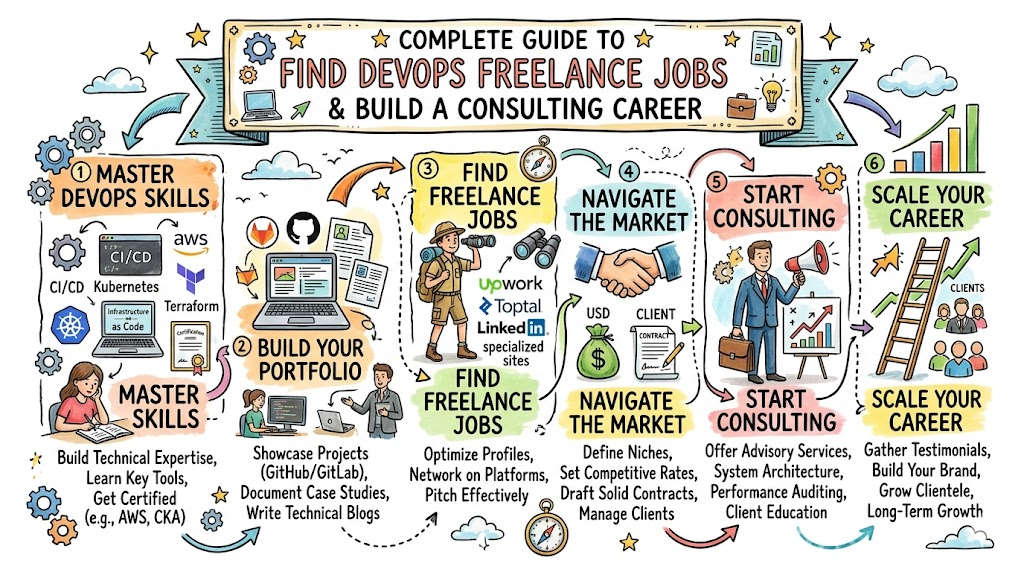
To establish a sustainable flow of DevOps freelance jobs, professionals must learn how to navigate both digital platforms and physical business ecosystems. Success in this field requires a blend of solid infrastructure automation skills and strategic self-marketing. By focusing on building real-world proof of capability, optimizing engineering profiles, and learning how to communicate technical ROI to business owners, you can transform from a passive job seeker into a highly sought-after technical consultant.
Developing this level of market readiness requires a deep understanding of continuous deployment ecosystems, container orchestrators, and enterprise cloud architecture. Aspiring consultants often leverage structured training environments to bridge the gap between purely theoretical knowledge and production-ready implementation strategies. Platforms like DevOpsSchool provide the comprehensive, practical engineering foundations necessary to build production-grade portfolios that capture the attention of high-paying global clients. With the right combination of technical confidence and targeted client acquisition frameworks, any dedicated engineer can navigate this competitive domain and build a thriving freelance practice.
Why DevOps Freelancing Is Growing
Rapid Cloud Migration and Adoption
Organizations across every industrial vertical are abandoning on-premises infrastructure in favor of cloud-hosted ecosystems. However, migrating complex corporate systems to providers like Amazon Web Services, Microsoft Azure, or Google Cloud Platform is rarely straightforward. Companies frequently discover that unexpected cloud costs, poor resource allocation, and unoptimized environments can quickly derail their digital initiatives.
Because many of these migration challenges are project-based, hiring a full-time cloud engineering team to handle a temporary transition is financially inefficient. Instead, businesses actively seek out specialized professionals for short-term DevOps consulting projects to architect, secure, and validate their new cloud environments.
The Rise of the Startup Ecosystem
The contemporary startup landscape operates under intense time-to-market constraints. Early-stage companies must build, test, and ship software features at high speeds to satisfy venture capitalists and early adopters. These lean startups rarely have the financial runway or structural necessity to employ full-time, senior site reliability engineers or automation specialists.
By leveraging DevOps freelancing, a startup can hire an expert consultant for ten hours a week to manage their deployments, secure their API gateways, and establish proper monitoring systems. This arrangement gives the startup access to elite infrastructure expertise at a fraction of the cost of a full-time salary.
Universal Automation and Security Needs
Modern software systems are too complex to be managed via manual server configuration or legacy deployment scripts. Security vulnerabilities, configuration drift, and unexpected downtime are constant threats to corporate profitability. Companies now recognize that infrastructure as code, automated continuous integration, and containerized deployment pipelines are mandatory operational frameworks rather than luxury options.
This universal demand has created an extensive ecosystem for freelance DevOps work, where organizations contract independent specialists to audit current deployment practices, automate manual workflows, and build resilient continuous integration pipelines.
Skills Clients Expect From DevOps Freelancers
| Skill | Why Clients Care |
| Linux and Scripting | Forms the fundamental operating system layer for modern servers; essential for writing automation scripts in Bash or Python. |
| Continuous Integration & Delivery (CI/CD) | Directly accelerates feature delivery, shortens development cycles, and ensures code changes are automatically tested and deployed. |
| Docker Containerization | Solves the classic problem of applications working on a local machine but failing in production by packaging software uniformly. |
| Kubernetes Orchestration | Ensures applications automatically scale up or down based on web traffic, preventing costly system crashes during peak usage. |
| Cloud Architecture (AWS, Azure, GCP) | Prevents catastrophic data loss, minimizes infrastructure costs through proper resource configuration, and guarantees global availability. |
| Monitoring and Observability | Provides leadership teams with real-time dashboards to track application performance, detect system bugs, and resolve outages before customers notice. |
| Infrastructure as Code (IaC) | Allows teams to track, version control, and rapidly duplicate entire server architectures using text files rather than manual clicking. |
Deep-Dive into Client Technical Expectations
When a client decides to look outside their organization for engineering talent, they are looking for immediate execution. They do not want to fund a freelancer’s learning curve. If a business owner hires you to resolve an issue with their deployment pipeline, they expect you to thoroughly understand how Linux kernels handle system resources, how to diagnose broken permissions, and how to write clean automation scripts.
Your scripting capability must extend beyond basic command execution; you must be able to write modular, maintainable automation scripts that integrate smoothly with system APIs and handle runtime errors gracefully.
In the realm of containerization and orchestration, simply knowing how to build a basic Dockerfile is no longer sufficient to secure premium DevOps freelance jobs. Clients expect their independent engineers to build minimal, secure multi-stage container builds that eliminate unnecessary dependencies and minimize security vulnerabilities.
Furthermore, when dealing with production Kubernetes clusters, you must demonstrate a clear understanding of ingress controllers, persistent volume configurations, network policies, and cluster auto-scaling dynamics. Your work must ensure that the client’s infrastructure remains secure, cost-effective, and highly resilient under heavy user traffic.
Online Ways to Find DevOps Freelance Jobs
| Method | Best For |
| Freelancing Platforms | Securing initial client contracts, building early portfolio items, and gaining fast transactional project experience. |
| LinkedIn Networking | Developing high-value corporate connections, establishing a long-term personal brand, and securing direct inbound consulting inbound leads. |
| GitHub Visibility | Providing undeniable, open-source evidence of your code quality, architecture patterns, and technical execution capabilities. |
| Personal Portfolio Website | Presenting highly detailed, business-focused case studies that translate technical automation into measurable corporate profitability. |
| Remote DevOps Job Boards | Finding long-term, dedicated contract opportunities with established international enterprises and tech startups. |
| Online Communities and Forums | Building organic peer relationships, discovering unadvertised technical problems, and positioning yourself as an accessible subject matter expert. |
Method #1: Freelancing Platforms
Digital marketplaces provide an accessible starting point for professionals trying to find DevOps freelance jobs without an established local network. These platforms aggregate thousands of business owners who are actively seeking technical support for their development pipelines and cloud environments.
Upwork
Upwork functions as a massive global clearinghouse for freelance engineering contracts. To succeed on Upwork, avoid sending generic proposals that read like an academic resume. When applying for contracts, your proposal should immediately address the specific problem outlined in the client’s posting.
If a client states their Jenkins build is failing due to memory allocation errors, your proposal should lead with an analysis of how you intend to isolate the container resource constraints and fix the pipeline configuration. Keep your communication direct, highlight your past technical resolutions, and clearly outline your intended project phases.
Freelancer
Freelancer features a high volume of competitive bidding projects and short-term technical troubleshooting tasks. The platform moves quickly, meaning you must monitor job feeds closely and submit highly structured proposals as soon as opportunities arise.
Focus on projects with verified payment structures and transparent technical guidelines. By consistently delivering high-quality automation work on small infrastructure fixes, you can accumulate positive client reviews that elevate your profile rankings over time.
Fiverr
Fiverr operates on a productized services model, allowing you to package your infrastructure skills into explicit, predefined deliverables called “gigs.” Instead of applying to open jobs, you configure fixed-price service packages such as “I will build a production-ready GitHub Actions workflow for your Node.js application” or “I will audit your AWS cloud architecture for security and cost optimization.”
This approach minimizes negotiation friction and sets clear boundaries regarding project scope, preventing clients from expanding the project requirements without paying additional fees.
Toptal
Toptal positions itself as an exclusive marketplace for elite freelance engineers, filtering applicants through a rigorous technical and behavioral screening process. Passing their coding exams, live architecture walkthroughs, and communication assessments gives you access to enterprise-grade clients and premium billable hourly rates.
Toptal manages the account acquisition process for you, connecting you directly with premium organizations that need complex cloud architecture design and advanced automated system tuning.
[Traditional Job Application] ---> High Competition, Low Response, High Friction
[Productized Gig Strategy]   ---> Clear Deliverables, Zero Scope Creep, Transparent Pricing
Method #2: LinkedIn Networking
LinkedIn serves as a powerful professional database for uncovering high-value DevOps consulting projects. Instead of using the platform as a passive online resume, transform your profile into a client-focused landing page that speaks directly to the business problems you solve.
Optimizing Your Profile Headline
Your LinkedIn headline should clearly communicate your core value proposition rather than just stating a generic job title. Avoid basic designations like “DevOps Freelancer.”
Instead, use clear, outcome-oriented descriptions such as “Cloud Consultant | Helping SaaS Companies Automate CI/CD Pipelines, Reduce AWS Spend, and Eliminate Production Downtime.” This structure immediately tells startup founders and technical directors how your expertise can improve their bottom line.
Strategic Technical Content Distribution
To build real authority on LinkedIn, you must consistently share your engineering insights. Document your daily technical challenges, cloud migration strategies, and automation wins. Write comprehensive, text-based breakdowns of how you resolved a specific production issue:
1. The Problem: A client's microservices architecture was dropping 15% of network requests during peak traffic.
2. The Diagnosis: Isolated the issue to misconfigured Kubernetes ingress controller timeout thresholds.
3. The Resolution: Re-architected the ingress routing rule and introduced automated horizontal pod autoscaling.
4. The Business Impact: Eliminated user checkout dropouts and reduced server latency by 40%.
Sharing these detailed breakdowns demonstrates your hands-on engineering capabilities to prospective clients who follow your professional updates.
Proactive Outreach to Decision Makers
Do not wait for recruiters to message you. Use LinkedIn’s search filters to identify Chief Technology Officers, Directors of Engineering, and Technical Product Managers at early-stage startups that recently closed funding rounds. Send personalized, low-pressure connection requests focusing entirely on their potential infrastructure challenges.
Your message should avoid aggressive sales pitches; instead, offer a brief, helpful insight regarding cloud scalability or pipeline optimization, positioning yourself as an accessible consultant when they need external engineering support.
Method #3: Build a Strong GitHub Profile
For technical buyers, verified public repositories are far more convincing than a written resume. A clean, active GitHub profile provides concrete proof that you can write structured, secure, and production-grade automation code.
Public Repository Standards
Every repository you use to attract clients must be presented professionally. This means organizing your directories cleanly, removing all hardcoded secrets or API tokens, and maintaining a clear commit history.
A disorganized repository filled with uncommented code sends a message to prospective clients that your work is messy and difficult to maintain. Ensure every public project reflects enterprise-level engineering practices.
The Anatomy of an Elite README File
Your repository documentation must be highly detailed and accessible to both technical and non-technical readers. A high-converting README file should include:
- A clear, high-level summary of the business or technical problem the repository solves.
- A detailed architectural diagram illustrating the flow of data and system components.
- A clear, step-by-step installation guide outlining all necessary environment variables and prerequisite tools.
- A comprehensive breakdown of the configuration files, security practices, and testing strategies implemented.
Essential Portfolio Projects to Showcase
To attract high-quality DevOps clients, build and document three core open-source reference architectures:
1. Production-Grade CI/CD Pipeline
Build a comprehensive repository showcasing an automated deployment workflow using GitHub Actions, GitLab CI, or Jenkins. The pipeline should automatically ingest a sample microservice, execute linting and unit tests, perform security vulnerability scanning on application dependencies, build a minimal Docker container image, and deploy it smoothly to a staging cloud environment with automated rollback capabilities if any tests fail.
2. Comprehensive Dockerization Repository
Create a repository demonstrating advanced multi-stage Docker configurations for diverse runtime environments such as Node.js, Python, and Java. Document how your container configurations reduce overall image sizes, optimize build caching layers, run configurations securely as non-root users, and use health checks to verify application runtime integrity.
3. Infrastructure as Code (IaC) Framework
Develop a modular Terraform or CloudFormation repository that spins up a highly available, multi-zone virtual private cloud environment. The configuration should automatically provision managed databases, configure secure routing tables, isolate private subnets, establish load balancers, and implement strict identity and access management security controls, demonstrating your ability to manage infrastructure using code.
[Developer Pushes Code]
          │
          ▼
┌─────────────────────────────────┐
│     GitHub Actions Pipeline     │
├─────────────────────────────────┤
│  1. Code Linting & Unit Tests   │
│  2. Dependency Security Scan    │
│  3. Multi-Stage Docker Build    │
│  4. Push Image to Container Reg │
└─────────────────────────────────┘
          │
          ▼
┌─────────────────────────────────┐
│     Production Environment      │
├─────────────────────────────────┤
│  • AWS Elastic Container Serv.   │
│  • Automated Health Checks      │
│  • Zero-Downtime Rolling Update │
└─────────────────────────────────┘
Method #4: Build a Personal Portfolio
A dedicated portfolio website separates general freelance contractors from premium technical consultants. Your website should serve as a specialized landing page designed to turn visiting corporate leaders into active consulting leads.
Writing Impactful Case Studies
Prospective clients care far less about your specific list of certifications and much more about how you solve complex operational problems. Format your portfolio website around highly detailed case studies using the Situation-Task-Action-Result framework.
Instead of writing “I configured Prometheus for a company,” construct a detailed narrative: “Optimizing Infrastructure Visibility for a High-Traffic Financial Platform.” Break down the exact metrics you improved, the system anomalies you uncovered, and how your monitoring layout prevented costly production downtime.
Defining Your Consulting Services
Clearly list the specific technical problems you solve on your services page. This clarity prevents you from wasting time on discovery calls for work outside your core expertise. Clearly define your primary offerings:
- CI/CD Pipeline Design: Streamlining manual deployment workflows into fully automated release cycles.
- Cloud Cost Optimization: Auditing bloated infrastructure setups to eliminate wasted resources and reduce monthly cloud invoices.
- Containerization Migrations: Migrating monolithic legacy applications into secure, lightweight Docker containers orchestrated by Kubernetes clusters.
Adding Clean Contact Channels
Make it incredibly easy for a busy engineering manager to reach out to you. Integrate a clean calendar booking tool directly into your website’s contact section.
Provide a brief, structured contact form that asks prospective clients about their cloud infrastructure type, current operational bottlenecks, and estimated project timelines, ensuring you gather key business context before your initial discovery call.
Method #5: Remote DevOps Job Boards
Many companies seeking full-time remote engineers are also open to hiring specialized independent contractors to tackle urgent, project-based work. You can find high-quality DevOps remote jobs by monitoring dedicated job boards that prioritize remote-first software engineering and cloud infrastructure roles.
We Work Remotely
We Work Remotely stands as one of the largest global clearinghouses for remote engineering roles. Search their DevOps and SysAdmin sections specifically for roles labeled as contract, freelance, or temporary projects.
When applying to these postings, position your freelance consulting practice as an agile solution that can quickly address their engineering backlog without the lengthy onboarding cycles associated with full-time employees.
FlexJobs
FlexJobs carefully vets every job listing on its platform to eliminate low-quality postings, spam, and predatory freelance listings. This rigorous screening makes it an excellent channel for finding high-quality DevOps remote jobs with established corporations, healthcare systems, and financial institutions that require strict data security compliance and verified engineering credentials.
Remote.co
Remote.co curates a highly targeted list of remote cloud computing, automation, and site reliability roles. Monitor their system engineering categories daily and apply with custom proposals that highlight your specialized remote communication frameworks, production time-zone availability, and past success managing cloud infrastructure independently.
Method #6: Online Communities and Networking
Engaging with online engineering communities allows you to connect with potential clients who are looking for help with real-world infrastructure challenges.
Participating in Specialized Forums
Spend time on technical discussion boards like Reddit (such as r/devops, r/aws, and r/kubernetes) and Stack Overflow. Do not use these platforms to drop generic advertisements for your services. Instead, look for developers posting urgent questions about broken deployments, complex Terraform errors, or confusing container routing issues.
Provide comprehensive, well-structured text answers that explain the underlying system mechanics and offer clear, step-by-step solutions. When community members notice you consistently providing actionable advice, they will often reach out directly to hire you for complex DevOps consulting projects.
Digital Meetups and Cloud Study Groups
Join regional online tech meetups, cloud computing webinar groups, and open-source study circles. Attend these sessions regularly to learn about the latest industry trends and build genuine professional relationships with the organizers and presenters.
Engineering leads frequently attend these virtual events to find skilled talent, making these communities an excellent source for organic, word-of-mouth client referrals.
Offline Ways to Find DevOps Freelance Jobs
| Method | Why It Works |
| Local Networking Events | Puts you face-to-face with local business owners who need immediate technical help but prefer hiring local consultants. |
| Tech Conferences | Connects you with engineering executives, enterprise decision-makers, and corporate tech buyers who manage large budgets. |
| Startup Communities | Gives you access to founders who need high-end infrastructure automation but can only afford part-time contract help. |
| Professional Referrals | Generates high-converting consulting leads because trusted industry peers have already verified your engineering skills. |
| Existing Workplace Contacts | Capitalizes on your established professional trust, allowing you to turn past employers into long-term consulting clients. |
Navigating Local Business Events
Local business mixers and chamber of commerce events are filled with non-technical business owners running traditional companies that rely heavily on software platforms. When discussing your career at these offline events, completely drop complex technical jargon.
If you tell a local logistics company owner that you write custom Kubernetes custom resource definitions, they will not understand how that helps their business. Instead, explain your value in plain language: “I build automated systems that protect retail websites from crashing during major sales events, ensuring they never lose out on customer transactions.”
Attracting Clients at Major Tech Conferences
When attending large tech conferences like AWS re:Invent, KubeCon, or regional DevOps Days, avoid spending all your time collecting promotional swag or chatting exclusively with other engineers. Instead, focus on attending presentations delivered by engineering directors and system managers.
After their presentations, approach them to ask thoughtful questions about their infrastructure scaling strategies or cloud security challenges. Exchange professional contact details, and follow up a few days later with a clean, helpful resource related to their talk to keep the conversation going.
[Conference Presentation Ends]
              │
              ▼
[Approach Presenter with Specialized Question]
              │
              ▼
[Exchange LinkedIn / Business Card Details]
              │
              ▼
[Follow-Up with Practical Technical Resource]
              │
              ▼
[Schedule Virtual Cloud Discovery Session]
Leveraging Startup Incubators and Accelerators
Schedule in-person visits to local technology co-working hubs, startup incubators, and business accelerators. These spaces host dozens of early-stage companies that need to build reliable deployment systems but cannot afford full-time infrastructure engineers.
Offer to host free, in-person educational workshops on basic cloud security, containerization workflows, or cost-saving infrastructure strategies. These sessions allow you to showcase your technical expertise directly to a room full of founders who may soon need to hire independent DevOps consultants.
Real-World Example: Beginner Failing to Find Freelance Work
The Scenario
Ankit is an infrastructure engineer with two years of corporate experience who decided to start looking for DevOps freelance jobs. He set up an Upwork profile, copied the bullet points directly from his traditional corporate resume, and began applying to dozens of random job listings every day.
His applications used a generic template: “Dear Hiring Manager, I am a certified engineer with experience in Linux, CI/CD, and AWS. Please review my profile and hire me for your project.”
The Complications
After three weeks of intensive bidding, Ankit received zero responses, leading to immense frustration. His public GitHub profile was entirely empty, leaving prospective clients with no way to verify his coding or configuration skills.
Furthermore, whenever a prospective client asked a question on an online forum, Ankit would simply reply, “PM me for cheap freelance work,” which damaged his credibility and caused community moderators to flag his accounts as spam.
Lessons Learned
- Generic Profiles Fail: Corporate resumes do not translate well into freelance profiles; clients want to see clear descriptions of the specific business problems you can solve.
- Proposals Must Add Value: Standard copy-pasted templates are ignored by serious clients; proposals must address the unique technical needs of each project description.
- Proof of Competence is Mandatory: Without public code repositories or case studies, you are asking clients to take an expensive risk on unverified talent.
- Desperation Lowers Value: Aggressive, spam-style self-promotion drives high-quality clients away and hurts your professional standing.
Real-World Example: Beginner Getting First DevOps Client
The Scenario
Rahul is a systems administrator who wanted to transition into freelance DevOps work. He realized he needed clear, public proof of his technical capabilities before applying for contracts. He built three public GitHub repositories showcasing clean, modular Terraform files and an automated GitHub Actions pipeline.
He then optimized his LinkedIn profile to focus on how containerization can reduce infrastructure costs for growing software applications.
The Acquisition Strategy
Instead of sending generic sales pitches, Rahul monitored LinkedIn and local tech forums for startup leaders discussing software performance issues. He spotted a tech founder complaining about how slow their development team’s manual deployment process was.
Rahul sent a personalized message: “I noticed your team is spending hours on manual deployments. I put together an open-source template showing how to automate this entire process using secure pipelines. You can review the architecture here on my GitHub. I hope this helps speed up your releases.”
The Outcome
The startup founder was impressed by the detailed documentation in Rahul’s repository and invited him to a discovery call. During the call, Rahul focused entirely on how automation would save their development team hours of manual work every week.
They agreed to a small, fixed-price contract to automate their primary deployment pipeline. Rahul completed the project successfully, ahead of schedule, which led to a long-term monthly consulting retainer and his first high-value client referral.
Phase 1: Build & document 3 production GitHub repositories.
Phase 2: Optimize LinkedIn profile to focus on client problem-solving.
Phase 3: Provide helpful, non-sales technical advice to startup founders.
Phase 4: Land first automated pipeline project and secure a long-term retainer.
Common Beginner Mistakes
- Waiting Passively for Clients to Find YouMany engineers set up a basic profile on a freelance marketplace and simply wait for high-paying contracts to land in their inbox. Freelancing requires continuous, proactive outreach, content creation, and active networking to keep your project pipeline full.
- Operating Without a Verified PortfolioApplying for infrastructure contracts without public code repositories is like trying to sell a house without letting the buyer see inside. Clients will not trust you with their core production data if you cannot show them clean, documented examples of your code.
- Poor Communication and Overloading Clients with JargonA major mistake is explaining complex technical details to non-technical business managers. If you focus entirely on abstract tools instead of explaining how your work reduces server costs or prevents system downtime, clients will not see the value in hiring you.
- Underpricing Services Due to Low ConfidenceSetting ultra-low rates to win jobs often backfires by attracting difficult clients who demand excessive revisions. Low pricing also tells sophisticated buyers that you might lack the technical confidence to handle critical enterprise infrastructure securely.
- Failing to Agree on Project Scope in WritingAccepting freelance work based on vague, verbal agreements frequently leads to scope creep, where clients add extra requirements without paying more. Always document the explicit deliverables, timeline boundaries, and revision limits in writing before starting any work.
Common Misunderstandings
- You Need Decades of Enterprise Experience to BeginYou do not need to be a principal architect to start finding DevOps freelance jobs. Plenty of small businesses and startups simply need help with straightforward tasks like configuring basic container builds or setting up clean continuous integration pipelines.
- Industry Certifications Guarantee Client ContractsCertifications show you can pass a standardized exam, but clients care much more about real-world implementation. A comprehensive, public case study detailing how you fixed a broken system is far more persuasive to a hiring manager than a certification badge.
- The Lowest Bidder Always Wins the ContractPremium clients actually avoid the cheapest freelancers because low prices often hint at poor quality or lack of experience. High-quality organizations are willing to pay professional rates for competent consultants who communicate clearly and protect their data.
- Freelancing Platforms Are the Only Way to Find WorkWhile marketplaces like Upwork are useful for getting started, they represent only a small fraction of the freelance market. Many of the most profitable consulting contracts are secured directly through personal networking, GitHub repositories, and LinkedIn outreach.
Best Practices for Finding DevOps Freelance Jobs
- Build Production-Grade Projects Before PitchingBefore reaching out to clients, ensure your public repositories contain well-documented, clean automation code that demonstrates your hands-on experience.
- Translate Technical Actions into Clear Business ValueWhen speaking with clients, always explain how your technical choices improve business metrics, such as accelerating feature releases or lowering cloud costs.
- Maintain a Consistent Professional Networking ScheduleDedicate a few hours every week to sharing helpful content on LinkedIn, answering forum questions, and connecting with tech founders, even when your current schedule is busy.
- Use Clear Service Agreements to Prevent Scope CreepAlways outline the exact project steps, delivery timelines, and boundaries in a written document before accessing a client’s server environments.
- Follow Up Professionally with Past Project ClientsCheck in regularly with past clients to see how their systems are running; these brief updates often open the door to new infrastructure projects and referrals.
Direct Client Communication Framework
When a prospective client responds to your outreach, send a professional message designed to move them toward a discovery call:
Hello [Client Name],

Thanks for reaching out about your deployment pipeline. I reviewed your current setup, and it looks like your development velocity is being bottlenecked by manual staging checks and unoptimized container caching layers.

I have helped engineering teams resolve similar bottlenecks by implementing automated multi-stage builds and streamlined test suites, which often cuts deployment times in half.

Let me know if you have 15 minutes this Thursday for a brief strategy call. We can look at your current pipeline architecture and map out a practical plan to automate your releases securely.

Best regards,
[Your Name]
Role of DevOpsSchool in Freelance Readiness
Transitioning successfully into independent consulting requires a shift from a traditional employee mindset to a solutions-driven business approach. Clients hire freelancers to solve specific operational problems, meaning you must be ready to step into unfamiliar codebases and deploy stable solutions immediately.
This level of professional readiness requires comprehensive, hands-on experience across multiple deployment setups, cloud platforms, and automation tools.
Building this versatile technical foundation can be challenging without structured guidance. This is where educational platforms like DevOpsSchool play an important role in preparing engineers for the freelance market. Their structured learning paths focus heavily on real-world engineering setups, practical problem-solving, and advanced automation frameworks.
By guiding students through real-world deployment challenges, cloud migration projects, and complex infrastructure troubleshooting scenarios, they help aspiring consultants develop the deep technical confidence required to handle independent client work.
[Theoretical Knowledge Only]  ---> High Client Friction, Low Confidence, Low Rates
[Hands-On Engineering Depth] ---> Smooth Client Onboarding, High Trust, Premium Consulting Rates
Furthermore, this practical education teaches engineers how to document their technical architectures cleanly and design scalable automation workflows—skills that are essential for building a premium public portfolio.
When you learn to view infrastructure through a lens of business efficiency and reliable performance, you can communicate more effectively with corporate decision-makers. This combinations of deep technical skills and clear professional presentation allows you to confidently acquire clients, deliver high-quality freelance work, and scale your independent consulting practice.
Career Importance of Freelancing Skills
Core Consulting Roles and Specialized Market Functions
DevOps Freelancer
Focuses on delivering specialized, project-based engineering support, such as building custom continuous integration setups, containerizing existing applications, and updating server configurations.
DevOps Consultant
Acts as a strategic advisor who evaluates an organization’s entire software delivery lifecycle, uncovers workflow inefficiencies, and designs comprehensive automation strategies for their development teams.
Cloud Consultant
Specializes in designing highly available cloud architectures, managing complex migrations, and auditing cloud setups to ensure strong data security and lower monthly infrastructure bills.
Automation Consultant
Focuses entirely on replacing manual IT tasks with reliable software scripts, streamlining everything from local developer environments to enterprise release cycles.
SRE Consultant
Works with high-traffic platforms to maximize system reliability, configure advanced monitoring dashboards, and build resilient infrastructure that handles heavy user traffic without crashing.
Crucial Professional Consulting Competencies
Building a successful freelance career forces you to grow far beyond basic technical skills. When you run an independent consulting practice, you are entirely responsible for managing client accounts, negotiating project scopes, and explaining your technical value to non-technical business leaders.
Learning to explain how complex automation projects save companies time and money turns you into a hybrid professional who understands both software engineering and business strategy.
This mix of business communication and deep technical skills makes you incredibly valuable in the modern job market. The confidence you gain from fixing broken production environments, managing complex data migrations, and guiding clients through major tech updates stays with you throughout your career.
Whether you choose to remain an independent consultant or eventually return to a senior corporate leadership role, the problem-solving and communication skills developed through freelancing will elevate your professional standing.
Industries Hiring DevOps Freelancers
SaaS Platforms
Software-as-a-Service startups operate in highly competitive markets where releasing features quickly and maintaining system uptime are critical to survival. These companies frequently hire independent consultants to fine-tune their Kubernetes setups, optimize container performance, and build fast, automated deployment pipelines that keep their development teams moving smoothly.
E-Commerce Companies
Online retail brands experience massive, unpredictable spikes in web traffic during seasonal sales events and major marketing campaigns. They regularly contract freelance engineers to audit their cloud setups, configure auto-scaling rules, and implement reliable load balancers to ensure their checkout systems remain stable and performant during peak shopping hours.
Banking and Finance
Financial technology platforms must adhere to strict regulatory compliance, data privacy laws, and security standards. Because full-time security engineers are scarce, financial organizations hire specialized consultants to build secure infrastructure setups, implement strict user access controls, and set up clear audit logs for their automated deployment systems.
Healthcare Systems
Digital health platforms and medical application vendors must guarantee total patient data privacy and follow strict industry regulations like HIPAA. They bring in external consultants to design isolated private networks, implement strong data encryption pipelines, and verify that their cloud infrastructure meets all legal security requirements.
Telecom Companies
Modern telecommunications providers manage massive networks running diverse software services. They use freelance optimization experts to modernize legacy operational systems, migrate outdated management tools into lightweight containers, and build fast, automated infrastructure pipelines to handle large data workflows.
Fast-Growing Startups
Early-stage startups need to build modern deployment systems immediately but rarely have the budget to hire a full-time, senior operations team. By leveraging independent consultants for short-term projects, they get premium infrastructure setup and cloud coaching at a price that fits their runway.
┌────────────────────────────────────────────────────────┐
│             Industries Securing Freelancers            │
├────────────────────────────────────────────────────────┤
│ • SaaS: Demands rapid feature release pipelines        │
│ • E-Commerce: Requires high-availability auto-scaling  │
│ • Fintech/Health: Demands strict security compliance    │
│ • Startups: Need lean infrastructure initialization    │
└────────────────────────────────────────────────────────┘
Future of DevOps Freelancing
The market for independent cloud engineering is moving away from basic server configuration toward high-level architectural strategy. As automated tools handle more day-to-day administrative tasks, clients are looking for consultants who can align complex technical setups with long-term business goals.
Engineers who adapt to these shifting industry needs will find plenty of high-value consulting contracts.
[Legacy Focus]  ---> Manual SysAdmin, Basic Shell Scripting, On-Premises Maintenance
[Modern Future] ---> Platform Engineering, AI Integration, Enterprise Cost Management
The rise of Platform Engineering is a major trend shaping the future of the industry. Instead of manually building individual pipelines for separate development teams, modern consultants are hired to design Internal Developer Platforms.
These self-service platforms allow software developers to safely provision infrastructure and deploy code on their own within secure guidelines, saving time for the entire engineering organization.
Additionally, the integration of artificial intelligence and machine learning into cloud operations is creating new niches for specialized consultants. Companies need experts who can implement AI-driven monitoring tools, configure automated anomaly detection scripts, and build reliable pipelines for training machine learning models.
By continually updating your technical skills and focusing on high-impact areas like cloud cost optimization and advanced security compliance, you can ensure your consulting practice remains profitable for years to come.
FAQs (15 Questions)
How do I find DevOps freelance jobs?
You can find DevOps freelance jobs by using a mix of online freelancing marketplaces like Upwork and Toptal, sharing technical case studies on LinkedIn, and publishing clean automation repositories on GitHub. Additionally, attending regional tech conferences, startup meetups, and local business mixers helps you build a strong offline network of direct clients.
Can beginners freelance in DevOps?
Yes, beginners can secure freelance work if they have a strong public portfolio that proves their hands-on skills. While enterprise-level cloud migrations require years of experience, plenty of early-stage startups and small businesses need help with simpler projects like automating basic code testing pipelines or containerizing simple web applications.
Which platform is best for finding DevOps remote jobs?
For project-based freelance work, Upwork and Toptal are excellent options due to their high volume of global technical listings. If you are looking for long-term contract roles and dedicated remote positions with established companies, monitor specialized remote job boards like We Work Remotely, FlexJobs, and Remote.co daily.
Do I need a portfolio to find freelance DevOps work?
Yes, a verified technical portfolio is essential for attracting high-quality clients. Technical buyers will not trust a consultant with their live server environments based on a text resume alone; you must provide public GitHub repositories or case studies that show you can write clean, production-grade automation code.
Is LinkedIn important for getting DevOps consulting projects?
LinkedIn is one of the most effective tools for securing premium, direct consulting contracts. By optimizing your profile headline to focus on the business problems you solve and regularly sharing breakdowns of your technical projects, you can attract inbound leads from startup founders and engineering directors.
How do I get my first DevOps freelance client?
To get your first client, pick a common infrastructure problem—like a slow deployment pipeline or high cloud costs—and share a clear, step-by-step guide on how to fix it within your professional network. Reaching out directly to early-stage startups with helpful, free advice and a link to your public code portfolio is a highly effective way to land your first contract.
Do industry certifications help in securing DevOps clients?
Certifications show that you understand core technical concepts, but they do not guarantee client contracts. Freelance buyers look for practical problem-solving skills and real-world execution. Pairing your certifications with public GitHub repositories and detailed project case studies creates a much stronger impression.
Can I freelance part-time while keeping my full-time job?
Yes, many engineers start their freelance careers by taking on small, short-term consulting projects during evenings and weekends. This approach allows you to build your business confidence, test your pricing strategies, and establish a steady stream of clients before transitioning to full-time independent work.
What are the most in-demand skills for DevOps freelance jobs?
The skills most requested by clients include writing clean Infrastructure as Code templates with Terraform, building automated continuous integration pipelines, containerizing applications with Docker, managing scalable clusters with Kubernetes, and optimizing infrastructure costs on major cloud platforms like AWS, Azure, and GCP.
How should I price my DevOps freelancing services?
Beginners often start with a competitive hourly rate on freelance marketplaces to win their first few reviews. As you build your portfolio and gain confidence, transition to value-based, fixed-price project packaging. This model ensures you are paid for the business value you deliver rather than just the hours you spend working.
How do I prevent scope creep during a freelance contract?
To prevent clients from expanding your workload without paying more, always outline the exact technical deliverables, timeline boundaries, and revision limits in a written agreement before starting any work. If a client requests extra features later, reference the original document and provide a separate cost estimate for the additional tasks.
What industries hire the most independent DevOps consultants?
High demand is concentrated in fast-growing SaaS platforms, fast-paced e-commerce brands, healthcare technology vendors, financial services apps, and early-stage startups that need to launch stable, secure cloud applications quickly without hiring a large, permanent operations team.
How can I showcase my skills if all my past corporate work is private?
If your previous corporate projects are protected by non-disclosure agreements, build independent, open-source reference architectures on your personal GitHub profile. Create clean repositories that showcase your custom Terraform modules, advanced container configurations, and fully automated deployment workflows using mock applications.
What are common mistakes beginners make when pitching to clients?
Common mistakes include sending generic, copy-pasted application templates, focusing too much on technical jargon instead of explaining the business value of your work, underpricing services, and failing to verify that the client has a clear budget and project timeline before accepting the work.
How is the long-term outlook for freelance cloud automation work?
The long-term outlook is incredibly strong as companies continue migrating to modern cloud setups. The growth of specialized areas like platform engineering, internal developer tools, cloud-native architecture, and AI-driven system monitoring ensures a steady demand for skilled independent consultants who can optimize complex software environments.
Final Thoughts
Building a sustainable career around DevOps freelance jobs requires persistence, technical discipline, and consistent self-marketing. Many engineers mistakenly believe that technical expertise alone is enough to guarantee a full pipeline of high-paying contracts. In reality, visibility is just as important as technical skill in the independent consulting market. The most successful freelance engineers are not necessarily the ones who write the most complex code; they are the professionals who understand how to locate clients, communicate clearly, and deliver measurable business value.
Treat your freelance practice like a real business from day one. This means setting aside time every week for professional networking, updating your public code repositories, and connecting with tech founders, even when your current schedule is busy. By focusing on solving real operational problems rather than just collecting technical certifications, you can build trust with potential buyers and stand out from the competition.
Building a freelance career takes time, and you will likely face some initial rejections as you refine your proposals and outreach strategies. View every quiet week as an opportunity to improve your public portfolio, learn a new automation tool, or write a helpful case study that showcases your skills. With a consistent approach, a professional portfolio, and a clear focus on delivering business value, you can successfully navigate the competitive independent market and build a rewarding, long-term cloud consulting practice.
