Introduction
The DevOps freelancing market is more competitive than ever. Every day, talented engineers from across the globe log into platforms like Upwork, Freelancer, and Toptal, hoping to land their next big cloud infrastructure or CI/CD project. However, many brilliant technical minds struggle to convert their skills into paying clients. The reason is rarely a lack of technical expertise; it is almost always a failure in communication.
Many DevOps freelancers treat proposal writing as an afterthought, sending generic, robotic messages that do nothing to build trust. When you are bidding on a project, you are not just selling a script or a server configuration; you are selling confidence, reliability, and business continuity. Clients who are looking for DevOps support are often under pressure, dealing with broken pipelines, downtime, or the need to scale their infrastructure rapidly. They need someone who understands their pain.
At DevOpsSchool, we have spent years mentoring professionals who bridge the gap between technical execution and business value. A well-crafted proposal is the bridge that turns a prospect into a long-term partner. In this guide, we will explore the nuances of writing a DevOps freelance proposal that wins projects, builds reputation, and sets the stage for a sustainable career in cloud and automation consulting.
What Is a DevOps Freelance Proposal?
A DevOps freelance proposal is a business document submitted by a freelancer to a potential client to secure a specific project or contract. It outlines how you intend to solve the client’s technical challenge, your approach to the work, the expected timeline, and the cost of your services.
It is not merely a resume or a list of certifications. A resume tells a client what you have done in the past; a proposal tells the client what you will do for their future. It is a strategic sales document that demonstrates you have analyzed their unique environment and have a concrete plan to improve their development lifecycle, cloud operations, or automation workflows.
Why Proposal Writing Matters in DevOps Freelancing
In the freelance economy, your proposal is your first and often your only chance to make an impression. Here is why it is the most critical skill for a DevOps freelancer:
- Establishing Trust: Clients entrust you with their production environments, data, and critical infrastructure. A professional, thoughtful proposal signals that you are responsible and trustworthy.
- Demonstrating Technical Credibility: It allows you to frame your technical knowledge in the context of the client’s specific needs. It shows that you are not just a tool user, but an engineer who understands how to apply technology to solve business problems.
- Setting Boundaries and Expectations: A good proposal clearly defines the scope of work. This protects you from scope creep and ensures that you and the client are on the same page regarding deliverables.
- Communication Skills: Your proposal is a sample of your documentation skills. If your proposal is messy, poorly structured, or unclear, the client will assume your infrastructure code and communication style will be equally chaotic.
How Clients Evaluate DevOps Freelancers
When a client reviews dozens of proposals, they are looking for reasons to eliminate candidates quickly. You need to provide them with reasons to keep you on the shortlist.
| What Clients Look For | Why It Matters |
| Relevant Experience | They want proof you have solved their specific problem before. |
| Technical Understanding | They check if you understand their tools (e.g., AWS, Kubernetes, Jenkins). |
| Problem-Solving Approach | They need to know your logic, not just your toolset. |
| Communication Clarity | They need to know you can explain complex issues simply. |
| Delivery Confidence | They need assurance that you will meet deadlines. |
Clients are rarely looking for the cheapest option. They are looking for the “safest” option—the person who creates the least amount of anxiety about the project’s success.
Structure of a Winning DevOps Freelance Proposal
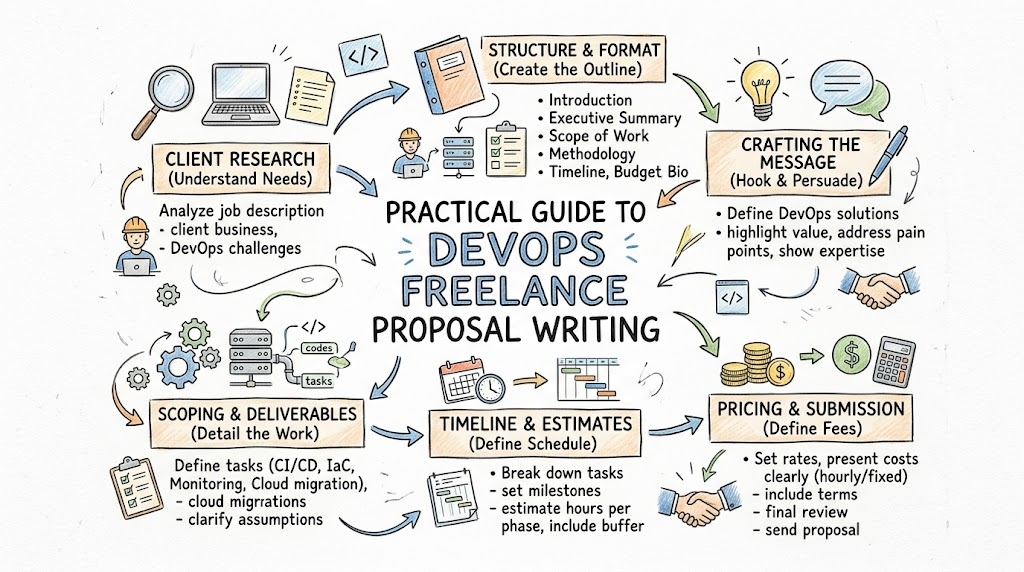
A successful proposal follows a logical flow that guides the client from their current pain point to your proposed solution.
| Proposal Section | Purpose |
| Personalized Greeting | Establishes rapport and shows you read the job post. |
| Problem Understanding | Validates the client’s issues and pain points. |
| Relevant Experience | Provides social proof and technical background. |
| Proposed Solution | Outlines your technical approach and methodology. |
| Timeline and Delivery | Sets clear expectations for milestones. |
| Pricing Approach | Provides transparency on costs. |
| Call to Action | Encourages the next step in the conversation. |
Step 1: Start With a Personalized Introduction
Never use a copy-paste template that looks like a form letter. Clients can spot a generic proposal from a mile away. Start by addressing the specific problem mentioned in the job description.
- Bad Example: “Hello, I am a DevOps engineer with 5 years of experience. I see you need help with AWS. I am available.”
- Good Example: “Hi, I read your post about the intermittent latency issues in your Kubernetes production cluster. Having managed similar high-traffic clusters on AWS, I understand how critical this stability is for your user experience.”
Step 2: Show You Understand the Client’s Problem
You must mirror the client’s language. If they say they are struggling with “slow deployment times,” do not just say “I can do CI/CD.” Say, “I understand that your current deployment pipeline is taking too long to build, which is slowing down your feature releases.” This proves you are listening.
Step 3: Highlight Relevant DevOps Experience
Do not list every tool you have ever used. Filter your experience to match the job. If the client asks for Jenkins and Docker, focus on your experience with those.
- Contextualize your experience: Instead of saying “I know Kubernetes,” say “I have optimized Kubernetes ingress controllers and autoscaling for clients in the e-commerce sector to reduce costs by 20%.”
- Mentioning Tools: Focus on the tools they are using or the tools they should be using to solve the problem.
Step 4: Present a Clear Technical Solution
This is the “meat” of the proposal. You do not need to give away your entire strategy for free, but you must outline the high-level steps you will take to solve the issue.
Example: “To resolve your CI/CD bottleneck, I will:
- Audit your current Jenkins pipeline for configuration drift.
- Implement parallel stages to speed up execution.
- Configure artifact caching to reduce build times.
- Integrate automated testing at the pre-merge stage.”
Step 5: Set Realistic Timelines
Clients hate missed deadlines. Be honest about how long the project will take. If it is a complex infrastructure migration, break it down into phases.
- Phase 1: Assessment and Planning (2 days)
- Phase 2: Implementation of core changes (1 week)
- Phase 3: Testing and UAT (3 days)
Step 6: Price Your Services Professionally
Decide whether to charge by the hour or by the project. For fixed-price projects, ensure the scope is very tight. If you are a beginner, do not price yourself so low that you attract “difficult” clients who expect enterprise-grade work for pennies. Price based on the value you provide, not just the time you spend.
Step 7: End With a Strong Call to Action
End by inviting them to a brief consultation. This reduces the barrier to hiring you.
- Example: “I am available for a 15-minute discovery call to discuss your specific infrastructure constraints. Let me know if you are free on Thursday morning.”
Real-World Example: Weak DevOps Proposal
“Dear Sir/Madam, I am a top-rated DevOps developer. I have worked on many projects with Jenkins, Docker, Terraform, and Kubernetes. I have 100% completion rate. Please hire me for your project. I will do a good job. Check my profile.”
- Why it fails: It is entirely “me-focused.” It says nothing about the client’s problem, contains no plan, and relies on generic claims. It is robotic and dismissive of the client’s specific needs.
Real-World Example: Winning DevOps Proposal
“Hi [Client Name], I saw your request for an automated Terraform setup for your multi-region AWS environment. I have successfully deployed similar Infrastructure-as-Code setups for SaaS companies looking to ensure high availability.
I understand your main pain point is manual configuration drift. My approach would be to:
- Create modular Terraform templates for your environment.
- Implement a CI/CD pipeline using GitHub Actions to apply changes automatically.
- Add state locking to prevent concurrent deployment issues.
I have completed similar projects in the past and can walk you through my methodology. Are you available for a quick chat this week to discuss your current AWS architecture?”
- Why it wins: It is concise, demonstrates expertise, addresses the specific technology, and offers a low-friction path to a conversation.
Common Proposal Mistakes DevOps Freelancers Make
- Copy-Paste Syndrome: Using the same paragraph for every job application.
- Too Much Jargon: Using technical acronyms to sound smart instead of focusing on business outcomes.
- Ignoring the Pain Point: Failing to acknowledge the client’s specific frustration.
- Unrealistic Promises: Promising “zero downtime” or “instant fixes” is often setting yourself up for failure.
- Weak Formatting: Sending a wall of text that is difficult to scan.
Common Beginner Misunderstandings
- Low Pricing Wins Projects: Clients often view low prices as a sign of low quality, especially in critical fields like DevOps.
- Long Proposals Are Better: Clients are busy. Concise, scannable proposals are better than long, detailed essays.
- Certifications Alone Win Trust: Certifications are great, but clients care more about whether you can solve their immediate problem.
- Technical Terms Impress Clients: Business owners care about uptime, speed, and cost-reduction, not how many commands you know.
Best Practices for Writing Winning DevOps Freelance Proposals
- Research the Client: If the company name is available, look at their website. Tailor your message to their industry.
- Stay Concise: Keep your proposal under 400 words if possible.
- Be Solution-Oriented: Focus on the “result” you will deliver.
- Check for Typos: A professional engineer is meticulous with details. Proofread your work.
- Follow Up: If you do not hear back within 3-4 days, send a polite, short follow-up message.
Role of DevOpsSchool in Freelance Career Growth
Building a career in DevOps requires more than just knowing how to run commands. It requires a deep understanding of the ecosystem. DevOpsSchool provides the structured learning environment that many freelancers need to transition from theoretical knowledge to real-world project readiness. By gaining hands-on exposure to advanced CI/CD pipelines, cloud-native architectures, and modern monitoring tools, you build the confidence required to pitch these services professionally. When you can articulate complex concepts because you have mastered them through professional training, your proposals naturally become more authoritative and persuasive.
Career Importance of Proposal Writing Skills
Proposal writing is a foundational skill for several career paths within the IT sector:
- DevOps Freelancer: You are your own sales team. If you cannot write a proposal, you cannot get work.
- DevOps Consultant: Clients hire consultants to provide strategic direction. Your proposal is the start of that advisory relationship.
- Cloud Consultant: You must convince stakeholders to move to the cloud or change their architecture; your proposal is your business case.
- Platform Engineer: Even within a company, you need to “pitch” your infrastructure improvements to management or other engineering teams.
Mastering this skill turns you from a “worker” into a “solution provider.”
Freelancing Platforms for DevOps Professionals
- Upwork: Great for a mix of short-term and long-term contracts. Requires high-quality proposal writing to stand out.
- Freelancer: High volume of jobs, but competitive. Speed and clarity in proposals are essential.
- Fiverr: Best if you package your services (e.g., “I will set up a Jenkins Pipeline for you”).
- Toptal: Highly vetted. You need excellent communication and technical skill to pass their screening and win client trust.
Future of DevOps Freelancing
The future of DevOps freelancing is moving toward specialized consulting. As cloud-native technologies like Kubernetes and serverless architectures become more complex, companies will increasingly rely on external experts to handle specific components of their infrastructure. AI-assisted automation is also changing the landscape, meaning freelancers who focus on high-level architecture and problem-solving, rather than just repetitive tasks, will be the most in-demand.
FAQs
- What is a DevOps freelance proposal?It is a document that outlines your approach, experience, and pricing for a specific DevOps project.
- How do I win DevOps freelance clients?By focusing on their specific problems, showing relevant experience, and communicating clearly.
- Should beginners freelance in DevOps?Yes, but start with smaller, manageable tasks to build your portfolio and testimonials.
- How long should a proposal be?Short, concise, and focused. Usually 300 to 500 words is plenty.
- What mistakes should I avoid?Avoid generic templates, excessive jargon, and failing to address the client’s specific pain point.
- How do I price DevOps projects?Start by estimating the hours and complexity, then adjust based on the value delivered.
- Do certifications help?They help get noticed, but your proposal’s quality matters more for actually winning the project.
- How important is communication?It is as important as your technical skill. Clients will not hire an expert who cannot explain their work.
- Should I mention my tools?Yes, but only the ones relevant to the project mentioned in the job description.
- What if I don’t have enough experience?Focus on your passion for problem-solving and highlight any similar projects you have done in training or personal labs.
- How do I handle the “Call to Action”?Always end by asking for a meeting or a quick chat to discuss the details.
- Is it better to charge hourly or fixed?Hourly is safer for undefined work; fixed price is better for well-defined tasks.
- Should I include a portfolio?Yes, include links to GitHub repositories or case studies that demonstrate your skills.
- How often should I follow up?Follow up once after 3-4 days if you have not heard back. Do not spam.
- Can I use AI to help with proposals?Use AI to help you structure your thoughts, but never copy-paste AI-generated text. It sounds robotic and insincere.
Final Thoughts
The ability to write a winning DevOps freelance proposal is not just about getting the next contract. It is a fundamental professional skill that showcases your ability to think, communicate, and solve problems. Remember, every time you send a proposal, you are starting a relationship. Treat the client’s problem as if it were your own, be clear about how you will fix it, and remain professional in every interaction. Success in this field rewards those who combine technical depth with human connection. Take the time to master your craft and your communication, and you will build a sustainable and rewarding career.
